
快递价格战

Search documents
快递掀起反内卷,抵制“8毛发全国”真能自救吗?
Hu Xiu· 2025-08-18 23:05
Core Viewpoint - The express delivery industry is experiencing a significant shift against internal competition, with companies preparing for a new price war as delivery prices increase. The ongoing growth in delivery volume is expected to sustain this competitive pricing environment [1] Industry Summary - The express delivery sector is currently witnessing a trend of rising prices, indicating a departure from previous internal competition practices [1] - Companies are gearing up for a "real" price war, suggesting that competitive dynamics are intensifying as they respond to market conditions [1] - The continuous high growth in delivery volume is a key factor that will likely perpetuate the cycle of price competition within the industry [1]
快递涨价了,但快递公司都在准备价格战
远川研究所· 2025-08-13 13:11
Core Viewpoint - The article discusses the recent price increase in the express delivery industry in Guangdong, which is seen as a response to the ongoing price war and declining average prices in the sector. The price adjustment is expected to have significant implications for the market dynamics and competition among delivery companies [4][6]. Group 1: Price Increase and Market Dynamics - Guangdong's express delivery base price was raised to 1.4 yuan per ticket, marking a 40% increase, aimed at curbing low-price competition and ensuring market stability [4][6]. - The express delivery sector in Guangdong is crucial, accounting for approximately 25% of the national total, with 234.3 billion packages sent in the first half of the year [4][6]. - Despite the price increase, the underlying issues of fierce competition and price wars in the express delivery industry remain unresolved [4][6]. Group 2: Historical Price Trends - The average price per express delivery ticket in China dropped from 8.14 yuan to 7.52 yuan in the first half of the year, a year-on-year decline of 7.7% [6]. - Over the past five years, the express delivery industry has experienced a continuous decline in average ticket prices, with a total decrease of 32% [11][22]. - The express delivery market has seen a tenfold increase in volume over the past decade, with a projected 1.758 billion packages to be delivered in 2024, reflecting a year-on-year growth of 21.5% [22][29]. Group 3: Competitive Landscape - The express delivery industry is characterized by intense competition, with major players struggling to establish a stable market structure. The top eight companies hold 85.2% of the market share, a modest increase of 2.7% over five years [19][22]. - The market remains fragmented, with new entrants and investments continuing to flood in, exacerbating the price competition [26][29]. - The industry's growth is heavily tied to the e-commerce sector, which drives demand for delivery services, further intensifying competition among providers [26][29]. Group 4: Investment and Operational Challenges - Companies in the express delivery sector are investing heavily in fixed assets, such as sorting facilities and transportation vehicles, often outpacing revenue growth [27][29]. - The fixed asset growth for companies like YTO Express has been significantly higher than revenue growth, indicating a focus on capacity expansion despite ongoing price wars [27][29]. - The article suggests that as long as the express delivery volume continues to grow rapidly, the price wars are unlikely to cease, creating a challenging environment for profitability [29].





快递费上调确认!继义乌后,广东也涨了:底价上调0.4元,各家不得低于1.4元揽收
Mei Ri Jing Ji Xin Wen· 2025-08-13 08:35
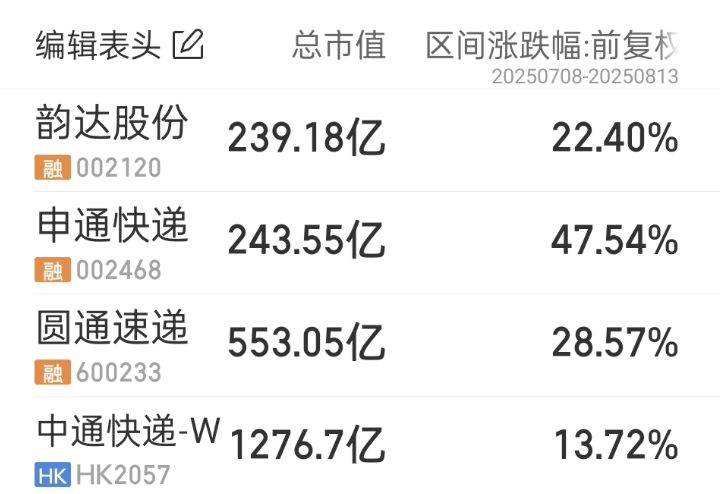
Core Viewpoint - The express delivery industry in Guangdong has implemented a price increase, raising the minimum cost per ticket to 1.4 yuan, which is expected to stabilize the financial situation of many delivery companies after a prolonged period of low pricing competition [1][2]. Group 1: Price Increase Details - Starting from August 5, the overall base price for express delivery in Guangdong has been raised by 0.4 yuan per ticket, with the average price exceeding 1.4 yuan [1]. - The increase in base price is aimed at ensuring that no express delivery company can collect below the cost price of 1.4 yuan, particularly affecting e-commerce clients who have high delivery demands [1]. - Prior to Guangdong, the city of Yiwu in Zhejiang province had already initiated a price increase mechanism, raising the base price from 1.1 yuan to 1.2 yuan [1]. Group 2: Industry Background - The express delivery industry has been suffering from a "low-price for volume" competition model, leading to reduced profit margins for grassroots outlets and poor service quality [2]. - The average price per ticket for express delivery in China has significantly decreased from 28.55 yuan in 2007 to 7.49 yuan as of June this year [2]. - Major express companies like SF Express, Shentong, Yunda, YTO, and Zhongtong have seen their average ticket revenues drop by approximately 40% since their listings in 2017, with only Zhongtong showing a slight increase [2]. Group 3: Regulatory Environment - The State Post Bureau has emphasized the need for stronger industry regulation and has opposed "involutionary" competition, aiming to improve service quality in the express delivery sector [3]. - Following these regulatory discussions, stocks of major express companies have surged, with Yunda's stock price increasing by 22.4%, Shentong by 47.54%, YTO by 28.57%, and Zhongtong by 13.72% [3][4].


快递费一夜暴涨!电商人哭晕,9.9包邮将成历史?
Sou Hu Cai Jing· 2025-08-12 15:29
Core Viewpoint - The recent surge in express delivery fees, driven by policy changes, has sparked significant concern among e-commerce merchants, with potential annual losses estimated at 21.9 million for high-volume businesses [1][4]. Group 1: Price Increase Impact - Major express delivery companies, including Shentong, YTO, Zhongtong, and Yunda, have collectively raised their base prices from 1 yuan to over 1.4 yuan per package, particularly affecting small items [1][3]. - The price increase is seen as a response to the government's call to end "bloodletting competition" in the logistics sector, aiming to improve service quality [3][4]. Group 2: Merchant and Consumer Reactions - Merchants are facing a dilemma: raising prices may lead to reduced customer traffic, while not raising prices could result in unsustainable profit margins [3][4]. - There are concerns that if merchants pass on the increased delivery costs to consumers, low-cost shipping options like "9.9 yuan with free shipping" may disappear, impacting consumer purchasing behavior [4]. Group 3: Industry Challenges - The express delivery industry has been struggling with declining per-package revenue, approaching cost levels, and a high turnover rate among delivery personnel, leading to service quality issues [4]. - Despite the government's strict regulations against pricing below 1.4 yuan, the effectiveness of these measures remains uncertain due to potential non-compliance by franchise operators [4].
千合直播电商公司极兔派费大调整,快递小哥熬出头了
Sou Hu Cai Jing· 2025-07-21 04:13
Core Viewpoint - Jitu Express has signed the first comprehensive algorithm and labor rules agreement in the express delivery industry, focusing on six key issues including income security, rights protection, labor protection, care, skill enhancement, and negotiation mechanisms, benefiting over 290,000 workers across its nationwide network [1][3]. Group 1: Agreement and Compensation - The agreement explicitly guarantees the delivery fee standards for couriers, establishing a mechanism to ensure timely and full payment of wages by franchisees, with delivery fees not less than 25% of the average income per package from franchisees [3][5]. - This initiative aims to prevent the phenomenon of unrestrained reductions in delivery fees, promoting fair and reasonable compensation for couriers [3][5]. Group 2: Industry Context and Performance - The express delivery industry is currently experiencing intense competition, with a notable decline in average revenue per package across various companies, including a general drop of 8.2% in the first five months of 2025 [4]. - Despite the competitive landscape, the total express delivery volume in China is projected to exceed 1 trillion packages by 2025, with Jitu achieving a record high of approximately 7.39 billion packages in the second quarter of 2025, marking a 23.5% year-on-year increase [5][6][7]. Group 3: Market Strategy and Growth - Jitu Express has rapidly ascended to become one of the top five express delivery companies in China within three years, leveraging its low pricing strategy and partnerships with major e-commerce platforms like Pinduoduo, Taobao, and JD.com [11][12][15]. - The company has seen significant growth in both the Chinese and Southeast Asian markets, with package volumes in Southeast Asia increasing by 65.9% year-on-year, indicating substantial untapped potential in both regions [6][7]. Group 4: Stock Performance - Following its strong performance, Jitu's stock price has surged over 40% in the past month, reflecting investor confidence in the company's growth trajectory and market position [7].

交通运输行业2025年6月快递数据点评:顺丰控股件量维持高增,件量和份额同比分别+31.8%和0.1pct
Minsheng Securities· 2025-07-20 11:21
Investment Rating - The report maintains a "Recommended" rating for SF Express, Shentong Express, and Yunda Express, indicating a positive outlook for these companies in the express delivery sector [8]. Core Insights - The express delivery industry showed robust performance in the first half of 2025, with a total business volume of 956.4 billion pieces, reflecting a year-on-year growth of 19.3%. The total revenue reached 7187.8 billion yuan, growing by 10.1% year-on-year [3][5]. - The report highlights that the demand for express delivery is driven by trends such as the increasing volume of small packages, reverse logistics, and the benefits from lower-tier markets. The growth rate of express delivery volume significantly outpaces the growth of retail sales and online retail sales [6]. - Price competition in the industry is intensifying due to the trend of smaller packages and ongoing price wars. However, the report suggests that the intensity of price competition may be controllable due to policy guidance aimed at promoting high-quality development [6][7]. Summary by Sections Industry Data - In June 2025, the express delivery business volume reached 168.7 billion pieces, with revenue of 1263.2 billion yuan, marking a year-on-year increase of 15.8% and 9.0%, respectively [3]. - For the first half of 2025, the express delivery revenue was 7187.8 billion yuan, with a year-on-year growth of 10.1%, while the business volume was 956.4 billion pieces, growing by 19.3% [3][5]. Company Performance - In June 2025, SF Express reported a revenue of 199.62 billion yuan, with a year-on-year growth of 14.2%. The business volume was 14.60 billion pieces, growing by 31.8% year-on-year [4]. - For the first half of 2025, SF Express's revenue was 1091.55 billion yuan, with a year-on-year growth of 10.2%, and a business volume of 78.13 billion pieces, reflecting a growth of 25.7% [5]. Investment Recommendations - The report suggests that the express delivery sector is currently undervalued, with expectations of continued growth driven by the expanding e-commerce market and new demands from lower-tier markets. It recommends focusing on leading companies in the e-commerce express delivery sector, such as ZTO Express, YTO Express, Yunda Express, Shentong Express, and Jitu Express, as well as the comprehensive logistics leader SF Express [7].
交通运输行业2025年5月快递数据点评:顺丰控股件量增速持续领跑行业,件量和份额同比分别+32%和0.3pct
Minsheng Securities· 2025-06-20 05:03
Investment Rating - The report maintains a "Recommended" rating for companies such as Shentong Express and Yunda Express, indicating a positive outlook for these firms in the express delivery sector [8]. Core Insights - The express delivery industry continues to show strong performance, with May 2025 data indicating a business volume of 17.32 billion pieces and revenue of 125.55 billion yuan, reflecting year-on-year growth of 17.2% and 8.2% respectively [3]. - The demand for express delivery is driven by trends such as the increasing popularity of small and light packages, the rise of reverse logistics, and the benefits from lower-tier markets [6]. - The competitive landscape is intensifying, with major players adjusting strategies to focus on market share rather than aggressive price competition, suggesting a controlled environment for price wars compared to previous years [6]. Summary by Sections Industry Data - In May 2025, the express delivery sector achieved a total business volume of 173.2 billion pieces and revenue of 1255.5 billion yuan, with cumulative revenue from January to May reaching 5924.6 billion yuan, up 10.3% year-on-year [3]. - The cumulative business volume for the same period was 787.7 billion pieces, marking a year-on-year increase of 20.1% [3]. Company Performance - For May 2025, the revenue and business volume for major companies were as follows: - SF Express: Revenue of 19.38 billion yuan, business volume of 1.48 billion pieces, with a year-on-year growth of 13.4% and 32% respectively [4]. - Shentong Express: Revenue of 4.41 billion yuan, business volume of 2.26 billion pieces, with a year-on-year growth of 13.0% and 16% respectively [4]. - Yunda Express: Revenue of 4.42 billion yuan, business volume of 2.30 billion pieces, with a year-on-year growth of 6.7% and 13% respectively [4]. - YTO Express: Revenue of 5.85 billion yuan, business volume of 2.76 billion pieces, with a year-on-year growth of 14.8% and 21% respectively [4]. Investment Recommendations - The report suggests that the express delivery sector is currently undervalued, with expectations of continued growth driven by the expanding e-commerce market and new demands from lower-tier markets [6]. - It recommends focusing on leading companies in the e-commerce express delivery space, including ZTO Express, YTO Express, Yunda Express, Shentong Express, and Jitu Express, as well as the logistics leader SF Express [6].
淡季填仓大战升级,“毕业寄”这块肥肉不好吃了?
3 6 Ke· 2025-06-16 12:01
Core Insights - The graduation season has become a competitive battleground for express delivery companies, with nearly 12.22 million graduates from around 3,000 universities creating significant demand for luggage delivery services [2][3] - Major players like SF Express and JD Logistics are aggressively marketing their services, offering discounts and special promotions to capture market share [2][5] Group 1: Market Dynamics - The demand for luggage delivery during graduation is driven by a consumer mindset cultivated by years of market education, making it a natural choice for students [3] - Companies are leveraging the graduation season as a critical business opportunity, especially during a traditionally slow period for the express delivery industry [9] Group 2: Competitive Strategies - SF Express has introduced a "first order starting at 0 yuan" promotion for certified student members, aiming to attract the "Z generation" entering the workforce [5] - JD Logistics has also been proactive, providing free packing materials and on-site services to graduates, indicating a strategic push to enhance brand presence among young consumers [7] Group 3: Operational Challenges - The rapid increase in demand has led to operational challenges, including the need for significant staffing and resource allocation to handle peak periods effectively [10][14] - Issues such as price transparency and service reliability have emerged, with reports of unexpected fees and service shortcomings affecting customer experience [12][14] Group 4: Economic Considerations - The competitive landscape has intensified, leading to price wars where delivery costs have dropped below 1 yuan per kilogram, impacting profitability for companies [12] - Companies are exploring strategies like exclusivity agreements with universities to secure profitable contracts, but the trend of multiple service providers per campus complicates this approach [12]


还有比快递更惨的行业吗?
商业洞察· 2025-04-11 08:42
以下文章来源于有数DataVision ,作者严张攀 有数DataVision . 数据表象与商业真相 作者: 严张攀 来源: 有数DataVision(lD: gh_dc4453e8feed) 2024年,极兔中国区平均客单价下滑了大约7%,但依靠对成本更加有效的管理措施,不仅公司 扭亏为盈,单票息税前利润也终于转正,来到了0.007美元。 作为中国快递史上的最强黑马,极兔的冲突性来自两点。 一是极兔在通达系厮杀最激烈的时期进入中国市场,但反而在高烈度的价格战中收获了最大的战 果。 二是极兔在中国扭亏为盈,反而凸显了快递公司在中国面临的残酷竞争。 2024年,极兔中国区的送件量比东南亚地区多出了足足152亿件,但东南亚市场的经调整息税前 利润,比国内高出一倍有余。 如果新能源车企业觉得自己在内卷,那么他可以看看快递。 01 增长的诅咒 快递创造了中国商业世界的两伊战争,两者的区别是两伊战争只打了八年。 一般来说,国内快递可以简单划分为两大类。 时效件 由顺丰和EMS主宰,上游是订单分散的个人和企业。由于建机场买飞机都需要行政审 批,顺丰有非常深的护城河。 电商件 则是通达系的天下,赚钱全靠低价走量。 相比时 ...