政治风险溢价

Search documents
分析师:日元后续走向更多将取决于美联储与日本央行的政策分歧
Sou Hu Cai Jing· 2025-09-07 23:40
Core Viewpoint - The future direction of the Japanese yen will largely depend on the policy divergence between the Federal Reserve and the Bank of Japan, rather than domestic political factors [1] Group 1 - If the resignation of Shinto Abe leads to increased instability within the Liberal Democratic Party, the market may price in a higher political risk premium [1] - This could result in a surge of safe-haven inflows into the yen, which would help to mitigate pressure on Japanese government bond yields [1]
政治风险溢价升温 贵金属价格重心上移
Jin Tou Wang· 2025-08-26 07:25
Core Viewpoint - The market sentiment regarding interest rate cuts has shifted, leading to a rebound in the US dollar index, which closed up 0.71% at 98.394, while gold and silver prices experienced declines due to the stronger dollar [1][2]. Market Overview - On August 26, the US dollar index rebounded, closing at 98.394, up 0.71% as optimism about interest rate cuts waned [1][2]. - Spot gold traded within a narrow range, ultimately closing down 0.19% at $3365.8 per ounce, while spot silver fell more significantly, down 0.72% to $38.57 per ounce [1][2]. Key News Summary - President Trump signed a document to remove Federal Reserve Governor Cook from her position, effective immediately, which caused a short-term drop in the dollar index and a rise in gold prices by over $20 [3]. - Cook faced unprecedented allegations of mortgage fraud, which, if proven, could lead to criminal charges. Trump's demand for her immediate resignation has sparked significant legal and institutional controversy [3]. - The potential removal of Cook could allow Trump to reshape the Federal Reserve's leadership, enhancing his control over monetary policy and undermining the central bank's traditional independence [3][4]. Implications for Precious Metals - The market anticipates an over 80% chance of the Federal Reserve cutting interest rates in September, influenced by Powell's dovish stance at the global central bank meeting, which could support gold prices [4]. - The political intervention in the Federal Reserve's operations has created uncertainty in policy, leading to a weaker dollar and lower real interest rates, thus increasing gold's investment appeal [4]. - If political pressures continue, gold and other precious metals may receive long-term structural price support [4]. Trading Outlook - Precious metals are expected to maintain a strong upward trend in September, driven by expectations of Federal Reserve rate cuts and political risk premiums [5]. - If the Federal Reserve signals clear easing in September, gold prices may break above $3440; however, unexpected inflation or hawkish statements could lead to a drop towards $3380 [5]. - Silver is likely to follow gold's movements but may underperform due to its industrial characteristics, with attention needed around the $39 level [5].
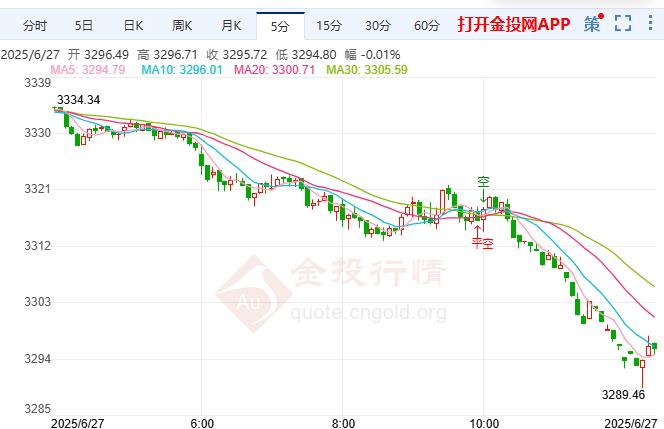
伦敦金短线急跌 鲍威尔证词令市场失望
Jin Tou Wang· 2025-06-27 06:26
Group 1 - The core viewpoint of the news highlights the disappointment in the market following Chairman Powell's cautious testimony, which did not align with traders' expectations for dovish signals [3] - Powell reiterated the Federal Reserve's "wait-and-see" approach without providing clear guidance on potential interest rate adjustments in July, creating a policy vacuum interpreted by the forex market as long-term restrictive monetary conditions [3] - The lack of clear dovish communication has unexpectedly weakened the US dollar, indicating that market participants were prepared for more accommodative statements [3] Group 2 - Political uncertainty regarding the potential announcement of Powell's successor by President Trump as early as September adds complexity to monetary policy expectations [3] - The traditional transition period of three to four months may accelerate, fundamentally altering the dynamics of the Federal Reserve's independence and potentially impacting policy expectations before actual leadership changes [3] - The political pressure surrounding interest rate policy creates a complex environment where market expectations include the probability of political succession, posing external challenges to central bank credibility and necessitating a recalibration of policy continuity assumptions [3]

【UNFX课堂】白宫的“后座司机”策略:特朗普急于换掉鲍威尔,华尔街屏息以待
Sou Hu Cai Jing· 2025-06-27 02:00
Core Viewpoint - Donald Trump is considering announcing his choice for the next Federal Reserve Chair significantly ahead of schedule, which could influence monetary policy before the official transition occurs [1][9]. Group 1: Trump's Strategy - The idea is to create a "designate chair" who can shape market expectations about future interest rates through public appearances [2]. - This strategy is seen as a high-risk maneuver, with several potential candidates emerging, each with different backgrounds and perceived flaws [3]. Group 2: Potential Candidates - Kevin Walsh, a former Fed governor known for his hawkish stance, is considered but may not align with Trump's preference for a more dovish candidate [3]. - Kevin Hassett, the Director of the National Economic Council, reportedly has little interest in the position [3]. - Scott Bessenette, the Treasury Secretary, is viewed as a favorable option due to his strong connections on Wall Street and ability to navigate chaotic policies [4]. - David Malpass, former World Bank President, has recently shifted to support rate cuts, signaling alignment with Trump's views, though his public image is questioned [4]. - Christopher Waller, a current Fed governor, is seen as a dark horse candidate due to his recent calls for rate cuts [4]. Group 3: Market Implications - The political maneuvering introduces significant uncertainty for Wall Street, which dislikes unpredictability, especially regarding borrowing costs [6]. - If a dovish candidate is chosen, it could lead to bond market sell-offs due to inflation concerns, countering Trump's desired outcomes [6]. - Stock markets may initially react positively to anticipated lower rates, but the sustainability of this reaction depends on the new chair's credibility [6]. Group 4: Independence Concerns - Trump's actions are perceived as a threat to the independence of the Federal Reserve, a principle that has been crucial since the 1970s to avoid political interference [7]. - Many in Wall Street believe that an independent Fed is vital for maintaining price stability and the credibility of the financial system [7]. - The potential for a "political risk premium" in asset prices may arise from perceived political interference [7]. Group 5: Powell's Position - Jerome Powell's term as Fed Chair ends in May 2026, but he may remain on the board until January 2028, potentially providing a stabilizing influence [8]. - Powell's calm demeanor and focus on economic stability suggest he is attempting to separate himself from the political drama surrounding the Fed [8][9].
4大集团暴亏781亿,李嘉诚后悔晚了,长和宣布新消息,外交部发话
Sou Hu Cai Jing· 2025-04-01 05:53
Group 1 - CK Hutchison Holdings has accumulated losses nearing HKD 100 billion, prompting potential asset restructuring by Li Ka-shing, with significant stock price declines observed across its subsidiaries following the announcement of a port transaction with BlackRock [1][3] - On March 29, CK Hutchison's stock fell by 6.98%, and its subsidiary, Hutchison Whampoa, dropped by 7.95%, leading to a total market value loss of HKD 32.36 billion over 11 trading days, with the combined market value of its four major groups shrinking by over HKD 78.1 billion [1] - Morgan Stanley downgraded CK Hutchison's rating, citing a surge in political risk premium, while the National Market Regulatory Administration has begun reviewing the port transaction for potential antitrust issues, which could prevent Li Ka-shing from cashing out USD 19 billion [1][4] Group 2 - Despite the losses, CK Hutchison has not confirmed any decision regarding the sale of its telecommunications business, which has led to market speculation about asset restructuring, including a potential spin-off of the telecom unit [3] - Li Ka-shing has responded to criticism regarding the port transaction, asserting that he has not received any special privileges from the government and framing the deal as a necessary business move, although the economic benefits of the transaction are questionable given the significant asset depreciation [4] - The U.S. has expressed support for the port transaction, aiming to weaken China's control over the Panama Canal, while China's Foreign Ministry has reiterated its opposition to economic coercion, indicating a geopolitical struggle surrounding the logistics sector [6]