
政策分歧

Search documents
澳元震荡上行 加息预期与经济动能交织
Jin Tou Wang· 2026-02-26 02:27
Group 1 - The core viewpoint is that the Australian dollar (AUD) is experiencing a short-term upward trend against the US dollar (USD), supported by the Reserve Bank of Australia's (RBA) interest rate hike expectations and commodity currency attributes, despite economic growth momentum slowing and external risks limiting its upward potential [1][3]. - The RBA raised interest rates by 25 basis points to 3.85% on February 3, demonstrating its commitment to controlling inflation, which, although has decreased from its peak, remains above the target range of 2%-3%. Market expectations suggest that if inflation remains sticky, further rate hikes may occur, enhancing the attractiveness of the AUD [1][2]. - The AUD benefits from strong commodity prices, which provide marginal support for the exchange rate, even though the appreciation of the AUD somewhat dilutes the price increases of commodities priced in AUD [1][2]. Group 2 - Economic growth momentum is slowing, with the Westpac Bank indicating that the leading index growth rate for Australian economic activity fell to 0.02% in January 2026, raising concerns that further rate hikes could suppress consumption and investment, hindering economic recovery [2]. - There is significant divergence in views regarding the RBA's policy path, with some analysts suggesting that economic growth is nearing potential levels, limiting further rate hike capacity, and even considering the possibility of rate cuts within the year, which could weaken the upward momentum of the AUD [2]. - Technical analysis indicates that the AUD/USD is in a phase of upward movement, having broken through previous resistance levels, with key support at 0.7115 and resistance at 0.7150. The expected short-term trading range is between 0.7115 and 0.7150, pending confirmation from economic data or RBA signals [2][3].
CA Markets:2026 开年,10 年期美债交易热潮深度解码
Sou Hu Cai Jing· 2026-01-08 02:46
Group 1: Core Insights on 10-Year U.S. Treasury Yield - The 10-year U.S. Treasury yield is experiencing significant market attention, with a recent drop to 4.01%, and a notable increase in options trading volume betting on a further decline below 4% [1][3][5] - The yield's recent movements reflect a shift from an upward trend to a steady decline, influenced by economic data and geopolitical events [3][4] - The trading volume for the 10-year Treasury on January 8 reached $280 billion, with a notable increase in overseas investor participation, indicating rising demand for U.S. Treasuries [4][6] Group 2: Options Market Analysis - The options market shows a strong bet on the 10-year Treasury yield dropping below 4%, with significant trading volumes in call options [5][6] - The implied volatility of these options has risen to 12%, indicating increased market expectations for short-term yield fluctuations [6] - The probability of the yield falling below 4% by January 25 has increased to 65%, driven by dovish comments from Federal Reserve officials and rising unemployment rates [6][12] Group 3: Yield Curve and Economic Outlook - The yield curve, specifically the spread between the 10-year and 2-year Treasury yields, has narrowed, suggesting reduced recession fears [7][8] - This narrowing is attributed to expectations of future Fed rate cuts and stronger-than-expected GDP growth, which has slightly improved long-term economic growth forecasts [8][12] - The recent movements in the yield curve indicate a market reassessment of recession risks, potentially impacting Treasury trading strategies [7][8] Group 4: Federal Reserve Policy Implications - The Federal Reserve's policy outlook is a critical factor influencing the 10-year Treasury yield, with recent comments from officials suggesting a cautious approach to future rate changes [9][10] - Market expectations for rate cuts in 2026 have shifted, with a 50% probability of one cut and a 30% probability of two cuts, reflecting a cooling of previous expectations [11][12] - Divergence in Fed officials' views on policy direction has led to cautious trading behavior in the Treasury market, resulting in narrower yield fluctuations [13] Group 5: Supply and Demand Dynamics - The supply of 10-year Treasuries is decreasing, with a planned issuance of $60 billion in January, down from $70 billion in December, alleviating supply pressure [16][17] - Demand for Treasuries is increasing, particularly from overseas investors, with significant increases in holdings from China and Japan [16][17] - The improved supply-demand dynamics are contributing to the downward pressure on yields, even amid policy uncertainties [16][17] Group 6: Asset Correlation Insights - The 10-year Treasury yield has shown a strong positive correlation with the U.S. dollar index, reflecting how interest rate expectations influence both markets [19] - Recent trends indicate that both the stock market and Treasury yields are moving in the same direction, driven by optimistic economic forecasts [18] - This correlation may shift if economic data diverges, potentially restoring the traditional inverse relationship between stocks and Treasuries [18]


央行会议纪要对汇率的影响是什么
Jin Tou Wang· 2026-01-07 04:27
Group 1 - The core value of central bank meeting minutes lies in revealing policymakers' assessments of economic growth, inflation levels, and employment markets, which directly influence market expectations regarding interest rate trends, a key driver of exchange rate pricing [1] - If the minutes indicate hawkish signals such as "high inflation pressure" or "need to tighten monetary policy further," it suggests a high probability of interest rate hikes, attracting international capital inflow and leading to currency appreciation [2] - Conversely, if the minutes emphasize weak economic growth or that inflation has returned to target levels, it signals potential interest rate cuts or increased monetary easing, reducing the attractiveness of domestic assets and suppressing currency value [4] Group 2 - The minutes also reveal policy disagreements among committee members, which can lead to short-term volatility in exchange rates; a consensus among members leads to stable market expectations, while significant disagreement increases uncertainty and volatility [6] - If the minutes indicate a close vote between rate hike proponents and those favoring cuts, it may result in significant fluctuations in exchange rates until new economic data or policy signals clarify the direction [6] - The market's understanding of the central bank's policy response function, influenced by the minutes, affects exchange rate pricing; for instance, if inflation data is highlighted as a core adjustment indicator, subsequent inflation releases will become critical for exchange rate movements [7] Group 3 - The impact of the meeting minutes on exchange rates also depends on the deviation from market expectations; if the content aligns with prior expectations, the effect is limited, but unexpected hawkish or dovish signals can lead to significant exchange rate movements [9] - Meeting minutes from major central banks like the Federal Reserve or European Central Bank have a more pronounced effect on global exchange rates compared to those from smaller economies [9]
美联储新主席5月上任“利好出尽”?野村:明年7-11月的美国市场“需要特别警惕”
Hua Er Jie Jian Wen· 2025-12-29 01:45
Core Viewpoint - Nomura Securities warns that the U.S. market may face significant challenges in the coming months as the new Federal Reserve Chairman takes office in May 2024, leading to potential investor sell-offs of dollar assets and pressure on U.S. equity and bond markets in the second half of the year [1]. Group 1: Market Risks and Predictions - Nomura strategist Naka Matsuzawa indicates that while the new Chairman is expected to lead a rate cut in June, subsequent policy paths are uncertain, with potential strong opposition from the FOMC against further cuts due to signs of economic recovery [1][2]. - The period from July to November 2024 is predicted to be a "high-risk" phase for the market, where a policy deadlock between the Fed and the Trump administration could catalyze sell-offs in U.S. stocks and bonds, as well as a weakening dollar [2][3]. Group 2: Historical Context and Leadership Concerns - Historical analysis shows that previous transitions of Federal Reserve Chairpersons have often led to market volatility, with the 1987 "Black Monday" being a notable example shortly after Alan Greenspan took office [3]. - There are concerns that the new Chairman may be pressured to align with the Trump administration's re-inflation policies, which could lead to increased market volatility if perceived as too dovish or compromising [3]. Group 3: Global Asset Allocation Trends - From a macro asset allocation perspective, Nomura anticipates a significant global economic recovery by 2026, shifting market drivers from "excess liquidity" to "corporate earnings," which may diminish the relative advantage of U.S. assets [4]. - As other major economies potentially halt rate cuts or begin raising rates, the dollar is expected to weaken, particularly during sensitive periods in the second half of the year, leading to a reassessment of U.S. asset dominance and potential capital outflows [4].
全球资产配置每周聚焦(20251219-20251226):沪深300隐含波动率低位回升-20251228
Shenwan Hongyuan Securities· 2025-12-28 08:15
Market Overview - The US 10-year Treasury yield decreased to 4.14%, down 2 basis points, while the US dollar index fell by 0.69% to 98.0[3] - The A-share market saw all indices rise, with the ChiNext Index, CSI 1000, and STAR 50 leading the gains[3] - Gold prices increased by 4.24% this week, driven by a short squeeze in silver, leading precious metals to outperform global assets[3] Capital Flows - In the week ending December 24, 2025, foreign capital inflows into the Chinese stock market totaled $12.6 billion, while domestic capital inflows reached $71.32 billion[3] - The US stock market saw a significant inflow of $222.6 billion into fixed income funds, while Chinese equity markets attracted $83.9 billion[16] Valuation Metrics - The Shanghai Composite Index's valuation is at the 87.5th percentile over the past decade, trailing only the S&P 500 and CAC 40[3] - The equity risk premium (ERP) for A-shares slightly decreased but remains at a historically neutral level[15] Risk Sentiment - The implied volatility of the CSI 300 index has shown a low recovery, indicating a more optimistic pricing of volatility compared to the previous week[3] - The put-call ratio for the S&P 500 increased to 1.08, reflecting a slight rise in bearish sentiment[3] Economic Data - The US consumer confidence index fell significantly to 51.0, indicating a cooling economy[3] - The probability of a Fed rate cut in January 2026 increased to 82.3%, up from 77.9% the previous week[3]
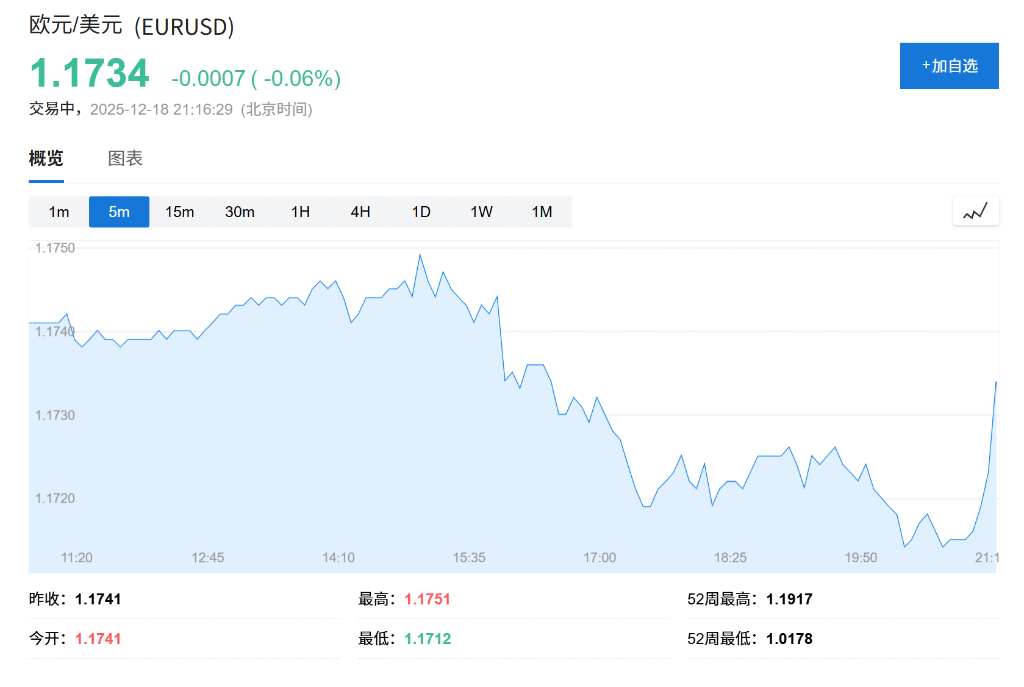
欧央行连续第四次按兵不动,重申通胀将在中期回归2%目标,巩固2026年加息预期
Sou Hu Cai Jing· 2025-12-18 14:09
Core Viewpoint - The European Central Bank (ECB) decided to maintain interest rates unchanged for the fourth consecutive meeting, with the deposit rate remaining at 2%, aligning with analysts' expectations [1] Economic Resilience and Inflation Target - The macroeconomic backdrop of the meeting indicates stronger resilience in the Eurozone economy than previously anticipated, with the third quarter performance exceeding market expectations [5] - The ECB's statement reflects a tolerance for short-term inflation fluctuations, projecting that inflation will stabilize at the 2% target in the medium term, despite forecasts suggesting it may be slightly below this target over the next two years [5] Market Expectations Shift and Policy Divergence - The ECB's decision to hold rates steady distinguishes it from the global trend of monetary easing, as both the Bank of England and the Federal Reserve have recently cut rates [6] - Investors are reassessing their expectations, moving away from a singular focus on easing and beginning to price in the possibility of the ECB raising rates as early as 2026 [6] Decision-Maker Stance Towards Hawkishness - Statements from ECB officials reinforce expectations of a pause in rate cuts and potential future rate hikes, with Executive Board member Isabel Schnabel indicating that she is not overly concerned as long as inflation deviates only slightly from the target [7] - The previously dovish stance of Lithuanian central bank governor Gediminas Simkus has shifted, acknowledging the unexpectedly strong economic performance and suggesting no further easing is necessary [7] Interest Rate Details - ECB deposit facility rate: 2%, expected: 2%, previous: 2% [8] - ECB marginal lending rate: 2.4%, expected: 2.4%, previous: 2.4% [8] - ECB main refinancing rate: 2.15%, expected: 2.15%, previous: 2.15% [8]
【UNforex财经事件】就业降温信号累积 政策分歧未解 黄金延续高位运行
Sou Hu Cai Jing· 2025-12-17 09:21
Group 1 - Gold prices have shown strong performance, with XAU/USD reaching around 4340 USD, close to a seven-week high, amid signs of a cooling U.S. labor market and pressure on the dollar [1] - The U.S. non-farm payrolls added 64,000 jobs in November, slightly above expectations, but the unemployment rate rose to 4.6%, the highest since 2021, indicating a marginal slowdown in the job market [1] - Average hourly earnings increased by only 0.1% month-on-month, a significant drop from previous values, suggesting a decrease in wage inflation pressure [1] Group 2 - The Federal Reserve completed its third rate cut of the year in December, but there is significant disagreement among officials regarding the need for further easing in 2026, with some suggesting no further adjustments are necessary [2] - The market is closely monitoring statements from key Fed officials, as any hawkish signals could support the dollar and disrupt commodity markets [2] - Discussions around the long-term pricing logic of U.S. assets are intensifying, with some strategists suggesting that investors may first reduce dollar exposure before re-evaluating U.S. Treasuries and equities [2] Group 3 - In the current environment of rate cuts, cooling employment, and a pressured dollar, gold's defensive and hedging functions are gaining market attention [3] - Technically, gold prices are stabilizing above the 100-day moving average, with the Bollinger Bands opening and the RSI above the midpoint, indicating a strong bullish structure [3] - If XAU/USD can maintain above the 4305 USD level, it may test the 4350 USD area, while a short-term pullback could see support around 4270 USD [3] Group 4 - The focus should be on structural changes rather than isolated results during this phase of marginal employment cooling and unresolved policy disagreements [4] - Key considerations include whether the labor market continues to show signs of "moderate cooling," if official statements will lead to directional shifts in rate expectations, and whether the dollar and U.S. Treasuries will further strengthen gold's hedging demand [4] - The market is still in a "reassessment" phase rather than confirming a trend, with employment slowdown providing a basis for easing, but inflation stickiness and policy independence issues remain constraints [4]
【美联储决议前夕,美国市场“超级平静”】数据显示,恐慌指数VIX和追踪债券市场预期波动率的MOVE指数均降至低位,尾部风险对冲大量平仓。但分析师警告这种平静较为脆弱:美联储内部出现政策分歧,可能出现分裂投票;鹰派降息或就业恶化都可能迅速引发新一轮波动。
Sou Hu Cai Jing· 2025-12-06 11:46
Core Viewpoint - The U.S. market is experiencing an unusual calm ahead of the Federal Reserve's decision, with low levels of the VIX and MOVE indices indicating reduced volatility expectations [1] Group 1 - The VIX, a measure of market volatility, has dropped to low levels, suggesting a lack of fear among investors [1] - The MOVE index, which tracks bond market volatility, has also decreased, indicating a similar trend in the fixed income market [1] - Analysts warn that this calmness is fragile due to internal policy disagreements within the Federal Reserve, which could lead to a split vote [1] Group 2 - Potential hawkish rate cuts or deteriorating employment conditions could quickly trigger a new wave of market volatility [1]
白宫取消原定面试流程!新美联储主席哈塞特“呼之欲出”
Hua Er Jie Jian Wen· 2025-12-03 03:41
Core Viewpoint - Trump's cancellation of the scheduled interviews for the Federal Reserve Chair candidates indicates that the selection for this key position is effectively finalized, with Kevin Hassett being the likely choice [1][2]. Group 1: Candidate Selection Process - Trump has signaled that Hassett is the frontrunner for the Federal Reserve Chair position, as he stated he knows who he wants to select and referred to Hassett as a "potential Fed Chair" during a public event [1][2]. - The initial candidate pool was narrowed from 11 to 5 by Treasury Secretary Mnuchin, but Trump has shown disinterest in continuing the interview process, effectively bypassing the established selection protocol [2]. - The White House claimed that no one knew the next Fed Chair candidate before the President's announcement, but Trump's public comments have undermined this assertion [2]. Group 2: Implications of the Appointment - The appointment of the new Fed Chair is considered one of Trump's most significant decisions for his second term, as the current Chair Powell's term ends in mid-May [3]. - The new Chair will face a divided decision-making environment, needing to balance risks of a slowing job market against persistent inflation risks, with pressures from Trump to lower interest rates [3]. - Trump's regret over appointing Powell, influenced by Mnuchin's recommendation, adds complexity to the selection process, as Treasury Secretary Mnuchin's past decisions may impact his current standing [3].
美联储陷“数据真空”决策困境 金价4000关口命悬一线
Xin Lang Cai Jing· 2025-11-21 04:18
Core Viewpoint - The current gold price is experiencing a downward trend, trading around $4050 per ounce, reflecting a significant drop from its recent high of $4110.03, and a 7% decrease from the historical peak of $4381.29 reached in October. However, gold prices have still shown a remarkable 55% increase since 2025 [1]. Group 1: Market Dynamics - The recent Federal Reserve meeting minutes revealed "serious divisions" among policymakers, with the better-than-expected September non-farm payroll data supporting the rationale for slowing the current easing pace [2]. - The September non-farm payroll report showed an unexpected increase of 69,000 jobs, but the unemployment rate rose to 4.4%, the highest since 2021, indicating potential challenges for the labor market [2]. - The CME FedWatch Tool indicates a 60.2% probability of maintaining current interest rates in the upcoming meeting, with a 39.8% chance of a rate cut, reflecting a shift in market expectations [2]. Group 2: Technical Analysis - Key resistance levels for gold are identified at $4240 and near the historical high of $4381, which may impact short-term price movements [4][5]. - Support levels are established at $4041 (20-day moving average), $4000 (psychological level), and $3886 (near the low point from October 28), which are crucial for maintaining price stability [6][7]. - Despite short-term pressures, gold's performance remains driven by multiple macro factors, indicating strong upward momentum even in a hawkish Fed environment [7].