
数字化治理

Search documents
龙华探索全过程监管新模式 政府采购既要“程序合规”又要“智慧高效”
Shen Zhen Shang Bao· 2025-12-27 21:32
Core Insights - The new regulatory model in Longhua District, Shenzhen, aims to enhance fair competition in government procurement by addressing issues such as biased clauses and lack of transparency [1][3] - Systematic reforms by the Longhua District Finance Bureau have shifted government procurement from compliance-focused to a more efficient and intelligent approach [1][2] Group 1: Regulatory Changes - Longhua District has implemented a comprehensive government procurement guide and templates for various sectors to ensure fair competition and compliance with policies supporting small and medium enterprises [1][2] - An "early intervention" mechanism has been established for projects over 10 million yuan, allowing for proactive assessment and resolution of potential issues [2] Group 2: Monitoring and Evaluation - The district has introduced a negative list for evaluation experts and procurement agents, along with regular inspections to mitigate risks of manipulation during the evaluation process [2][3] - Continuous monitoring of procurement performance is conducted to prevent speculative behaviors, with a focus on both penalties and preventive measures against violations [3] Group 3: Impact and Results - The implementation of these reforms has led to a significant reduction in procurement complaints, with a 58.62% decrease in cases received by the Finance Bureau compared to the previous year [3] - The establishment of a supplier performance sharing mechanism aims to reward compliant suppliers while penalizing those who violate regulations, enhancing overall procurement efficiency and transparency [3][4]
利比里亚本土公司成立合规服务中心,助力简化政府业务流程
Shang Wu Bu Wang Zhan· 2025-12-26 05:38
利比里亚《非洲首页报》12月25日报道:利比里亚本土企业Golden Touch Corporation公司(GTC)近日正 式成立了合规服务部,旨在为个人、专业人士和企业提供一站式政府文档与监管服务办理,以应对该国 长期存在的行政程序繁琐、效率低下及不透明等问题。该中心位于外交部附近,业务范围涵盖公司注 册、护照与签证、驾照与车辆登记、出生证明、生物识别服务以及工作居留许可等多种关键公共服务, 并提供从申请准备、跟进、支付到许可证获取的全流程行政支持。公司创始人兼首席执行官卡表示,此 举是为了让企业家能更专注于业务发展而非应对官僚程序。合规服务部负责人强调,中心并非与政府部 门竞争,而是通过减少拥堵、增强透明度来补充官方服务。出席活动的政府官员对此举措表示赞赏,认 为其填补了利比里亚向数字化治理转型过程中的服务缺口,并特别表彰了这家女性主导企业在男性主导 领域取得的成就与韧性。 ...
深圳功能型无人车领跑,关键在“铺路”
Xin Lang Cai Jing· 2025-12-24 00:16
□李妹妍 这条"路",首先是一条审慎创新的"制度之路"。功能型无人车上路,最大的挑战往往并非技术,而是规 则与责任的不明晰。深圳没有简单采取"允许"或"禁止"的二元思路,而是以数字化治理手段,将"未知 领域"转变为"规范轨道"。2025年7月,全国首个功能型无人车管理服务平台在深圳上线,如同一座"空 中交通管制塔",实现了全流程数字化管理。企业在线申请线路,可"秒审秒批";政府则可依据实时交 通数据,实现精准管控。这一创新治理框架,既坚守安全底线,又释放产业活力,让规则从制约转变为 生产要素,营造出稳定、可预期的营商环境。 这条"路",也是一条深度融合的"场景之路"。深圳并未将无人车视为孤立的运输工具,而是将其有机嵌 入城市现有的物流与交通大系统。全国首创的"无人小车+地铁""无人小车+新型公交场站"等模式,打破 了不同交通业态之间的壁垒,实现了资源的高效整合与利用。今年十五运会期间,顺丰无人车还进驻深 圳大运中心,打造从场馆外围到内部各场馆的"智慧物流闭环",实现了赛事物资的随叫随到。这种以场 景驱动的融合思维,让无人车成为激活城市交通运行网络的关键节点,也让无人车从"可选项"变成了智 慧城市升级中不可或缺 ...
推动充电设施均衡布局
Xin Hua Ri Bao· 2025-12-14 21:37
Core Viewpoint - The development of charging infrastructure is crucial for implementing the national "dual carbon" strategy and assessing government governance capabilities in the digital age [1] Group 1: Planning and Design - A systematic planning and guidance mechanism should be established to predict charging demand based on the development trends of new energy vehicles and spatial resource characteristics [1] - The establishment of a district-level "old community power expansion guidance fund" is proposed to secure funding for infrastructure upgrades through diversified financing methods [1] - Safety technical guidelines for charging facility construction should be developed in collaboration with relevant departments and fire rescue agencies [1] Group 2: Collaborative Mechanisms - A joint meeting system should be established, led by district leaders, involving relevant departments, street offices, power supply companies, and operating enterprises for charging facility construction [1] - A management responsibility list for charging facility construction should be created to clearly define the responsibilities of government departments, communities, property companies, and operating companies in various stages of application, construction, operation, and maintenance [1] Group 3: Operational Model Innovation - The promotion of a unified construction and operation model is suggested, where professional operating companies are responsible for the construction and maintenance of charging facilities to enhance service quality [2] - The establishment of a unified smart charging service platform across the district is recommended, along with a regulatory mechanism covering the entire lifecycle of charging facilities [2]


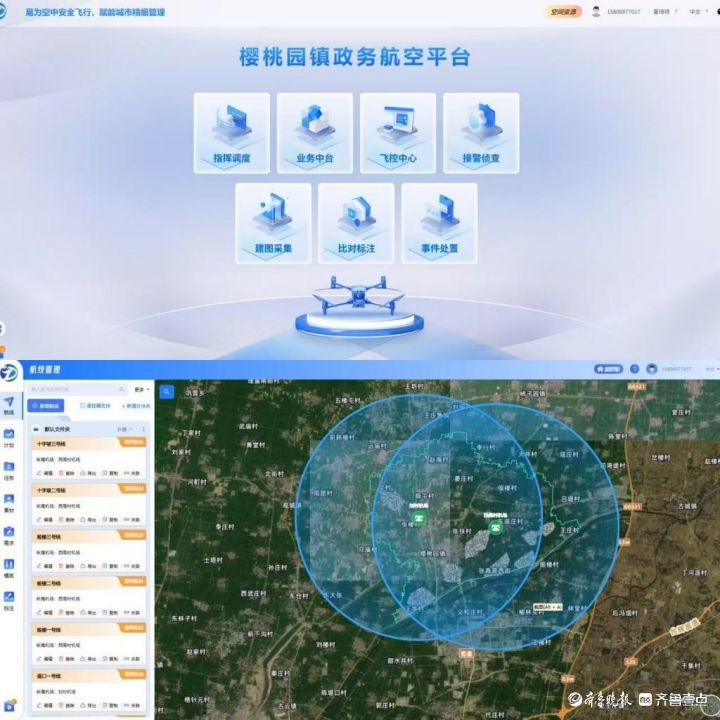
聊城铁塔创新“铁塔+无人机”模式,助力莘县樱桃园镇数字化转型
Qi Lu Wan Bao· 2025-12-12 14:58
Core Insights - The implementation of the "Tower + Drone System Digital Remote Sensing Platform" in Sherry Garden Town has led to a 70% increase in the efficiency of identifying land violations, enhancing core governance tasks such as farmland protection and ecological monitoring [1][2] Group 1: Digital Transformation and Resource Integration - The company has focused on the governance needs of all 58 villages in Sherry Garden Town, targeting key tasks like farmland protection and illegal construction [2] - By leveraging its tower resources and integrating drone patrols, the company has established a comprehensive "air-ground" intelligent monitoring network, achieving 24/7 coverage of the governance area [2] - Advanced technologies such as AI recognition, GIS, and 5G real-time transmission have been utilized to break down data barriers among 12 government departments, enhancing the accuracy of illegal activity alerts [2][4] Group 2: Efficient Problem Resolution - The company has assisted in creating a closed-loop management chain for monitoring, warning, dispatching, handling, and archiving issues, ensuring rapid response to illegal activities [4] - A dual prevention model combining technical monitoring and grid patrols has been established, allowing for early detection and quick resolution of problems [4] - The company has also enhanced public awareness of the digital monitoring model through various channels, fostering a supportive environment for governance efforts [4] Group 3: Expanding Application Boundaries - The company is extending the application of the "Tower + Drone System" beyond core governance tasks to include ecological monitoring, agricultural safety, and crop growth monitoring [4][6] - In ecological protection, the system supports real-time monitoring of water quality and pollution along 12 rivers, while in agricultural safety, it aids in fire prevention through advanced imaging technologies [4][6] Group 4: Collaborative Governance - A collaborative governance platform has been established to encourage public participation, allowing citizens to report issues and receive feedback on resolutions [6][7] - The mechanism promotes a cooperative environment involving government leadership, technological empowerment, and public engagement, creating a comprehensive governance model [7] Group 5: Future Directions - The company aims to continue focusing on the actual governance needs of rural areas, deepening technological innovation and resource integration to provide efficient and cost-effective digital transformation solutions [7]
云享科技:从“痛点攻坚”到“生态共荣”,数字星河照亮治理之路
Xin Lang Cai Jing· 2025-11-28 17:17
Core Viewpoint - The article highlights the advancements and practical achievements in the field of smart city management, particularly through the case study of Guangzhou Yunxiang Data Technology Co., Ltd, which focuses on AI and big data to enhance urban governance efficiency [1][4]. Company Overview - Yunxiang Technology, established in November 2017, is a wholly-owned subsidiary of Guangzhou Baiyun Industrial Investment Group, with a registered capital of 100 million yuan. The company specializes in new-generation information technology, including video surveillance, cloud services, system integration, big data operations, and smart city construction [1][4]. - The company holds 56 software copyrights, 3 invention patents, and has developed various data products and information systems [1]. Digital Governance Engines - Yunxiang Technology has developed three digital governance engines: the intelligent sanitation scheduling system, the gas safety digital closed loop, and the AI work order governance hub, aimed at addressing urban management challenges [4][5]. - The intelligent sanitation scheduling system tracks over 7,000 sanitation workers in real-time, optimizing operational routes and resource allocation [5]. - The gas safety digital closed loop includes 16 types of hazard identification models, enhancing safety inspections and compliance [5]. Performance Improvements - After two years of implementation, urban governance efficiency in Baiyun District has significantly improved, with a 62% reduction in sanitation vehicle idle rates and a savings of 11 million yuan in fiscal expenditure [6]. - The gas safety inspection coverage increased from 68% to 100%, maintaining a zero occurrence of carbon monoxide poisoning for two consecutive years [6]. - The AI work order system achieved a 92% accuracy rate in automatic identification of urban issues, reducing average processing time from 14 hours to 2 hours [6]. Collaborative Ecosystem - Yunxiang Technology promotes a collaborative ecosystem by attracting over 20 innovative enterprises and partnering with leading companies like Huawei to enhance smart city management solutions [7]. - A framework agreement was signed with Huawei Cloud to jointly develop and market smart city management solutions, aiming to replicate the "Baiyun model" nationwide [7]. Expansion and Recognition - The smart city management system has been successfully implemented in various districts and cities, with potential business opportunities exceeding 300 million yuan across more than 30 cities [8]. - The company's achievements have garnered attention from over 200 organizations, including government departments and universities, showcasing its practices at national conferences [9]. Transformational Impact - The digital transformation led by Yunxiang Technology is not merely a technological upgrade but a comprehensive restructuring of governance concepts and collaboration mechanisms, contributing valuable experiences for nationwide smart city management [11].

打破路径依赖高质量建设地方“双一流”大学
Xin Hua Ri Bao· 2025-11-17 22:01
Core Insights - The article emphasizes the critical role of local "Double First-Class" universities in advancing national strategies and regional development, highlighting their importance in education, technology innovation, and talent cultivation [1] Group 1: Collaborative Mechanisms - Establishing a collaborative mechanism is essential for breaking down development barriers, with education, technology, and talent as the three core elements that determine a university's competitive edge [2] - A comprehensive coordination framework should be developed, involving unified leadership from the Party committee, collaboration between schools and departments, and inter-departmental cooperation to overcome governance challenges [2] - Innovation platforms should be created based on national strategies and regional needs, breaking down disciplinary boundaries and forming cross-disciplinary teams for research and talent development [2] Group 2: Focus on Core Areas - Local "Double First-Class" universities should concentrate their efforts on key areas rather than spreading resources too thin, transitioning from a "broad and general" approach to a "focused and strong" strategy [3] - It is recommended to categorize and integrate existing disciplines, focusing on developing 1-2 core competitive discipline clusters to achieve breakthroughs in evaluations [3] - A dynamic adjustment mechanism for disciplines should be established to align with regional industrial upgrades, promoting emerging fields like renewable energy and artificial intelligence while phasing out outdated disciplines [3] Group 3: Talent Development - A comprehensive "attract, cultivate, retain" talent system is necessary, with innovative approaches to talent acquisition and support from local governments [4] - Emphasis should be placed on nurturing young talent through long-term support and creating a conducive academic environment to retain skilled individuals [4] - The quality of talent cultivation must be prioritized, with a focus on adapting training models to meet contemporary demands and enhancing practical skills through project-based learning [5] Group 4: Social Service Integration - Local "Double First-Class" universities must transition from insular operations to actively engaging in regional development, aligning their services with local needs [6] - Establishing regular mechanisms for university-enterprise collaboration and creating specialized service teams can enhance the effectiveness of technology transfer and talent training [6] - Expanding funding sources through partnerships with local governments and enterprises is crucial for sustainable development [6] Group 5: Support Systems - A robust support system is essential for the successful implementation of internal development initiatives, requiring improved governance capabilities and digital transformation [7] - Strengthening administrative teams and fostering a culture of collaboration and innovation will enhance the overall effectiveness of university operations [7] - Creating a supportive environment that encourages exploration and tolerates mistakes is vital for fostering a culture of innovation [7]
杭州加快推进41个城乡风貌区建设 实施244个项目 投资超130亿元
Hang Zhou Ri Bao· 2025-11-04 03:12
Group 1 - The transformation of old residential houses into art spaces and the upgrade of unsold bamboo into high-value crafts are revitalizing rural areas in Hangzhou, leading to significant income increases for local communities [2] - Hangzhou's urban development strategy focuses on effective investment, operation, and service, with 41 urban and rural landscape areas and 8 comprehensive quality areas under construction, achieving an investment completion rate of 163.54% [2] - The "智荟绿谷·数贸全球" industrial landscape area has seen a transformation from traditional industrial zones to modern digital and fashion industries, with 14 projects totaling 2.2 billion yuan [3] Group 2 - The "裳美四季·时尚采荷" industrial landscape area is leveraging fashion consumption and local resources, with an investment of 476 million yuan leading to commercial upgrades [4] - The "江河都会·国际杭城" comprehensive quality landscape area has initiated 54 key projects with over 25.8 billion yuan in investments, aiming to create a global urban landmark [5] - The "渔光互补" project in the "南沙稻谷·萧东智谷" area has significantly increased profits for local farmers, with average profits rising from 800 yuan to over 10,000 yuan per mu [7] Group 3 - Hangzhou is exploring cross-regional collaborations, such as the "浙皖边驿·云上天路" landscape area, which aims to attract 4.5 million tourists and generate 1.461 billion yuan in tourism revenue by 2024 [8] - The integration of resources in the "钦钟山韵·共筑桃源" area has led to over 1 billion yuan in tourism revenue and 600,000 visitors [8] - The development of the "一江四韵·千年古埠" landscape area includes new public transport routes and educational tourism initiatives, enhancing local connectivity and cultural heritage [8]

《常州市优化营商环境条例》获批 以法治护航营商环境
Zhong Guo Xin Wen Wang· 2025-10-22 00:32
Core Points - The "Regulations on Optimizing the Business Environment in Changzhou" has been approved and will take effect on January 1, 2026, marking a significant step in enhancing the local business environment [1][2] - The regulations include a pioneering chapter on "Green Environment," aligning with national carbon peak goals and the World Bank's new business environment assessment system [1][2] Group 1: Legislative Framework - The regulations consist of seven chapters and sixty-five articles, developed through extensive research, public consultation, and multiple reviews to ensure social consensus [1] - The framework addresses various aspects of the business environment, including market, government, green, cultural, and legal environments, aiming to create a stable, fair, transparent, and predictable development environment for all business entities [1] Group 2: Digitalization and Administrative Efficiency - The regulations emphasize digital infrastructure development and the management of public data platforms, while also integrating digital knowledge and skills into civil servant training to enhance government digital governance capabilities [2] - A management system for administrative inspections related to enterprises will be established, promoting a "comprehensive check once" approach to streamline processes [2] Group 3: Support for Enterprises - The regulations focus on protecting the legitimate rights of small and medium-sized enterprises (SMEs), requiring large enterprises to pay SMEs promptly as per legal agreements [2] - The government is mandated to fulfill policy commitments and contractual agreements to address the practical concerns of businesses [2] Group 4: Continuous Improvement Mechanism - A dynamic optimization mechanism for the business environment will be established, with the municipal development and reform department responsible for creating annual task lists, and local governments required to report on optimization efforts every two years [2] - The implementation of these regulations is seen as a key indicator of Changzhou's commitment to continuously improving the business environment through legal means [2]
农药行业特定农药闭环管理服务平台正式发布
Zhong Guo Hua Gong Bao· 2025-10-20 01:01
Core Insights - The release of a specific pesticide closed-loop management platform marks a new phase in the digital governance of high-risk pesticides in China, emphasizing "full-chain traceability, real-time supervision, and accountability" [1][2] - The platform aims to address industry pain points such as data silos and delayed traceability caused by traditional paper and Excel reporting methods [1] Group 1: Platform Features - The platform features a global insight dashboard that serves as a "smart command center" for government regulation, monitoring key indicators like production capacity and export balance rates [1] - It provides full-process traceability, giving each batch of raw materials a "digital passport" for precise tracking through six key nodes: raw material storage, production, quality inspection, transportation, customs declaration, and shipping [2] - The platform also offers an enterprise self-certification perspective, creating an "electronic evidence chain" that solidifies compliance operations into immutable digital records [2] Group 2: Industry Impact - The launch of the closed-loop management service platform represents a significant innovation in the governance model of the pesticide industry, leveraging digital technology to enhance safety and build trust [2] - The association has organized a seminar to demonstrate the platform's core functionalities and discuss regulatory trends and supply chain integration with industry experts [2]