
新就业群体

Search documents
“准时送达”四个字的背后(大地风华)
Ren Min Ri Bao· 2025-10-01 22:11
Core Insights - The article emphasizes the importance of understanding the lives of delivery workers in the Chinese express delivery industry, highlighting their dedication and the challenges they face in their daily work [1][2]. Group 1: Industry Development - The Chinese express delivery industry has evolved from manual delivery methods to automated sorting and drone delivery, showcasing rapid advancements driven by the hard work of countless individuals [2]. - The industry's growth is reflected in the commitment of workers who often work long hours, including overnight shifts during peak seasons, demonstrating resilience and determination [2]. Group 2: Human Element - The experiences of delivery workers, such as their interactions with customers and their willingness to go the extra mile, illustrate the human side of the logistics industry, emphasizing their role as "unsung heroes" [1][2]. - The musical "In the Distance" serves as a platform to raise awareness about the contributions of delivery workers, allowing audiences to appreciate their hard work and the significance of their roles in everyday life [4]. Group 3: Cultural Impact - The performance of "In the Distance" resonated with delivery workers, who found reflections of their own experiences in the portrayal of their profession, indicating a cultural connection between the arts and the realities of the workforce [4]. - The article suggests that the narrative of a vibrant China is not just about grand stories but is composed of the lives of diligent workers, including delivery personnel, who contribute to the economy and society [4].


“这是对我们新就业群体的肯定”(阅兵式上的青春力量)
Ren Min Ri Bao· 2025-09-17 22:22
Core Viewpoint - The recognition of delivery riders, exemplified by Liu Jian's invitation to the military parade, highlights the value and contributions of new employment groups in society [2][3]. Group 1: Individual Achievements - Liu Jian, a delivery rider since 2017, has completed over 100,000 deliveries and received numerous five-star ratings for his service [2]. - He was selected as a "Knight Leader" in 2020 due to his outstanding performance and willingness to mentor others, training over 300 new riders in five years [2]. Group 2: Community Engagement - Liu Jian actively participates in community governance and volunteer activities, leveraging the mobility of delivery riders to conduct safety patrols during deliveries [2]. - His leadership has inspired his team to engage in volunteer services, leading to their recognition as an advanced unit for volunteer service in the Wangjing Street area [2].

让新就业群体成为首都发展的有生力量
Bei Jing Ri Bao Ke Hu Duan· 2025-08-28 01:14
Core Viewpoint - The article highlights Beijing's initiatives to integrate new employment groups into the city through various supportive actions, focusing on enhancing their living conditions, professional recognition, and community involvement in the digital economy era. Group 1: Initiatives for New Employment Groups - Beijing has launched three action plans: "Diversity and Friendliness," "Comprehensive Improvement," and "Deep Integration" to promote the construction of a "Friendly City" for new employment groups, which includes delivery workers, ride-hailing drivers, and online streamers [1] - Over 14,200 service venues have been opened to support new employment groups, and initiatives like the "Little Brother Classroom" have been implemented to enhance their skills and community integration [1][4] Group 2: Community Support and Services - Nearly 2,000 friendly scenarios have been created to address key issues faced by new employment groups, such as parking and access difficulties, with a focus on the "last mile" of service delivery [4][5] - The establishment of 800 24-hour "All-Time Stations" has been achieved, providing essential services and support for new employment groups, including food discounts and rest areas [5][18] Group 3: Rights and Welfare Enhancements - A significant effort has been made to improve labor rights and social security for new employment groups, with over 50,000 delivery workers signing labor contracts, representing 89.5% of the total [14] - The city has initiated a one-stop dispute resolution center for labor disputes, providing legal assistance and mediation services to new employment groups, recovering nearly 2.5 million yuan in economic losses [15] Group 4: Community Engagement and Political Integration - The establishment of 182 party organizations and over 900 group organizations has been initiated to strengthen the political engagement of new employment groups, enhancing their sense of belonging and community involvement [21][23] - New employment groups have been actively participating in community governance, with many taking on roles such as "deputy building managers" and volunteers, contributing significantly to urban management [23] Group 5: Educational and Skill Development - Collaborations with educational institutions have led to the launch of programs like "Little Brother Classroom" and "Little Brother Goes to University," benefiting over 36,000 individuals with skills training and educational opportunities [15] - Various training initiatives have been introduced, including a mobile training program offering 49 different courses, aimed at enhancing the employability and skill sets of new employment groups [15]
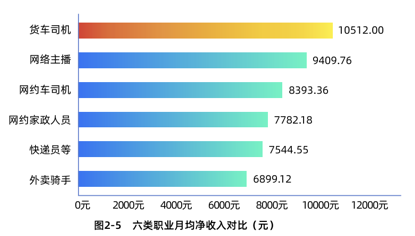
2025年货车司机月净收入10512元
21世纪经济报道· 2025-08-19 13:26
Core Viewpoint - The report from Renmin University of China indicates that by 2025, the average net income of truck drivers will reach 10,512 yuan per month, significantly higher than other new employment groups. However, the continuous decline in freight rates and oversupply of transport capacity are constraining income growth, prompting calls for regulatory intervention [1][6]. Group 1: Income and Economic Status - Truck drivers exhibit a strong economic return, with an average monthly net income of 10,512 yuan, placing them at the top among six new employment groups [6]. - Over 90% of truck drivers earn between 8,001 yuan and 32,000 yuan, indicating a concentration of income in the middle to high range [6]. - The average monthly consumption of truck drivers is 6,578 yuan, the highest among new employment groups, with significant spending on education, reflecting their commitment to family responsibilities [8]. Group 2: Work Conditions and Demographics - The majority of truck drivers are middle-aged, with nearly 80% aged between 30 and 49, and the highest proportion (50.24%) in the 30-39 age range [4]. - Truck drivers work long hours with an average of only 3.54 rest days per month, indicating a high-intensity work environment [9]. - Most truck drivers operate alone, with 88.65% driving without companions, highlighting the solitary nature of the job [9]. Group 3: Career Development and Skills - The profession of truck driver is evolving, with many drivers transitioning to roles such as fleet managers or logistics operators, indicating a clear career development path [12]. - A significant portion (27.94%) of drivers would choose to remain in the trucking industry if given the chance to start over, suggesting job stability and potential for career growth [12]. - Digital skills are crucial, as drivers with higher digital capabilities and platform usage report significantly higher income levels [16].

今年货车司机月净收入10512元 高强度工作成常态
2 1 Shi Ji Jing Ji Bao Dao· 2025-08-19 12:01
Core Insights - The report from Renmin University of China indicates that by 2025, the average net income of truck drivers will reach 10,512 yuan, significantly higher than other new employment groups [1][3] - The trucking industry is facing challenges such as declining freight rates and oversupply of capacity, leading to increased competition and calls for regulatory intervention [1][3] Income and Employment Structure - Truck drivers exhibit a strong economic return, with over 90% of drivers earning between 8,001 yuan and 32,000 yuan monthly, indicating a stable and potentially growing income stream [3] - The age distribution shows that drivers aged 30 to 49 constitute nearly 80% of the workforce, with the 30 to 39 age group being the most represented at 50.24% [1] Consumption Patterns - Truck drivers have the highest average monthly consumption among new employment groups at 6,578 yuan, with notable spending on education (1,688.83 yuan) reflecting their commitment to family responsibilities [5] - The average monthly rest days for truck drivers is 3.54, which is lower than some other new employment groups, indicating a high workload [5] Career Development and Digital Skills - The profession is attracting individuals due to flexible working hours, relatively high income, and interest in driving, with many drivers expressing a willingness to continue in this field even if given a choice [7] - A significant portion of drivers (91.82%) utilize platforms for order management, highlighting the importance of digital skills in enhancing income and career prospects [10][11] Platform Evolution - Internet freight platforms have evolved from simple order-taking tools to comprehensive operational platforms that manage various aspects of the logistics process, including scheduling and financial settlements [9] - The level of digital capability among drivers is becoming a critical factor influencing their income and career development, with higher platform usage correlating with increased earnings [10][11]
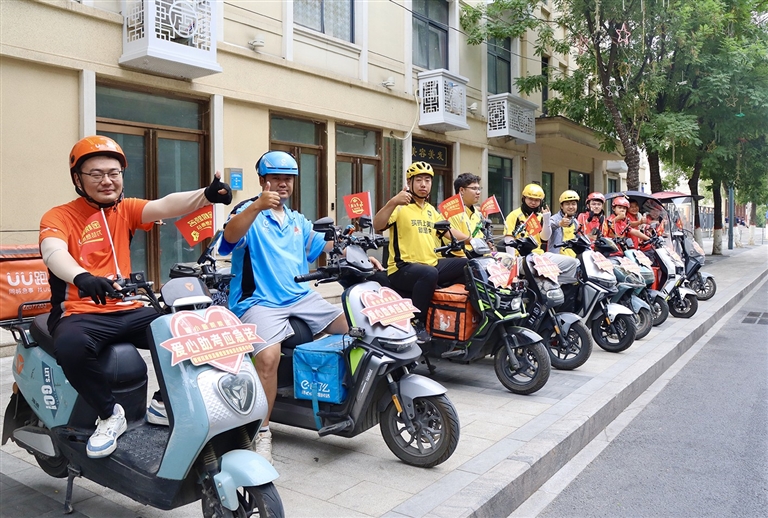
从心出发 向“新”而行
He Nan Ri Bao· 2025-07-22 00:55
Core Points - The article emphasizes the importance of integrating new employment groups into the community through effective governance and support systems, particularly in Zhengzhou [1][18] - It highlights the role of the Communist Party in leading initiatives to improve the lives of delivery workers and other new employment groups, focusing on their needs and challenges [1][12] Group 1: Community Support Initiatives - Zhengzhou has established a comprehensive service center for new employment groups, providing amenities such as free charging stations, rest areas, and affordable meal options [2][4][5] - The service center conducts surveys and meetings to understand the specific needs of delivery workers, ensuring that services are tailored to their concerns [2][4] - Initiatives like the "Warm Little New" help group engage delivery workers in community service activities, fostering a sense of belonging and support [14][16] Group 2: Technology and Efficiency - The introduction of the "community code" via the "Zhenghao Ban" app streamlines the delivery process, allowing riders to register their entry into residential areas quickly [3] - The service center collaborates with platform companies to address common issues faced by delivery workers, such as charging needs for their devices and vehicles [4][5] Group 3: Empowerment and Participation - New employment groups are encouraged to participate in community governance, acting as "mobile sentinels" to report issues and assist in local governance [14][16] - The article notes that nearly 380,000 individuals in Zhengzhou belong to this new employment group, highlighting their significant presence in the urban workforce [10] Group 4: Party Leadership and Development - The Communist Party is actively involved in enhancing the organizational structure for new employment groups, establishing industry-specific party committees to address their unique challenges [18][20] - The article discusses the importance of integrating party activities with the daily lives of these workers, ensuring that they feel connected to the broader community and governance efforts [20][21]
江苏首个省级层面聚焦新就业群体的慈善项目启动——用城市“温度”回应奋斗“热度”
Xin Hua Ri Bao· 2025-04-29 23:21
Core Points - The "New Employment Group Charity Emergency Relief" project is the first provincial-level charity initiative in Jiangsu focusing on new employment groups, aimed at providing assistance to those facing temporary difficulties due to major illnesses or accidents [1][2] - Approximately 10 million new employment group members exist in Jiangsu, accounting for about 12% of the national total, covering various sectors including long-distance freight drivers, delivery personnel, and online service workers [1][2] - The project allocates 2 million yuan for relief efforts, targeting individuals who have worked in new employment forms for at least six months and are currently in need of assistance [2][3] Summary by Categories Project Overview - The project is initiated by multiple provincial departments and aims to alleviate the economic burden on new employment group members facing urgent difficulties [1][2] - It focuses on providing charity-based supplementary assistance to improve the living conditions and social recognition of this workforce [2][4] Target Group and Challenges - New employment group members often face long working hours, high labor intensity, and insufficient social security, making them vulnerable during emergencies [2][3] - The majority of these workers are non-local residents, highlighting the need for targeted support from society [2][4] Relief Measures - The project outlines specific relief measures, including one-time assistance for medical expenses exceeding 10,000 yuan, and tiered support for those injured in accidents, with maximum aid reaching 10,000 yuan [3] - Additional one-time assistance ranging from 2,000 to 5,000 yuan is available for individuals facing other special difficulties [3] Community Support and Resources - The project aims to connect various resources to enhance support for new employment groups, focusing on diverse needs such as health care, child care, and living services [4][5] - The initiative includes the establishment of service centers offering discounted housing options for new employment group members, with rental prices significantly lower than market rates [5]