
新能源车险出海

Search documents
新能源车险出海重大机遇!专访车车科技张磊
券商中国· 2025-09-17 03:11
Core Viewpoint - The article discusses the expansion of China's new energy vehicle insurance industry into international markets, highlighting the opportunities, challenges, and future trends associated with this move [1][5][9]. Group 1: Market Dynamics - The export of Chinese new energy vehicles (NEVs) has seen significant growth, with exports reaching 1.203 million units in 2023, a year-on-year increase of 77.6% [5]. - NEV exports are primarily concentrated in Europe, particularly in Belgium and the UK, as well as in Brazil and Southeast Asia, where demand is high [6]. - In the first seven months of 2023, NEVs accounted for 35% of the total 3.68 million vehicles exported from China, indicating a strong growth momentum [6]. Group 2: Opportunities for Insurance Industry - The insurance industry faces opportunities as overseas consumers show a willingness to purchase Chinese vehicles due to their high cost-performance ratio and advanced technology features [7]. - The challenges for car manufacturers include high financing costs for NEV exports and high insurance premiums due to low local ownership rates and limited claims data [7][13]. - The insurance sector can leverage the "going out" strategy to innovate in cross-border business and globalize insurance contracts and claims standards [7][8]. Group 3: Future Trends - The future of NEV insurance overseas is expected to follow three trends: 1. Transitioning from "product export" to "service export," emphasizing collaboration with leading Chinese car manufacturers [10]. 2. Technology empowerment becoming a core competitive advantage, with a focus on building digital insurance platforms [11]. 3. Expanding coverage from just vehicles to the entire NEV ecosystem, including insurance for charging stations and autonomous driving [12]. Group 4: Challenges and Solutions - The main challenges for the insurance industry in expanding overseas include regulatory barriers, cultural differences, data scarcity, and the need for a repair network [13]. - Potential solutions include partnering with local insurance companies to utilize domestic claims data for pricing models, establishing overseas representative offices for data support, and exploring co-insurance mechanisms [14][15]. Group 5: Strategic Plans - The company plans to initiate its internationalization process in Q4 2025, focusing on the Asia-Pacific and European markets, with a strategy to follow Chinese car manufacturers abroad [16]. - The goal is to replicate successful domestic NEV insurance service models in international markets, aiming for overseas business to contribute over 10% of revenue by 2027 [16].


新能源车险开始赚钱了!压缩综合成本率+业务出海,险企找到盈利新途径
Mei Ri Jing Ji Xin Wen· 2025-09-05 14:16
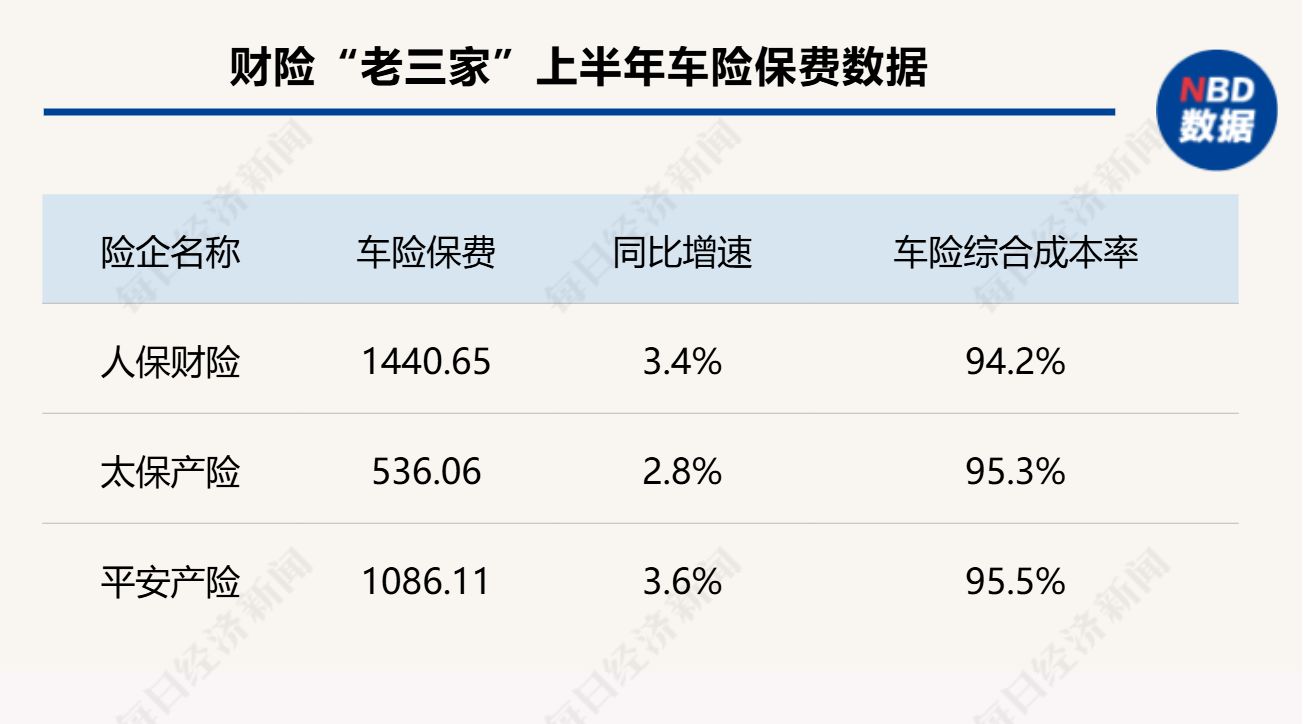
Core Insights - The insurance sector is witnessing a shift in the profitability of new energy vehicle (NEV) insurance, moving away from previous losses as major insurers find ways to achieve underwriting profitability [1][3][5] Group 1: Industry Performance - The property and casualty insurance industry reported a total auto insurance premium income of 450.5 billion yuan in the first half of the year, reflecting a year-on-year growth of 4.5% [2] - The "big three" insurers (People's Insurance, Ping An, and Taiping) accounted for 68% of the industry's auto insurance revenue, with premium incomes of 144.07 billion yuan, 108.61 billion yuan, and 53.61 billion yuan respectively, showing year-on-year growth rates of 3.4%, 3.6%, and 2.8% [1][2] Group 2: New Energy Vehicle Insurance - NEV insurance is becoming a significant growth area for insurers, with the "big three" finding profitable strategies in this segment, unlike smaller firms that remain cautious due to high costs [3][4] - Taiping achieved NEV insurance premium income of 10.596 billion yuan, increasing its share from 14.1% to 19.8% in the auto insurance segment, while Ping An reported a 46.2% year-on-year growth in NEV insurance premiums, reaching 21.7 billion yuan [3][4] Group 3: Cost Management and Profitability - The combined cost ratios for the "big three" insurers improved, with figures of 94.2%, 95.5%, and 95.3%, indicating a reduction of 2.6 percentage points year-on-year due to reforms and better cost management [2] - NEV insurance is characterized by high premiums and high claims, leading to challenges in profitability, but the "big three" have begun to navigate these issues effectively [2][3] Group 4: International Expansion - Major insurers are looking to expand their NEV insurance offerings internationally, with successful entries into markets like Hong Kong and Thailand, aiming to leverage the growing export of Chinese NEVs [5][6][7] - The export of Chinese NEVs is projected to exceed one million units by mid-2025, presenting significant opportunities for overseas insurance business [5][6]


中报观察|新能源车险盈利拐点已至,险企海外“闯关”挑战多
Huan Qiu Wang· 2025-09-05 06:10
Core Viewpoint - The insurance industry is experiencing a turning point in the profitability of new energy vehicle (NEV) insurance, with some companies reporting positive results after years of losses due to high claim rates and costs associated with NEVs [1][5]. Group 1: Market Dynamics - The NEV insurance sector has evolved from being a secondary option for consumers to a primary choice, but it has faced challenges such as high claim rates and costs [2][4]. - In 2024, the insurance industry covered 31.05 million NEVs, generating premium income of 140.9 billion yuan, but reported an underwriting loss of 5.7 billion yuan, indicating ongoing financial struggles [4]. Group 2: Profitability Signals - Recent reports from listed insurance companies for the first half of 2025 indicate a shift towards profitability in NEV insurance, with China Ping An achieving a 49.3% increase in NEV insurance coverage and a 46.2% rise in premium income [5]. - China Pacific Insurance reported that NEV insurance premiums accounted for 19.8% of its total auto insurance premiums, up from 14.1% the previous year, signaling a growing market share [5]. Group 3: Strategic Changes - The transition from "passive underwriting" to "active management" in NEV insurance is attributed to improved data collection, refined pricing models, and collaboration with manufacturers [6]. - The insurance industry has seen over 50% growth in NEV premiums annually since 2021, with household vehicle premiums growing significantly [6]. Group 4: Policy and Regulatory Support - Regulatory bodies have issued guidelines to enhance the quality and management of NEV insurance, focusing on reducing repair costs and improving service levels [7][8]. - The establishment of a risk-sharing mechanism aims to address the challenges of high claim rates and improve the insurability of NEVs [8]. Group 5: Innovation and Product Development - Insurance companies are innovating products to meet diverse market needs, including introducing new insurance models and addressing emerging risks associated with advanced driver-assistance systems (ADAS) [9]. - The introduction of "basic + variable" insurance products and "battery separation" models aims to better cater to the unique risks of NEVs [9]. Group 6: International Expansion - Companies are expanding NEV insurance offerings internationally, with China Pacific Insurance launching projects in Hong Kong and Thailand as part of its global strategy [10]. - The internationalization of NEV insurance is seen as an opportunity to enhance service offerings alongside vehicle sales abroad [10]. Group 7: Challenges in International Markets - The expansion into international markets faces challenges such as high repair costs, lack of local data for risk assessment, and differences in regulatory environments [11]. - Companies must navigate varying local regulations and establish effective partnerships to ensure successful operations in foreign markets [11].


人保、太保、平安成本普降,新能源车险出海成新浪潮
2 1 Shi Ji Jing Ji Bao Dao· 2025-09-04 00:25
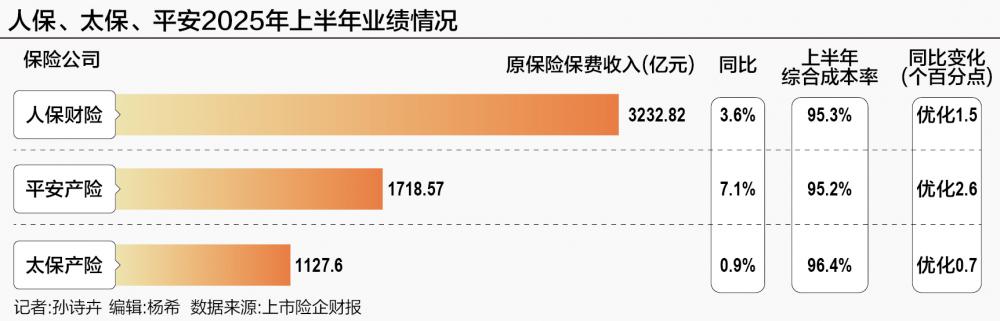
Core Viewpoint - The overall performance of listed insurance companies in China shows a positive trend in premium income and cost management, with a focus on the growth of new energy vehicle insurance and international expansion strategies [1][3][4]. Group 1: Premium Income and Market Share - The combined premium income of China Life Insurance, Ping An Property & Casualty, and China Pacific Property Insurance reached 607.9 billion yuan, accounting for 63% of the market share [1]. - China Life Insurance reported a premium income of 323.28 billion yuan, a year-on-year increase of 3.6% [1][2]. - Ping An Property & Casualty achieved a premium income of 171.86 billion yuan, with a growth rate of 7.1% [1][2]. - China Pacific Property Insurance's premium income was 112.76 billion yuan, reflecting a 0.9% increase year-on-year [1][2]. Group 2: Cost Management and Profitability - The comprehensive cost ratios (COR) for the three companies generally decreased, indicating improved underwriting profitability [1]. - China Life Insurance's COR was 95.3%, down 1.5 percentage points year-on-year, marking the best level in nearly a decade [1]. - Ping An's COR improved by 2.6 percentage points to 95.2%, showing the most significant improvement [1]. - The average COR for the listed insurance companies was 96.1%, a year-on-year improvement of 1.5 percentage points, driven by reduced disaster claims and enhanced cost control [1]. Group 3: New Energy Vehicle Insurance Growth - New energy vehicle insurance is experiencing significant growth, with China Pacific's premium income from this segment reaching 10.596 billion yuan, increasing its share of total vehicle insurance premiums from 14.1% to 19.8% [3]. - The profitability of new energy vehicle insurance is improving, with several companies reporting underwriting profits in this area [3][4]. - China Life Insurance's market share in new energy vehicle insurance is 34.2%, surpassing that of traditional fuel vehicles by 2.7 percentage points [4]. Group 4: International Expansion Strategies - China Life Insurance has initiated a three-step strategy for international development, focusing on Hong Kong, Asia, and global markets, with successful entries into Thailand and other Southeast Asian countries [5]. - China Pacific has also accelerated its international strategy, forming partnerships with major new energy vehicle manufacturers to support their overseas expansion [5]. Group 5: Non-Vehicle Insurance Performance - The non-vehicle insurance business showed varied performance among the three companies, with China Life Insurance's non-vehicle premium income growing by 3.8% to 179.22 billion yuan [6]. - Ping An's non-vehicle premium income increased by 13.8%, with significant growth in health, agricultural, and accident insurance [7]. - The upcoming "reporting and operation integration" policy is expected to positively impact the non-vehicle insurance sector, promoting rational competition and improving underwriting capabilities [8].
财险老三家人保、太保、平安成本普降,新能源车险出海成新战场
2 1 Shi Ji Jing Ji Bao Dao· 2025-09-03 06:20
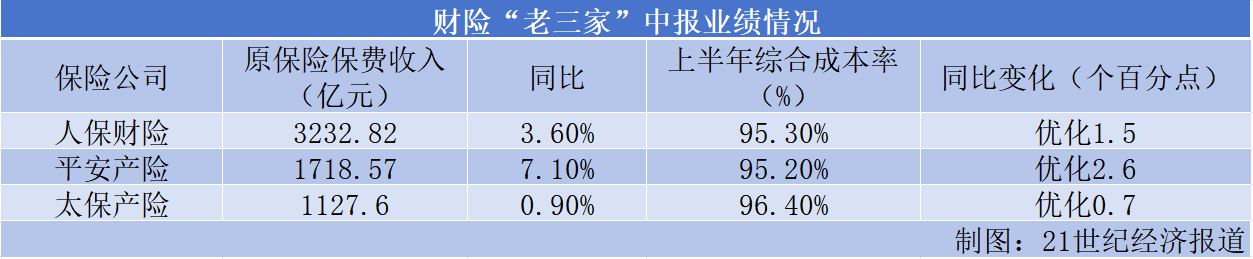
Group 1: Core Insights - The three major property insurance companies in China (PICC, Ping An, and Taiping) reported a total premium income of 607.9 billion yuan, capturing a market share of 63% [1][2] - PICC achieved a premium income of 323.28 billion yuan, a year-on-year increase of 3.6%; Taiping reported 112.76 billion yuan, up 0.9%; and Ping An reached 171.86 billion yuan, growing by 7.1% [1][2] - The overall combined ratio (COR) for these companies improved, with Ping An at 95.2% (down 2.6 percentage points), PICC at 95.3% (down 1.5 percentage points), and Taiping at 96.4% (down 0.7 percentage points) [1][2] Group 2: New Energy Vehicle Insurance - The new energy vehicle (NEV) insurance market is experiencing growth, with Taiping's NEV insurance premium income reaching 10.596 billion yuan, increasing its share of car insurance premiums from 14.1% to 19.8% [3][4] - NEV insurance is moving towards profitability, with several companies reporting improved underwriting results [3][4] - PICC's NEV insurance market share is 34.2%, exceeding that of fuel vehicles by 2.7 percentage points, indicating a strategic focus on this segment [4][5] Group 3: Non-Car Insurance Performance - PICC's non-car insurance premium income was 179.22 billion yuan, up 3.8%, with improvements in various segments [6] - Taiping's non-car insurance premium income decreased by 0.8% to 59.154 billion yuan, influenced by structural adjustments [6] - Ping An's non-car insurance premium income grew by 13.8% to 63.246 billion yuan, with significant growth in health and accident insurance [7] Group 4: Regulatory Changes and Industry Outlook - The upcoming "reporting and operation integration" policy aims to shift the industry focus from scale competition to value cultivation, addressing issues like high fees and premium collection risks [8] - The new regulations are expected to positively impact non-car insurance performance in 2025 and significantly improve results in 2026 [8]
盈利曙光初现,国内新能源车险出海远征
Bei Jing Shang Bao· 2025-09-02 13:16
Group 1 - The core viewpoint of the articles highlights the rapid development of China's new energy vehicle (NEV) industry, which is increasingly focusing on overseas markets, leading to a new trend in NEV insurance expansion abroad [1][6] - The domestic insurance industry faced significant losses in the NEV insurance sector in 2024, with 31.05 million NEVs insured, generating premium income of 140.9 billion yuan, and incurring underwriting losses of 5.7 billion yuan [2][5] - In the first half of 2025, major insurers like China Pacific Insurance and Ping An Insurance reported profitability in their NEV insurance segments, with Ping An's premium income reaching 21.7 billion yuan, a 46.2% year-on-year increase [2][3] Group 2 - Factors contributing to the turnaround in profitability for some insurers include policy support for pricing optimization, collaboration with the industry to reduce costs, and an increase in premium scale to dilute costs [4][5] - The insurance industry is gradually identifying improvement paths for NEV insurance, with regulatory guidance issued to enhance quality and efficiency through data sharing and risk classification [5][6] - Major insurers are actively expanding their NEV insurance business overseas, with significant growth in NEV exports, which reached 1.06 million units in the first half of the year, a 75.2% increase [6][7] Group 3 - Challenges faced by insurers in the overseas market include differences in claims systems, regulatory environments, and risk characteristics compared to the domestic market [9][10] - Establishing a global supply network for parts and collaborating with local repair businesses are crucial for ensuring efficient and quality claims services in foreign markets [9][10] - The lack of historical data in local markets poses challenges for reasonable pricing and underwriting, necessitating the development of local data-driven pricing models [10]
金融中报观|盈利曙光初现,国内新能源车险出海远征
Bei Jing Shang Bao· 2025-09-01 13:55
Core Insights - The insurance industry is witnessing a significant shift towards profitability in the new energy vehicle (NEV) insurance sector, driven by the rapid growth of the NEV market in China and increasing competition among insurers [1][4][5] Group 1: Industry Performance - In 2024, the domestic insurance industry faced losses in the NEV insurance sector, with 31.05 million NEVs insured, generating premium income of 140.9 billion yuan, and incurring underwriting losses of 5.7 billion yuan [3] - By the first half of 2025, major insurers like China Pacific Insurance and Ping An Insurance reported profitability in their NEV insurance segments, with China Pacific's premium income reaching 10.596 billion yuan, up from 14.1% to 19.8% of total auto insurance premiums [4] - Ping An Insurance reported a 46.2% year-on-year increase in NEV insurance premium income to 21.7 billion yuan, achieving a market share of 27.6% and providing risk coverage of 21 trillion yuan [4] Group 2: Factors Contributing to Profitability - Key factors for the turnaround in profitability include policy support for pricing optimization, collaboration with the industry chain to reduce costs, and the expansion of premium scales to dilute costs [5] - Improvements in repair technology and supply chain optimization have also contributed to reduced costs in NEV insurance [5] Group 3: Industry Challenges and Solutions - Despite the profitability of leading insurers, the NEV insurance sector still faces overall underwriting losses, particularly in high-risk areas like ride-hailing services [6] - The regulatory framework and industry guidelines released in January 2025 aim to enhance data sharing, repair standards, and rate determination to improve the quality and efficiency of NEV insurance [6][7] Group 4: International Expansion - Major insurers are now looking to expand their NEV insurance offerings internationally, aligning with the global expansion of China's NEV market [8] - In the first half of 2025, China exported 3.083 million vehicles, with NEV exports growing by 75.2% to 1.06 million units [8][9] - Insurers like PICC have successfully launched NEV insurance products in Hong Kong and Thailand, with plans to further develop their international presence [9][10] Group 5: Data and Regulatory Challenges - The international expansion of NEV insurance faces challenges such as differing regulatory environments, local repair standards, and the need for localized service teams [11] - Establishing a global supply network for parts and collaborating with local repair businesses are crucial for ensuring efficient claims processing [11] - The lack of historical data in overseas markets complicates pricing and underwriting, necessitating the development of local data-driven pricing models [12]

加大资金入市力度!中国人保透露A股投资动向
Zhong Guo Zheng Quan Bao· 2025-08-28 23:28
Core Viewpoint - China Pacific Insurance (601319) is optimistic about the growth potential of its overseas auto insurance business, particularly in the new energy vehicle (NEV) sector, which is expected to become a new growth highlight for the company [1][4]. Investment Strategy - The company has increased its investment in A-shares, with A-share investment assets growing by 26.1% year-to-date, and the proportion of A-shares in total investment assets rising by 1.2 percentage points [2]. - The company aims to build an equity investment portfolio that balances stable investment returns with opportunities for excess market returns [2]. - The investment in OCI (Other Comprehensive Income) high-dividend stocks has increased by 60.7% year-to-date, outperforming the CSI 300 Dividend Index by 7.8 percentage points [2]. Future Outlook - The company plans to continue enriching its equity investment model and strengthen research reserves for high-quality targets, focusing on investments that align with national strategic directions and have strong growth potential [3]. Overseas Expansion - The NEV auto insurance project is a key part of the company's international strategy, with expectations for significant growth in overseas auto insurance business [4]. - The company has successfully launched its first NEV auto insurance policy in Hong Kong and has insured over a thousand Chinese brand NEV vehicles in the region, with a current claims ratio of approximately 50% [4]. Stock Performance - In the first half of the year, the company's A-shares reached a six-year high, while its H-shares achieved a 13-year high, and China Pacific Insurance's H-shares reached a 22-year high [5]. - The increase in stock price is attributed to multiple factors, including high-quality economic development in China, improving development environment, and the company's strong fundamentals [5]. - The company emphasizes the importance of market communication and shareholder return capabilities in its ongoing market value management efforts [5].
车险“中国方案”赋能汽车产业“生态出海”
Zheng Quan Ri Bao· 2025-08-19 16:37
Core Viewpoint - The article highlights the challenges faced by Chinese electric vehicle (EV) manufacturers in securing affordable insurance when expanding into international markets, emphasizing the need for a comprehensive service ecosystem to support this transition [1][2][3]. Group 1: Market Trends - The export of Chinese electric vehicles is experiencing significant growth, with projected exports of 1.203 million, 1.284 million, and 1.06 million units for 2023, 2024, and the first half of 2025, respectively, representing year-on-year growth of 77.6%, 6.7%, and 75.2% [2]. - The increasing focus on localizing service systems by Chinese EV companies is raising the demand for overseas insurance services [2]. Group 2: Challenges in Insurance - Chinese EV owners abroad are facing high insurance premiums and difficulties in obtaining coverage, with examples of insurance companies refusing to insure vehicles due to concerns over parts supply and repair capabilities [3]. - Key issues identified include insufficient insurance supply, weak repair capabilities for EVs overseas, and high claims costs due to a lack of pricing experience among local insurers [2][3]. Group 3: Domestic Insurance Companies' Initiatives - Domestic insurance companies are actively seeking to support the international expansion of Chinese EVs, with strategic partnerships being formed to facilitate insurance coverage in markets like Thailand [4]. - Notable collaborations include China Pacific Insurance partnering with Mitsui Sumitomo Insurance and Zhongyi Insurance Brokerage to implement insurance solutions for Chinese EV manufacturers in Thailand [4]. Group 4: Future Directions - The article suggests that domestic insurers should focus on key markets where Chinese manufacturers are investing in factories, leveraging core technological advantages for competitive positioning [8]. - Recommendations include enhancing collaboration with automakers, sharing driving data, and developing localized insurance products to better meet market needs [8].
从“制造出口”到“体系出口” 新能源车出口迎保险保障护航
Jin Rong Shi Bao· 2025-08-08 07:04
Core Insights - The article highlights the challenges faced by Chinese electric vehicle (EV) manufacturers in overseas markets, particularly regarding insurance costs and services [1][2][3] - A significant breakthrough has been achieved with the launch of the first batch of EV insurance in Thailand, marking a key development in the internationalization of China's insurance services [2][3][5] Group 1: Insurance Collaboration and Market Entry - China Pacific Insurance (CPIC) has partnered with Mitsui Sumitomo Insurance and several domestic EV manufacturers to implement a comprehensive insurance solution for EVs exported to Thailand [2][3] - The insurance project covers nearly 1,000 EVs and includes vehicle damage insurance, third-party liability insurance, and local traffic compulsory insurance [2][3] - The collaboration aims to provide full risk protection for Chinese EV manufacturers as they expand into the Thai market, with plans for future local production and operations [2][4] Group 2: Growth of EV Exports and Insurance Demand - In the first half of the year, China's automobile exports reached 3.083 million units, a year-on-year increase of 10.4%, with EV exports growing significantly to 1.06 million units, up 75.2% [2][3] - The rising number of exported EVs has highlighted the need for corresponding insurance services, as evidenced by higher insurance premiums for Chinese EVs compared to traditional fuel vehicles in markets like Australia and the UK [2][3] Group 3: Challenges in Overseas Insurance Operations - High insurance premiums for EVs in Thailand are partly due to local insurers lacking pricing experience, which has dampened consumer enthusiasm for purchasing EVs [3][6] - The insurance industry faces multiple challenges in expanding overseas, including adapting to diverse regulatory environments, local driving habits, and establishing localized service networks [6][7] - Building operational capabilities in foreign markets is crucial for insurance companies, necessitating collaboration with local firms and the development of a comprehensive service network [7] Group 4: Strategic Importance of Overseas Insurance - The move to provide insurance for exported EVs is seen as a strategic necessity for domestic insurers, especially as competition in the domestic market intensifies [5][6] - The integration of insurance services with the export of EVs is essential for creating a complete industry chain, as the demand for insurance services grows alongside the increasing intelligence and localization of exported vehicles [4][5]