村镇银行改革

Search documents
村镇银行“归巢” 国有大行与区域银行齐发力
Bei Jing Shang Bao· 2025-10-30 00:34
Core Viewpoint - The ongoing "return to the nest" reform of village banks, led by main initiating banks, aims to address risks and optimize the financial layout in rural areas, ensuring that financial services remain rooted in local communities and meet the needs of rural residents [1][7][11]. Summary by Sections Village Bank Mergers and Acquisitions - On October 29, three village banks in Shandong were approved for dissolution, with their assets and operations taken over by Qingdao Rural Commercial Bank, marking a significant step in the "village to branch" reform [1][2]. - The day before, six village banks in Sichuan were also absorbed by Chengdu Rural Commercial Bank, indicating a broader trend of consolidation in the sector [2][3]. Background and Rationale - Village banks were established to serve "three rural issues," small and micro enterprises, and county-level economies, filling gaps left by traditional financial institutions. However, many have strayed from their original mission due to weak capital, governance issues, and inadequate risk control [7][11]. - The "village to branch" reform involves the absorption of village banks into their main initiating banks, eliminating their independent legal status and allowing for unified management and operations [7][11]. Strategic Implications - The main initiating banks can leverage their risk management frameworks and capital allocation mechanisms to reduce potential risks associated with village banks, enhancing their overall risk resilience [4][10]. - The consolidation allows main banks to deepen their penetration into rural financial markets by utilizing existing customer bases and branch networks of the absorbed village banks [4][10]. Future Outlook - The reform is expected to continue, with more village banks likely to be integrated into main initiating bank systems, as highlighted by recent regulatory approvals and ongoing discussions in the financial sector [11][12]. - The central government's emphasis on rural financial reform and the need for differentiated strategies for different institutions will be crucial for the success of these reforms [11][12].




村镇银行“归巢”
Bei Jing Shang Bao· 2025-10-29 16:40
Core Viewpoint - The ongoing "village-to-branch" reform led by main initiating banks aims to optimize the rural financial landscape by absorbing and merging village banks, addressing issues such as weak capital, governance, and risk management [1][7][12]. Group 1: Recent Developments - On October 29, three village banks in Shandong (Jining Blue Ocean, Rizhao Blue Ocean, and Yinan Blue Ocean) were approved for dissolution, with all assets and operations transferred to Qingdao Rural Commercial Bank [1][3]. - The day before, six village banks in Sichuan were also absorbed by Chengdu Rural Commercial Bank, marking a significant step in the reform process [3][4]. - The "village-to-branch" initiative is part of a broader trend where both state-owned and regional banks are consolidating village banks into their operations [5][9]. Group 2: Strategic Implications - The absorption of village banks allows main initiating banks to leverage unified risk management frameworks and capital allocation mechanisms, effectively reducing potential risks [5][10]. - This consolidation enhances the main banks' county-level network coverage, utilizing existing village bank customer bases to deepen financial services in rural areas [5][12]. - The reform is seen as a long-term strategy to improve the quality of financial services while addressing risks, with a focus on balancing efficiency and service quality [12][13]. Group 3: Regulatory Context - The 2025 Central Document emphasizes the importance of maintaining the agricultural support role of rural banks and encourages a tailored approach to reform [12][13]. - Regulatory bodies are pushing for main initiating banks to increase capital in viable village banks while encouraging full acquisitions of those lacking potential [13][14].


广东3家农商行“收编”改制支行集中开业,村行改革化险提速
Nan Fang Du Shi Bao· 2025-09-18 11:32
Core Viewpoint - The recent reforms in Guangdong's village and town banks have led to the successful establishment of several commercial bank branches through the absorption and merger of village banks, marking a significant step in the region's financial restructuring [2][5][8]. Group 1: Recent Developments - On September 16, the Guangzhou Rural Commercial Bank's Zhongshan Dongfeng branch was inaugurated, having been transformed from the Zhongshan Dongfeng Zhujiang Village Bank [3][5]. - The Shunde Rural Commercial Bank's Sanshui branch also opened on September 15, representing the first successful cross-initiator merger of a village bank into a branch in Guangdong [5][8]. - In total, 11 commercial bank branches have been approved to open in Guangdong since September, all resulting from the mergers of village banks by Guangzhou, Shunde, and Jiangmen Rural Commercial Banks [5][6]. Group 2: Mergers and Acquisitions - The Shunde Rural Commercial Bank has been particularly active, successfully absorbing and merging multiple village banks, including the Sanshui Zhujiang Village Bank and the Foshan Gaoming Shunyin Village Bank [6][10]. - The Guangzhou Rural Commercial Bank plans to absorb five Zhujiang Village Banks, completing the merger of all such banks in Guangdong [7][10]. - Jiangmen Rural Commercial Bank has also targeted several village banks, including the recent merger of Longchuan and Raoping Ronghe Village Banks [7][10]. Group 3: Strategic Goals - The opening of new branches aims to enhance local economic services, with commitments to support local industries and projects, such as the strategic cooperation agreement signed by Guangzhou Rural Commercial Bank with local asset management [8][9]. - Shunde Rural Commercial Bank plans to invest no less than 10 billion yuan in the next five years to support manufacturing, technological innovation, and green industries in the Sanshui area [9][10]. Group 4: Challenges and Performance - Despite the aggressive expansion through mergers, both Guangzhou and Shunde Rural Commercial Banks are facing performance pressures, with declines in net profits reported [10]. - The integration of village banks into larger banking systems is seen as a way to enhance capital strength and operational efficiency, but balancing short-term risks with long-term sustainability remains a challenge [10].

一省级农商行,增持!
Zhong Guo Ji Jin Bao· 2025-09-10 15:08
Core Insights - Ningxia Huanghe Rural Commercial Bank increased its stake in Ningxia Tongxin Rural Commercial Bank to 46.78% by acquiring 24.9 million shares, up from 21.62% [1][2] Company Summary - Huanghe Rural Commercial Bank now holds a total of 36.25 million shares in Tongxin Rural Commercial Bank, following the recent acquisition [2] - As of the end of 2024, Huanghe Rural Commercial Bank has total assets of 75.756 billion, deposits of 49.745 billion, and loans of 39.075 billion [2] - Tongxin Rural Commercial Bank, established in January 1992, has a registered capital of 52.5 million and serves over 380,000 customers through its 15 branches and 142 rural financial service stations [3] Industry Summary - The reform of village and town banks is accelerating, with over 100 banks completing mergers and acquisitions by August 2025, surpassing the total for 2024 [4] - The government aims to enhance the risk management and transformation of local small financial institutions through various measures, including capital supplementation and restructuring [4] - Experts predict that the restructuring of village and town banks will continue to accelerate, leading to a gradual reduction in their numbers [4]
一省级农商行 增持!
Zhong Guo Ji Jin Bao· 2025-09-10 14:57
Group 1 - Ningxia Huanghe Rural Commercial Bank increased its stake in Ningxia Tongxin Rural Commercial Bank to 46.78% by acquiring 24.9 million shares, raising its total holdings to 36.25 million shares from 21.62% [1][2] - The approval from the Ningxia Financial Regulatory Bureau mandates Tongxin Rural Commercial Bank to adhere to relevant laws and regulations for the shareholding change, enhance equity management, optimize its equity structure, and improve corporate governance and internal control mechanisms to mitigate risks [2] - As the first provincial-level cooperative reform pilot in the country, Huanghe Rural Commercial Bank's increased stake enhances its influence and strengthens its financial network in the Ningxia region [2] Group 2 - Tongxin Rural Commercial Bank, established on January 21, 1992, has a registered capital of 52.5 million yuan and has set up 15 branches, 23 self-service banks, and 142 rural financial service stations, serving over 380,000 customers [3] - The ongoing reform of village and town banks has accelerated, with over 100 village and town banks completing mergers and acquisitions by August 20, 2025, surpassing the total for the entire year of 2024 [4] - The government aims to promote risk resolution and transformation of local small financial institutions through various measures, including capital supplementation, mergers, and market exits, indicating a potential for further consolidation in the sector [4]
一省级农商行,增持!
中国基金报· 2025-09-10 14:52
Core Viewpoint - Ningxia Huanghe Rural Commercial Bank has increased its stake in Ningxia Tongxin Rural Commercial Bank to 46.78% through the acquisition of 24.9 million shares, enhancing its influence in the region's financial landscape [2][4]. Group 1: Shareholding Changes - The approval from the Ningxia Financial Regulatory Bureau allows Huanghe Rural Commercial Bank to hold a total of 36.250431 million shares in Tongxin Rural Commercial Bank, with the shareholding ratio changing from 21.62% to 46.78% [4]. - Tongxin Rural Commercial Bank is required to comply with relevant laws and regulations to complete the shareholding change and improve its governance and internal control mechanisms [4]. Group 2: Strategic Implications - The increase in shareholding, while not achieving full control, significantly enhances Huanghe Rural Commercial Bank's influence and is expected to strengthen its financial network in Ningxia [4]. - Huanghe Rural Commercial Bank, as the first provincial-level cooperative reform pilot in the country, is positioned to create a more efficient financial service network through this strategic move [4]. Group 3: Industry Context - The reform of village and town banks is accelerating, with over 100 village and town banks having completed mergers and acquisitions by August 20, 2025, surpassing the total for the entire year of 2024 [7]. - The government is focusing on risk management and transformation of local small and medium financial institutions, which may lead to further consolidation in the sector [7][8].

村镇银行加速“村改支”背景下的发展之道
Jin Rong Shi Bao· 2025-08-21 04:56
Core Viewpoint - The ongoing reform of village banks in China is expected to accelerate mergers and consolidations, particularly as they align with the reforms of rural credit cooperatives, raising questions about the future development and differentiation of village banks [1] Group 1: Current Status and Trends - As of mid-2024, there are over 1,600 village banks operating across 31 provinces in China, employing more than 100,000 personnel, indicating a robust organizational structure [2] - The overall operational status of village banks is stable and improving, with controllable risks, although significant polarization remains evident within the sector [2] Group 2: Reform Objectives and Impacts - The primary goal of the village bank reform is to mitigate risks by restructuring and merging high-risk institutions, which is expected to reduce the number of village banks while enhancing the overall risk management capabilities [3] - Some provinces have adopted a "one-size-fits-all" approach, merging all village banks into larger commercial or rural banks regardless of their performance, which may not be the most effective strategy [3] Group 3: Predictions and Industry Ecology - The "village bank to branch" reform model is suitable for high-risk village banks, but indiscriminate merging based solely on the parent bank's characteristics is not advisable [4] - Post-reform, village banks are anticipated to optimize governance and strengthen their overall capabilities, leading to the emergence of a number of high-quality, specialized village banks [4] Group 4: Challenges and Recommendations - A significant challenge in the reform process is the "one-size-fits-all" policy adopted by some provinces, which could hinder the effectiveness of the reforms [5] - Merging stable and well-managed village banks with nearby counterparts is suggested as a viable option to maintain the village bank identity while addressing risks and enhancing strength [5] Group 5: Differentiation and Management - Village banks that have performed well and provided effective services to small and micro enterprises are likely to retain their competitive advantages post-merger, as their local knowledge and flexibility are difficult to replicate [6] - The parent banks should consider granting autonomy to well-performing village banks, respecting their independence while ensuring effective resource allocation and risk management [7]
常熟银行首次启动中期分红 年内三次计划“村改支”
Mei Ri Jing Ji Xin Wen· 2025-08-11 12:36
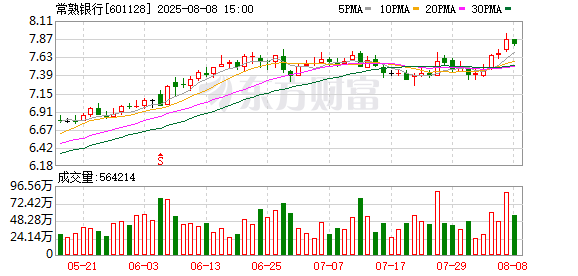
Core Viewpoint - Changshu Bank reported a strong performance in the first half of 2025, with significant year-on-year growth in both revenue and net profit, indicating effective strategies in expanding its market presence and optimizing resource allocation [1][2][3]. Financial Performance - Revenue for the first half of 2025 reached 6.062 billion yuan, a year-on-year increase of 10.1% [1]. - Net profit attributable to shareholders was 1.969 billion yuan, reflecting a year-on-year growth of 13.51% [1]. - The bank's total assets exceeded 400 billion yuan, marking a 9.45% increase from the beginning of the year [3]. - The non-performing loan (NPL) ratio stood at 0.76%, a slight decrease of 0.01 percentage points from the start of the year [3]. Revenue Composition - Interest income contributed 4.64 billion yuan, with a modest year-on-year increase of 0.83% [4]. - Non-interest income surged to 1.422 billion yuan, a significant year-on-year increase of 57.26%, primarily driven by investment income [4]. - Investment income reached 1.201 billion yuan, up 30.94% year-on-year, with bond investment income showing a remarkable growth of 560.13% [4]. Strategic Expansion - Changshu Bank has absorbed and merged seven village banks this year, enhancing its presence in county markets and optimizing resource allocation [2][6]. - The bank's revenue from areas outside Changshu accounted for 66.52% of total revenue, indicating successful regional expansion [1][6]. - The bank's strategy includes establishing new branches following the absorption of village banks, which is expected to further enhance its market reach [6][7]. Dividend Policy - The bank announced its first interim dividend, distributing 0.15 yuan per share, totaling 497 million yuan, which is 25.27% of the net profit for the first half of 2025 [2][5]. - This marks a shift in the bank's dividend policy, as the annual dividend payout ratio has decreased in recent years [4][5].
常熟银行首次启动中期分红,年内三次计划“村改支”,上半年常熟以外地区营收占比超6成
Mei Ri Jing Ji Xin Wen· 2025-08-09 00:48
Core Viewpoint - Changshu Bank has reported a double-digit year-on-year growth in both revenue and net profit for the first half of the year, indicating strong financial performance and strategic expansion efforts [2][3]. Financial Performance - Revenue for the first half of the year reached 6.062 billion yuan, with a year-on-year increase of 10.1% [2]. - Net profit attributable to shareholders was 1.969 billion yuan, reflecting a year-on-year growth of 13.51% [2]. - The bank's total assets exceeded 400 billion yuan, marking a 9.45% increase from the beginning of the year [3]. Revenue Composition - Interest income amounted to 4.64 billion yuan, with a slight year-on-year increase of 0.83% [4]. - Non-interest income reached 1.422 billion yuan, showing a significant year-on-year growth of 57.26% [4]. - Investment income was a major contributor to non-interest income, totaling 1.201 billion yuan, up 30.94% year-on-year [4]. Asset Quality - The non-performing loan (NPL) ratio stood at 0.76%, a slight decrease of 0.01 percentage points from the beginning of the year [3]. - The provision coverage ratio was 489.53%, indicating a strong risk buffer despite a decrease of 10.98 percentage points from the start of the year [3]. Strategic Expansion - Changshu Bank has increased its revenue from outside Changshu to 66.52%, with a similar percentage for pre-provision profit [2][5]. - The bank has plans to absorb and merge seven village banks and establish branch offices, enhancing its presence in county markets [9][10]. Dividend Policy - The bank announced its first interim dividend distribution plan, proposing a cash dividend of 0.15 yuan per share, totaling 497 million yuan, which represents 25.27% of the net profit for the first half of 2025 [5][7].
村镇银行年内84家获批解散,兼并重组成主旋律
Huan Qiu Wang· 2025-07-10 02:35
Core Insights - The reform of small and medium-sized financial institutions, particularly in the village and town bank sector, is accelerating, with a significant increase in the number of banks approved for dissolution in 2025 compared to previous years [1][3] Group 1: Reform Progress - As of July 9, 2025, 84 village and town banks have been officially approved for dissolution, showing a notable increase compared to the same period in 2023 and 2024 [1] - The core idea of the village bank reform is "merger and reorganization, reduction and quality improvement," with most banks being absorbed and merged into local city commercial banks or rural commercial banks [1][3] Group 2: Regional Developments - Inner Mongolia has the highest number of village bank dissolutions in the first half of the year, with 15 banks approved for dissolution, followed by Shandong and Jiangsu with 14 and 5 respectively [3] - The total number of village banks in the country has decreased from 1,538 at the end of 2024 to 1,454 as of July 9, 2025 [3] Group 3: New Trends - New trends in the village bank reform include cross-province mergers, such as Harbin Bank acquiring Chongqing Youyang Rongxing Village Bank and establishing branches in Chongqing [3] - Major state-owned banks, like Industrial and Commercial Bank of China, have also entered the merger and reorganization process, acquiring their own established village banks [3] - Despite these developments, large-scale cross-regional operations by regional banks remain unlikely, with future reforms expected to focus on enhancing services for agriculture and small enterprises while mitigating risks [3]