
气候行动

Search documents
美媒:日本再次被评“气候行动最差生”
Huan Qiu Shi Bao· 2025-11-25 22:50
Core Points - Japan received the "Fossil Award" at COP30 for its negative stance on climate action, marking multiple instances of this recognition [1] - The award was given due to Japan's funding for fossil fuel projects, hindering transition plans, and promoting misleading technological solutions [2] Group 1: Criticism of Japan's Climate Actions - Japan is accused of attempting to "extend the life" of fossil fuels by promoting technologies like CCS (Carbon Capture and Storage) and hydrogen, which are seen as distractions rather than real solutions [2] - The country has funded large natural gas projects in Australia, threatening local land, water, and culture, and has been criticized for not obtaining proper consent from indigenous communities [3] - Japan's excessive procurement of LNG has crowded out renewable energy development, contributing to a climate crisis with significant financial backing for fossil fuel projects [3] Group 2: Japan's Stance on Climate Justice - Japan has been obstructing the inclusion of fairness and community voices in climate transition plans within formal negotiations, supporting a proposal to take no action until 2026 [4] - Environmentalists argue that Japan's energy strategy should not be endorsed by other countries, as it aims to extend the use of coal and natural gas [5] - Concerns have been raised that Japan is positioning Malaysia as a "carbon dump" for its CO2 emissions, which could lead to high-risk dependencies for Southeast Asian nations [5]
巴西贝伦气候大会闭幕 通过有关气候行动总体协议
Zhong Guo Xin Wen Wang· 2025-11-23 07:14
Core Points - The COP30 conference in Belem, Brazil, concluded with the adoption of a new overall agreement on climate action [1] - The agreement emphasizes the need for global collaboration to address the climate crisis, accelerate emission reductions, and enhance climate resilience [1] - The conference was extended due to disagreements among parties on key issues, with the final session experiencing interruptions from dissenting parties [1] Summary by Sections - **New Agreement**: The conference adopted the agreement titled "Global Mobilization: United Cooperation to Address Climate Change Challenges," urging countries to proactively respond to climate change and accelerate climate action [1] - **Funding Commitment**: The agreement calls for wealthy nations to double their financial contributions by 2035 to assist other countries in addressing global climate change [1] - **Trade Barriers**: The agreement highlights that increasing trade barriers are limiting the use of clean energy technologies, and climate institutions are urged to analyze how international trade can align with climate action [1]
美国反对,但宣言获压倒性通过!
Zhong Guo Ji Jin Bao· 2025-11-23 00:48
Core Points - The G20 Leaders' Declaration has been approved by the majority of member countries, demonstrating their commitment to addressing common challenges and promoting unity, despite opposition from the United States [1] Group 1: Climate Action - Acknowledgment of the urgency in addressing climate change, with support for efforts to triple global renewable energy capacity [2] Group 2: Debt Issues - Commitment to strengthening the implementation of debt management mechanisms to alleviate the high debt pressure faced by developing countries [3] Group 3: Inclusive Growth - Emphasis on promoting broad development, enhancing industrial value addition, and ensuring equitable access to critical mineral resources [4] Group 4: Multilateral Cooperation - Reaffirmation of the commitment to multilateralism, calling for countries to work together to tackle global challenges [5] Group 5: Summit Themes and Priorities - The summit focused on four main priorities: enhancing disaster response capabilities, ensuring debt sustainability for low-income countries, raising funds for a just energy transition, and utilizing critical minerals for inclusive growth and sustainable development [5]
美国反对无效,压倒性通过
第一财经· 2025-11-23 00:47
Core Viewpoint - The G20 summit in Johannesburg has successfully adopted a joint declaration, emphasizing multilateral cooperation to address global challenges and support for developing countries, despite opposition from the United States [3][5]. Group 1: Declaration Highlights - Climate Action: Acknowledgment of the urgency in addressing climate change, supporting efforts to triple global renewable energy capacity [6]. - Debt Issues: Commitment to strengthen the implementation of debt management mechanisms to alleviate high debt pressures on developing countries [7]. - Inclusive Growth: Emphasis on promoting broad development, enhancing industrial value addition, and ensuring equitable access to critical mineral resources [8]. - Multilateral Cooperation: Reaffirmation of the commitment to multilateralism, calling for countries to work together to tackle common global challenges [9].

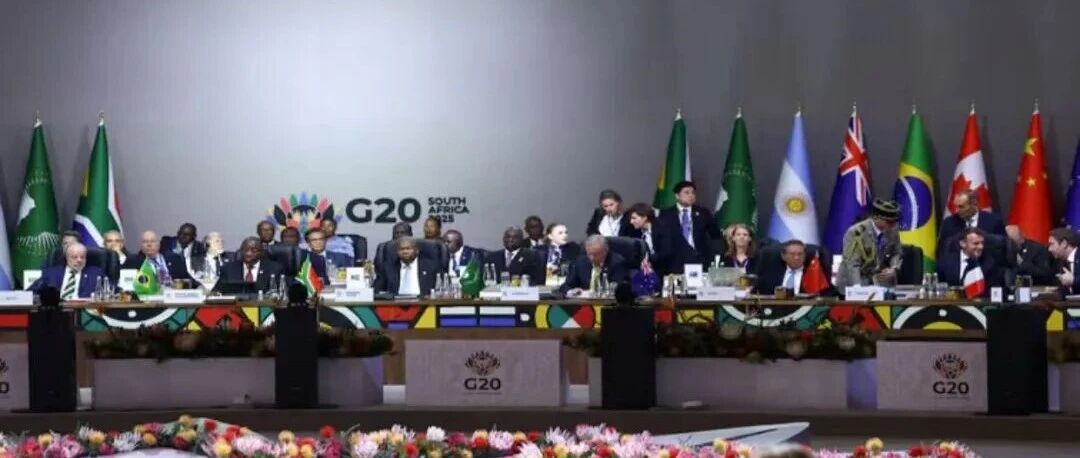
COP30峰会闭幕 通过有关气候行动总体协议
Yang Shi Xin Wen· 2025-11-22 21:18
Core Points - The COP30 conference concluded in Belem, Brazil, with the adoption of a new climate action agreement titled "Global Mobilization: United Action to Address Climate Change Challenges" [1] - The agreement calls for wealthy nations to double their funding by 2035 to assist other countries in addressing global climate change [1] - It highlights the impact of increasing trade barriers on the use of clean energy technologies and urges climate institutions to analyze how international trade can align with climate action [1]
二十国集团领导人第二十次峰会宣言 获压倒性通过!
Mei Ri Jing Ji Xin Wen· 2025-11-22 15:20
Core Points - The G20 Leaders' Summit declaration has been approved by the majority of member countries, despite opposition from the United States [1][4] - The summit emphasizes the importance of multilateralism and aims to send a strong signal that it can yield results [4][5] Group 1: Summit Themes and Priorities - The summit is themed "Unity, Equality, and Sustainability" and focuses on four main priorities: enhancing disaster response capabilities, ensuring debt sustainability for low-income countries, funding for a just energy transition, and achieving inclusive growth through the utilization of critical minerals [4][5] - The first phase of the summit addresses inclusive and sustainable economic growth, while the second phase focuses on climate and disaster response capabilities [6] Group 2: Climate and Debt Issues - The declaration recognizes the urgency of addressing climate change and supports efforts to triple global renewable energy capacity [5] - There is a commitment to strengthen debt management mechanisms to alleviate the high debt burden faced by developing countries [5] Group 3: Multilateral Cooperation - The summit reaffirms the commitment to multilateralism and calls for countries to work together to tackle common global challenges [5] - South Africa will assume the G20 presidency on December 1, 2024, with the United States taking over from December 1, 2025, to November 30, 2026 [7]
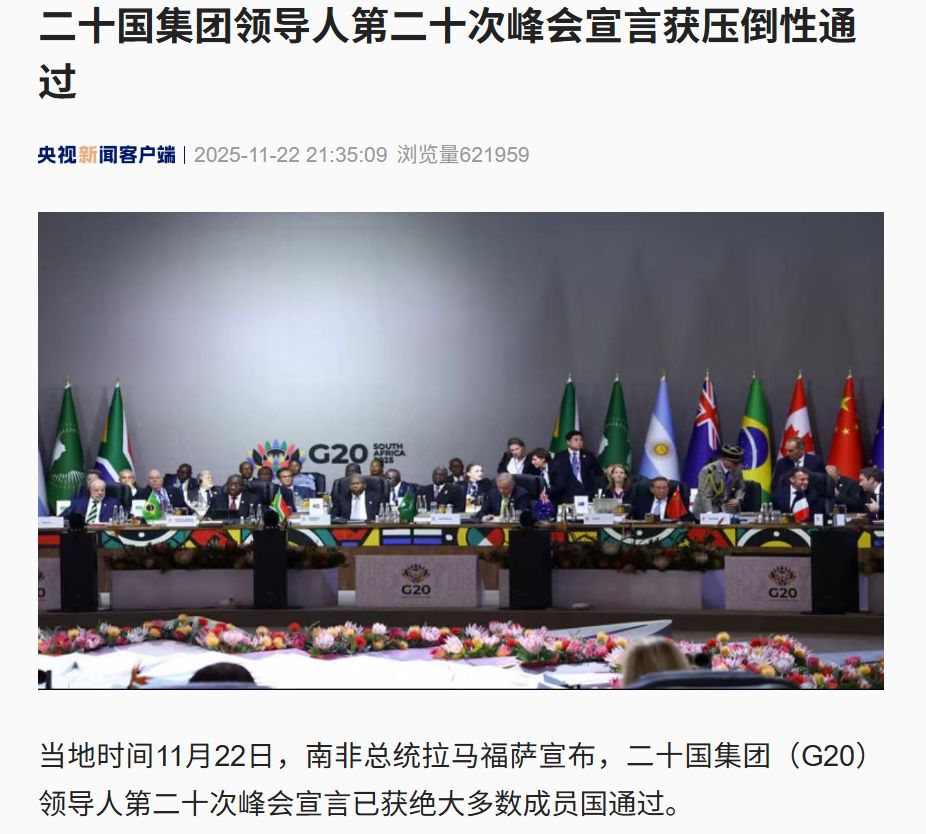
二十国集团领导人第二十次峰会宣言获压倒性通过
Yang Shi Xin Wen· 2025-11-22 14:00
Core Points - The G20 Leaders' Declaration has been approved by the majority of member countries, despite opposition from the United States, highlighting the commitment of G20 members to address common challenges and promote unity and cooperation [1] Group 1: Key Themes from the Declaration - Climate Action: Acknowledgment of the urgency in addressing climate change, with support for efforts to triple global renewable energy capacity [2] - Debt Issues: Commitment to strengthen the implementation of debt management mechanisms to alleviate the high debt pressure faced by developing countries [2] - Inclusive Growth: Emphasis on promoting broad-based development, enhancing industrial value addition, and ensuring equitable access to critical mineral resources [2] - Multilateral Cooperation: Reaffirmation of the commitment to multilateralism, calling on countries to work together to tackle global challenges [2]
UNFCCC副执行秘书努拉·哈姆拉吉:弥合气候融资缺口 可负担资金是实现国家自主贡献的关键之一
Xin Lang Cai Jing· 2025-11-19 06:56
Core Viewpoint - The COP30 conference in Brazil emphasizes the urgent need for enhanced climate action and the critical role of private sector investment in achieving the goals of the Paris Agreement [1][3]. Group 1: ESG Services and Initiatives - Sina Finance ESG Rating Center offers 14 ESG services, including information, reports, training, and consulting, to help listed companies promote ESG concepts and improve sustainable development performance [1]. - The center aims to establish a suitable ESG evaluation standard system for China and promote the development of ESG investment in the asset management industry [4]. Group 2: Climate Action Challenges - Noura Hamladji highlighted that a significant barrier to achieving emission reduction and climate action goals under the Paris Agreement is the lack of sufficient and low-cost funding, particularly for developing countries [3]. - Developing countries have plans for emission reduction or adaptation but face challenges due to insufficient funding sources and high financing costs [3]. Group 3: Role of Private Sector and International Cooperation - Hamladji emphasized the necessity of leveraging more private capital and utilizing private sector technology, innovation, and solutions to enhance climate action [3]. - She noted that developing countries are becoming more proactive in rule-making and mechanism design, with Africa emerging as a solution provider rather than a passive recipient [3]. - The concept of "South-South cooperation" is highlighted as a new pillar for climate action, with China playing a leading role in this collaborative model [3]. Group 4: Urgency of Climate Action - Hamladji reiterated the urgency of climate action, stating that while progress has been made since the Paris Agreement, more needs to be done, and the pace of transformation must accelerate [3]. - She called on negotiators to confront the pressing challenges facing humanity and the planet and to work together to find solutions [3].

世界经济论坛可持续金融总负责人:ESG已从理念探讨走向资本部署
Xin Lang Cai Jing· 2025-11-19 06:42
Core Viewpoint - Climate action is not merely a cost but a crucial element in addressing multiple crises, acting as a "risk multiplier" that exacerbates various challenges faced by humanity [4][5]. Group 1: Climate Change and Its Implications - Climate change is linked to energy security, food insecurity, and geopolitical instability, necessitating a transition to clean energy and improved efficiency [4]. - Failure to address climate issues will lead to increased pressure and tensions, such as large-scale migration from agricultural decline regions [5]. Group 2: Sustainable Finance and Long-term Value - Investing in emerging sectors may reduce short-term returns but enhances risk management and creates long-term value [6]. - Transitioning to a low-carbon, resource-efficient economy is essential for economic resilience and to avoid higher financing costs [6]. Group 3: Leadership and Coordination in Climate Action - Coordinated leadership is essential for effective climate action, with the World Economic Forum playing a pivotal role in uniting various sectors to transform climate commitments into actionable plans [8]. - The Forum is also a key player in research and thought leadership, promoting clean energy investments and addressing food security and natural conservation [8][9]. Group 4: Future Trends in Climate Action - Four critical trends are identified for future climate action: 1. Infrastructure improvement is necessary to meet the increasing demand for electricity driven by various factors [11]. 2. Integration of data and technology, such as AI and satellite data, is vital for risk management and accurate climate disclosures [11]. 3. Climate adaptation and resilience should focus on infrastructure, agriculture, and water systems to prepare for future shocks [11]. 4. Strengthening regional cooperation is crucial amidst geopolitical fragmentation, requiring innovative local financial solutions [12].

对话世界经济论坛可持续金融总负责人:ESG已从理念探讨走向资本部署
Xin Lang Cai Jing· 2025-11-15 00:39
Core Viewpoint - The 30th United Nations Climate Change Conference (COP30) emphasizes that climate action is not merely a cost but a crucial element in addressing multiple crises, including energy security, food insecurity, and geopolitical instability [4][5]. Group 1: Climate Action as a Solution - Climate change is described as a "risk multiplier" that exacerbates various crises faced by humanity, necessitating a transition to clean energy and improved efficiency [4]. - Climate action is seen as central to resolving geopolitical issues, with inaction potentially leading to significant migration pressures and political instability in regions affected by agricultural decline [5]. Group 2: Sustainable Finance and Long-term Value - Investment in emerging sectors may reduce short-term returns but is essential for enhancing risk management and creating long-term value [6]. - The transition to a low-carbon, resource-efficient economy is critical; failure to do so may result in increased financing costs and economic vulnerability [6][7]. - Discussions around ESG (Environmental, Social, and Governance) have shifted from theoretical to practical applications, focusing on specific projects and asset transformations [6][7]. Group 3: Leadership and Coordination in Climate Action - Coordinated leadership is essential for effective climate action, with the World Economic Forum acting as a neutral platform to unite business, government, academia, and civil society [8]. - The Forum is involved in discussions on climate finance and private capital mobilization, aiming to translate climate commitments into actionable plans [8][9]. Group 4: Future Trends in Climate Action - Four key trends are identified for future climate action: 1. Improvement of infrastructure to meet increasing electricity demands driven by various factors, including AI and data centers [10]. 2. Integration of data and technology, such as AI and satellite data, to enhance risk management and climate disclosure accuracy [10][11]. 3. Focus on climate adaptation and resilience, emphasizing the importance of preparing high-risk regions for future climate impacts [11]. 4. Strengthening regional cooperation amidst geopolitical fragmentation, which may foster local financial innovations and partnerships [11].