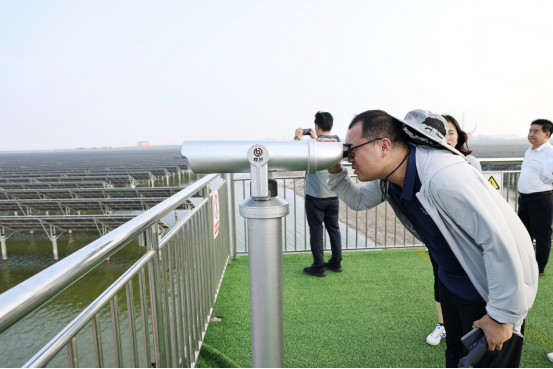
渔光互补

Search documents
“渔光互补”双丰收
Liao Ning Ri Bao· 2025-10-12 00:45
Core Insights - The project is a 100 MW fish-solar complementary photovoltaic project in Dalian, which has supplied approximately 1.315 billion kWh of green electricity and reduced CO2 emissions by over 1.14 million tons, marking a significant achievement in the province's "dual carbon" goals [1] - As the largest photovoltaic project in Northeast China completed in one go, it generates an annual electricity output of 160 million kWh, saving 49,000 tons of standard coal and reducing CO2 emissions by 139,000 tons, providing crucial green energy support for carbon peak and carbon neutrality goals [1] - The innovative "fish-solar complementary" model allows for fish farming beneath the solar panels, enhancing economic output per unit area and promoting the transformation and upgrading of traditional agricultural and fishery industries [1] Industry Impact - The project has created a new development model of "ecology + photovoltaic + tourism," serving as a new engine for the development of surrounding ecological tourism resources, attracting numerous visitors and boosting local service industries such as dining and accommodation [1] - The unique landscape, blending technology and natural beauty, has led to increased production of agricultural by-products and higher incomes for local farmers, providing tangible ecological benefits to the community [1]


穗恒运A台山光伏项目受“桦加沙”影响,资产损失或超千万
Zheng Quan Shi Bao Wang· 2025-10-08 12:44
Core Viewpoint - The company, Suihengyun A, reported asset damage to its solar projects due to Typhoon "Hagupit," with estimated losses potentially exceeding 10% of its projected net profit for 2024 [1][2]. Group 1: Impact of Typhoon - The typhoon caused damage to various components of the 500MW fish-solar complementary photovoltaic project, including modules, inverters, and support structures [1]. - The company has initiated damage assessment and insurance claims to mitigate the financial impact of the losses [3]. Group 2: Project Details - The 500MW project, located in Taishan, covers nearly 6,500 acres and has a total static investment of approximately 2.16 billion [2]. - The first phase of the project (200MW) began in 2019, with Suihengyun A holding a 60% stake, while the second phase (300MW) started in 2020, with a 55% stake [2]. Group 3: Financial Performance - The first phase generated revenue of 93 million and a net profit of 34.42 million, while the second phase achieved revenue of 132 million and a net profit of 46.28 million [3]. - Overall, the revenue contribution from these projects to Suihengyun A's total revenue is relatively low [3]. Group 4: Emergency Response - Prior to the typhoon, the company activated its emergency response mechanism, implementing preventive measures and forming a rescue team [3]. - Post-typhoon, the company has begun recovery efforts, including damage cleanup and maintenance [3].

山东垦利:创新海域立体分层设权,激活“渔光互补”新空间
Qi Lu Wan Bao Wang· 2025-09-17 13:27
Core Viewpoint - The article highlights the innovative approach of utilizing marine space in a layered manner, allowing both aquaculture and offshore photovoltaic projects to coexist, thus breaking the traditional single-use model in marine resource management [1][2][3]. Group 1: Project Overview - The Guohua HG14 offshore photovoltaic project, approved by the State Council, is set to be the largest offshore photovoltaic project in China, with a planned capacity of 1000 MW and an annual output sufficient to meet the needs of 2.67 million urban residents [1]. - The project faced initial challenges due to existing legal usage rights for aquaculture in the same marine area, which had been granted to four companies in 2022 [1]. Group 2: Regulatory Changes - A new regulation from the Ministry of Natural Resources in 2023 encouraged layered rights allocation in marine areas, allowing for multiple uses of the same space without compromising safety and security [1][2]. - The local government in Dongying recognized the area as a testing ground for this new policy, leading to the development of a layered rights registration system [2]. Group 3: Implementation and Benefits - The implementation of layered rights allowed aquaculture to continue on the seabed while enabling the construction of photovoltaic facilities on the water surface, promoting synergy between the two industries [3]. - The first batch of photovoltaic units is expected to generate 1.78 billion kWh of clean electricity annually, saving 500,000 tons of standard coal and reducing carbon dioxide emissions by 1.34 million tons [3]. - The coexistence of photovoltaic panels and aquaculture has resulted in a mutually beneficial scenario, with the panels providing shade that enhances the growth of certain marine species [3].
板上发电水下养虾,“渔光互补”助力绿色发展
Qi Lu Wan Bao· 2025-09-11 09:36
Core Viewpoint - The "fishing and solar integration" model in Binhai Town, Zhanhua District, is transforming local aquaculture by combining photovoltaic power generation with shrimp farming, promoting both economic and ecological benefits [2][3][4] Group 1: Project Overview - The "fishing and solar integration" project cleverly combines solar power generation with saltwater shrimp farming, enhancing both economic and ecological outcomes [2][3] - The project is located in Binhai Town, Zhanhua District, which has favorable geographical and environmental conditions for saltwater shrimp farming [3] Group 2: Technological Implementation - Photovoltaic power stations are installed above shrimp ponds at a fixed angle of 25 degrees to optimize power generation and shading effects [3] - The design reduces water temperature in shrimp ponds by 1-2 degrees Celsius, leading to a 2-3 times increase in shrimp yield [4] Group 3: Environmental Impact - The annual power generation from the photovoltaic stations can reduce coal consumption by over 120,000 tons, significantly decreasing carbon dioxide emissions [4] - The project contributes to energy conservation, emission reduction, and sustainable development, showcasing the potential of green energy applications [4] Group 4: Economic Benefits - The integration of traditional aquaculture with renewable energy has led to a cross-industry collaboration, improving air quality and optimizing land resources [4] - The saltwater shrimp produced in the "fishing and solar integration" ponds are reported to be more desirable in terms of taste and quality, attracting consumer interest [4]

海安大力发展"渔光互补"光伏产业
Xin Hua Ri Bao· 2025-08-21 04:09
Core Viewpoint - The city of Hai'an is prioritizing ecological conservation and green development by leveraging its abundant water resources to promote the "fishing and solar complementarity" photovoltaic industry, integrating clean energy production with aquaculture [1] Group 1 - Hai'an is developing a "fishing and solar complementarity" photovoltaic industry that combines clean energy generation with aquaculture [1] - The initiative creates an ecological landscape characterized by "water-based power generation and underwater aquaculture" [1] - A drone photo taken on August 20 showcases one of the "fishing and solar complementarity" photovoltaic power stations in the Lixia River water town of Hai'an [1]
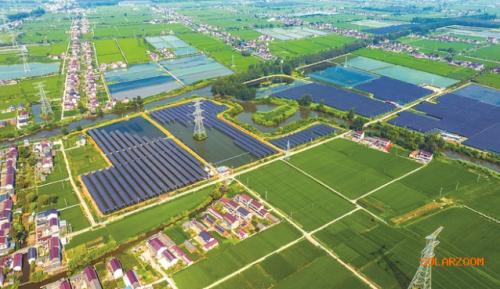
鱼塘搭光伏 “绿电”富一方
Hang Zhou Ri Bao· 2025-08-20 07:46
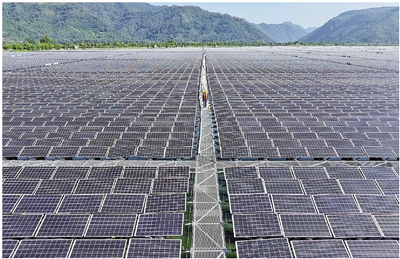
Core Viewpoint - The floating photovoltaic power plant in Jiande City, Zhejiang, has achieved significant daily power generation, exceeding 100,000 kilowatt-hours, benefiting from recent hot weather conditions [2] Group 1: Project Overview - The photovoltaic power plant was established in August 2017, utilizing the upper space of 420 acres of fish ponds in Chunjingyuan Village [2] - The plant has an annual power generation capacity of 20 million kilowatt-hours [2] Group 2: Environmental Impact - The operation of the power plant contributes to a reduction of over 14,000 tons of carbon emissions annually [2] - The project supports local ecological preservation while enhancing collective economic income [2]
湖南能源集团发展股份有限公司2025年半年度报告摘要
Shang Hai Zheng Quan Bao· 2025-08-18 19:47
Core Points - The company did not distribute cash dividends or issue bonus shares during the reporting period [3] - The company plans to purchase land use rights and has agreed to a compensation of 10.76 million yuan for the recovery of certain buildings [6][7] - The company has appointed a new vice president and has undergone significant management changes [9][22][24] - The company is involved in a major asset restructuring, planning to acquire stakes in several power generation companies [10] - The company has approved a profit distribution plan for the fiscal year 2024, proposing a cash dividend of 0.50 yuan per share [21] Company Overview - The company has not experienced any changes in its controlling shareholder or actual controller during the reporting period [4][5] - The company has a total of 464,158,282 shares, with a proposed cash dividend distribution amounting to 23.21 million yuan [21] - The company has undergone a name change from "Hunan Development Group Co., Ltd." to "Hunan Energy Group Development Co., Ltd." [25] Important Events - The resignation of the vice president and the chairman has been officially recorded, with new appointments made [22][24] - The company has approved a significant investment in a photovoltaic project, with a total investment of approximately 36.15 million yuan [12] - The company has signed exclusive cooperation agreements related to renewable energy projects, including a solar power project in Qinghai [13][15][16]

第三个全国生态日: 妙用光伏 点绿成"金"
Zhong Guo Xin Wen Wang· 2025-08-18 02:23
Group 1 - The article highlights the integration of photovoltaic (PV) technology with ecological restoration, emphasizing its role in transforming barren lands into productive areas while generating clean energy [1][2] - The "fishing and solar" model in Anji County demonstrates how PV panels can provide shade for fish farming, leading to increased fish growth and farmer income [1] - The Xinjiang mining project showcases the innovative use of PV technology for land restoration, combining solar energy generation with ecological recovery and livestock farming [1][2] Group 2 - In Qinghai Province, the implementation of PV technology has significantly improved local agriculture, turning desert areas into productive pastures and increasing farmers' incomes [3] - As of May this year, China's total installed PV capacity has surpassed 1 billion kilowatts, equivalent to approximately 48 Three Gorges Dam projects, contributing to the generation of 1.2 trillion kilowatt-hours of green energy annually [3]
漳州发展:拟定增10.5亿元聚焦生态整治及新能源项目
Sou Hu Cai Jing· 2025-08-04 12:18
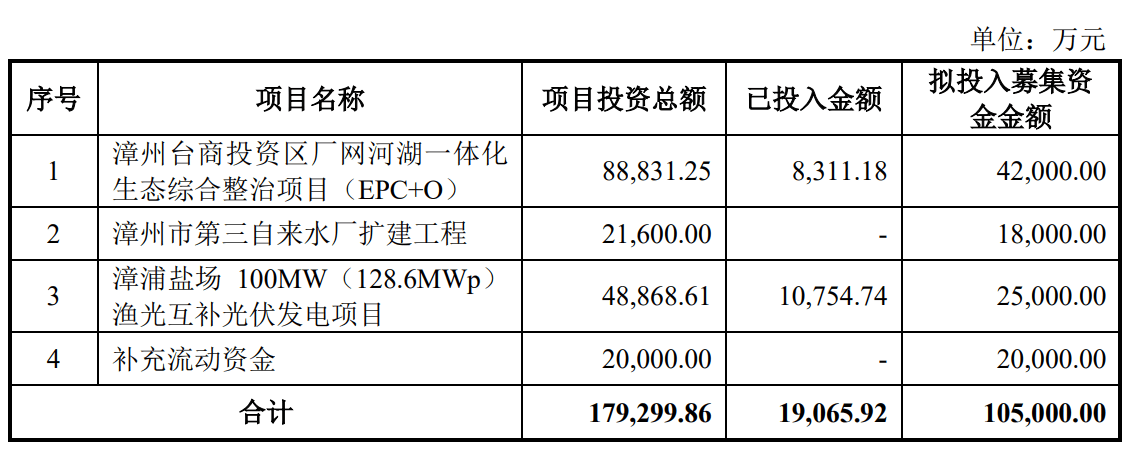
Core Viewpoint - Zhangzhou Development (000753) plans to issue up to 297 million shares to raise no more than 1.05 billion yuan for business upgrades and new energy initiatives [1] Group 1: Fundraising Details - The total amount to be raised is capped at 1.05 billion yuan, which will be allocated to four major projects [1] - The specific projects include: - Zhangzhou Taiwan Business Investment Zone integrated ecological remediation project with an investment of 420 million yuan [2] - Expansion of Zhangzhou's third water plant with an investment of 180 million yuan [2] - Zhangpu Salt Field 100MW (128.6MWp) fish-solar complementary photovoltaic project with an investment of 250 million yuan [2] - 200 million yuan allocated for working capital [1][2] Group 2: Project Descriptions - The integrated ecological remediation project aims to enhance drainage facilities and achieve full coverage of the municipal sewage network, with an expected gross profit margin of around 13% [3] - The expansion of the third water plant will increase its capacity to 200,000 m³/d, addressing the growing water demand in the city, with a post-tax internal rate of return of 6.25% and a payback period of 14.32 years [3] - The photovoltaic project will utilize a fish-solar complementary model, with a post-tax internal rate of return of 8.42% and a payback period of 10.53 years [4] Group 3: Share Subscription and Lock-up Period - Fujian Zhanglong Group, the controlling shareholder, agrees to subscribe for at least 20% of the total shares issued and will not participate in the market pricing process [2] - The shares subscribed by Zhanglong Group will have a lock-up period of 18 months, while other subscribers will have a lock-up period of 6 months [2]

虾池子上建光伏,魏桥创业源头减排绿色发展提供新样本
Qi Lu Wan Bao Wang· 2025-07-11 06:28
Group 1 - The core viewpoint of the articles highlights the innovative collaboration between Weiqiao Chuangye Group and State Power Investment Corporation in developing the Hongye 2GW fish-solar complementary photovoltaic project, which integrates clean energy generation with ecological aquaculture [2][4][5] - Weiqiao Chuangye Group operates 18 production bases globally, employs 100,000 staff, and has total assets of 305 billion yuan, positioning itself as a significant player in the industry [1] - The Hongye project has a total investment of approximately 9 billion yuan, covers an area of about 45,000 acres, and has a total installed capacity of 2 million kilowatts, featuring the largest 220kV booster station in the country [2][4] Group 2 - The project is expected to generate 1.6 billion kWh of electricity in 2024, equivalent to saving 650,000 tons of coal and reducing carbon dioxide emissions by 1.3 million tons [4] - Upon completion, the project will provide nearly 3 billion kWh of green electricity annually, saving 1.3 million tons of coal and reducing carbon dioxide emissions by 2.6 million tons [4] - The project exemplifies a successful model of "water-based photovoltaic power generation, underwater aquaculture, and industrial salt production," showcasing high-quality development through resource integration [4][5] Group 3 - Weiqiao Chuangye Group's subsidiary, Huimeng New Materials Co., Ltd., has invested in a smart factory with an annual production capacity of 4 million tons of alumina, which includes various advanced production facilities [5][7] - The alumina production process utilizes Bayer's advanced technology, producing high-quality alumina with an aluminum oxide content of over 98.99% and sodium oxide content below 0.25% [7] - The green electricity generated from the Hongye project will primarily meet the electricity needs of the alumina production process, contributing to a reduction of 910,000 tons of carbon dioxide emissions annually [7]