渔光互补光伏电站

Search documents
全力以赴稳增长 央企下好“先手棋”
Zhong Guo Zheng Quan Bao· 2026-01-07 20:50
Core Viewpoint - The commencement of major projects across the country marks a significant push in infrastructure investment, driven by state-owned enterprises (SOEs) focusing on key areas to stabilize and enhance economic growth in 2026 [1][3]. Group 1: Major Projects and Investments - SOEs are concentrating on "two heavy" and "two new" sectors, initiating significant projects to accumulate development momentum [1][3]. - In Xiong'an New Area, several SOE headquarters projects have started construction, including China Chengtong, China Agricultural Development, and China Huadian [1]. - The National Energy Group has launched a 7 billion yuan expansion project for the Wanzhou Power Plant, which will add 2 units of 1 million kilowatts capacity and is expected to generate over 20 billion kilowatt-hours annually by 2028 [1]. Group 2: New Energy and Green Initiatives - SOEs are increasingly investing in emerging industries and green low-carbon sectors, with projects like a 120MW photovoltaic power station in Fujian and a resource recycling project in Shandong [2]. - China State Construction Engineering Corporation is advancing multiple key projects across various sectors, including infrastructure and renewable energy [2]. Group 3: Infrastructure Development - In Shenzhen, 222 key projects with a total investment of approximately 157.34 billion yuan were launched, focusing on smart manufacturing and logistics [3]. - Fuzhou plans to start 185 major projects in the first quarter, with a total investment of 120.97 billion yuan, including a 3 billion yuan low-altitude economic equipment manufacturing base [3]. Group 4: Policy and Financial Support - The National Development and Reform Commission has expedited the approval of major infrastructure projects, with total investments exceeding 400 billion yuan, signaling a commitment to effective investment [5]. - A total of 5 billion yuan in new policy financial tools has been fully allocated, supporting over 2,300 projects with a total investment of around 7 trillion yuan [5]. - The anticipated growth in overall infrastructure investment is projected to rebound to around 8% year-on-year, focusing on major projects and energy transition [6].
福建莆田能源“含绿量”再提升
Zhong Guo Neng Yuan Wang· 2025-12-31 06:47
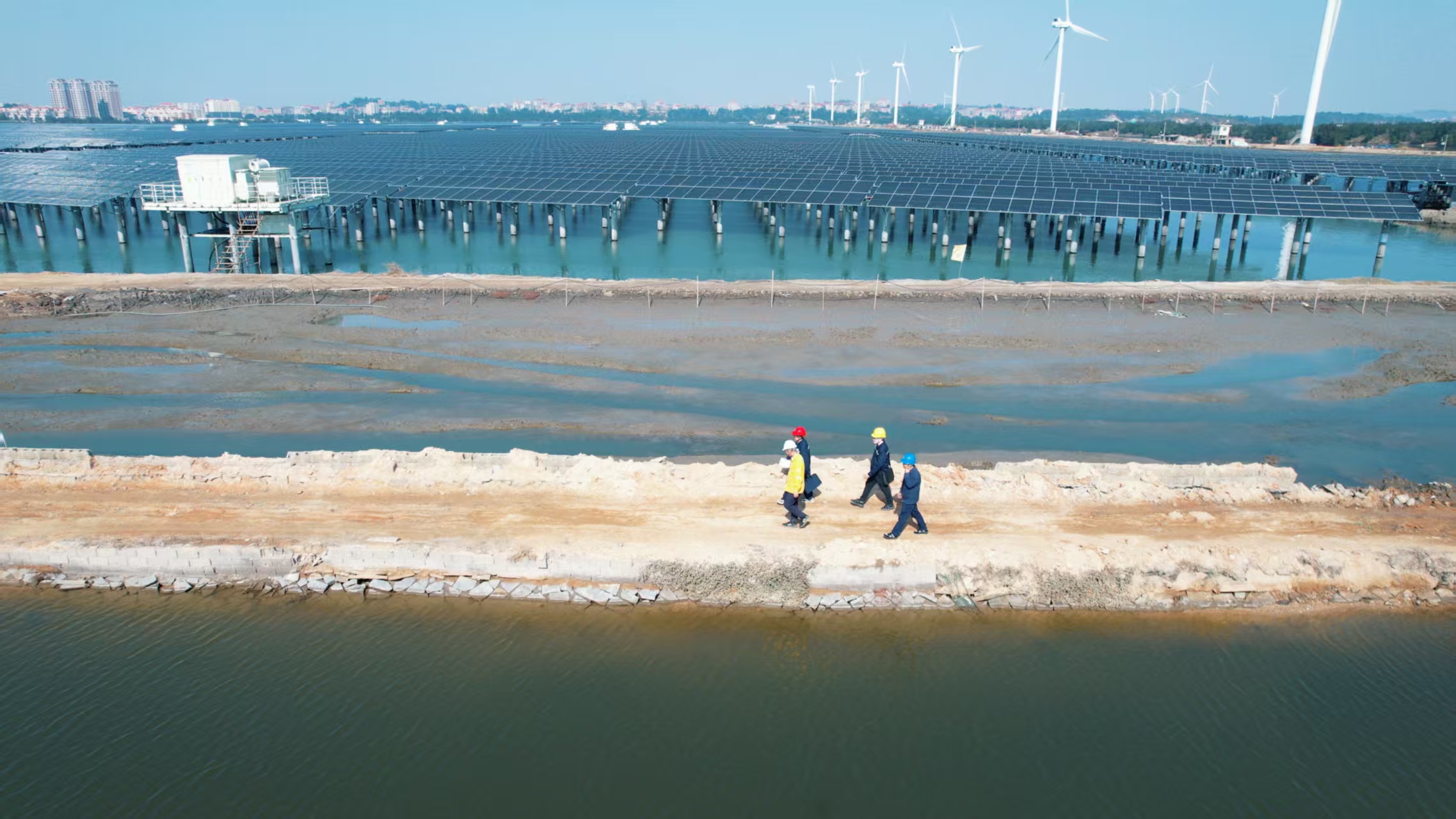
Core Insights - The Huaren Zhongmen A District 100 MW fish-solar complementary photovoltaic power station project in Putian City, Fujian Province, has officially connected to the grid, enhancing the region's clean energy ratio and supporting local green and low-carbon development [1][2] Group 1: Project Overview - The project is located in Zhongmen Town, Putian City, and is a key provincial project for 2025, utilizing a fish-solar complementary model that integrates approximately 2,500 acres of sea area and 30 acres of land [1] - The planned installed capacity of the project is 100 MW, with supporting infrastructure including a 110 kV booster station and a 10 MW/20 MWh electrochemical energy storage system, aiming to create a demonstration photovoltaic power station that integrates generation and storage [1] Group 2: Operational Efficiency - The State Grid Putian Power Supply Company collaborated with Huaren New Energy (Putian) Co., Ltd. to successfully complete remote operations and main electrical impact tests at the 220 kV Qiwang Substation and the project's booster station, achieving successful grid connection [1] - The 110 kV outgoing project starts from the 220 kV Qiwang Substation and connects to the photovoltaic power station booster station, with a temporary transition plan developed to ensure timely project advancement despite challenges in coordinating existing line corridors [1] Group 3: Environmental Impact - Once operational, the project is expected to generate an average annual electricity output of approximately 130 million kWh, sufficient to meet the annual electricity needs of about 50,000 households [2] - The project will save approximately 40,000 tons of standard coal annually, leading to a reduction in carbon dioxide emissions by about 110,000 tons, nitrogen oxides by 17.27 tons, and smoke dust by 2.21 tons, equivalent to the ecological benefit of planting 6 million trees [2]

华电400MW渔光互补项目EPC总承包招标!
Xin Lang Cai Jing· 2025-12-02 11:59
Core Points - The announcement for the EPC general contracting tender for the 400MW fish-solar complementary photovoltaic power station project in Huadian Gulei Development Zone was published on December 1, with Huadian Zhangzhou Energy Co., Ltd. as the tenderer [1][5] - The project is located in Shaxi Town, Gulei Port Economic Development Zone, Zhangzhou, Fujian Province, and includes a 220kV booster station (with a 40MW/80MWh energy storage system) and a photovoltaic power station with a total installed capacity of 516.0064MWp (400MW AC) [1][5] Tender Details - The tender is divided into three sections: - Section One includes the construction of a 220kV booster station (with a 40MW/80MWh energy storage system) and the eastern photovoltaic area (installed capacity of 96.6238MWp DC, 74.7MW AC) - Section Two involves the construction of the central photovoltaic area with an installed capacity of 192.283MWp (148.2MW AC) - Section Three covers the western photovoltaic area with an installed capacity of 227.0996MWp DC (177MW AC) [6][7] - The project is scheduled to commence construction on December 30, 2025 [7] Bidder Requirements - Bidders must have good financial status, commercial reputation, and relevant qualifications, as well as at least one EPC general contracting performance record of a centralized photovoltaic power generation project of 100MWp or more from January 1, 2020, to the bid submission deadline [2][7] - Joint bids are accepted for all three sections [3][7] Submission Timeline - The deadline for submission and opening of bids is set for December 22, 2025, at 9:00 AM [4][8]

益美国际控股(01870)附属与GEC订立共同开发协议
智通财经网· 2025-11-19 10:37
Core Viewpoint - The announcement highlights a joint development agreement between the company's wholly-owned subsidiary, Cuiyu Development Limited, and Gainza Energy Corporation to develop a 40 megawatt-hour solar power project in the Philippines, reflecting the company's commitment to expanding its green energy business in Southeast Asia [1] Group 1: Joint Development Agreement - Cuiyu Development and GEC plan to establish a joint venture or special purpose entity to develop the solar power project in Buhi, Camarines Sur, Philippines [1] - Prior to the agreement, GEC submitted a letter of intent to the Philippine Department of Energy for a solar operating contract related to the project [1] Group 2: Strategic Goals - The board believes that the joint development agreement demonstrates the ongoing collaboration and commitment of both parties in the green energy sector [1] - The agreement aligns with the company's commercial objectives of expanding its green energy business in Southeast Asia and reflects its vision to become a major green energy producer in the region [1]
益美国际控股附属与GEC订立共同开发协议
Zhi Tong Cai Jing· 2025-11-19 10:32
Core Viewpoint - Yimei International Holdings (01870) has announced a joint development agreement with Gainza Energy Corporation (GEC) to develop a 40 megawatt-hour solar power project in the Philippines, reflecting the company's commitment to expanding its green energy business in Southeast Asia [1] Group 1: Joint Development Agreement - The agreement involves the establishment of a joint venture or special purpose entity for the solar power project in Buhi, Camarines Sur, Philippines [1] - Prior to the agreement, GEC submitted a letter of intent to the Philippine Department of Energy for a solar operating contract related to the project [1] Group 2: Strategic Goals - The board believes that the joint development agreement demonstrates the ongoing collaboration and commitment between the parties in the green energy sector [1] - The initiative aligns with the company's commercial objectives to expand its green energy business in Southeast Asia and reflects its vision to become a major green energy producer in the region [1]
海安大力发展"渔光互补"光伏产业
Xin Hua Ri Bao· 2025-08-21 04:09
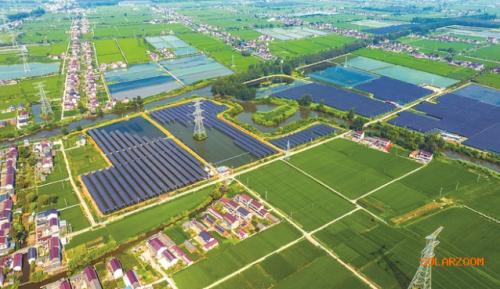
Core Viewpoint - The city of Hai'an is prioritizing ecological conservation and green development by leveraging its abundant water resources to promote the "fishing and solar complementarity" photovoltaic industry, integrating clean energy production with aquaculture [1] Group 1 - Hai'an is developing a "fishing and solar complementarity" photovoltaic industry that combines clean energy generation with aquaculture [1] - The initiative creates an ecological landscape characterized by "water-based power generation and underwater aquaculture" [1] - A drone photo taken on August 20 showcases one of the "fishing and solar complementarity" photovoltaic power stations in the Lixia River water town of Hai'an [1]
2025年中国渔光互补光伏电站行业类型、发展环境、项目建设情况及行业趋势研判:渔光互补光伏电站发展优势明显,项目接连落地[图]
Chan Ye Xin Xi Wang· 2025-05-20 01:20
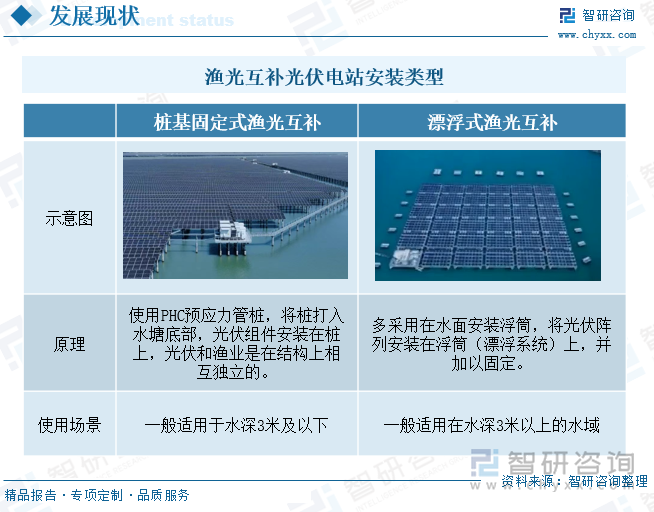
Core Viewpoint - The "fish-solar complementary" model combines aquaculture and photovoltaic power generation, allowing for dual use of water surfaces for energy production and fish farming, addressing land scarcity for solar projects and providing new solutions for the aquaculture industry [1][11][5]. Industry Overview - The "fish-solar complementary" model is characterized by the installation of solar panels above fish ponds, enabling fish and shrimp farming below, thus creating a dual benefit of energy generation and aquaculture [2][5]. - Common installation methods include pile foundation and floating systems, with the former suitable for water depths of 3 meters or less, and the latter for deeper waters [2][5]. Market Background - The global push for clean energy and the reduction of fossil fuel dependency has led to the rapid growth of the photovoltaic industry in China, which has become the second-largest power source after coal [7][9]. - In 2024, China's solar photovoltaic capacity is expected to reach 885.68 GW, with a new installed capacity of 277.57 GW, leading the world in both new and cumulative installations [7][9]. Current Market Status - Various policies have been introduced to encourage the development of "fish-solar complementary" photovoltaic stations, promoting the integration of aquaculture and green energy [13][15]. - Significant projects include the 378 MW project by Yueda Huafeng and the 1.09 million kW project by Guohua Investment, showcasing the growing interest and investment in this sector [16][17]. Industry Chain - The industry chain for "fish-solar complementary" includes upstream components like solar panels and aquaculture supplies, midstream project design and construction, and downstream markets for electricity and aquatic products [19][21]. Development Trends - The trend towards "fish-solar complementary" is expected to accelerate, driven by technological innovations and decreasing investment costs, making it a mainstream model for solar power station construction [25][27].