
澜湄合作

Search documents
中柬签署2025年度澜湄合作专项基金项目协议
Zhong Guo Xin Wen Wang· 2025-09-17 09:07
Core Points - The signing ceremony for the 2025 Mekong Cooperation Special Fund project agreement took place in Phnom Penh, Cambodia, with representatives from China and Cambodia present [1][2] - China has supported Cambodia in implementing 108 projects through the Mekong Cooperation Special Fund, benefiting hundreds of thousands of people across more than ten provinces [1] - The 11 new cooperation projects signed include cultural heritage protection, peace initiatives, and empowerment of female entrepreneurs, showcasing the vitality and potential of Mekong cooperation [1] Summary by Sections - **Mekong Cooperation Fund**: The Mekong Cooperation Special Fund has facilitated significant projects in poverty alleviation, education, and health, contributing to local development [1][2] - **Future Collaboration**: China expresses willingness to enhance collaboration with Mekong countries, focusing on digital economy and artificial intelligence, aiming for a new decade of cooperation [2] - **Cambodia's Perspective**: Cambodia acknowledges the fund's role in regional integration and sustainable development, emphasizing its impact on local livelihoods and economic growth [2]
东西问丨郭延军:澜湄合作十年,打造全球区域合作“金色标杆”
Zhong Guo Xin Wen Wang· 2025-08-22 12:42
Core Viewpoint - Lancang-Mekong Cooperation (LMC) has established itself as a "golden benchmark" for global regional cooperation over the past decade, emphasizing inclusivity and equal consultation among the six member countries [3][6]. Mechanism Development - The LMC has developed a multi-layered cooperation framework, including leaders' meetings, foreign ministers' meetings, and specialized cooperation centers in areas such as water resources and environmental protection [5][6]. - Trade between China and the five Mekong countries has surged from a low starting point to $437 billion in 2024, marking a 125% increase since the mechanism's inception [6]. Economic Connectivity - The China-Laos Railway has facilitated the transport of over 50 million tons of goods in three years, expanding the variety of transported products from over 500 to 3,000 [6]. - The establishment of "smart ports" in Yunnan has exemplified the integration of hard and soft connectivity within the LMC framework [6]. Social and Cultural Exchange - The number of Chinese tourists visiting Vietnam increased by 77.8% in the first two months of 2025, highlighting the growth in people-to-people exchanges [8]. - The LMC has successfully implemented joint law enforcement mechanisms to combat cross-border crimes, enhancing regional security [8]. Water Resource Management - The LMC has established a multi-level policy coordination mechanism for cross-border water resource management, including the creation of a five-year action plan for water resource cooperation [9][10]. - Since 2020, China has provided hydrological data to Mekong countries, aiding in flood and drought management [9]. Biodiversity and Environmental Protection - The LMC has signed a strategic framework for environmental cooperation, focusing on biodiversity protection and combating illegal wildlife trade [10]. - Joint initiatives have led to the establishment of protected areas and the release of over 4.2 million native fish into the Mekong River to restore aquatic resources [10]. Cultural Integration - The LMC promotes cultural exchanges that transition from spontaneous interactions to systematic collaboration, enhancing mutual understanding among member countries [12]. - Cross-border religious activities and shared cultural elements among ethnic groups have fostered a unique cultural landscape in the region [12]. Governance Innovation - The LMC distinguishes itself from other transnational river governance models by emphasizing voluntary participation and equal consultation among member states [17]. - The mechanism integrates economic, social, and cultural governance, creating a comprehensive governance system that focuses on value creation through cooperation [17].


澜沧江-湄公河合作第十次外长会在云南举行
Xin Hua She· 2025-08-15 10:34
Core Points - The 10th Foreign Ministers' Meeting of the Lancang-Mekong Cooperation was held in Anning, Yunnan, emphasizing the progress and future direction of the cooperation mechanism [1] - Wang Yi proposed a "Lancang-Mekong Cooperation 2.0" aimed at fostering unity, cooperation, openness, and innovation among the six participating countries [1] - The meeting highlighted the importance of multilateralism and free trade in addressing complex international challenges [1] Group 1 - The meeting was co-chaired by Wang Yi, Chinese Foreign Minister, and Thailand's Foreign Minister Don Pramudwinai, with participation from foreign ministers of Cambodia, Laos, Myanmar, and Vietnam [1] - Wang Yi outlined four key suggestions for future cooperation: enhancing top-level design, promoting innovative development, deepening law enforcement cooperation, and strengthening cultural exchanges [1] - The meeting acknowledged the achievements of the past decade and the significant role of China in leading the cooperation [1] Group 2 - Three outcome documents were released: the "Lancang-Mekong Cooperation Five-Year Action Plan (2023-2027) Annual Progress Report for 2024," the "2025 Annual List of Special Fund Support Projects," and a report on enhancing non-traditional security cooperation [2]
王毅分别会见来华出席澜湄合作第十次外长会的五国外长
Xin Hua Wang· 2025-08-14 17:49
Group 1 - The meeting between Wang Yi and foreign ministers from Thailand, Cambodia, Myanmar, Laos, and Vietnam emphasizes the importance of regional cooperation and the construction of a community with a shared future [1][2][3] - Wang Yi expressed China's willingness to deepen cooperation with Thailand, highlighting the significance of the "China-Thailand Community of Common Destiny" and the role of both countries as co-chairs in ensuring the success of the Mekong Cooperation meeting [1] - The discussions with Cambodia focused on enhancing bilateral relations and combating cross-border crime, with both sides expressing a commitment to a comprehensive partnership [1][2] Group 2 - In the meeting with Myanmar, Wang Yi highlighted the 75th anniversary of diplomatic relations as an opportunity to deepen cooperation and support Myanmar's development path that aligns with its national conditions [2] - The dialogue with Laos centered on upgrading the China-Laos railway and encouraging Chinese investment in Laos, while also promoting a shared vision against economic coercion [2] - Wang Yi's meeting with Vietnam aimed at reinforcing strategic communication and mutual support in multilateral platforms, with a focus on maintaining free trade rules and international trade systems [3]
王毅:中方支持泰柬双方加强对话协商,重建互信,重归于好
Xin Jing Bao· 2025-08-14 08:58
Group 1 - The meeting between Wang Yi and Thai Foreign Minister Don Pramudwinai marks the 50th anniversary of China-Thailand diplomatic relations, emphasizing the deepening friendship and cooperation between the two nations [3] - China expresses willingness to enhance bilateral strategic cooperation and promote the construction of a China-Thailand community of shared future, aiming for new achievements in regional peace and stability [3] - Both sides agree to accelerate the construction of the China-Thailand railway and encourage more enterprises to invest in Thailand, focusing on green development, digital economy, and artificial intelligence [3] Group 2 - The Mekong-Lancang Cooperation is highlighted as a successful sub-regional cooperation mechanism, entering its tenth year and poised for further development under China's strategic guidance [5] - Thailand values the Mekong-Lancang Cooperation and believes it will contribute significantly to regional prosperity and stability [5] - Discussions also included the situation at the Thailand-Cambodia border, with China supporting dialogue and cooperation to rebuild trust between the two countries [5]
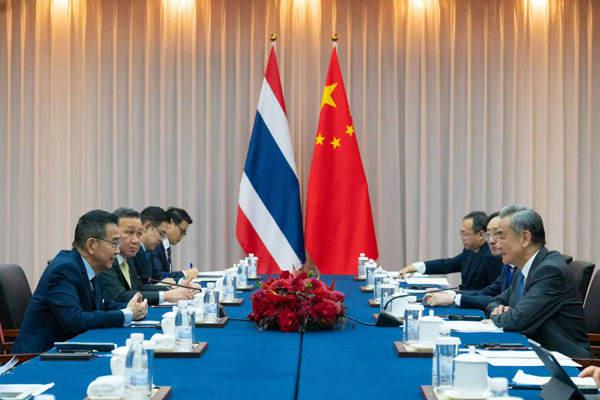
官宣!中老缅泰外长将会晤
券商中国· 2025-08-13 08:47
Core Viewpoint - The 10th Mekong Cooperation Foreign Ministers' Meeting aims to strengthen regional cooperation among China and Mekong countries, focusing on shared development and addressing challenges posed by unilateralism and protectionism [1][2]. Group 1: Background and Expectations - The Mekong Cooperation mechanism involves China and five Southeast Asian countries: Cambodia, Laos, Myanmar, Thailand, and Vietnam, promoting a new type of regional cooperation [1]. - The meeting marks the 10th anniversary of the Mekong Cooperation mechanism, highlighting the importance of collaboration among the countries during a critical development phase [1]. - China hopes to review cooperation achievements, summarize successful experiences, and plan future developments to enhance economic resilience and community ties among Mekong nations [1]. Group 2: Informal Meetings and Topics - An informal meeting among the foreign ministers of China, Laos, Myanmar, and Thailand will be held during the conference to discuss regional situations and joint efforts against cross-border crime [2].
外交部发言人就王毅将主持澜湄合作第十次外长会 并举行中老缅泰外长非正式会晤答记者问
Zheng Quan Shi Bao Wang· 2025-08-13 07:27
Group 1 - The core viewpoint of the news highlights the significance of the Lancang-Mekong Cooperation (LMC) as a new regional cooperation mechanism among China and five Southeast Asian countries, emphasizing the need for unity and collaboration to promote common development in the face of global challenges [1] - The LMC has entered its 10th year, with member countries at a crucial stage of accelerated development, necessitating a focus on strengthening cooperation and enhancing regional stability [1] - The meeting aims to review cooperation achievements, summarize successful experiences, and plan for future development of the mechanism, with the goal of creating a more resilient economic development belt in the Lancang-Mekong region [1] Group 2 - An informal meeting among the foreign ministers of China, Laos, Myanmar, and Thailand will be held during the conference to discuss regional situations and joint efforts against cross-border crime [2]
为澜湄合作蓄好“人才活水”
Ren Min Ri Bao· 2025-08-01 19:20
Group 1: Core Views - The Lancang-Mekong Cooperation (LMC) is a new sub-regional cooperation mechanism initiated by six countries, aiming to build a community with a shared future, benefiting from their geographical proximity and developmental needs [1] - Humanistic exchanges are a key pillar of LMC, fostering cultural ties and mutual understanding among the countries, with a notable increase in Chinese language learning as a reflection of this cooperation [2][3] - The trade volume between China and the Mekong River countries is projected to exceed $450 billion in 2024, doubling over the past decade, driven by significant infrastructure projects and enhanced people-to-people connections [3] Group 2: Education and Skills Development - The LMC has prioritized vocational education cooperation to address talent shortages and enhance labor quality, with various initiatives and partnerships established across the region [4][5] - The demand for skilled labor in high-tech industries and traditional sectors is rising, leading to a recognition of the "Chinese + vocational skills" education model as essential for regional economic development [5] - Events such as the "LMC Youth Entrepreneur Forum" and "LMC Youth Innovation Competition" are fostering youth engagement and collaboration in vocational training and skills development [7][8] Group 3: Economic Impact - The LMC is creating a "magnetic field effect" that attracts resources and investments, with the availability of skilled labor being a critical factor for businesses [7] - Chinese enterprises are expanding their presence in the region, generating employment opportunities and focusing on capacity building through education and skills training [8] - The synergy between language skills and vocational training is driving economic growth, with a collaborative approach to regional development being established [7][8]
澜湄驻华大使“沉浸式”体验西藏文化 共话生态合作新机遇
Zhong Guo Xin Wen Wang· 2025-07-11 08:31
Core Insights - The visit of ambassadors from Mekong River basin countries to Tibet highlights the importance of cultural immersion and ecological cooperation in the region [1][2] - The event aims to enhance the content of Mekong cooperation and promote high-quality development, fostering friendly exchanges and mutual cooperation between Mekong countries and Tibet [2] Group 1: Cultural Experience - Ambassadors experienced the unique historical and cultural charm of Tibet through visits to significant cultural landmarks such as the Potala Palace and Jokhang Temple [1] - The modern infrastructure of Lhasa, including the Lhasa Gonggar International Airport, impressed the ambassadors, showcasing the harmonious coexistence of modernization and traditional culture in Tibet [1] Group 2: Ecological Cooperation - The visit emphasized the ecological significance of the rivers flowing through Tibet, including the Mekong River, and the successful protection of these ecosystems [2] - There is a strong desire among the ambassadors to enhance ecological protection cooperation and cultural exchange, contributing to sustainable development [2]
联通绿色能源 南博会展示澜湄合作未来
Zhong Guo Xin Wen Wang· 2025-06-22 10:24
Group 1 - The 9th China-South Asia Expo features a green energy pavilion showcasing the future of Lancang-Mekong cooperation, attracting 12 Fortune 500 companies and 4 industry leaders [1] - The pavilion's theme is "Digital Intelligence Empowerment Drives, Co-Expanding Green Energy New Journey," highlighting the "electricity artery" of the Lancang-Mekong region and the vision of a green future powered by clean energy [1] - Since 2004, the China-Myanmar power transmission line has initiated cross-border electricity interconnection, with over 76 billion kilowatt-hours of electricity exchanged between China, Laos, Myanmar, and Vietnam, of which over 90% is clean energy [2] Group 2 - The collaboration between China and Laos in developing a clean energy base in northern Laos includes vocational education, community building, and agricultural support, benefiting both countries [2] - The cross-border electricity model not only helps Laos convert natural resources into economic advantages but also supports China's energy transition and electricity supply security [2]