
生成式人工智能技术

Search documents
针对“黑公关”一事,雷军:今年已取证数百个账号
Bei Jing Ri Bao Ke Hu Duan· 2025-09-13 12:37
Core Viewpoint - The article discusses the issue of "black public relations" affecting several automotive companies, including Xiaomi, Xiaopeng, NIO, and Deep Blue, highlighting the use of AI-generated defamatory content and the ongoing legal actions taken against such practices [3]. Group 1: Black Public Relations Issue - Several automotive companies have been targeted by similar smear tactics, including AI-generated rumors and negative comments aimed at car owners [3]. - The legal department of the companies has collected evidence from hundreds of accounts and initiated dozens of lawsuits, with multiple cases currently under investigation [3]. Group 2: Regulatory Actions - A joint action by six government departments has been launched to combat black public relations and online manipulation, requiring internet platforms to enhance their identification and control of AI-generated content and malicious actors [3]. - The initiative aims to create a cleaner and more transparent environment for the development of the automotive industry in China [3].



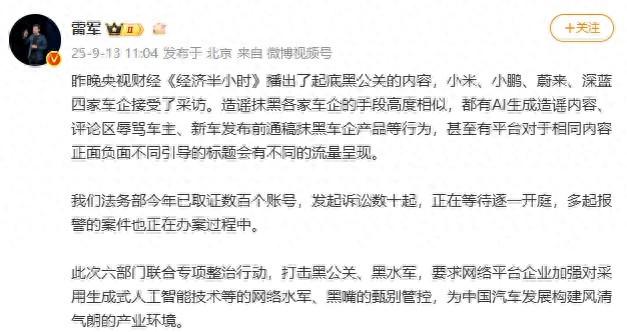
雷军回应“汽车黑公关”:小米法务部今年已取证数百个账号、发起诉讼数十起,正等待逐一开庭
Xin Lang Cai Jing· 2025-09-13 06:05
Core Viewpoint - The article discusses the issue of "black public relations" targeting various car companies, highlighting the legal actions taken by Xiaomi against malicious online activities [1][2]. Group 1: Legal Actions - Xiaomi's legal department has collected evidence from hundreds of accounts this year and has initiated dozens of lawsuits, which are currently awaiting court hearings [1][2][4]. - Multiple cases reported to the authorities are also under investigation [2][4]. Group 2: Industry Context - The report from CCTV Finance revealed that several car companies, including Xiaomi, Xiaopeng, NIO, and Deep Blue, have been targeted by similar smear tactics, including AI-generated false content and derogatory comments against car owners [2][4]. - A joint action by six departments aims to combat black public relations and online manipulation, requiring internet platforms to enhance their identification and control of malicious actors using generative AI technology [2][4].
“AI+钢铁”发展空间广阔
Zhong Guo Jing Ji Wang· 2025-08-21 07:29
Core Insights - The integration of AI in the steel industry is seen as a crucial step towards achieving high-end, intelligent, and green development, as emphasized by industry leaders [1][2]. Group 1: Digital Transformation Initiatives - The China Iron and Steel Association has prioritized digital transformation as one of the three major projects in the industry, launching a three-year action plan for digital transformation [1]. - The association has released guidelines for the construction of intelligent manufacturing standards and digital transformation projects in the steel industry [1]. Group 2: AI Applications and Innovations - AI applications in the steel industry have shown promising results in optimizing production processes, quality control, and supply chain management [1]. - The "human-machine hybrid intelligence" model proposed by Northeast University aims to address the "black box" nature of steel production, enabling high-fidelity online predictions throughout the entire process [2]. Group 3: Environmental Sustainability - The development of AI in the steel sector is expected to promote green and sustainable practices, contributing to energy conservation and environmental protection [1]. - The establishment of a cross-enterprise and cross-industry AI ecosystem is anticipated to enhance collaboration among steel companies, upstream and downstream enterprises, research institutions, and technology service providers [1]. Group 4: Technical Advancements - The shift from experience-driven to intelligent decision-making in ironmaking is highlighted as a key trend, with mixed intelligence empowering the process [3]. - A new intelligent steelmaking system has been developed that combines knowledge-driven and data-driven approaches to address traditional challenges in steel production [3].
新华视点|3到15天速成万粉号——AI造假起号乱象调查
Xin Hua She· 2025-08-11 08:33
Core Insights - The article highlights the rising trend of AI-generated fake accounts on social media, which are used to quickly gain followers and monetize content through deceptive practices [1][2][4] Group 1: AI-generated Content and Its Impact - Many social media accounts utilize AI technology to create convincing content that misleads users into believing it is real, leading to significant engagement despite the presence of technical flaws [2][3] - The phenomenon of "AI account creation" targets specific demographics, particularly middle-aged women, using strategies that exploit age-related anxieties to drive engagement and sales [2][4] Group 2: Monetization Strategies - Tutorials for creating AI-generated accounts are prevalent, with claims that users can generate significant income in a short time by following specific methods [4] - The market for buying and selling AI-generated accounts is booming, with prices for accounts varying widely based on follower count, indicating a lucrative but potentially illegal trade [5][6] Group 3: Regulatory and Governance Challenges - The rise of AI-generated fake accounts has prompted multiple platforms to enhance their content identification systems and implement stricter regulations to combat this issue [2][6] - Experts emphasize the need for collaborative governance among technology providers, platforms, and content creators to effectively address the challenges posed by AI misuse [6][7]
新华视点丨“AI押题”噱头吸睛,靠谱吗?
Xin Hua She· 2025-06-05 03:37
Core Viewpoint - The article discusses the rise of "AI prediction" products marketed to students and parents during exam preparation, questioning their reliability and effectiveness in improving exam performance [1][6]. Group 1: Market Dynamics - Various businesses are promoting "AI prediction" and "AI score improvement" products, claiming accuracy rates exceeding 80% for exam predictions, with prices often around hundreds of yuan for study materials [1][2]. - The products are primarily targeted at anxious students and parents, with many customers purchasing these materials in hopes of better exam performance [1][2]. Group 2: Product Claims and Limitations - One seller claims their AI model predicts exam content with over 75 points coverage based on historical exam data, but the actual content is often broad and aligns with standard curriculum topics [2][3]. - Experts argue that AI-generated predictions fail to grasp the complexities of exam questions, which require higher-order thinking and contextual understanding that AI cannot replicate [3][4]. Group 3: Regulatory and Ethical Concerns - The marketing strategies employed by these businesses are criticized as misleading, with claims of high accuracy rates being deemed as false advertising under relevant laws [6][7]. - There are calls for regulatory bodies to address exaggerated claims and fraudulent practices in the "AI prediction" market, emphasizing the need for transparency and accountability in AI educational products [7].
全球半导体市场回暖 晶合集成2024年扣非净利润同比增长超700%
Zheng Quan Ri Bao· 2025-04-21 13:40
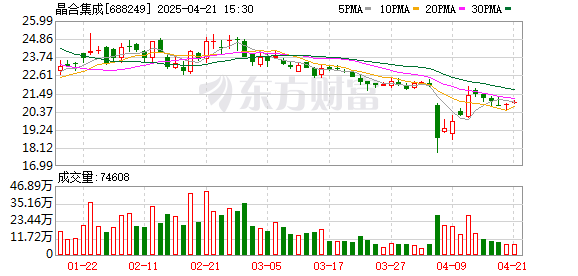
Company Performance - Company achieved operating revenue of 9.249 billion, a year-on-year increase of 27.69% [2] - Net profit attributable to shareholders reached 533 million, up 151.78% year-on-year [2] - Net profit excluding non-recurring gains and losses was 394 million, a significant increase of 736.77% year-on-year [2] Product Segmentation - Display driver chips (DDIC) remained the primary revenue source, accounting for 67.50% of main business income [2] - Image sensor chips (CIS) increased their share to 17.26%, becoming the second-largest product [2] Research and Development - Company invested 1.284 billion in R&D, a 21.41% increase year-on-year, representing 13.88% of operating revenue [2] - Achievements in R&D include mass production of 55nm mid-to-high-end BSI and stacked CIS chips, small batch production of 40nm high-voltage OLED display driver chips, and successful functionality verification of 28nm logic chips [3] Industry Outlook - According to WSTS, the global semiconductor market is projected to reach 628 billion in 2024, a 19.1% increase from 2023 [3] - Anticipated growth in the semiconductor market is supported by emerging fields such as AI, electric vehicles, smart manufacturing, and the Internet of Things [3] Shareholder Returns - Company plans to distribute a cash dividend of 1.00 per 10 shares, totaling 194 million (including tax) [4] - Dividend distribution is expected to signal operational stability and strong profitability, enhancing investor confidence [5]

院士邬贺铨:车路云协同的关键在于数据 未来更应关注“算力压缩”
Zhong Guo Jing Ying Bao· 2025-03-28 21:08
Core Viewpoint - The development of intelligent transportation systems relies heavily on vehicle intelligence, but it has limitations in complex environments, necessitating a shift towards vehicle-road-cloud collaboration for comprehensive situational awareness and improved traffic management [1][2]. Data and Computational Challenges - Training Level 5 (L5) models requires 17 billion kilometers of data, with at least 100 million kilometers of real roadside data, which is challenging to collect [2] - Each vehicle generates approximately 1GB of data per second, leading to a total of around 12GB of data per vehicle during travel after compression [2] - Currently, only 1% of traffic data comes from real roads, with 90% sourced from closed roads and simulations, highlighting a significant data scarcity issue [2] Data Annotation and AI Solutions - The high cost of data annotation necessitates the development of AI-based methods to replace manual processes, although a portion of original data (10%-20%) should be retained to prevent data obsolescence [3] - The demand for computational power in intelligent driving is proportional to model parameters and training data, while inversely related to training duration and GPU utilization [3] Vehicle Communication and Computational Requirements - Different vehicles have varying application needs, requiring capabilities for direction indication, predictive actions, and communication with other vehicles and infrastructure [4] - Minimum computational requirements for vehicle levels L2, L3, L4, and L5 are 4-10 Tops, with L5 needing up to 1000 Tops, which current vehicles cannot support [3][4] Focus on Computational Compression - Strategies for reducing computational demands include utilizing generative AI techniques and attention mechanisms to streamline calculations [5][6] - The deployment of large models in the cloud can lower usage barriers, allowing for user-specific data adjustments [6] Network Infrastructure Development - Upgrading existing 5G networks and establishing V2X networks is essential for supporting intelligent transportation systems, requiring collaboration among various stakeholders [7] - A national unified V2X operator is proposed to standardize and scale network construction, with an estimated investment of 400 billion yuan to achieve comprehensive coverage and enhance urban traffic efficiency [7]