租金收益率

Search documents
抄底商业房产
经济观察报· 2025-07-12 04:40
Core Viewpoint - In major cities like Beijing and Shanghai, individuals and institutions with idle funds are increasingly seeking investment opportunities in the second-hand housing market, focusing on tenant stability, rental yield, and the surrounding living environment rather than just city or regional factors [2][5][9] Investment Trends - Investors like Li Kun are purchasing commercial properties, such as a ground-floor shop in Haidian District, Beijing, for 5 million yuan, with a unit price of approximately 70,000 yuan per square meter, while the residential average in the area is around 90,000 yuan per square meter [2][4] - The annual rental yield for Li Kun's property is estimated at around 4%, reflecting a stable demand for local services provided by such commercial properties [5][11] Market Dynamics - The competition among buyers is intense, leading to price fluctuations; for instance, a property in Zhongguancun was sold for 6.11 million yuan, a 110% premium over its assessed value [5][9] - In June, a commercial property in Shanghai sold for 25 million yuan, with a unit price below 10,000 yuan per square meter, indicating a strong potential for rental yield [7][9] Investment Opportunities - The current market presents unique investment opportunities characterized by a divergence in property prices and rental yields, with some properties showing significant rental yield increases as prices drop [9][11] - Investors are particularly interested in distressed assets, including properties from bankruptcy proceedings, which often see price reductions with each failed auction [10][11] Investment Criteria - Both individual and institutional investors are establishing systematic investment standards, focusing on core urban areas and evaluating the economic conditions of the surrounding regions [13][14] - The rental yield is a critical factor in investment decisions, with a focus on properties that can provide stable income despite market fluctuations [13][14]


抄底商业房产
Jing Ji Guan Cha Wang· 2025-07-12 02:31
Core Insights - The article discusses the trend of individual and institutional investors, like Li Kun, seeking investment opportunities in the second-hand real estate market, particularly in commercial properties, due to stable rental yields and low vacancy rates [1][2][4] Investment Trends - Investors are increasingly focusing on the stability of tenants, rental yields, and the surrounding living environment rather than just the city or region for investment decisions [1][2] - In major cities like Beijing and Shanghai, some investors are engaging in competitive bidding for quality commercial properties, leading to significant price premiums [2][4] Market Dynamics - The article highlights a shift in investment logic due to real estate market adjustments, with many institutions selling quality assets at prices significantly lower than their purchase prices from 2019 [4][5] - The current market is characterized as a buyer's market overall, but high-quality projects remain competitive, creating a seller's market for those assets [5] Rental Yield Analysis - The rental yield for the commercial properties discussed ranges from approximately 2.5% to over 8%, depending on the specific property and market conditions [2][3][4] - Investors are particularly interested in properties with rental yields exceeding 3%, indicating potential bottom-fishing opportunities [5] Investment Criteria - Investors, both individuals and institutions, are establishing systematic investment standards, focusing on core urban areas and the economic conditions of those regions [6][7] - The article emphasizes the importance of assessing rental yields and potential appreciation when evaluating investment properties, with a noted preference for commercial over residential investments due to stability concerns [6][7]
房地产拐点有望1-2年后到来
3 6 Ke· 2025-06-23 02:09
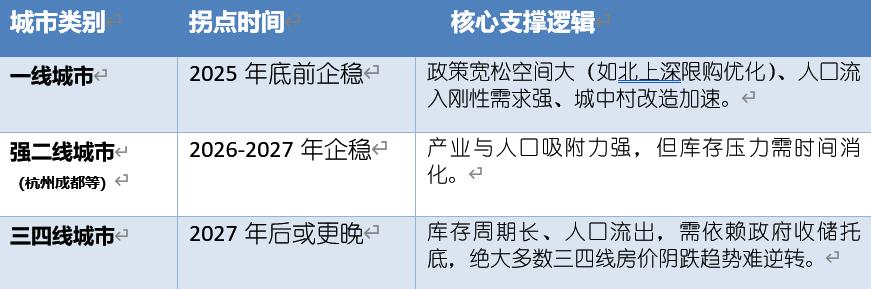
Core Viewpoint - The Chinese real estate market is expected to reach a turning point in housing prices between 2026 and 2027, contrary to the prevailing pessimistic sentiment among the public [1][2]. Group 1: Market Recovery Phases - The recovery of the real estate market is anticipated to occur in three phases: 1. Transaction volume stabilization by 2025 due to continuous government support [3][4]. 2. Price stabilization in 2026 as supply and demand reach a balance [4]. 3. Investment recovery post-2026 with increased land purchases and new construction [4]. Group 2: City-Specific Turning Points - Different cities will experience varying timelines for market stabilization: - First-tier cities are expected to stabilize by the end of 2025 due to favorable policies and strong demand [5]. - Strong second-tier cities, such as Hangzhou and Chengdu, are projected to stabilize between 2026 and 2027 [5]. - Third and fourth-tier cities may not see stabilization until 2027 or later due to long inventory cycles and population outflows [6][7]. Group 3: Indicators for Price Trends - Traditional indicators like price-to-income ratios and rental yields are deemed ineffective for predicting turning points; instead, the focus should be on supply-demand dynamics and inventory de-stocking cycles [8][14]. - The current inventory de-stocking cycles in key cities indicate a potential for price stabilization, while cities with longer cycles may face continued pressure on prices [16]. Group 4: Future Market Outlook - The overall recovery of the Chinese real estate market is expected to be challenging, with only a few core cities likely to present structural opportunities [19]. - The market's sensitivity to policy changes has diminished, and the focus should shift to city-specific supply-demand relationships to gauge future price movements [16].