不动产投资

Search documents
黑石集团:当前正是配置不动产领域的良机
Zheng Quan Shi Bao Wang· 2026-01-15 09:27
Core Viewpoint - The commercial real estate sector is entering a new phase, presenting one of the most attractive entry points for investors in recent years, according to Nadeem Meghji, Global Head of Real Estate at Blackstone [1] Group 1: Market Trends - Real estate values peaked in 2022 and subsequently declined by 22% over the next two years, primarily due to rising benchmark interest rates and ongoing challenges in the office market [1] - Clear signs of value stabilization are expected by early 2024, with a gradual recovery rather than a sharp V-shaped rebound [1] Group 2: Investment Strategy - Blackstone has invested a total of $42 billion in equity since recognizing the potential for cyclical recovery, positioning its portfolio to capitalize on upcoming opportunities [1] - Current real estate prices show significant relative advantages, being only 7% above the trough, while stocks and fixed income assets remain near their peak values [1] - This combination of valuation reset and relative value creates one of the most attractive entry points for disciplined investors in recent years [1]

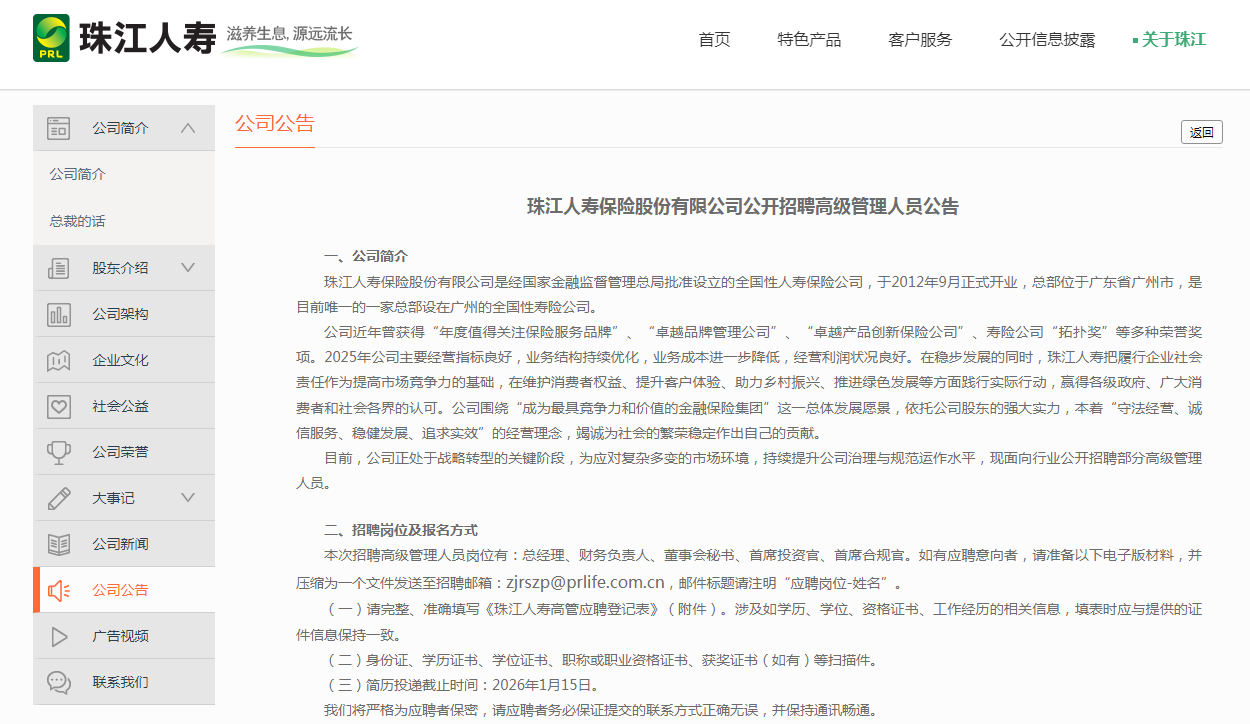
罕见!珠江人寿“海选”5名高管,偿付能力报告已缺席4年
Guo Ji Jin Rong Bao· 2025-12-30 10:36
Core Viewpoint - Zhujiang Life Insurance Co., Ltd. has publicly recruited five key executives, including a general manager, for the first time in four years, indicating a strategic transformation phase amid a complex market environment [1] Group 1: Executive Recruitment - The company is seeking to enhance governance and operational standards by hiring a general manager, financial officer, board secretary, chief investment officer, and chief compliance officer [1] - The previous general manager, Fu Anping, had a notable background as one of the first actuaries in China and was involved in drafting the Insurance Law [1] - Fu Anping joined Zhujiang Life in April 2022, but his qualifications were only approved in May 2024, and he is expected to resign by August 2025 [1] Group 2: Company Background - Zhujiang Life was established in September 2012, headquartered in Guangzhou, with a registered capital of 6.7 billion yuan [2] - It is the only national life insurance company based in Guangzhou, with shareholders including Guangdong Zhujiang Investment Holding Group and Guangzhou Financial Holding Group [2] - The company achieved profitability of 42 million yuan in its fourth year, breaking the industry norm of achieving breakeven by the seventh year [2] Group 3: Financial Performance and Risks - Since 2021, Zhujiang Life has not disclosed financial data in its annual reports, and its solvency reports indicated a core solvency ratio of 52.02% and a comprehensive solvency ratio of 104.04% as of Q4 2021, nearing regulatory limits [2] - The company has significant exposure to real estate investments, with a reported overdue amount of 350 million yuan related to a real estate project [2] - As of 2022, the company has not released solvency reports or core operating data, but it claims that its main operating indicators are good and business costs are decreasing [3]

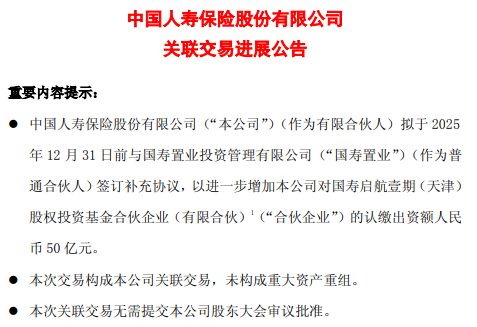
中国人寿:增加对国寿启航壹期(天津)股权投资基金合伙企业认缴出资额50亿元
Xin Lang Cai Jing· 2025-12-18 09:37
Group 1 - The core announcement is that China Life intends to sign a supplementary agreement with Guoshou Real Estate Investment Management Co., Ltd. to increase its subscribed capital by RMB 5 billion in the Guoshou Qihang Phase I (Tianjin) Equity Investment Fund Partnership by December 31, 2025 [1][3] - The investment will focus on real estate projects in first-tier and strong second-tier cities, aligning with legal and regulatory requirements [1][3] - Real estate core assets are characterized by low risk and inflation resistance, which matches the long-term nature and stable return pursuit of insurance funds [1][3] Group 2 - The related transaction is considered part of the company's normal business operations and does not harm the company's interests [1][3] - The transaction is not expected to adversely affect the company's independence [1][3]

政策延续宽松导向,外资、险资“抢滩”布局核心资产
Sou Hu Cai Jing· 2025-10-27 11:26
Core Insights - The real estate industry in Q3 2025 is characterized by "policy support + trend bottoming," with increasing financial pressure on residential development, stable operations in commercial real estate, high debt pressure in industrial parks, and strong risk resistance in warehousing and logistics [2][3] Residential Development - The residential development sector continues to experience dual characteristics of "policy support + trend bottoming" in Q3 2025, with major cities like Beijing, Shanghai, and Shenzhen further relaxing purchase restrictions and optimizing housing fund policies [3] - The average net debt ratio increased from 81.40% in 2022 to 88.15% in Q2 2025, while EBITDA margin dropped from 13.41% to -4.44%, indicating significant financial stress [3][4] - The average sales gross margin decreased from 18.53% in 2022 to 12.01% in Q2 2025, reflecting ongoing challenges in profitability [4] Commercial Real Estate - Commercial real estate companies maintain relatively stable financial conditions, with a net debt ratio around 8% in Q2 2025 [4][6] - The leasing demand in Shanghai's office market has shown a notable recovery, with finance, consumer goods, and professional services being the top three sources of leasing demand [4][6] Industrial Parks - Industrial park enterprises face high debt and profitability pressures, with the average net debt ratio rising from 65.31% in 2022 to 90.56% in Q2 2025 [5][6] - The EBITDA margin remains high at 42.33%, but the diluted ROE decreased from 7.73% to -0.33%, indicating declining returns [5][6] Warehousing and Logistics - Warehousing and logistics companies demonstrate strong risk resistance, with the average net debt ratio increasing from 9.78% in 2022 to 19.48% in Q2 2025 [9][10] - The EBITDA margin remains positive, and companies are investing in smart logistics and cold chain logistics to enhance efficiency and service quality [9][10] Debt Market Dynamics - The total issuance of real estate debt has decreased, while the amount due for repayment has reached a new high, with a total repayment amount of 1394.30 billion yuan in Q3 2025, up 5.1% year-on-year [11] - The net financing amount has shown a "negative expansion" trend, with net financing below -200 billion yuan for three consecutive quarters [11] Foreign Investment and REITs - Foreign and domestic collaborations are accelerating in core asset layouts, with significant transactions recorded in the commercial real estate sector, totaling approximately 331.2 billion yuan in Q3 2025 [13] - The REITs market is evolving from a "single type" to a "diversified structure," with new categories like consumer REITs gaining traction and foreign institutional participation bringing new vitality and opportunities [15]

光大嘉宝: 光大嘉宝股份有限公司2025年半年度报告
Zheng Quan Zhi Xing· 2025-08-29 11:45
Core Viewpoint - The report indicates that Everbright Jiabao Co., Ltd. experienced a decline in revenue and net profit during the first half of 2025, primarily due to reduced sales in real estate development and ongoing challenges in the real estate market [1][2][3]. Company Overview and Financial Indicators - Company name: Everbright Jiabao Co., Ltd. [1] - Stock code: 600622 [2] - Total assets as of the end of the reporting period: RMB 21,944.82 million, a decrease of 3.41% compared to the previous year [2]. - Revenue for the first half of 2025: RMB 641.51 million, a decrease of 10.89% year-on-year [2][10]. - Net profit attributable to shareholders: -RMB 373.03 million, compared to -RMB 327.59 million in the same period last year [2][11]. Industry and Business Analysis - The overall economic environment in China remains stable, with GDP growth of 5.3% in the first half of 2025, but the real estate sector continues to face challenges, including a decline in investment and sales [3][4]. - The real estate development investment decreased by 11.2%, and new residential sales area dropped by 3.5% [3]. - The property management sector is seeing a trend towards consolidation, with the top 20 companies expanding their managed areas by 28% year-on-year [4]. Operational Performance - The company focused on enhancing its real estate asset management capabilities, emphasizing light-asset models such as entrusted management and professional consulting [5][6]. - The company launched several projects, including commercial and residential developments in major cities like Beijing and Guangzhou [5][6]. - The company reported a net cash flow from operating activities of RMB 131.37 million, a decrease of 17.40% compared to the previous year [2][10]. Financial Performance and Changes - The company’s operating costs decreased by 2.61% to RMB 382.30 million, primarily due to reduced costs associated with lower sales [10]. - Financial expenses decreased by 13.98% to RMB 214.38 million, attributed to lower interest expenses [10]. - The company recorded an increase in tax and additional charges by 128.49% to RMB 56.73 million, mainly due to adjustments in land value-added tax [10][11]. Risk Management and Future Outlook - The company is actively managing risks associated with market fluctuations and is focused on maintaining liquidity through various financing channels [6][7]. - The company aims to leverage its established brand reputation and extensive industry network to navigate the ongoing transformation in the real estate sector [8][9].

北京最火商场,要被卖了
投中网· 2025-08-10 07:35
Core Viewpoint - The article discusses the significant transaction involving Ingka Group's plan to sell three shopping centers in China, highlighting the increasing role of insurance capital in real estate investment amid the group's declining performance in its core retail business [4][11][13]. Group 1: Transaction Details - Ingka Group is planning to sell three shopping centers located in Wuxi, Beijing, and Wuhan, with a total asking price of 16 billion yuan [4][7]. - The Wuxi center, opened in 2014, has seen a steady increase in foot traffic, reaching over 18 million visitors in 2024, while generating sales of 4.3 billion yuan [8]. - The Beijing center, one of the largest shopping centers in Asia, attracts around 30 million visitors annually and is projected to generate nearly 10 billion yuan in sales [8]. - The Wuhan center recorded a remarkable opening day foot traffic of 80,000, maintaining a weekend foot traffic of over 100,000 [8]. - The transaction is expected to be led by a fund backed by Taikang Life, with a total fund size of 8 billion yuan, and involves other insurance companies as co-investors [9]. Group 2: Insurance Capital's Role - Insurance capital has become a significant player in real estate investment, with companies like Taikang Life, Xinhua Insurance, and others actively participating in various projects [5][6]. - From 2022 to 2024, insurance companies invested approximately 9.3 billion USD in commercial real estate in China, positioning themselves as leaders in the Asia-Pacific region [17]. - In the first half of the year, major insurance firms invested 4.747 billion yuan in real estate projects, marking a more than sixfold increase compared to the previous year [18]. Group 3: Market Context and Challenges - Ingka Group has faced challenges in its retail segment, with a reported revenue decline of 5.5% and a net profit drop of 46.5% in 2024 [13]. - The decision to sell shopping centers is seen as a strategy to optimize asset structure and reduce heavy asset burdens while maintaining operational control [13][14]. - The article suggests that the shift towards a light asset operation model may enhance Ingka's competitiveness in the market [14].
全方位掘金千亿级市场 券商变身公募REITs最大玩家
Zheng Quan Shi Bao· 2025-07-13 20:39
Group 1 - The core viewpoint of the news is that the public REITs market is becoming increasingly competitive, with significant interest from brokerage firms, leading to low allocation rates for individual investors [1][2][5] - The effective subscription confirmation ratio for the recent Chuangjin Hexin Shounong REIT was only 0.7755%, indicating high demand and low supply [1] - The public investors' effective subscription confirmation ratio was even lower at 0.2616%, meaning that for every 1,000 yuan subscribed, only 2.6 yuan was allocated [1] Group 2 - Brokerage firms have become the largest players in the public REITs market, surpassing insurance asset management in terms of holdings [3] - As of the end of 2024, brokerage firms held over 70 million shares of public REITs, accounting for 23.73% of the total market investors [3] - Major brokerages like CITIC Securities hold a diversified portfolio of REITs, with most individual holdings between 1% and 5%, reflecting their role as liquidity providers in the market [3] Group 3 - The stable dividend expectations and strong secondary market performance of public REITs have made them attractive in a low-interest-rate environment [5][6] - Brokerages are deeply involved in various aspects of the public REITs market, including fund management, financial advisory, and participation in new issuances and secondary market trading [6] - As of now, there are 73 public REITs listed or approved, with 9 managed by brokerage asset management firms [6] Group 4 - The limited issuance of public REITs by brokerage asset management is primarily due to regulatory constraints rather than a lack of interest [7] - Many successful public funds in the REITs space are affiliated with brokerages, leveraging their parent companies' resources and expertise [7] - The investment logic of REITs aligns more closely with real estate investment, which may provide brokerage asset management firms an opportunity to excel in this area [7]






抄底商业房产
经济观察报· 2025-07-12 04:40
Core Viewpoint - In major cities like Beijing and Shanghai, individuals and institutions with idle funds are increasingly seeking investment opportunities in the second-hand housing market, focusing on tenant stability, rental yield, and the surrounding living environment rather than just city or regional factors [2][5][9] Investment Trends - Investors like Li Kun are purchasing commercial properties, such as a ground-floor shop in Haidian District, Beijing, for 5 million yuan, with a unit price of approximately 70,000 yuan per square meter, while the residential average in the area is around 90,000 yuan per square meter [2][4] - The annual rental yield for Li Kun's property is estimated at around 4%, reflecting a stable demand for local services provided by such commercial properties [5][11] Market Dynamics - The competition among buyers is intense, leading to price fluctuations; for instance, a property in Zhongguancun was sold for 6.11 million yuan, a 110% premium over its assessed value [5][9] - In June, a commercial property in Shanghai sold for 25 million yuan, with a unit price below 10,000 yuan per square meter, indicating a strong potential for rental yield [7][9] Investment Opportunities - The current market presents unique investment opportunities characterized by a divergence in property prices and rental yields, with some properties showing significant rental yield increases as prices drop [9][11] - Investors are particularly interested in distressed assets, including properties from bankruptcy proceedings, which often see price reductions with each failed auction [10][11] Investment Criteria - Both individual and institutional investors are establishing systematic investment standards, focusing on core urban areas and evaluating the economic conditions of the surrounding regions [13][14] - The rental yield is a critical factor in investment decisions, with a focus on properties that can provide stable income despite market fluctuations [13][14]