股票ETF资金流向

Search documents
太突然!超140亿“跑了”
Zhong Guo Ji Jin Bao· 2025-08-15 05:41
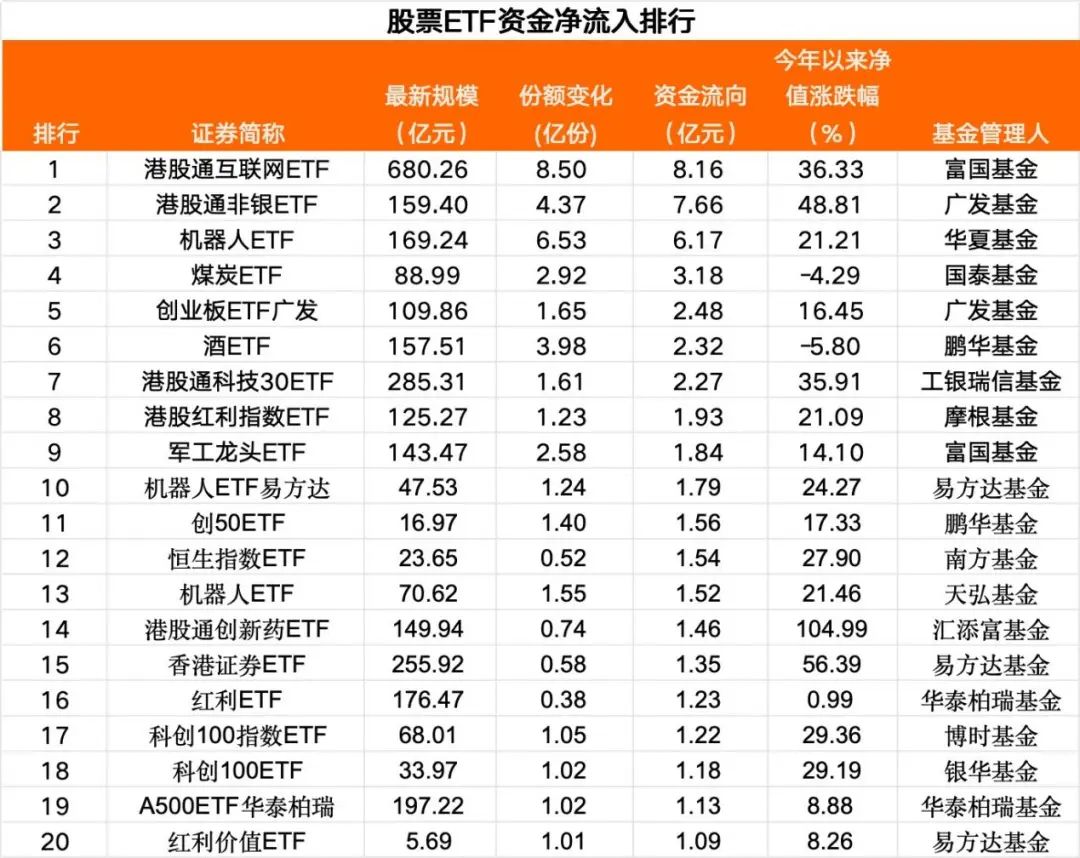
Group 1 - The stock ETF market experienced a net outflow of 14.6 billion yuan on August 14, with the overall market showing a downward adjustment trend [1][2] - The total number of stock ETFs in the market reached 1,173, with a total scale of 3.87 trillion yuan as of August 14, 2025 [3] - The top three stock ETFs with net inflows on August 14 were the FuGuo Hong Kong Internet ETF, the GuangFa Hong Kong Non-Bank ETF, and the HuaXia Robotics ETF, each with inflows exceeding 600 million yuan [4] Group 2 - The recent trend of net inflows into stock ETFs has paused, with a total outflow exceeding 20 billion yuan over the past three trading days [2][7] - The top 20 stock ETFs with the largest net outflows included the Sci-Tech 50 ETF, the Shanghai 50 ETF, and various industry ETFs related to semiconductors and securities, indicating significant losses in these areas [7][9] - The GuangFa Hong Kong Non-Bank ETF and the Hong Kong Innovation Drug ETF have shown remarkable performance, with the former's scale increasing over 19 times since the beginning of the year and a year-to-date return of 48.81% [5][6]

太突然!超140亿“跑了”......
中国基金报· 2025-08-15 05:34
Core Viewpoint - The A-share market experienced a turbulent adjustment on August 14, with all three major indices closing lower, and a net outflow of 14.6 billion yuan from stock ETFs, indicating a cautious sentiment among investors [2][4][10]. Fund Flow Analysis - On August 14, stock ETFs saw a net outflow of 14.6 billion yuan, marking the third consecutive trading day of outflows totaling over 20 billion yuan for the week [3][10]. - Despite the overall outflow, 22 stock ETFs recorded net inflows exceeding 100 million yuan, with industry ETFs leading the inflow [6][10]. - The top three ETFs by net inflow included the Fuquan Hong Kong Internet ETF, the Guangfa Hong Kong Non-bank ETF, and the Huaxia Robotics ETF, each with inflows over 600 million yuan [6][7]. ETF Performance - As of August 14, the total number of stock ETFs in the market reached 1,173, with a total scale of 3.87 trillion yuan [5]. - The Guangfa Hong Kong Non-bank ETF and the Guangfa Hong Kong Innovative Drug ETF were highlighted as leading products, with significant growth in scale and performance, achieving year-to-date returns of 48.81% and over 104%, respectively [7][10]. - The top 20 stock ETFs by net inflow were dominated by Hong Kong-related ETFs, particularly in sectors such as internet, non-bank finance, technology, and innovative drugs [6][8]. Sector-Specific Insights - The outflow was particularly pronounced in broad-based ETFs and industry ETFs, with the ChiNext 50, SSE 50, and ChiNext ETFs experiencing significant losses [10][12]. - The semiconductor and securities industry ETFs also faced substantial outflows, indicating a shift in investor sentiment away from these sectors [10][12]. - In contrast, the robotics and coal ETFs saw notable inflows, reflecting a divergence in sector performance amid market volatility [6][10]. Market Outlook - Analysts suggest that despite short-term volatility, the underlying logic for a positive market outlook remains intact, supported by stable economic fundamentals and a favorable policy environment [10][11].

沸腾了!狂买百亿!
中国基金报· 2025-08-05 06:19
Core Viewpoint - The Hong Kong stock market, particularly the Hang Seng Technology Index, has seen significant capital inflow, exceeding 10.2 billion yuan over the past five trading days, indicating strong investor interest in technology and internet-related ETFs [3][7]. Fund Flows - On August 4, the stock ETF market experienced a net inflow of 5.51 billion yuan, marking the second consecutive trading day of net inflows in August [6]. - The top three ETFs by net inflow on August 4 were the Hang Seng Technology ETF, Securities ETF, and Hong Kong Stock Connect Internet ETF, each with inflows exceeding 5 billion yuan [6][8]. - The total number of stock ETFs in the market reached 1,163, with a total scale of 3.76 trillion yuan as of August 4, 2025 [5]. Performance of Specific ETFs - The Hang Seng Technology ETF had a net inflow of 4.56 billion yuan on August 4, bringing its total size to 332.85 billion yuan, with an average daily trading volume of 45.6 billion yuan over the past month [7][8]. - Other notable inflows included the Securities Insurance ETF with 1.6 billion yuan and the Hong Kong Stock Connect Internet ETF with 1.3 billion yuan [7]. Outflows from Other ETFs - Conversely, several broad-based and sector-specific ETFs experienced significant outflows, with 16 ETFs seeing outflows exceeding 1 billion yuan, including the STAR 50 ETF and the Shanghai Stock Exchange 50 ETF [10]. - The STAR 50 ETF alone had a combined outflow of over 10 billion yuan from two funds, while the Shanghai 50 ETF saw outflows exceeding 3 billion yuan [10][12]. Market Sentiment - Market analysts suggest that the recent adjustments in the A-share market are normal following a period of continuous gains, and they anticipate a "slow bull" market trend supported by policy stabilization and adequate capital [11].

加仓!
Zhong Guo Ji Jin Bao· 2025-07-31 07:00
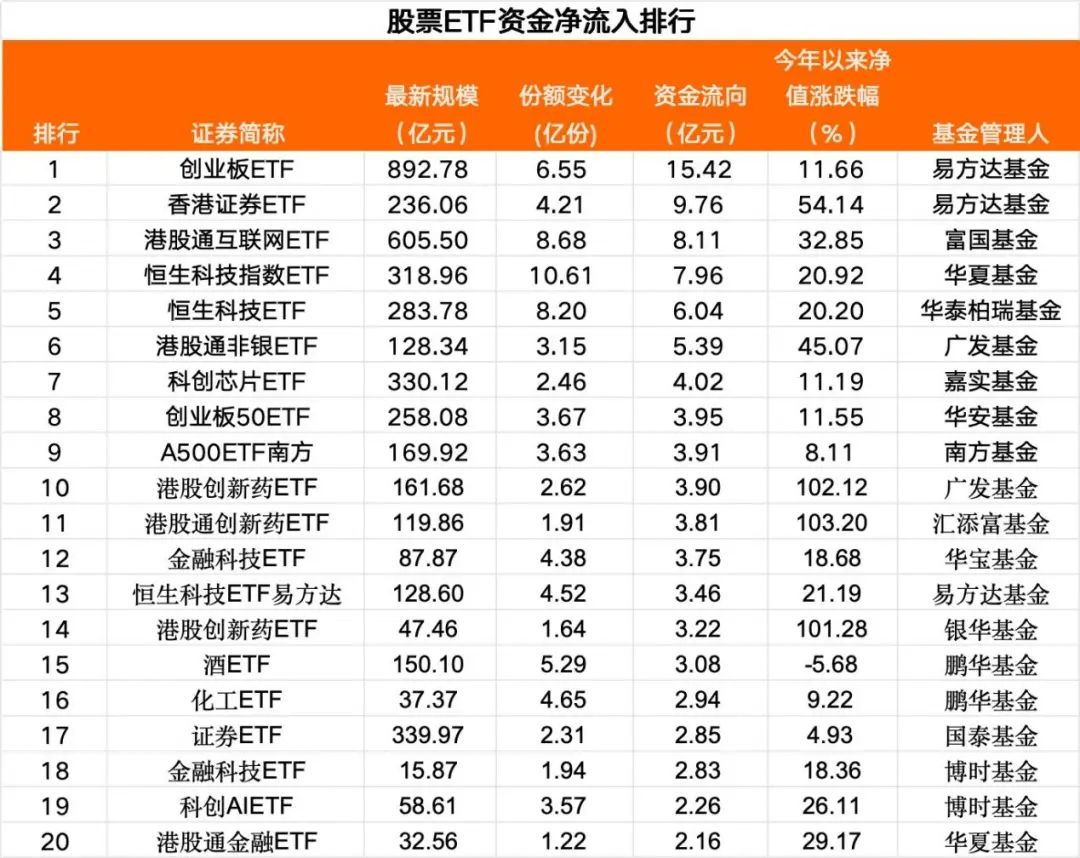
Core Insights - On July 30, the A-share market experienced fluctuations with the three major indices showing mixed results, while stock ETFs saw a net inflow of 7.5 billion yuan [1][2][3] Group 1: Stock ETF Inflows - On July 30, stock ETFs had a net inflow of 7.5 billion yuan, with significant inflows into the ChiNext index and Hong Kong-related ETFs covering sectors such as technology, finance, pharmaceuticals, and the internet [1][3] - The top three stock ETFs by net inflow were the E Fund ChiNext ETF (1.542 billion yuan), E Fund Hong Kong Securities ETF (976 million yuan), and the Fortune Hong Kong Internet ETF (811 million yuan) [3][4] - In July, net inflows into Hong Kong securities, internet, pharmaceuticals, and technology sectors reached 30 billion yuan [2][4] Group 2: Stock ETF Outflows - On the same day, 20 stock ETFs experienced net outflows exceeding 1 billion yuan, with the CSI 300, CSI 500, and CSI A500 ETFs among the hardest hit [6][7] - The top three stock ETFs by net outflow were the CSI 300 ETF (1.345 billion yuan), pharmaceutical ETFs (629 million yuan), and CSI 500 ETF (415 million yuan) [6][7] - The total net outflow from the top 20 stock ETFs included four CSI 300 ETFs with a combined outflow of over 2.1 billion yuan and four pharmaceutical-related ETFs with a total outflow exceeding 1 billion yuan [6][7]
又有资金,“跑了”!
中国基金报· 2025-07-07 06:24
Core Viewpoint - The A-share market experienced mixed performance on July 4, with a net outflow of 1.3 billion yuan from stock ETFs, primarily driven by broad-based ETFs and profit-taking behavior from short-term investors [1][2][3]. ETF Market Overview - As of July 4, the total scale of 1,135 stock ETFs reached 3.6 trillion yuan, with a net outflow of 1.302 billion yuan on that day [3]. - Broad-based ETFs saw the largest net outflow, totaling 5.474 billion yuan, with the CSI A500 index leading at 2.192 billion yuan [3]. - Specific ETFs with significant outflows included the CSI 300 ETF (0.983 billion yuan), A500 ETF by Harvest (0.377 billion yuan), and Dividend ETF (0.348 billion yuan) [3][6]. Market Sentiment and Future Outlook - The overall market sentiment has shown signs of recovery due to easing external risks and ongoing domestic growth policies, leading to a generally upward trend in the market [3][4]. - Analysts from HSBC Jintrust suggest that as external disturbances diminish and the Federal Reserve approaches a rate cut, the market's risk appetite is likely to improve, creating a favorable environment for equity assets [4]. Hong Kong Market Performance - Despite the overall outflow in stock ETFs, the Hong Kong market ETFs experienced a net inflow of 4.308 billion yuan, with the Hang Seng Technology Index leading at 1.986 billion yuan [8][9]. - Notable inflows were observed in ETFs managed by leading fund companies, such as E Fund's Hang Seng Technology ETF (0.24 billion yuan) and the SSE 50 ETF (0.12 billion yuan) [8][9]. Investment Opportunities - Analysts from Huaxia Fund maintain an overweight position on Hong Kong stocks, citing the core assets within the Hang Seng Index and Hang Seng Technology Index as having strong investment value due to their historical low valuations [9].
落袋为安,70亿“跑了”
中国基金报· 2025-06-30 06:42
Core Viewpoint - The stock ETF market experienced a net outflow of 7 billion yuan on June 27, indicating a shift in investor sentiment despite a recent market rebound [1][2][3]. Summary by Sections Market Overview - On June 27, the A-share market showed mixed performance with major indices fluctuating, leading to a total net outflow of approximately 70.14 billion yuan from the stock ETF market [3]. - The total scale of the stock ETF market reached 3.58 trillion yuan, with a reduction of 3.436 billion shares on the same day [3]. Fund Flows - The largest net outflow was observed in broad-based ETFs, totaling 6.732 billion yuan, with the ETF tracking the CSI 300 index experiencing the highest outflow of 3.723 billion yuan [3]. - Despite the overall outflow, certain ETFs, particularly those related to the Hong Kong market and banking sector, saw significant inflows, with the Hong Kong market ETFs attracting 1.851 billion yuan [7]. Sector Performance - The top sectors for inflows included banking ETFs, which saw a net inflow of 1.52 billion yuan, and ETFs tracking the CSI A500 index, which attracted 910 million yuan [7]. - Specific funds such as the Huatai-PB CSI A500 ETF and the Huabao Bank ETF led the inflows, with 3.2 billion yuan and 1.017 billion yuan respectively [7][8]. Future Outlook - Analysts suggest that the market may continue to experience a volatile and consolidating pattern due to internal and external uncertainties, with a focus on upcoming policy validations and corporate earnings [4]. - The potential for structural opportunities remains, with a recommendation for investors to maintain a long-term allocation strategy amidst increased volatility [4].

继续抄底!
中国基金报· 2025-06-23 07:07
Core Viewpoint - On June 20, the stock ETF market experienced a net inflow of 4.5 billion yuan, despite a general downward trend in the A-share market, indicating continued interest from investors in certain ETFs [1][4]. Summary by Sections Market Overview - The A-share market saw a collective adjustment with major indices declining, and total trading volume reached 1.07 trillion yuan on June 20 [1]. - For the week, stock ETFs attracted nearly 20 billion yuan, although there has been a slight net outflow in June overall [1]. ETF Inflows - On June 20, 19 stock ETFs recorded net inflows exceeding 100 million yuan, with the top three being: - Southern CSI 500 ETF: 1.39 billion yuan - Southern CSI 1000 ETF: 907 million yuan - E Fund ChiNext ETF: 391 million yuan [4]. - The total number of stock ETFs in the market reached 1,118, with a total scale of 3.48 trillion yuan as of June 20, 2025 [3]. ETF Outflows - On the same day, several stock ETFs experienced significant outflows, particularly: - CSI 300 ETF: nearly 400 million yuan - CSI 1000 ETF: approximately 300 million yuan [8]. - The outflows were concentrated in broad-based and industry-specific ETFs, with notable losses in the dividend ETFs [8]. Fund Company Insights - Major fund companies like E Fund and Huatai-PB reported significant inflows in their ETFs, with E Fund's ChiNext ETF seeing a net inflow of 391 million yuan and the CSI 300 ETF gaining 150 million yuan [4]. - Galaxy Fund suggested focusing on industries with stable performance and reasonable valuations amid macroeconomic uncertainties [9]. Future Outlook - According to various fund companies, the domestic policy is expected to continue supporting economic recovery, while external factors like interest rate expectations may alleviate pressure on the yuan [8]. - The overall sentiment indicates that major broad-based indices are likely to experience a strong oscillating pattern in the medium term, with no significant downside risks anticipated [8].