港股通非银ETF

Search documents
ETF及指数产品网格策略周报-20260303
HWABAO SECURITIES· 2026-03-03 11:08
Group 1: Grid Trading Strategy Overview - The essence of "grid trading" is a high buy low sell strategy, which does not predict market trends but utilizes natural price fluctuations within a certain range to generate profits, making it suitable for frequently fluctuating markets [3][11] - Characteristics of suitable grid trading targets include: selecting on-market targets, stable long-term trends, low trading costs, good liquidity, and high volatility. Equity ETFs are considered relatively suitable for grid trading [3][11] Group 2: ETF Grid Strategy Target Analysis - The Hong Kong Stock Connect Non-Bank ETF (513750.SH) benefits from an increase in the sales proportion of participating insurance products, which helps optimize the liability cost for insurance funds. In Q3 2025, the net profit of the top five listed insurance companies in A-shares reached CNY 426.04 billion, a year-on-year increase of 33.54%, driven by improved investment returns in stocks and equity funds [3][12] - The Robot ETF (159530.SZ) reflects the maturity of China's robotics industry and the arrival of a commercialization threshold, with significant advancements in AI technology expanding the commercial boundaries of robots in various sectors such as service, healthcare, and companionship [4][15] - The Tourism ETF (159766.SZ) saw record-breaking data during the Spring Festival, with 596 million domestic trips taken, an increase of 95 million from 2025, and total spending of CNY 803.48 billion, up CNY 126.48 billion year-on-year. This indicates a strong recovery in consumer spending in tourism, positioning it as a key driver for economic growth [5][6][17]
ETF 及指数产品网格策略周报(2026/3/3)
华宝财富魔方· 2026-03-03 09:18
Core Viewpoint - The article discusses the performance and potential of specific ETFs, particularly focusing on the non-bank insurance ETF and tourism ETF, highlighting their growth prospects driven by market conditions and consumer behavior. Group 1: Non-Bank Insurance ETF (513750.SH) - As of Q3 2025, the total net profit attributable to shareholders of the five major listed insurance companies in A-shares reached 426.04 billion yuan, a year-on-year increase of 33.54%, primarily driven by improved equity investment returns in a low-interest-rate environment [3][4]. - The active market trading and regulatory guidance are expected to enhance the proportion of equity investments by insurance funds, providing upward elasticity for their investment side [3]. - The sales of participating insurance products have significantly increased, helping insurance companies optimize their liability costs and alleviate pressure from interest rate spreads [3]. Group 2: Tourism ETF (159766.SZ) - During the 2026 Spring Festival holiday, domestic travel reached 596 million trips, an increase of 95 million trips compared to 2025, with total spending amounting to 803.48 billion yuan, up by 126.48 billion yuan, marking record highs in both visitor numbers and spending [6][7]. - The People's Bank of China reported that during the same period, transaction volumes processed by UnionPay and NetUnion reached 39.302 billion transactions, amounting to 13.12 trillion yuan, reflecting a year-on-year increase of 37.45% in transaction counts and 19.26% in transaction amounts [6]. - The "14th Five-Year Plan" emphasizes the construction of a strong tourism nation, aiming to enhance the supply of high-quality tourism products and services, positioning tourism as a key driver for consumption upgrades and economic growth [6][7].


布局港股!南向资金,连续7日净流入
Xin Lang Cai Jing· 2026-02-08 23:37
Core Insights - Southbound capital has been consistently flowing into the Hong Kong stock market since the beginning of 2026, with a net inflow of 56.6 billion yuan as of February 8, marking seven consecutive trading days of net buying [1] - The trend indicates a shift in investment focus from traditional high-dividend sectors to technology growth sectors, with Hong Kong tech leaders attracting significant attention due to their low valuations and high growth potential [2][4] Group 1: Southbound Capital Inflows - As of February 8, southbound capital has recorded a net buying amount of 56.6 billion yuan, with the last three trading days seeing net purchases exceeding 10 billion yuan each [1] - On February 5, the net buying amount reached a recent high of 22.206 billion yuan, indicating strong investor interest [1] - The trend of inflows is supported by the performance of various ETFs, particularly those focused on technology and consumer sectors [1][2] Group 2: ETF Performance - Several cross-border ETFs have seen significant growth, with the top performers including the Hang Seng Technology ETF and the Hong Kong Stock Connect Consumer ETF, reflecting investor enthusiasm for Hong Kong stocks [1][2] - The newly launched Hong Kong Stock Connect Technology ETF by Ping An Fund has also gained traction, increasing by 862 million yuan since its inception [1] Group 3: Market Valuation and Future Outlook - The Hang Seng Technology Index is currently trading at a price-to-earnings ratio of 22.38, which is lower than major global market indices, suggesting potential for valuation recovery [3] - Analysts believe that the valuation and earnings of Hong Kong stocks may see moderate expansion in 2026, driven by improved economic growth and corporate profitability [4] - There is a growing consensus among foreign investors regarding the investability of Chinese assets, with a notable shift of long-term capital from Europe and the U.S. towards the Chinese market [4]
ETF周报|4000点保卫战打响,你慌了吗?
Sou Hu Cai Jing· 2026-02-02 11:10
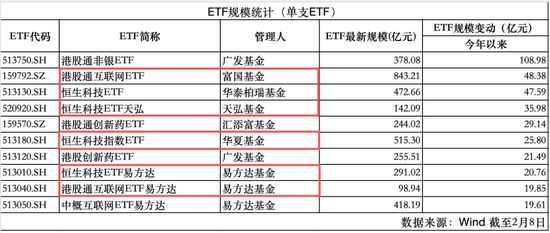
Overall Market Trends - The market experienced significant fluctuations, with the Shanghai Composite Index showing a decline of 0.44% last week, while the Hang Seng Index rose by 2.38% [3][4] - The overall market sentiment has shifted, with a noticeable rotation from small-cap stocks to undervalued large-cap stocks, particularly in the banking and consumer sectors [22][23] ETF Performance - Major ETFs such as the CSI 300 ETF saw a substantial decrease in scale, with the total assets of the top four CSI 300 ETFs shrinking from 1.19 trillion yuan to 570 billion yuan, a drop of over 50% [13][28] - The Gold ETF experienced a significant increase in scale, rising by 12.28% last week, making it the third-largest ETF in terms of scale [14][24] Sector Analysis - The banking sector showed resilience, with the Bank ETF increasing by 0.78% and the scale rising by 7.15% [22] - The consumer sector, particularly the liquor and food and beverage ETFs, saw a surge in trading volume, with the liquor ETF's trading volume increasing over 100% [22][23] - The agricultural sector is showing signs of recovery, supported by rising pork prices and favorable government policies [23] Global Market Context - Global indices such as the Nasdaq and DAX experienced declines, indicating a broader market fatigue after a prolonged period of growth [4][7] - The Fear and Greed Index indicated a drop to 78.99, reflecting a shift in market sentiment towards caution, although it remains in the greed zone [7][10] Fund Management Trends - Major fund management companies like E Fund and Huatai-PB saw significant reductions in their ETF scales due to major shareholders reducing their holdings [28] - Despite the overall decline in ETF scales, companies like Guotai and Huaan managed to grow their scales, benefiting from balanced industry allocations and strong gold ETFs [28]
开年超283亿资金涌入港股ETF
21世纪经济报道· 2026-01-30 14:23
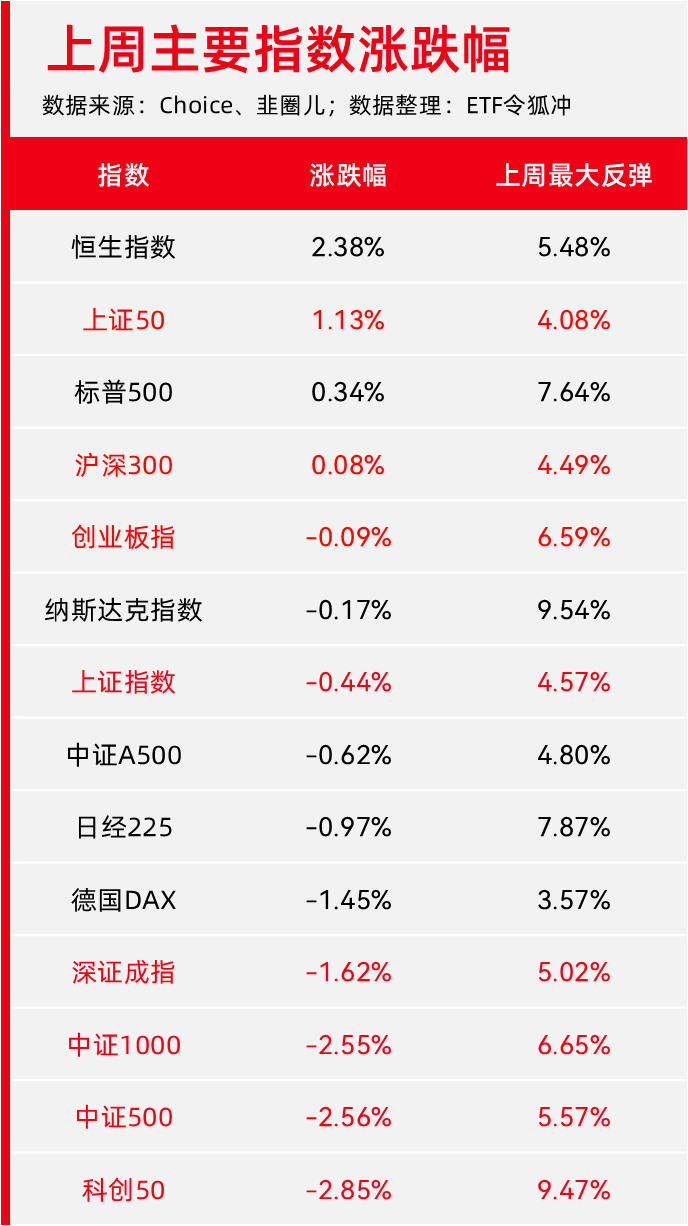
Core Viewpoint - The article highlights a significant inflow of funds into Hong Kong's technology sector through cross-border ETFs, indicating a growing interest in technology-themed investments as the market rebounds in early 2026 [1][3]. Fund Inflows and Performance - Since the beginning of 2026, over 160 Hong Kong ETFs have seen a net inflow of 28.389 billion yuan, with approximately 90% of this capital directed towards technology-themed products such as the Hong Kong Internet ETF and the Hang Seng Technology ETF [1][3][4]. - The total scale of Hong Kong ETFs has approached 800 billion yuan, marking an increase of nearly 79 billion yuan since the end of 2025, representing an 11% growth [6]. Product Development - At least 28 new Hong Kong-themed funds have been reported by public fund managers since the start of 2026, focusing primarily on technology, healthcare, and consumer sectors, with technology funds being the most prominent [1][8][9]. - The top 10 funds attracting significant capital include several technology ETFs, with inflows exceeding 10 billion yuan for products like the GF Hong Kong Non-Bank ETF and the FT Hong Kong Internet ETF [4][5]. Fund Performance - Most Hong Kong ETFs have recorded positive returns since the beginning of 2026, with several funds in the healthcare and non-bank sectors achieving returns over 10% [5][6]. - The performance of technology-themed ETFs has been particularly strong, with the Hong Kong Internet ETF and the Hang Seng Technology ETF yielding returns of approximately 8.9% and 8%, respectively [5]. Long-term Investment Outlook - The article emphasizes the long-term growth potential of the technology sector in Hong Kong, driven by global capital and talent influx, as well as favorable trends in artificial intelligence and innovation [10][11]. - The article also notes the potential for investment in upstream resources and companies expanding internationally, indicating a broader strategy for capital allocation in the Hong Kong market [10].

跨境ETF加速扩容,港股赛道成吸金主力
2 1 Shi Ji Jing Ji Bao Dao· 2026-01-21 13:05
Core Insights - The cross-border ETF market in China has reached a historic milestone, with a total scale surpassing 1 trillion yuan, reaching 10,025 billion yuan in January 2023, and remaining at 9,903.82 billion yuan as of January 20, 2026 [1][2] - The market has experienced exponential growth since 2021, with the number of products increasing from 24 to 208, a growth of 7.67 times, and the total shares rising from 236.55 billion to 9,532 billion, a growth of 39.30 times [1][2] - The annual compound growth rate of cross-border ETFs has exceeded 80% since 2021, with a significant increase of 119.53% in 2025 alone [2][3] Market Dynamics - The cross-border ETF market is highly concentrated, with the top five managers (Huaxia, Fuguo, Huatai-PB, E Fund, and ICBC Credit Suisse) accounting for over 60% of the market scale [4] - The leading product in the market is the Fuguo Hong Kong Stock Internet ETF, with a scale of 894 billion yuan, followed by the Huaxia Hang Seng Technology Index ETF at approximately 524 billion yuan [4] - There are currently 25 cross-border ETFs with a scale exceeding 10 billion yuan, up from 11 at the beginning of 2025 [4] Growth Drivers - The rapid development of cross-border ETFs is driven by factors such as the accumulation of household wealth, the internationalization of the yuan, strong performance in the Hong Kong technology sector, and the trend of global capital allocation [5] - The demand for diversified asset allocation has been fueled by the limited channels for investing overseas, particularly as overseas markets, especially the US stock market, have performed well [5] - The increasing number of innovative products has lowered participation barriers, further promoting the growth of cross-border ETFs [5] Future Trends - The cross-border ETF market is expected to continue expanding, with potential growth areas including regional expansion, thematic deepening, and strategic innovation [6] - Future developments may focus on emerging markets such as Brazil, India, and Southeast Asia, as well as thematic investments in sectors like semiconductors, AI, and renewable energy [6] - The market is likely to see a shift from broad-based indices to more specialized themes, with a growing proportion of thematic ETFs [6][7]
罕见!21只ETF成交额超百亿元
Zhong Guo Zheng Quan Bao - Zhong Zheng Wang· 2026-01-15 12:46
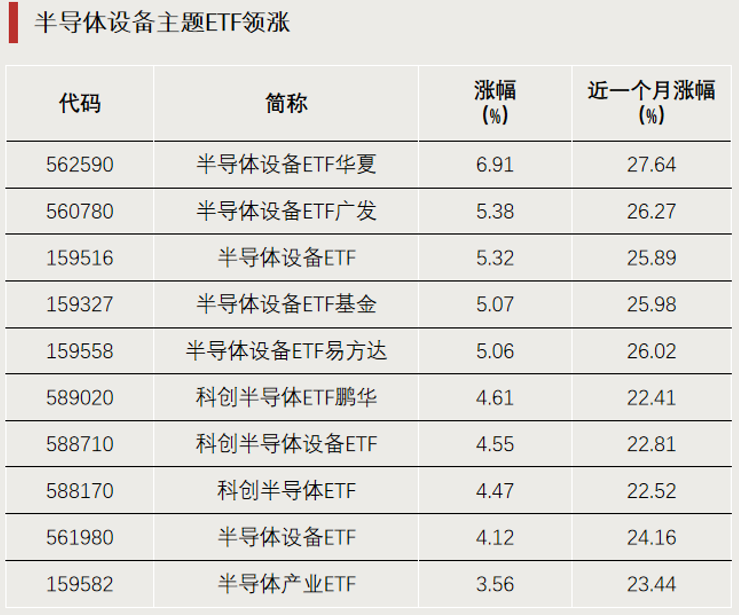
Group 1 - The semiconductor equipment ETFs experienced a counter-trend increase, with several related ETFs rising over 5% on January 15, despite a general market adjustment [1][4][10] - The largest gain was seen in the Huaxia Semiconductor Equipment ETF, which rose by 6.91%, while other semiconductor ETFs also showed significant increases [4][5][14] - The strong performance of the semiconductor equipment sector is attributed to the clear expansion plans of Chinese wafer fabs, leading to a substantial order backlog for domestic equipment manufacturers, with some orders extending to 2027 [4][10] Group 2 - On January 15, the ETF market was very active, with 21 ETFs exceeding a transaction volume of 10 billion yuan [2][11][18] - The majority of the ETFs with transaction volumes over 10 billion yuan were broad-based ETFs, including the CSI 500 ETF and the CSI 300 ETF, both surpassing 20 billion yuan in volume [2][7][18] - The inflow of funds into industry ETFs was notable, with software and satellite ETFs seeing net inflows exceeding 2 billion yuan on January 14 [3][12][20] Group 3 - The satellite-related ETFs, which had previously seen significant gains, experienced declines on January 15, with several products dropping over 9% [1][16][17] - The satellite industry ETFs, including the Satellite Industry ETF and the E Fund Satellite ETF, reported declines of 9.68% and 9.66%, respectively [6][17] - The general aviation ETFs also faced declines, with drops exceeding 6% [16][17] Group 4 - The market outlook remains positive, with expectations of continued inflows due to favorable macroeconomic conditions, including the appreciation of the RMB and the influx of insurance capital [10][21] - Investment strategies should focus on quality growth themes, particularly in semiconductor and advanced manufacturing sectors, as well as renewable energy [10][21]
开年以来ETF总规模增长近2546亿元 宽基产品成主要担当
Zheng Quan Ri Bao Wang· 2026-01-13 13:25
Group 1 - The total scale of ETFs has shown a growth trend since the beginning of the year, with an increase of nearly 254.6 billion yuan, reaching 6.27 trillion yuan as of January 12 [1] - Broad-based ETFs have performed particularly well, with multiple products linked to the CSI 300, CSI 500, and CSI 1000 experiencing scale growth exceeding 20 billion yuan [1] - The largest broad-based ETF is the CSI 300 ETF, with a total scale of 1.23 trillion yuan, which has seen an increase of nearly 42 billion yuan in January [1] Group 2 - The increase in scale for ETFs since January has been primarily driven by stock-type products, especially broad-based ETFs, with significant growth observed in products like the Southern CSI 500 ETF and the CSI 300 ETF Huatai-PB [2] - The substantial growth in broad-based ETFs is attributed to improved market investment confidence, with funds flowing into relatively stable large-cap index products [2] - In addition to broad-based ETFs, commodity ETFs, particularly those linked to gold, have also seen notable scale changes, with gold-linked ETFs growing by over 16 billion yuan in January [2] Group 3 - Cross-border ETFs have also experienced growth, with products like the Hang Seng Technology ETF and the Hong Kong Stock Connect Internet ETF seeing increases of over 14 billion yuan [3] - The growth in cross-border ETFs is driven by investors' increased demand for allocation in the Hong Kong technology sector, reflecting a favorable outlook for the technology industry this year [3]
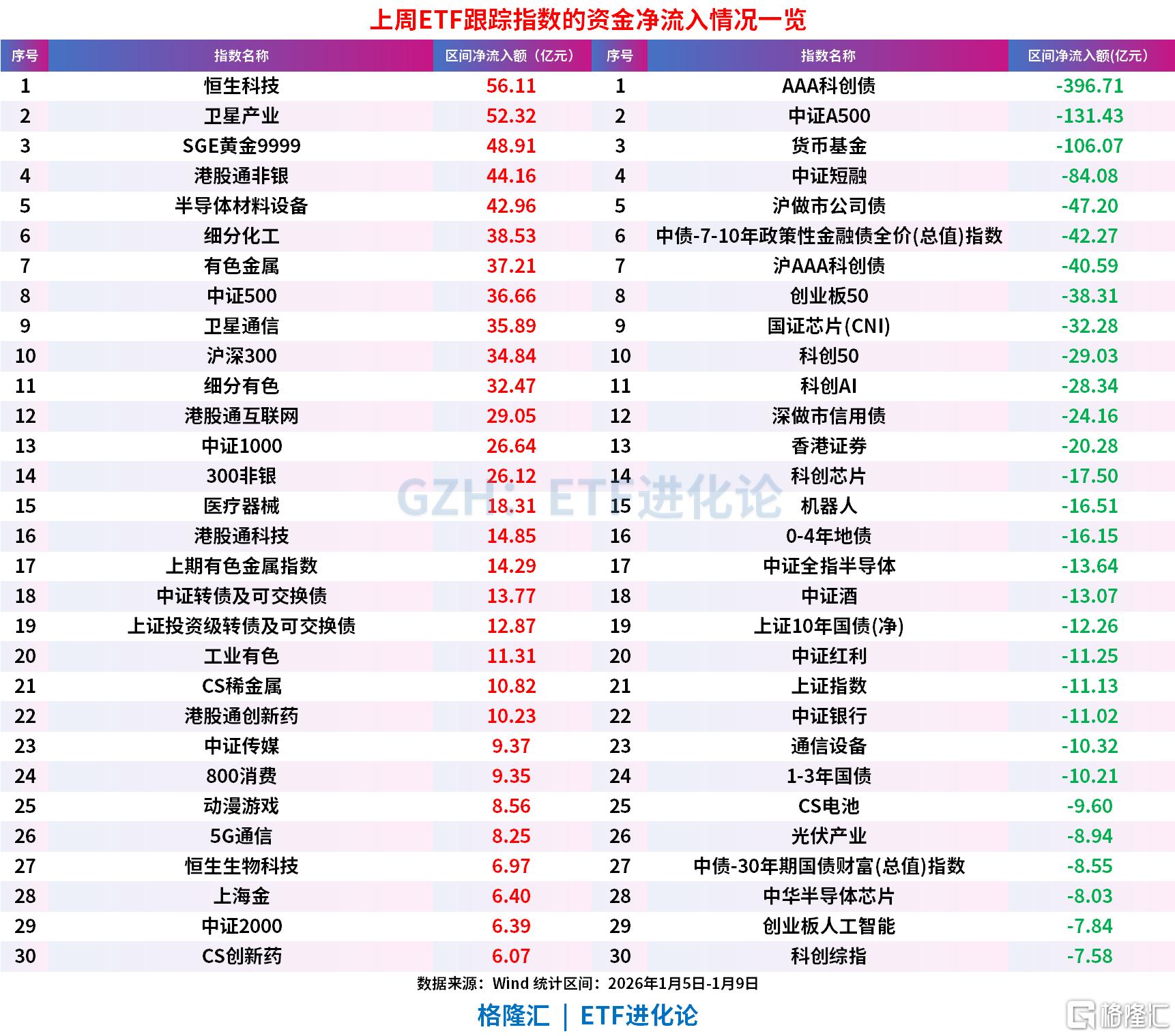
上周债券ETF狂流出超600亿,股票ETF净流入77.65亿元,恒生科技、卫星产业“吸金”居前
Ge Long Hui· 2026-01-12 09:32
Market Overview - The A-share market experienced a significant increase last Friday, with the Shanghai Composite Index achieving a 16-day winning streak, surpassing 4100 points, marking a new high in over 10 years. The market turnover exceeded 3.1 trillion yuan, making it the sixth instance in A-share history where turnover surpassed 3 trillion yuan [1] - During the week of January 5 to January 9, the A-share market welcomed a strong start to 2026, with major broad-based indices recording gains. The All A Index rose by 5.11%, while the Sci-Tech 50 surged by 9.80%. The CSI 1000 and Northbound 50 also saw increases of over 5% [2] Style and Sector Performance - In terms of market style, small-cap stocks outperformed, with the CSI 1000 rising by 7.03%, compared to the CSI 300's increase of 2.79%. All five major style indices recorded gains, with the growth style leading at 7.02% [3] - Most primary industries recorded gains, with the banking sector being the only one to decline. The top three performing sectors were comprehensive, defense and military industry, and media [3] Trading Activity - The A-share market showed a significant increase in trading activity, with the turnover on Friday surpassing 3 trillion yuan for the first time in 73 trading days. The average daily turnover for the week was 28.52 billion yuan, an increase of 7.236 billion yuan from the previous week. The average turnover rate was 2.2363%, up by 0.5 percentage points from the previous week. Northbound capital's average daily turnover was 327.15 billion yuan, an increase of 98.647 billion yuan from the previous week. As of last Thursday, the margin trading balance was 2.6206 trillion yuan, up by 79.924 billion yuan from the previous week [3] Fund Flows - Last week, the ETF market saw a net outflow of 56.932 billion yuan, with stock ETFs experiencing a net inflow of 7.765 billion yuan, commodity ETFs a net inflow of 6.967 billion yuan, and cross-border stock ETFs a net inflow of 5.374 billion yuan. Conversely, bond ETFs faced a significant net outflow of 66.4 billion yuan, and money market ETFs saw a net outflow of 10.607 billion yuan [4] - Specific indices such as Hang Seng Technology, satellite industry, SGE gold 9999, and others saw net inflows ranging from 3.484 billion yuan to 5.611 billion yuan, while various bond-related indices experienced net outflows [4][6] ETF Performance - The median weekly return for stock ETFs from January 5 to January 9 was 4.31%. Among broad-based ETFs, the Sci-Tech board ETF had the highest median return at 10.15%. By sector, technology ETFs had a median return of 7.28%, while military industry ETFs led with a median return of 13.50% [13] - Satellite ETFs saw significant gains, with the top performers including the E Fund Satellite ETF and the GF Satellite ETF, which rose by 22.46% and 22.42%, respectively [14][16] - Conversely, banking ETFs experienced declines, with the leading banking ETF dropping by 2.00% [17] Upcoming Developments - This week, nine new ETFs are set to be issued, including those focused on consumer electronics, low-volatility dividends, and biotechnology [19] - There are rumors regarding potential purchase limits on satellite ETFs and commercial aerospace ETFs, but fund companies have stated they have not received any official notifications regarding these changes [20]
大涨日,加仓!
Zhong Guo Ji Jin Bao· 2026-01-12 07:21
Group 1 - On January 9, the A-share market saw a significant increase, with total trading volume exceeding 3 trillion yuan and the Shanghai Composite Index stabilizing above 4100 points [2] - The net inflow of funds into stock ETFs exceeded 20 billion yuan, with notable inflows into broad-based ETFs like CSI 1000 and CSI 300, as well as industry-specific ETFs in satellite and semiconductor sectors [2][5] - The total scale of stock ETFs reached 4.99 trillion yuan, with a trading volume of 269.95 billion yuan on the same day, marking an increase of over 20 billion yuan compared to the previous trading day [3][5] Group 2 - The leading sectors for ETF performance included media, software, and satellite industries, with the media sector having three ETFs in the top ten by growth [3][4] - The top-performing ETF on January 9 was the Media and Entertainment ETF, which saw a trading volume of 32 million yuan and a daily increase of 8.41% [4] - Conversely, overseas market-related ETFs, such as the S&P Biotech ETF and the NASDAQ Biotech ETF, experienced declines of around 1% [3] Group 3 - The net inflow of funds into industry-themed ETFs was 11.37 billion yuan, while broad-based ETFs saw a net inflow of 5.14 billion yuan, indicating a preference for thematic investments [5][6] - The CSI 1000 ETF and the CSI 300 ETF from Huatai-PineBridge were the top three in terms of net inflow, with 1.93 billion yuan and 1.79 billion yuan respectively [6][8] - Notably, 24 stock ETFs experienced net outflows exceeding 1 billion yuan, particularly in the ChiNext and Sci-Tech 50 ETFs, as well as in sectors like chips and photovoltaics [5][7] Group 4 - Major fund companies like E Fund and Huaxia Fund reported significant net inflows into their ETFs, with E Fund's total ETF scale reaching 877.98 billion yuan, an increase of 36.28 billion yuan since the beginning of 2026 [8][9] - The Hong Kong Stock Connect Non-Bank ETF from GF Fund saw net inflows exceeding 4.4 billion yuan, reaching a new high of 33.2 billion yuan [9] - Analysts from various funds expressed a positive outlook for the A-share market in 2026, anticipating a shift from valuation-driven growth to fundamental-driven growth [9]