
资源

Search documents
盘前必读丨机械工业数字化转型实施方案印发;暑期档票房破70亿
Di Yi Cai Jing Zi Xun· 2025-08-03 23:32
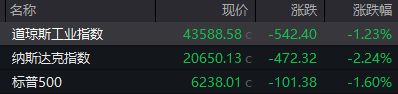
Market Overview - The U.S. stock market experienced a significant decline, with the Dow Jones Industrial Average falling by 542.40 points, or 1.23%, closing at 43,588.58 points. The Nasdaq Composite dropped 2.24% to 20,650.13 points, while the S&P 500 decreased by 1.60% to 6,238.01 points. This downturn was influenced by new tariffs imposed by Trump on several trade partners and a disappointing employment report, which showed a non-farm payroll increase of only 73,000, below the expected 104,000 [2][3]. Individual Stock Performance - Amazon's stock fell by 8.3% due to lower-than-expected revenue guidance for the third quarter. Other major tech stocks also saw declines, with Apple down 2.5%, Nvidia down 2.3%, and Tesla and Microsoft both down 1.8%. The Nasdaq China Golden Dragon Index decreased by 1.8%, with Alibaba down 2.9%, NetEase down 2.2%, Baidu down 2.0%, and JD down 1.8% [3]. Commodity Prices - Oil prices were pressured by economic uncertainty and expectations of increased production from OPEC+. WTI crude oil for the nearest month fell by 2.79% to $67.33 per barrel, while Brent crude oil dropped by 2.83% to $69.67 per barrel [3]. Gold Prices - Increased risk aversion led to a rise in gold prices, with October contracts on the New York Mercantile Exchange surpassing $3,400, marking a 2.02% increase [4]. Economic Policies - The People's Bank of China announced plans for a moderately loose monetary policy, including a reduction in the reserve requirement ratio and support for local government financing platforms. Additionally, a new tax policy on interest income from government bonds will take effect on August 8, 2025 [4][5]. Automotive Industry Performance - In July, several electric vehicle manufacturers reported their delivery figures: Li Auto delivered 30,731 vehicles, XPeng delivered 36,717 vehicles (up 229% year-on-year), NIO delivered 21,017 vehicles (up 25.2% year-to-date), and Leap Motor delivered 50,129 vehicles (up over 126% year-on-year). BYD reported July sales of 344,300 new energy vehicles, a slight increase from 342,400 vehicles in the same month last year [6][7][9]. Corporate Actions - China Shenhua announced plans to issue shares and pay cash to acquire assets from its controlling shareholder, with trading of its A-shares suspended starting August 4, 2025, for up to 10 trading days [8]. - Lianyi Intelligent Manufacturing is set to undergo a restructuring process, with a review by the Shenzhen Stock Exchange scheduled for August 8, 2025 [10].


中信证券:做趋势还是高切低?
券商中国· 2025-08-03 12:42
Core Viewpoint - The positioning of the market determines the behavior of dominant funds, which in turn influences the structure and pattern of rising industries. Historically, in liquidity-driven markets, leading industries tend to be concentrated rather than rotating between high and low positions. This reflects a pursuit of efficiency by funds, favoring high-consensus varieties over low-position varieties [1][4]. Group 1: Market Behavior and Trends - The market in July confirmed that industries are gradually focusing on trend-driven varieties, while the high-cut low model is less efficient [6][7]. - A review of the past 15 years shows that once a sector gains consensus, its strong performance tends to last until the end of the market cycle. Strong sectors often end later than mid-range sectors, and the excess returns of leading sectors over mid-range sectors tend to expand throughout the market cycle [3][4]. Group 2: Investment Focus Areas - Current focus areas include AI, innovative pharmaceuticals, resources, advanced technology, and the Sci-Tech Innovation Board [11]. - In the AI sector, there is uncertainty regarding the transition from North American supply chains to domestic ones. The demand for North American computing power is being reassessed, but the domestic supply chain lacks commercial closure [12]. - The innovative pharmaceutical sector is supported by potential business development expectations, with large pharmaceutical companies still having room for valuation growth compared to 2020-2021 [13]. - Resource stocks are currently well-matched in terms of fundamentals and valuations, with price increases reflecting earnings elasticity due to supply constraints and demand growth [13][14]. - The advanced technology sector is suitable for long-term investment despite some short-term fluctuations, driven by the potential of AI applications and semiconductor developments [14]. - The Sci-Tech Innovation Board presents opportunities for rebound, particularly in the semiconductor sector, which may receive a boost from optimistic guidance from key players [14]. Group 3: Market Liquidity and Fund Flows - Recent trends indicate a marginal slowdown in incremental liquidity, suggesting that the market needs to cool down for stability [9]. - In July, public mutual funds experienced a net outflow of approximately 25.1 billion, following a rare net inflow in June. This reflects a potential exhaustion of sales channels due to the previous issuance of floating rate products [10]. - Despite some outflows, industry and thematic ETFs saw significant net inflows, driven mainly by individual investors [10].

中信证券:做趋势还是高切低?
智通财经网· 2025-08-03 09:05
Core Viewpoint - The behavior of leading funds in the market is determined by the positioning of the market, which in turn influences the structure and pattern of industries that experience growth. Historically, liquidity-driven markets tend to concentrate on strong sectors rather than rotating between high and low performers [1][2]. Group 1: Market Behavior and Trends - In liquidity-driven markets, once a sector gains consensus, its strong performance tends to persist until the end of the market cycle [2]. - Strong sectors often see their peak performance occur later than mid-tier sectors, indicating a lack of significant high-low rotation [2]. - The excess returns of leading sectors compared to mid-tier and low-tier sectors tend to expand throughout the market cycle [2]. Group 2: Investment Focus and Sector Performance - Current focus remains on sectors such as AI, innovative pharmaceuticals, resources, and the STAR Market [1][6]. - In July, sectors with strong industrial trends, such as innovative pharmaceuticals and rare metals, outperformed, with ETFs recording significant gains: Communication ETF at 20.4%, Innovative Pharmaceutical ETF at 16.9%, and Rare Metals ETF at 15.4% [5]. - Conversely, sectors relying on short-term speculative themes, like coal, saw significant pullbacks, indicating a preference for strong trend sectors over low-positioned ones [5]. Group 3: Liquidity and Market Dynamics - Recent marginal slowdown in incremental liquidity suggests that the market needs to cool down for sustainable growth [6]. - Public mutual funds experienced a net outflow of approximately 25.1 billion in July, following a rare net inflow in June, indicating a shift in investor sentiment [7]. - Despite some outflows, industry and thematic ETFs saw net inflows, driven primarily by individual investors, with significant inflows into cyclical, manufacturing, and technology ETFs [7]. Group 4: Sector-Specific Insights - AI sector faces uncertainty regarding the transition from North American supply chains to domestic ones, with current trends reflecting more on industrial trends than pure valuation [8]. - The innovative pharmaceuticals sector is supported by potential business development expectations, with large pharmaceutical companies still having room for valuation growth compared to previous years [9]. - Resource stocks are currently well-matched in terms of fundamentals and valuations, with price increases reflecting earnings elasticity due to supply constraints and slow demand growth [10]. Group 5: Long-term Investment Considerations - The "15th Five-Year Plan" guidance is anticipated to provide clearer, quantifiable constraints on industry capacity expansion, which could stabilize long-term supply-demand relationships [4]. - The semiconductor sector, particularly the STAR Market, is expected to see a resurgence, especially if optimistic guidance is provided by key players like SMIC [10].


中信证券:目前重点关注的依然聚焦在AI、创新药、资源、恒科以及科创板
news flash· 2025-08-03 08:12
Core Viewpoint - The positioning of the market determines the behavior of leading funds, which in turn influences the structure and pattern of rising industries [1] Group 1: Market Behavior - Historically, market trends driven by incremental liquidity tend to concentrate on leading industries rather than rotating between high and low performers [1] - The essence behind this behavior is the pursuit of efficiency by funds, favoring high consensus stocks over low-positioned ones [1] Group 2: Recent Market Trends - The market performance in July confirmed that industries are gradually focusing on trend-driven stocks, while the high-cut low rotation model shows lower efficiency [1] - There has been a marginal slowdown in incremental liquidity recently, indicating that the market needs to cool down for stable long-term growth [1] Group 3: Focus Areas - Current key areas of focus include AI, innovative pharmaceuticals, resources, Hengke, and the Sci-Tech Innovation Board [1]