
高切低

Search documents
兴证策略张启尧团队:持股过节吗?
Xin Lang Cai Jing· 2026-02-08 09:07
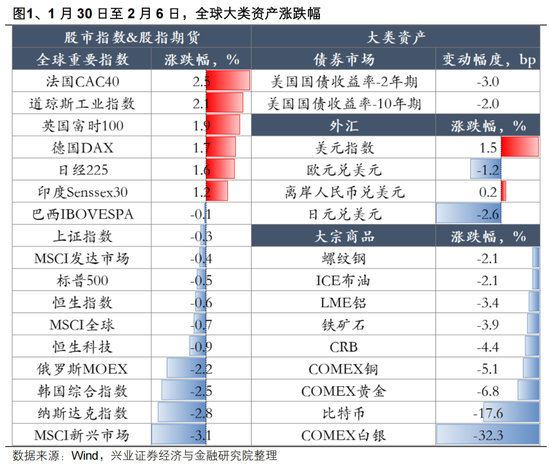
Group 1 - The recent global risk asset adjustment is primarily driven by narrative and sentiment rather than fundamental or policy changes, indicating a rebalancing of global assets and internal styles [10][25][32] - The core logic supporting the spring market remains unchanged, with positive fundamentals, favorable policies, and ample liquidity still in place [3][25][28] - The upcoming macro data releases from China and the US are expected to validate improvements in fundamentals, which could enhance market sentiment [7][28] Group 2 - The post-Spring Festival market is anticipated to favor technology manufacturing, resource products, and infrastructure chains, driven by an increase in risk appetite [11][32] - Key sectors to focus on include TMT (Technology, Media, and Telecommunications), high-end manufacturing (such as renewable energy and innovative pharmaceuticals), and price recovery chains (including chemicals, building materials, and steel) [14][35][38] - The AI application sector is expected to see concentrated catalysts, with its current crowding level being reasonable, making it a focal point for investment [17][38]

A股收评:涨停!扬眉吐气了!周五,A股会不会带来惊喜
Sou Hu Cai Jing· 2026-01-29 18:08
Core Viewpoint - The A-share market is experiencing a dramatic shift, with traditional sectors like liquor and real estate surging while technology stocks face significant declines, indicating a rotation of investment focus from high-valued "new assets" to undervalued "old assets" [1][8][10]. Liquor Sector - The liquor sector saw an impressive overall increase of 9.2%, with eight stocks, including Luzhou Laojiao and Jiu Gui Jiu, hitting the daily limit [4]. - The price of Moutai has slightly rebounded to around 1610 yuan per bottle, boosting market sentiment towards the liquor sector as consumption policies are anticipated to stimulate demand [5][19]. - The valuation of liquor stocks has returned to historically low levels, making them an attractive defensive choice amid market uncertainties [5]. Real Estate Sector - The real estate index rose by 2.95% on January 29, with leading companies experiencing significant price increases, reflecting a complex mix of market sentiment [5]. - The reduction in the number of real estate companies over recent years has led to a perception of a potential bottoming out in the sector, with some analysts suggesting it represents a once-in-a-decade opportunity [5][6]. - Despite weak sales data, first-tier cities like Shanghai show some resilience in housing prices, with a year-on-year increase of 5.1% in new home prices [7]. Technology Sector - The semiconductor index dropped approximately 5%, with many previously popular stocks undergoing substantial corrections, attributed to capital outflows and valuation pressures [10][22]. - The decline in technology stocks is linked to the inability of some companies to match their high valuations with performance, leading to necessary adjustments in a market with changing risk appetites [10]. Market Dynamics - The total trading volume reached 3.2 trillion yuan, indicating a significant shift in market dynamics, with some analysts viewing this as a potential signal of a market peak [2][22]. - The market is witnessing a "high to low" capital switch, where funds are moving from high-valued sectors to those with lower valuations and better short-term catalysts [8][23]. - The overall market remains divided, with over 3,566 stocks declining, suggesting that only a small portion of investors are benefiting from the current market conditions [11][24]. Investor Sentiment - There is a growing caution among investors, with a shift from blind speculation to a more analytical approach focusing on company fundamentals and valuation [24]. - The market sentiment has transitioned from widespread optimism to a more cautious and differentiated outlook, as investors reassess their strategies in light of recent volatility [24].
早盘直击|今日行情关注
申万宏源证券上海北京西路营业部· 2026-01-27 02:26
Group 1 - The spring market is entering a transition period with noticeable acceleration in sector rotation, as the market shifts from rapid ascent to a phase of horizontal consolidation, leading to unclear main lines and increased industry rotation [1] - The two main lines of the current spring market, commercial aerospace and AI applications, have shown significant divergence, impacting market sentiment [1] - Investors are focusing on relatively low-position sectors, particularly strong cyclical industries, resulting in a "high-cut-low" market characteristic typical of the transition period [1] Group 2 - On Monday, the two markets experienced differentiated fluctuations with trading volume at relatively high levels, as the Shanghai Composite Index opened high but closed lower, remaining above the 5-day moving average [1] - The Shenzhen Component Index underperformed compared to the Shanghai market, experiencing a larger adjustment but also closing above the 5-day moving average [1] - Market hotspots were mainly concentrated in upstream industries such as petrochemicals and non-ferrous metals, with large-cap blue-chip stocks performing strongly while small-cap and tech stocks saw adjustments [1] Group 3 - The Shanghai Composite Index has entered a horizontal consolidation phase after a continuous rebound, having started an upward trend in mid-December and reaching a new high in mid-January before entering the current fluctuation phase [1] - The current market characteristics include sector differentiation and a decrease in overall market volatility, with a need to monitor the support strength of the 5-day moving averages for various indices in the short term [1]

【机构策略】短期A股市场仍将震荡整理 中长期上行趋势仍在
Zheng Quan Shi Bao Wang· 2026-01-21 01:20
Group 1 - The A-share market is experiencing a significant style shift, indicating a strong willingness for funds to switch between high and low sectors amid adjustments in high-position themes and individual stocks [1] - The overall market trading volume remained stable compared to the previous trading day, with active trading levels not declining further; if the market can maintain above 2.5 trillion yuan, there will be more opportunities [1] - The market is likely to gradually shift towards a trend focused on fundamental improvements, especially during the annual report forecast period, suggesting investors should pay attention to sectors with good fundamentals that have lagged behind [1] Group 2 - The A-share major indices continued to adjust, with market volume remaining active, indicating a healthy adjustment process; approximately 60% of individual stocks experienced declines, particularly those that had previously seen significant gains [2] - Geopolitical tensions have led to rising precious metal prices, while the chemical sector is receiving ongoing attention due to recent oil price increases, with some stocks entering accelerated trends [2] - The A-share index is currently in a phase of oscillation and adjustment, with a long-term upward trend still in place; a reduction in high-risk preferences is more beneficial for a sustainable bull market [2]
研报掘金丨中信证券:将中国平安A股列为“十大金股”第一位,偿二代三期有望成为股价催化剂
Ge Long Hui A P P· 2025-12-10 02:02
Group 1 - The core viewpoint of the report is that CITIC Securities has updated its 2025 stock selection, highlighting China Ping An (601318.SH) as a key stock for high-cut low-rotation investment strategies [1] - China Ping An is noted for its forward-looking judgment on interest rate cycles, leading the market in long-term bond holdings and high dividend layouts [1] - The company is experiencing a positive trend in insurance contract service margins, with a significant quality change occurring, although alpha returns are slightly slower but more certain [1] Group 2 - The report anticipates that the upcoming regulatory measures and the second phase of the solvency regime will act as catalysts for the stock price [1] - December presents various market variables, including the Federal Reserve's interest rate decisions and the Central Economic Work Conference's directives, which could influence market dynamics [1] - The report suggests that the A-share and Hong Kong stock markets may experience a pattern similar to the US market, characterized by "sharp declines and slow recoveries" due to the nature of incoming capital [1]


建筑装饰行业周报(20251117-20251123):\高切低\,积极关注低位基建和地产链-20251125
Hua Yuan Zheng Quan· 2025-11-25 05:15
Investment Rating - The investment rating for the construction decoration industry is "Positive" (maintained) [2] Core Viewpoints - The overall market has weakened, with the Shanghai Composite Index down 3.9% and the ChiNext Index down 6.15%. This adjustment is likely influenced by multiple factors, including delayed expectations for US interest rate cuts, increased volatility in US stocks, and rising geopolitical uncertainties. As the year-end approaches, a "high-cut low" tendency may emerge in the market, where technology sectors may see profit-taking while the construction sector, with its counter-cyclical attributes and low valuations, becomes more attractive for allocation [3][10] - The report suggests focusing on construction companies with stable dividends and low valuations, regional construction firms with project advantages, and companies in the decoration sector that may benefit from policy improvements [4][11] Summary by Sections Market Performance - The Shanghai Composite Index fell 3.90%, the Shenzhen Component Index fell 5.13%, and the ChiNext Index fell 6.15%. The construction decoration index dropped 6.11%, with all sub-sectors declining. Among individual stocks, 8 stocks in the construction sector rose, with the top five performers being Zhengzhong Design (+14.14%), Shanghai Port (+11.83%), and others [5][16] Infrastructure Data Tracking - Special bonds issued this week amounted to 1176.39 billion, with a cumulative issuance of 72,311.75 billion, up 25.14% year-on-year. City investment bonds issued this week totaled 618.90 billion, with a net financing amount of 129.13 billion, resulting in a cumulative net financing amount of -5,407.40 billion [6][20][21] Company Dynamics - Notable new contracts signed by major companies include China Power Construction with new orders of 9579.79 billion, China Nuclear Engineering with new contracts of 1238.40 billion, and China Chemical with new orders of 3126.70 billion. Other companies also reported significant contract wins [14]
超700亿元资金抄底A股
2 1 Shi Ji Jing Ji Bao Dao· 2025-11-25 01:14
Core Viewpoint - The recent downturn in the A-share market has led to a significant inflow of funds into ETFs, indicating a "buy the dip" mentality among investors despite the market's overall decline [2][6][10]. Market Performance - The A-share market experienced a substantial adjustment from November 17 to 21, with the Shanghai Composite Index falling over 3% and the ChiNext Index dropping more than 6%, marking the largest weekly decline in months [1][4][5]. - As of November 24, signs of stabilization were observed, with all three major indices showing slight increases and a total of 4,228 stocks rising [3]. Fund Inflows - A total net inflow of 701.21 billion yuan was recorded for stock ETFs and cross-border ETFs, with broad-based index ETFs attracting 359.31 billion yuan, highlighting a strong preference for these investment vehicles during market corrections [2][6]. - Specific ETFs such as the CSI 500 ETF, STAR 50 ETF, and ChiNext ETF were particularly favored, with net inflows of 64.29 billion yuan, 56.99 billion yuan, and 55.33 billion yuan, respectively [6]. Investment Trends - The current market adjustment is viewed as a normal correction, with many investors seizing the opportunity to buy into ETFs as a long-term strategy rather than short-term speculation [6][7]. - A notable trend of "high cutting low" has emerged, where funds are flowing out of high-valuation sectors like electronics and into more stable sectors such as banking and consumer goods [8][9]. Sector Preferences - Despite the overall market correction, there remains a strong interest in technology stocks, with significant inflows into sector-specific ETFs such as AI and robotics [9]. - The market is expected to see a shift towards undervalued assets with high dividend yields and positive fundamental outlooks as investors adjust their strategies [10].
超700亿元资金抄底A股
21世纪经济报道· 2025-11-25 01:14
Core Viewpoint - The recent A-share market has experienced significant adjustments, with major indices seeing substantial weekly declines, yet there is a notable influx of funds into ETFs, indicating a "buy the dip" mentality among investors [2][4]. Fund Flows and Market Trends - During the week of November 17-21, A-shares faced a major downturn, with the Shanghai Composite Index dropping over 3% and the ChiNext Index falling more than 6%, marking the largest single-week decline in months [2][4]. - Despite this downturn, a total of 701.21 billion yuan flowed into stock and cross-border ETFs, with broad index ETFs attracting 359.31 billion yuan, highlighting a strong interest in these investment vehicles [4][5]. - The trend of "buying the dip" is evident, as many investors are taking advantage of the market correction to enter positions in ETFs [5][8]. Sector Preferences - The most favored ETFs during this period include the CSI 500 ETF, STAR 50 ETF, and ChiNext ETF, with net inflows of 64.29 billion yuan, 56.99 billion yuan, and 55.33 billion yuan, respectively [5][8]. - There is a clear shift in fund flows, with significant outflows from high-valuation sectors such as electronics and technology, while sectors like banking and consumer goods are gaining attention due to their relative stability and lower valuations [7][8]. Investment Strategies - Analysts suggest that the current market environment calls for a balanced investment approach, focusing on undervalued assets and sectors with strong fundamentals, such as AI, chips, robotics, and innovative pharmaceuticals [9]. - The recommendation for investors is to diversify their portfolios and consider stocks that have not seen significant price increases, rather than concentrating on high-flying tech stocks [9].

六大机构,最新A股研判来了
Zhong Guo Zheng Quan Bao· 2025-11-23 14:12
Group 1 - The technology growth sector has experienced a significant pullback, leading to adjustments in the A-share market, but the downside space is considered limited after continuous adjustments, with expectations for a market recovery starting in November and an early layout window for the spring 2026 market [1][7] - Investment institutions suggest focusing on dividend stocks, cyclical stocks benefiting from rising commodity prices, as well as innovative pharmaceuticals and defense industries; there are also rebound opportunities in AI computing power, storage, energy storage, and robotics sectors [1][6][7] Group 2 - The Ministry of Industry and Information Technology is committed to advancing high-quality development of the industrial internet, emphasizing smart, green, and integrated directions to support new productive forces [2] - The State-owned Assets Supervision and Administration Commission is promoting the professional integration of central enterprises, with key project signings in critical areas such as new materials, artificial intelligence, and logistics [3] Group 3 - Sixteen hard technology-themed funds have been approved, including the first batch of AI ETFs and chip ETFs, indicating a growing interest in technology investments [4] - Market sentiment remains cautious, with a focus on dividend stocks for defensive strategies, and a potential rebound in the technology sector as concerns over AI bubbles diminish [5][6] Group 4 - The lithium battery industry chain is experiencing high demand, driven by strong market conditions in energy storage and the upcoming sales peak for new energy vehicles, with expectations for continued high prosperity [8] - The AI industry continues to show strong momentum, supported by domestic policies promoting self-innovation and new productive forces, with long-term value becoming more apparent if AI giants enhance their profitability [9][10] Group 5 - Future market outlook suggests that major A-share indices may exhibit strong oscillation patterns, with a focus on three key areas: essential resource products with rigid supply, traditional industries benefiting from supply-side reforms, and high-elasticity sectors like military and AI industry chains [11]
策略定期报告:晴空颠簸
Guotou Securities· 2025-11-23 11:55
Group 1 - The report indicates that the A-share market is experiencing a significant adjustment, with major indices such as the Shanghai Composite Index dropping by 3.90% and the ChiNext Index falling by 6.15% this week, reflecting a shift from high to low valuation stocks [1][16][25] - The report highlights that the current market volatility is characterized as "clear air turbulence," suggesting that while fluctuations are present, the long-term bullish trend remains intact [2][30] - It is noted that the A-share market's high valuation levels are becoming increasingly unsustainable, with a need for a transition from a liquidity-driven bull market to a fundamental-driven bull market [2][38] Group 2 - The report emphasizes that the internal factors driving the market's adjustment include a rapid shift from high to low valuation stocks, particularly in the technology sector, where significant capital outflows have been observed [2][32][36] - External factors, such as concerns over the AI investment bubble and the declining expectations for a December interest rate cut by the Federal Reserve, have contributed to the downward pressure on global risk assets, including A-shares [2][30][37] - The report suggests that the transition to a fundamental-driven bull market will require monitoring the easing of political cycles and the recovery of economic cycles, particularly in the context of US-China trade relations [2][3][4] Group 3 - The report identifies a significant style shift in the A-share market, with a notable preference for sectors such as power equipment, chemicals, and pharmaceuticals, while technology stocks have faced increased selling pressure [55][56][57] - It is highlighted that the technology sector is experiencing internal differentiation, with strong performance in segments supported by fundamental trends, while weaker segments are underperforming [56][78] - The report also notes that the current high levels of institutional investment in technology stocks, exceeding 40%, indicate a potential risk of overexposure in this sector [77][78]