金税四期

Search documents
出海专访|跨境合规强监管之下,出海企业如何打造最优财税体系?
3 6 Ke· 2025-11-18 09:20
Core Insights - The OECD Common Reporting Standard (CRS) has completed its fifth round of bulk exchanges, involving 157 countries, enhancing global tax transparency and compliance [1] - Chinese tax authorities have gained access to extensive overseas financial account information, allowing for more comprehensive regulation of cross-border business and financial flows [1] - Many enterprises still harbor misconceptions about cross-border tax compliance, necessitating professional guidance to navigate these complexities [1] Group 1: Misconceptions about Tax Compliance - The primary goal of tax compliance design is to reasonably reduce tax burden costs, not merely to avoid penalties [2][3] - Tax compliance is not a one-time setup; it requires continuous adjustments based on the business's operational stage and market conditions [4] - Companies often overlook the role of Hong Kong as a flexible hub for overseas expansion, focusing solely on destination compliance [6][7] Group 2: Importance of Professional Guidance - Enterprises must understand local market policies and tax risks to effectively evaluate potential returns and costs [5] - Professional services can help businesses design tax structures that consider global tax system differences, optimizing costs from the outset [3][4] - The collaboration between platforms and service providers is essential for creating a compliance ecosystem that supports Chinese enterprises in global markets [8]
专访深圳市跨境电子商务协会执行会长王馨丨跨境电商合规监管升级:机遇与挑战并存,行业生态迎来重塑
Zheng Quan Shi Bao· 2025-11-02 13:36
Core Viewpoint - The compliance regulation of cross-border e-commerce in China is entering a deepening phase, with platforms like Amazon starting to report tax-related information of Chinese sellers. This shift is crucial for addressing the irregularities accumulated during the industry's rapid growth and is expected to reshape the compliance landscape for different types of sellers [1][2]. Industry Growth and Regulatory Changes - In 2024, China's cross-border e-commerce export scale is projected to exceed 2 trillion yuan, with a year-on-year growth of 16.9%, accounting for 8.5% of total goods trade exports. The overall cross-border e-commerce import and export volume is expected to reach approximately 2.71 trillion yuan, reflecting a 14% increase [2]. - The introduction of a reasonable tax system is seen as a necessary measure to ensure compliance within the industry, marking a shift from platforms being mere transaction facilitators to becoming key nodes in tax and compliance regulation [2][3]. Compliance Status and Challenges - The current compliance regulation is not the first of its kind; it has evolved from past initiatives to a more digital and regularized approach. The implementation of the "Golden Tax Phase IV" system is enhancing tax inspection and management [3]. - Data from the General Administration of Customs indicates that the total import and export volume of cross-border e-commerce in the first three quarters of 2025 is expected to be around 2.06 trillion yuan, with a growth rate of 6.4%, which is lower than historical levels due to the ongoing compliance processes [3][4]. Impact on Different Seller Types - For compliant sellers, the new tax information reporting requirements will have minimal impact, as they only need to ensure the accuracy of their information. However, small sellers lacking professional financial systems may face significant challenges in adapting to the new compliance landscape [4][5]. - The weak compliance awareness among small and medium-sized enterprises (SMEs) is attributed to several factors, including a lack of understanding of tax regulations, insufficient professional talent, and concerns about increased operational costs due to compliance [6][7]. Recommendations for Compliance - SMEs are encouraged to seek professional tax consulting and support to navigate complex tax issues and enhance their compliance capabilities. Regular training for employees on tax awareness is also recommended [9][10]. - Building a robust compliance system with professional tax personnel is essential for effective tax planning and management. Companies should also maintain open communication with tax authorities to resolve any disputes that may arise [10][11]. Long-term Industry Outlook - The current regulatory environment may pose challenges for non-compliant sellers, leading to increased operational costs and potential legal repercussions. However, the long-term effects of these regulations are expected to foster a more mature and high-quality development of the cross-border e-commerce sector [11][12]. - Compliant sellers may find new opportunities as the market space becomes less crowded with non-compliant entities, allowing them to focus on core business areas such as product innovation and customer service [11].
2025年1~7月财政数据点评:公共财政收支增速差收窄
BOHAI SECURITIES· 2025-08-20 13:59
Revenue Analysis - In the first seven months of 2025, the national general public budget revenue reached CNY 135,839 billion, with a year-on-year growth of 0.1%[3] - Tax revenue showed a narrowing decline, with individual income tax increasing by 8.8%, significantly higher than the overall tax growth rate[3] - Non-tax revenue growth slowed down compared to the previous months, indicating challenges in asset management by local governments[3] Expenditure Analysis - Public fiscal expenditure for the same period was CNY 160,737 billion, reflecting a year-on-year increase of 3.4%[4] - Social security and employment expenditures grew by 9.8%, highlighting a focus on livelihood over infrastructure[4] - Infrastructure spending continued to decline, with negative growth in urban and rural community investments[4] Government Fund Performance - Government fund revenue decreased by 0.7%, while expenditures surged by 31.7%, primarily due to accelerated disbursement of special bonds[5] - The overall broad fiscal expenditure (public fiscal expenditure + government fund expenditure) increased by 9.3% year-on-year[5] Fiscal Progress - By July 2025, the national general public budget revenue completion rate was 61.8%, below the five-year average of 63.5%[3] - Public fiscal expenditure completion rate stood at 54.1%, also lower than the five-year average of 54.7%[4] Risk Factors - Economic environment changes could significantly impact tax revenue bases, while unexpected policy changes may alter fiscal expenditure patterns[6]
2025年1-7月财政数据点评:公共财政收支增速差收窄
BOHAI SECURITIES· 2025-08-20 11:00
Revenue Insights - From January to July 2025, the national general public budget revenue reached CNY 135,839 billion, with a year-on-year growth of 0.1%[2] - The national general public budget expenditure was CNY 160,737 billion, showing a year-on-year increase of 3.4%[2] - Individual income tax revenue growth expanded to 8.8%, significantly higher than the overall tax revenue growth rate[2] Fund Budget Analysis - Government fund budget revenue decreased by 0.7% year-on-year, while expenditure surged by 31.7%[4] - The increase in fund expenditure is primarily due to the accelerated implementation of special national bonds and local special bonds[4] - The overall fiscal expenditure (public finance + government fund expenditure) grew by 9.3% year-on-year, reflecting a 0.4 percentage point increase from the previous month[4] Expenditure Trends - Public finance expenditure growth remained stable, with a focus on social welfare, which saw a 6.8% increase, particularly in social security and employment sectors, which grew by 9.8%[3] - Infrastructure spending continued to show negative growth, with specific sectors like urban community and transportation also experiencing declines[3] - Debt interest payments increased by 6.4%, indicating a rising trend in this area[3] Fiscal Performance Metrics - By the end of July 2025, the completion rate of the national general public budget revenue was 61.8%, below the five-year average of 63.5%[2] - The completion rate for public finance expenditure was 54.1%, also lower than the five-year average of 54.7%[3]
周末大消息!国债利息将征税 影响多大?火速解读来了
Zhong Guo Ji Jin Bao· 2025-08-03 01:03
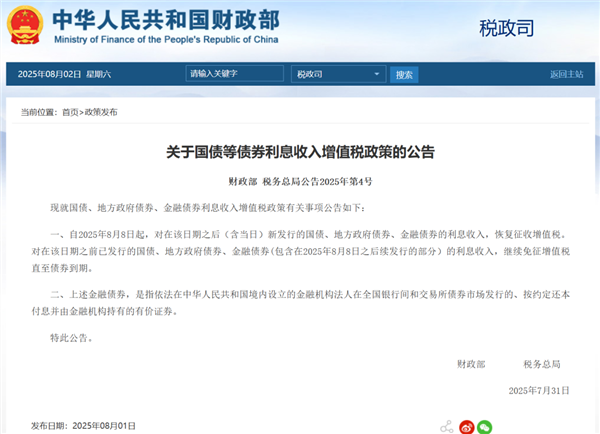
Core Viewpoint - The Ministry of Finance and the State Taxation Administration announced the resumption of value-added tax (VAT) on interest income from newly issued government bonds, local government bonds, and financial bonds starting from August 8, 2025, while maintaining VAT exemption for bonds issued before this date [1][2]. Group 1: Reasons for Policy Change - The historical mission of tax incentives has been fulfilled due to the significant scale of bond investments in the current "asset shortage" environment, making government bonds and local debts attractive [1]. - The policy aims to alleviate fiscal pressure and increase government revenue, with an estimated short-term revenue of approximately 33.7 billion yuan from the new VAT on bond interest income [2]. Group 2: Impact on Bond Market - The imposition of VAT on new bonds is expected to lead to an increase in issuance rates, creating a potential yield spread of 6-10 basis points between new and old bonds [3]. - The market reaction showed a short-term rise in 10-year government bond yields, followed by a decline, indicating investor preference for existing bonds due to anticipated tax pressures on new issues [3][4]. Group 3: Asset Class Implications - The removal of tax advantages for government bonds may shift investor interest towards equities and loans, although the overall impact on bond attractiveness is expected to be limited due to their low risk and high liquidity [4]. - The potential for a dual pricing mechanism for new and old bonds may emerge, with credit bonds maintaining their tax status, thus enhancing their relative attractiveness [4]. Group 4: Future Considerations - The central bank's policy direction will be crucial, particularly regarding liquidity measures to counterbalance the reduced attractiveness of new bonds [5]. - The ongoing debate about tax incentives for public funds and their potential changes could significantly affect the bond market's supply-demand structure [6]. Group 5: Individual Investor Impact - The impact on individual investors is minimal, as their participation in the bond market is low, and the VAT exemption for small taxpayers further mitigates any potential effects [7].

上半年财政收入数据的几个不寻常
Sou Hu Cai Jing· 2025-07-30 05:16
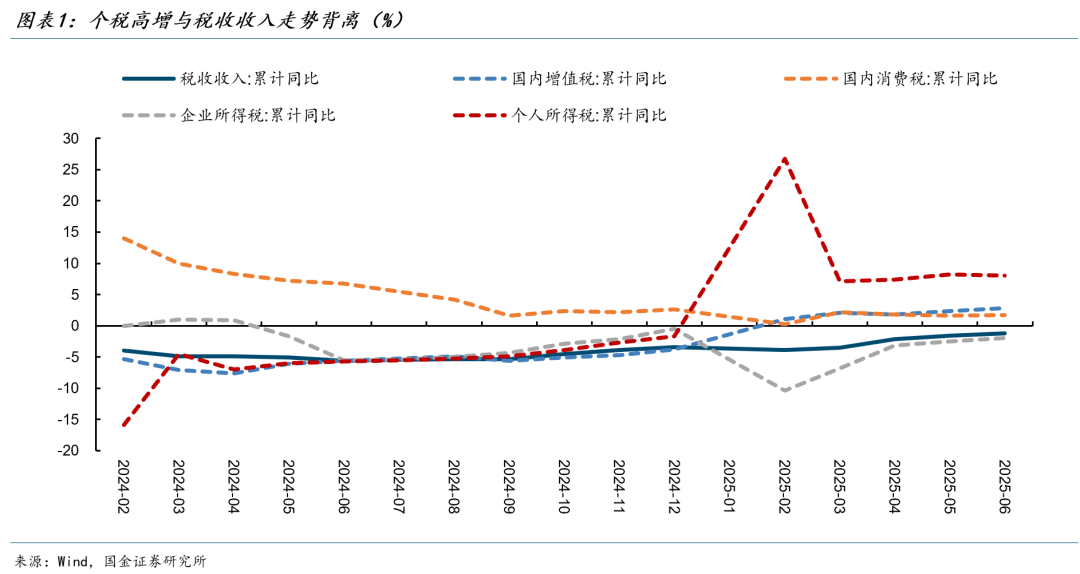
Group 1 - The core viewpoint of the articles highlights the significant increase in individual income tax (IIT) revenue, which is primarily attributed to improved tax collection efficiency and enforcement, rather than an increase in residents' disposable income [1][5][10] - In the first half of the year, individual income tax revenue grew by 8% year-on-year, while urban residents' per capita disposable income only increased by 4.7%, indicating a disparity between income growth and tax revenue [5][10] - The increase in individual income tax is mainly driven by high-income earners, with those earning over 1 million yuan annually contributing over 50% of the total IIT revenue, despite representing only 1% of the total filers [5][10] Group 2 - The divergence between value-added tax (VAT) and corporate income tax (CIT) is notable, with VAT revenue increasing by 2.8% while CIT revenue decreased by 1.9% in the first half of the year [12][13] - This divergence is attributed to "involution" competition leading to increased revenue without corresponding profit growth, as well as one-time factors affecting CIT collection early in the year [12][13] - The overall corporate income tax revenue was negatively impacted by a reduction in tax payments from central financial enterprises, which accounted for a significant portion of the decline [13] Group 3 - Non-tax revenue experienced a decline, with a year-on-year growth of only 3.7% in the first half of the year, and a negative growth rate observed since May [17][18] - The slowdown in non-tax revenue growth is linked to diminishing support from the monetization of state-owned assets and improvements in the business environment leading to reduced administrative fees and penalties [17][18] - The revenue from state-owned resource asset usage, which constitutes a significant portion of non-tax revenue, is expected to face challenges as easily monetizable assets have already been utilized [18]
上半年财政收入数据的几个不寻常(国金宏观张馨月)
雪涛宏观笔记· 2025-07-30 01:55
Group 1 - The core viewpoint of the article highlights that the significant increase in individual income tax (IIT) is primarily due to improved tax collection efficiency and enforcement, while the divergence between value-added tax (VAT) and corporate income tax (CIT) is mainly influenced by one-time factors at the beginning of the year. Additionally, the negative shift in non-tax revenue reflects improvements in the business environment [1][3][11]. Group 2 - In the first half of the year, national tax revenue reached 9.29 trillion yuan, showing a year-on-year decline of 1.2%, with VAT, CIT, and consumption tax growth rates at 2.8%, -1.9%, and 1.7% respectively. Despite weak growth in overall tax revenue, IIT saw a notable increase of 8% year-on-year [3][6]. - The growth in IIT is not aligned with improvements in residents' disposable income, which only increased by 4.7%. High-income earners contribute significantly to IIT, with those earning over 1 million yuan accounting for over 50% of the total IIT collected [6][10]. - The increase in IIT is attributed to several factors, including the full implementation of the "Golden Tax" Phase IV, which enhances tax collection efficiency through data integration and analysis, and the implementation of the Common Reporting Standard (CRS) for overseas income reporting [8][10]. - The rise in stock transfers and employee stock incentives, particularly in high-income cities like Beijing and Shanghai, has also contributed to the increase in IIT. In the first half of the year, Beijing's IIT revenue grew by 7.8% [10]. - The growth in dividend income from listed companies, with a total dividend payout of nearly 2.4 trillion yuan, has further supported the increase in IIT [10]. Group 3 - The divergence between VAT and CIT is unusual, with VAT growing by 2.8% while CIT declined by 1.9%. This divergence is attributed to "involution" competition leading to increased revenue without corresponding profit growth, as well as one-time factors affecting CIT collection early in the year [11][12]. - The decline in non-tax revenue, which reached 2.27 trillion yuan with a year-on-year growth of only 3.7%, is primarily due to reduced support from the monetization of state-owned assets and improvements in the business environment leading to lower administrative fees and penalties [15][16][17].

炒港美股“补税潮”突袭?一文了解始末
财联社· 2025-07-21 11:54
Core Viewpoint - A nationwide self-inspection and tax payment initiative targeting domestic residents' investment income from Hong Kong and U.S. stocks has been launched, focusing on high-net-worth individuals and requiring them to report and pay taxes on overseas income from 2022 to 2024 [1][2][4]. Group 1: Legal Basis and Tax Types - The legal basis for taxing domestic residents' overseas income has been clearly established, requiring individuals to report overseas investment income, interest, capital gains, and employment income [2][6]. - The tax types involved include capital gains tax and dividend tax, both subject to a 20% rate, with capital gains from investments via the Hong Kong Stock Connect being exempt from personal income tax until the end of 2027 [2][9]. Group 2: Impact and Industry Response - The frequency of tax payment notifications has significantly increased since May, expanding from first-tier cities to economically active regions, primarily targeting residents who invested through overseas brokers [3][4]. - The current round of tax notifications mainly affects high-asset individuals, with required payments ranging from over 100,000 to several million yuan, highlighting a previously weak enforcement of tax regulations on overseas investment income [4][6]. - Despite the notifications, industry insiders indicate that the overall impact on brokerage firms is manageable, as many had already ceased new business with mainland residents due to regulatory definitions of non-compliance [2][11]. Group 3: Tax Calculation and Controversies - Tax on capital gains is calculated based on the difference between selling and buying prices, with a 20% tax applied to the profit, while dividend tax involves a 20% total tax burden after accounting for U.S. withholding taxes [9][10]. - There are ongoing discussions regarding the taxation of losses and gains over multiple years, with investors expressing dissatisfaction over the requirement to pay taxes in profitable years despite no overall gain [10]. Group 4: Shift to Hong Kong Stock Connect - The tax policy has prompted some investors to consider shifting their focus to the Hong Kong Stock Connect, which offers significant tax advantages by exempting capital gains tax until 2027 [11][12]. - However, concerns remain regarding the limited range of investment options available through the Hong Kong Stock Connect, which may not cover all desired stocks and derivatives [12].

境外投资补税潮来袭?高净值人群必知的合规指南
私募排排网· 2025-07-21 03:50
Core Viewpoint - The article discusses the recent trend of "overseas investment tax supplementation," emphasizing that this is not a legal term but rather a reflection of strengthened tax compliance and the economic downturn, leading to increased scrutiny and pressure on investors [5][6][8]. Group 1: Background and Drivers - The trend of tax supplementation is driven by the transition from "loose management" to "refined governance" in tax administration, where previous gray areas for tax avoidance are being eliminated [5][6]. - The implementation of the "Golden Tax Phase IV" system and the Common Reporting Standard (CRS) has enhanced the ability of tax authorities to monitor overseas investments, leading to a perception of increased tax burden among companies [5][6][8]. - Economic downturns have intensified compliance cost pressures, as companies face additional expenses related to tax supplementation and penalties, which can threaten their survival [6][8]. Group 2: Tax Compliance and Obligations - Chinese tax residents are obligated to pay taxes on global income, including overseas investments, with the recent focus on capital gains, dividends, and interest from foreign investments [11][12][17]. - The tax rate for capital gains from overseas stock sales is set at 20%, with specific rules for dividends and interest income, requiring additional payments if taxes have already been withheld abroad [11][12][17]. - The tax authorities have begun notifying investors in Hong Kong and U.S. stocks to self-check and supplement taxes for the period from 2022 to 2024, indicating a proactive approach to tax compliance [11][12][17]. Group 3: Risk of Non-Compliance - The article outlines behaviors that could lead to being classified as "malicious tax evasion," including intentional concealment of overseas income and falsifying transaction records [14][16]. - Taxpayers can avoid penalties by voluntarily declaring and paying owed taxes before receiving a notice from tax authorities, but failure to comply can result in significant fines and back taxes [16][17][18]. - The article emphasizes the importance of maintaining proper documentation and compliance to mitigate risks associated with overseas investments and tax obligations [24][27][30]. Group 4: Future Outlook - The continuation of the tax supplementation trend will depend on the effectiveness of tax education and compliance measures implemented by the government, as well as the enforcement of long-term policies [32]. - As tax compliance becomes a competitive factor for businesses, the article suggests that companies must adapt to a landscape where tax governance is increasingly scrutinized [32].

个人所得税连续两个月高增,背后可能有四个原因
Xin Lang Cai Jing· 2025-06-23 09:39
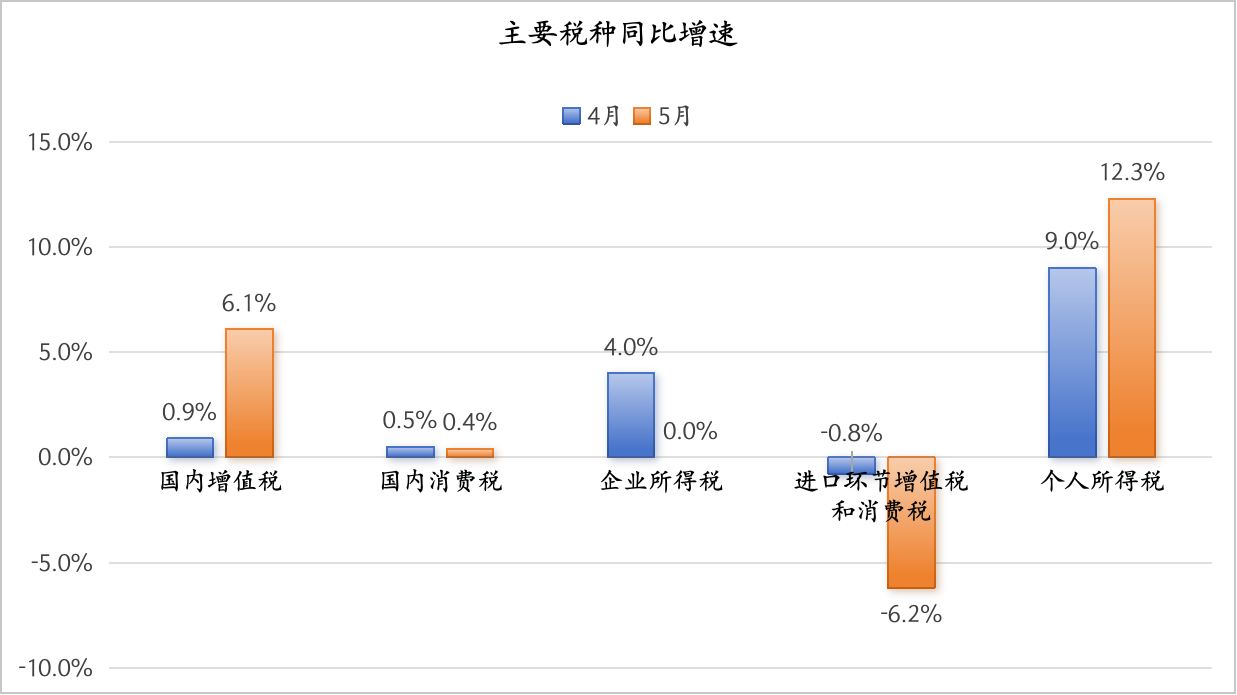
Group 1 - The core viewpoint of the articles highlights a significant increase in personal income tax (PIT) revenue, with a year-on-year growth of 8.2% from January to May, surpassing the overall tax revenue growth rate of -1.6% [1] - In May, the PIT growth accelerated to 12.3% compared to April, indicating a strong performance among major tax categories [1] - Analysts attribute the high growth in PIT to a combination of economic recovery, enhanced tax administration, wage adjustments, and dividend income [1][3] Group 2 - The marginal recovery in residents' income is a primary driver of the PIT increase, with urban residents' disposable income growing by 4.9% year-on-year in Q1, a 0.3 percentage point increase from Q4 of the previous year [3] - The active second-hand housing market in several cities has also contributed to the rise in PIT revenue [3][4] - The implementation of the "Golden Tax" Phase IV system has strengthened tax collection efforts, utilizing big data and artificial intelligence to monitor tax compliance [7][8] Group 3 - Wage adjustments and dividend income are significant factors influencing the PIT growth, with wages and dividends accounting for nearly 80% of PIT revenue [8] - The potential for continued high PIT growth in the second half of the year is supported by the expectation of further wage adjustments and stable dividend policies [8] - Despite potential economic uncertainties and a cooling real estate market, the likelihood of PIT experiencing negative growth remains low [10]