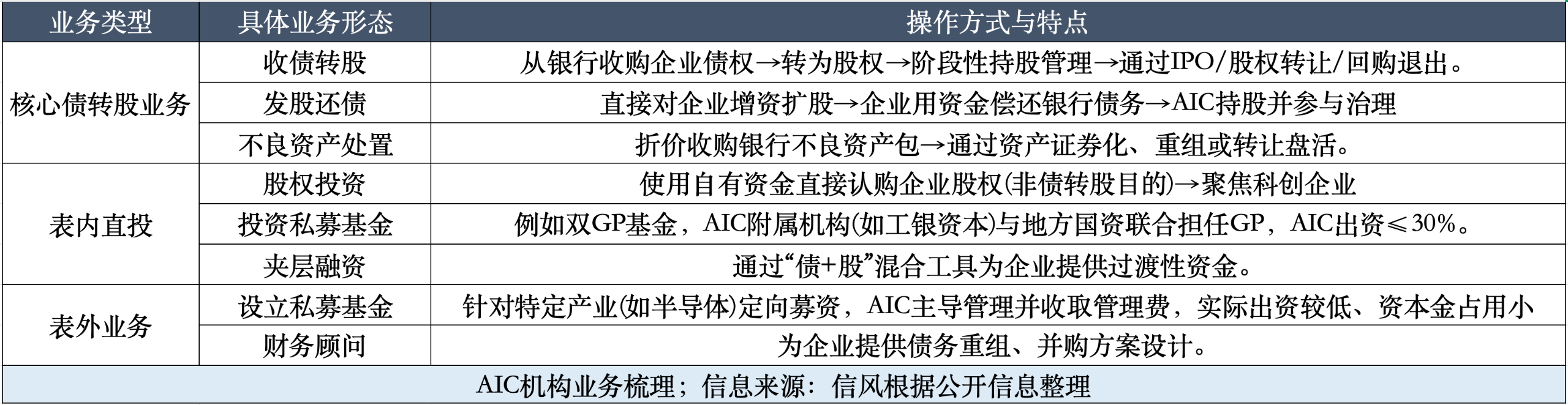
金融资产投资公司(AIC)

Search documents
股份行AIC破冰,兴业银行拔得头筹
Huan Qiu Wang· 2025-11-17 07:30
Core Insights - The establishment of Xingyin Financial Asset Investment Co., Ltd. marks the first financial asset investment company (AIC) initiated by a joint-stock bank in China, breaking the monopoly of the five major state-owned banks in this sector since 2017 [1][3] - The company has a registered capital of 10 billion yuan and aims to support technology innovation and the development of private enterprises by optimizing capital structures and reducing leverage [1][3] Regulatory Background - The significant expansion of regulatory policies in March 2023 allowed qualified commercial banks to establish AICs, promoting financial resources towards the technology innovation sector [3] - Following the approval of Xingyin's establishment, other banks such as CITIC Bank and China Merchants Bank were also granted permission to set up AICs, indicating a growing trend in the banking sector [3] Industry Impact - AICs are viewed as "patient capital," providing long-term support to technology enterprises and helping to lower financing costs while diversifying investment risks [4] - The growth of AICs is expected to provide stable and robust financial support for high-quality economic development and industrial upgrades in China [4]



全国首家!股份制银行AIC正式揭牌
证券时报· 2025-11-16 12:28
Core Viewpoint - The establishment of Xingyin Financial Asset Investment Co., Ltd. marks a significant expansion in China's banking sector AIC market, breaking the previous monopoly held by the five major state-owned banks and providing new momentum for financial support to technology innovation and private enterprises [2][4]. Group 1: Company Establishment - Xingyin Financial Asset Investment Co., Ltd. was officially established in Fuzhou on November 16, with a registered capital of 10 billion yuan, focusing on market-oriented debt-to-equity swaps and related businesses to support the optimization of capital structures for tech and private enterprises [1][5]. - This company is the first financial asset investment company initiated by a joint-stock bank, following the regulatory expansion allowing commercial banks to establish AICs [4][5]. Group 2: Regulatory Background - The establishment of Xingyin Investment is a result of the National Financial Regulatory Administration's notification in March, which supports qualified commercial banks in setting up AICs to channel financial resources towards technology innovation [4][5]. - The regulatory framework was expanded to include 18 pilot cities, allowing more commercial banks to participate in the AIC market, which previously consisted solely of state-owned banks [4][5]. Group 3: Industry Impact - The entry of Xingyin Investment is expected to enhance the financial support for technology innovation and private enterprises, contributing to the high-quality development of the real economy [7][8]. - As more banks are approved to establish AICs, the collective "patient capital" from the banking sector will help reduce financing costs for tech enterprises and diversify investment risks, providing stable financial support for economic development and industrial upgrades [8].

“新玩家”即将登场、投资端动作频频,AIC市场扩容提速
Bei Jing Shang Bao· 2025-11-10 11:44
Core Insights - The AIC market is experiencing significant changes with the entry of new players, particularly the approval of the first joint-stock bank AIC, Xingyin Investment, which marks a shift from state-owned banks dominating the market to a more diversified competitive landscape [1][3][5] Group 1: Market Developments - Xingyin Investment, a wholly-owned subsidiary of Industrial Bank, received regulatory approval to commence operations, with a registered capital of RMB 10 billion [3] - The establishment of Xingyin Investment is seen as a critical step in supporting the national strategy and empowering the real economy, particularly in aiding tech and private enterprises [3][5] - The AIC market is expanding rapidly, with several banks, including CITIC Bank and China Merchants Bank, also receiving approvals to establish their AICs, indicating a trend towards increased participation from joint-stock banks [5][6] Group 2: Investment Trends - The investment landscape within the AIC sector is becoming increasingly active, with various funds being established, such as the Jiangsu Social Security Sci-Tech Fund, which has a first-phase scale of RMB 50 billion [7] - Another notable fund, the Shenzhen Jianyuan Zhengxing Equity Investment Fund, aims to become the largest AIC fund in the country, with an overall scale projected to reach RMB 20 billion [8] - Major state-owned banks have reported significant progress in their AIC investments, with Industrial Bank establishing 28 AIC equity investment funds and Agricultural Bank serving nearly 300,000 tech enterprises [9] Group 3: Future Outlook - Analysts predict that the AIC sector will see a doubling in the number of institutions, with a competitive landscape emerging where state-owned banks leverage scale and policy resources, while joint-stock banks focus on flexibility and industry specialization [6] - The collaboration between government-guided funds and social capital is becoming more pronounced, facilitating long-term capital inflow into the tech innovation sector [10] - The active participation of AICs reflects a consensus on the need for innovation-driven development, emphasizing resource optimization and long-term investment strategies [10]

首家股份行AIC获批开业!兴银投资落地福州,注册资本百亿
Nan Fang Du Shi Bao· 2025-11-10 03:00
Group 1 - The core point of the article is the approval and establishment of the first financial asset investment company (AIC) under a joint-stock bank in China, specifically the Xinyi Financial Asset Investment Co., Ltd. [2][3] - Xinyi Investment has a registered capital of 10 billion RMB and is located in Fuzhou, Fujian Province [3]. - The establishment of Xinyi Investment marks a significant step for the company in supporting national strategies and empowering the real economy, focusing on debt-to-equity swaps and related businesses to support technology and private enterprises [3]. Group 2 - The approval of Xinyi Investment is part of a broader trend where other joint-stock banks, such as CITIC Bank and China Merchants Bank, are also establishing their AICs, with registered capitals of 10 billion RMB and 15 billion RMB respectively [3]. - The Postal Savings Bank, previously absent in the AIC sector, has also announced plans to establish its own AIC with a registered capital of 10 billion RMB, completing the lineup of the six major state-owned banks in this area [4]. - Currently, there are five operational AICs in China, all initiated by major state-owned banks in 2017, with varying performance results reported in their recent half-year reports [5]. Group 3 - The performance of existing AICs has shown significant disparity, with Agricultural Bank's investment arm reporting a net profit of 1.936 billion RMB, a year-on-year increase of 54.88%, while others like China Construction Bank's investment arm saw declines in net profit by 43.34% [5]. - Compliance issues have arisen, with some AICs facing penalties for business violations, highlighting the challenges of maintaining compliance and profitability in a competitive environment [6].

首家股份行AIC,获批开业!
券商中国· 2025-11-09 12:51
Core Viewpoint - The establishment of Xingyin Investment marks a significant step for Industrial Bank in supporting national strategies and empowering the real economy through specialized financial asset investment services [1][3]. Group 1: Company Developments - Xingyin Investment, a wholly-owned subsidiary of Industrial Bank, has received approval from the National Financial Regulatory Administration to commence operations, with a registered capital of 10 billion yuan [2][3]. - The approval process for Xingyin Investment began in May, and it is the first joint-stock bank to establish a financial asset investment company (AIC) [1][2]. - The company aims to leverage its experience in private equity and venture capital to support technology and private enterprises, optimizing capital structures and reducing leverage [3]. Group 2: Industry Context - The AIC license expansion is accelerating, with several banks, including CITIC Bank and China Merchants Bank, also receiving approvals to establish AICs [4][6]. - The regulatory environment is evolving, with policies introduced in 2024 to expand AIC direct equity investment pilot programs across multiple cities, enhancing the role of AICs in supporting economic growth [5][6]. - AICs are expected to open new avenues for banks to engage in equity investments, particularly in high-potential sectors such as advanced manufacturing, biomedicine, and artificial intelligence [7]. Group 3: Strategic Implications - The expansion of AICs is seen as a crucial mechanism for banks to participate in technology finance and equity markets, potentially leading to innovative business models in venture capital and corporate restructuring [7]. - Analysts suggest that the ability to conduct long-term equity investments through AICs will help banks address the mismatch between risks and returns in financing technology enterprises, enhancing support for these sectors [7].

兴业银行全资子公司兴银投资获准开业,注册资本为100亿元
Zhong Guo Ji Jin Bao· 2025-11-09 10:12
Core Viewpoint - The establishment of Xingyin Investment, a wholly-owned subsidiary of Industrial Bank, marks a significant step in the bank's efforts to support national strategies and empower the real economy through specialized and market-oriented debt-to-equity conversion and related businesses [6][5]. Group 1: Company Overview - Xingyin Investment has been approved to commence operations with a registered capital of 10 billion RMB, making it the first AIC initiated by a joint-stock bank [4][5]. - The approval from the National Financial Regulatory Administration was received on November 7, 2025, allowing Xingyin Investment to proceed with its opening procedures [5]. Group 2: Industry Context - Xingyin Investment is the sixth licensed AIC in the industry, following five state-owned banks, indicating a shift towards greater participation from joint-stock banks in the AIC sector [4][8]. - The AIC market has seen significant changes in 2025, with the National Financial Regulatory Administration expanding the pilot scope for AICs, allowing more commercial banks to engage in market-oriented debt-to-equity conversion and equity investment [8][9]. - The entry of joint-stock banks and urban commercial banks into the AIC space is expected to foster differentiated investment strategies, enhancing the overall financial system's ability to embrace uncertainty [9].

信银金投望“落子”广州,是否入局AIC银行仍存分歧
Feng Huang Wang· 2025-09-01 12:59
Core Viewpoint - The establishment of Asset Investment Companies (AIC) is gaining momentum among Chinese banks, with notable developments from banks like CITIC Bank and Postal Savings Bank, indicating a shift in the banking sector towards new investment opportunities and strategies [1][3][5]. Group 1: Developments in AIC Establishment - In March 2025, regulatory authorities announced further support for national banks to establish AICs, leading to responses from several banks including CITIC Bank and Industrial Bank [1]. - CITIC Bank announced plans to fully establish a financial asset investment subsidiary, receiving approval from the National Financial Supervision Administration for the establishment of Xinyin Financial Asset Investment Co., with a registered capital of RMB 10 billion [1]. - The headquarters of Xinyin Financial Asset Investment Co. is expected to be in Guangzhou, chosen for its significance in the Guangdong-Hong Kong-Macao Greater Bay Area and its vibrant tech enterprise ecosystem [1]. Group 2: Differing Attitudes Among Banks - There is a divide among banks regarding the establishment of AICs, with some banks like CITIC, Industrial, and China Merchants Bank officially moving forward, while others remain cautious and are observing the outcomes of these early adopters [3][4]. - Postal Savings Bank is actively pursuing the establishment of its own AIC, planning to invest RMB 10 billion, but has not yet received approval for its establishment [3][4]. Group 3: Market Sentiment and Challenges - The market generally views the expansion of AIC licenses from state-owned banks to joint-stock banks positively, anticipating new business opportunities distinct from traditional lending [5]. - Despite optimism, banks with existing AIC licenses are prioritizing stability and risk management, facing challenges such as limited exit channels for equity investments [5][6]. - The current IPO environment poses difficulties for banks seeking to realize returns on equity investments, leading to a cautious approach among smaller banks regarding AIC establishment [6].


邮储银行答21记者问:推进均衡战略,破局公司金融
2 1 Shi Ji Jing Ji Bao Dao· 2025-08-30 08:03
Core Viewpoint - Postal Savings Bank of China (PSBC) reported a stable mid-year performance with total assets reaching 18.19 trillion yuan, a 6.47% increase year-on-year, and net profit of 49.415 billion yuan, up 1.08% from the previous year [1][2]. Financial Performance - As of June 2025, PSBC's total assets were 18.19 trillion yuan, with total liabilities at 17.05 trillion yuan, reflecting growth rates of 6.47% and 6.21% respectively [1]. - The bank's operating income for the first half of the year was 179.446 billion yuan, a year-on-year increase of 1.50%, while net profit reached 49.415 billion yuan, growing by 1.08% [2]. - The net interest margin stood at 1.70%, with a slight decline of 17 basis points compared to 2024, primarily due to one-time factors affecting loan yield [7][9]. Revenue Structure Optimization - PSBC's interest income was 139.058 billion yuan, with corporate loan interest income showing a positive growth of 2.08% year-on-year despite a challenging interest rate environment [2]. - Non-interest income saw significant contributions, with intermediary business income increasing by 11.59% and other non-interest income rising by 25.16%, enhancing the overall revenue structure [2][3]. Company Financial Strategy - The bank is actively applying for a Financial Asset Investment Company (AIC) to enhance its corporate finance capabilities, which is a key part of its balanced strategy [4][6]. - PSBC aims to build a "1+N" operational and service system focusing on customer-centric approaches, integrating various financial services to improve client loyalty and return [5]. Market Positioning and Differentiation - The bank is focusing on high-efficiency operations by breaking down internal barriers and enhancing collaboration between different departments to improve service delivery [5]. - PSBC is targeting specific market segments aligned with national policy directions, emphasizing innovation and risk management to optimize its market strategies [6]. Future Outlook - The bank is confident in maintaining a strong net interest margin due to its effective management of both asset and liability sides, with a focus on long-term capacity building [9]. - PSBC's self-operated deposits increased by 130 billion yuan year-on-year, with a deposit interest rate decline of 20 basis points, indicating a stable funding cost structure [8].
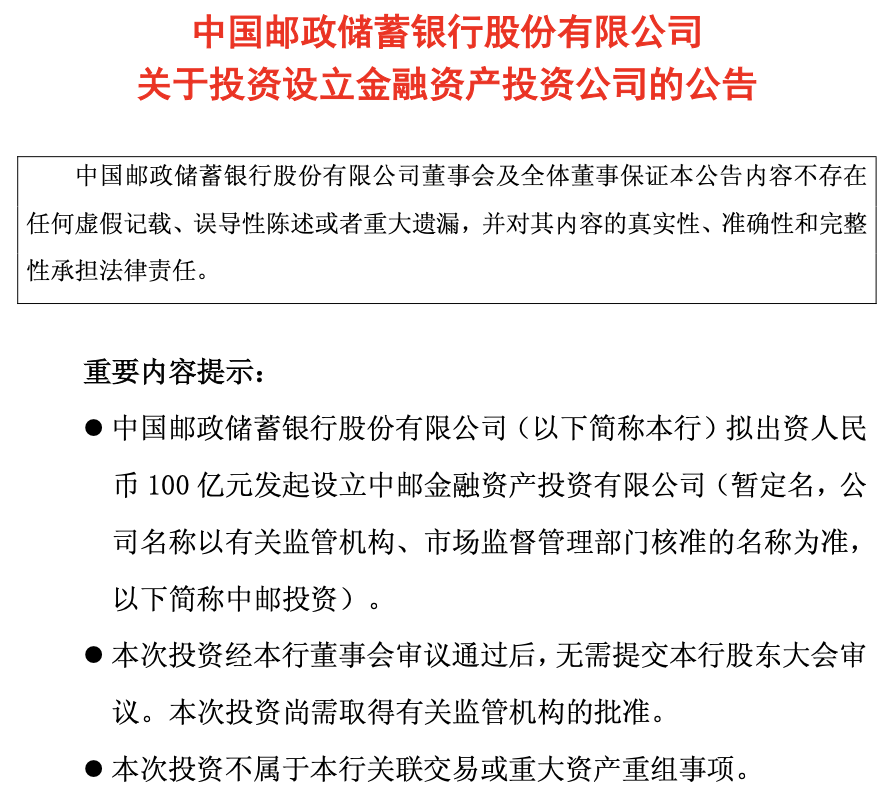
六大行AIC全部集结,邮储银行斥资百亿设立中邮投资
Hua Er Jie Jian Wen· 2025-07-16 15:01
Group 1 - Postal Savings Bank of China announced plans to invest 10 billion yuan to establish China Post Financial Asset Investment Co., Ltd. as a wholly-owned subsidiary [1] - The establishment of the AIC will expand the total number of AIC companies in the industry to nine, following the approval of Postal Savings Bank's investment qualifications [4] - The role of AIC has evolved from a tool for risk mitigation to a platform for banks to engage in equity investments and mixed operations, responding to national calls for supporting technological innovation [4][7] Group 2 - The profits from existing AICs have not significantly contributed to the parent banks, with total profits of 18.354 billion yuan for five major banks' AICs in 2024, accounting for less than 2% of the parent banks' total profits [7] - However, the profit growth rates for specific AICs, such as Bank of China Asset and Industrial and Commercial Bank Asset, have outpaced their parent banks, with compound annual growth rates reaching 57.93% from 2018 to 2024 [7] - The future performance of China Post Investment in terms of its ability to support the parent bank and enhance overall profitability remains to be seen [7]
“零售之王”AIC牌照落地 银行系股权投资迎来小高潮
Hua Er Jie Jian Wen· 2025-07-08 13:23
Core Viewpoint - The banking sector's financial asset investment companies (AICs) are shifting their focus from resolving non-performing assets to equity investments, as evidenced by the recent approval of China Merchants Bank's AIC, which highlights a broader trend in the industry [1][7]. Group 1: Regulatory Changes and Market Entry - China Merchants Bank has become the third joint-stock bank to hold an AIC license, following Industrial Bank and CITIC Bank [2]. - The regulatory landscape for AICs has evolved significantly since 2024, with the pilot program expanding from Shanghai to 18 cities, and the investment cap for AICs increasing from 4% to 10% of total assets [4][25]. - The rapid approval of AIC licenses for major joint-stock banks indicates a growing interest and participation in equity investment activities within the banking sector [5][30]. Group 2: Capital and Investment Strategy - China Merchants Bank's AIC, with a registered capital of 15 billion yuan, reflects its commitment to equity investment, surpassing its peers in the joint-stock banking sector [8]. - The establishment of AICs is seen as a means to enhance banks' capabilities in direct equity investments and integrated financial services [12][28]. - Historically, AICs were primarily focused on debt-to-equity swaps, but recent regulatory changes have allowed for a broader range of equity investment activities [14][24]. Group 3: Performance and Future Outlook - The performance of AICs has shown significant growth, with the profit growth rate of AICs outpacing that of their parent banks, indicating their potential to contribute to overall profitability [30]. - The shift towards equity investment is expected to align with market demands for long-term capital allocation, particularly in high-tech sectors [28][34]. - Challenges remain, including high capital consumption and reliance on IPOs for exits, which may impact the profitability of AICs [33][34].