高性能化

Search documents
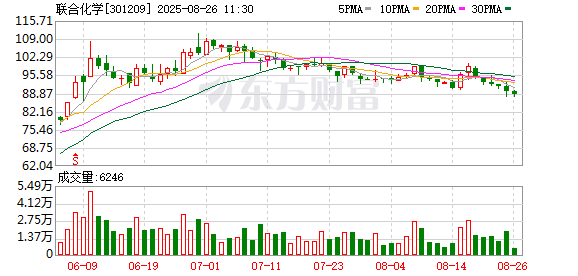
联合化学上半年营收净利双增长
Zhong Zheng Wang· 2025-08-26 07:18
Core Insights - The company reported a revenue of 269 million yuan for the first half of 2025, representing a year-on-year growth of 4.15% and a net profit of 33.76 million yuan, which is a 21.62% increase compared to the previous year [1] - The gross profit margin for pigments and base inks remained above 20%, and the net cash flow from operating activities reached 44.24 million yuan, showing a significant increase of 105.66% [1] Industry Overview - The company operates in the azo organic pigment sector, which is widely used in inks, plastics, coatings, textiles, and daily chemicals. The industry is currently trending towards environmental protection, high performance, and functionality due to stricter environmental regulations and upgrading of downstream industries [1] - The company has positioned itself to meet the EU's environmental regulations set for after 2028, indicating a proactive approach to compliance and sustainability [1] R&D and Market Position - The company has focused on R&D, with nearly 20 major projects underway, including a new red pigment suitable for UV curing technology, aimed at tapping into the high-growth UV curing market [2] - The company is also developing functional materials that meet customer-specified spectral characteristics, currently in the trial phase, which could enhance its position in the specialty materials market [2] - The company has established itself as a core supplier for large domestic and international ink manufacturers, particularly as the largest supplier and strategic partner for DIC Corporation's SUN CHEMICAL in China, highlighting its international competitiveness in technology, quality, and supply chain management [2]
联合化学上半年净利润同比增长21.62%
Zheng Quan Ri Bao· 2025-08-26 04:39
Group 1: Industry Development - The organic pigment industry, particularly azo organic pigments, is evolving towards environmental protection, high performance, and functionality due to stricter environmental regulations, downstream industry upgrades, and growing demand in emerging markets [1] - The company has products that meet EU environmental regulations set for after 2028, positioning itself as a leader in compliance with high standards [1] - The company emphasizes R&D investment in green processes and high-value-added products, collaborating with downstream industries to innovate and maintain market share [1] Group 2: R&D Projects - The company has disclosed nearly 20 major R&D projects, including a new red pigment suitable for UV curing technology, which has completed validation and aims to penetrate the high-growth UV curing market [1] - A functional material that meets customer-specified spectral characteristics is currently in customer trials, achieving an absorption rate of ≥95% in target bands, enhancing the company's position in the specialty materials market [1] Group 3: New Ventures - The company has established a subsidiary, Qichen Semiconductor New Materials, to enter the photoresist field, focusing on the R&D and production of styrene-based photoresist monomers and resins, creating a new profit growth point [1] - The initial design capacity for this project is 200 tons per year, with plans to expand production based on market demand [1] Group 4: Investment Activities - In July, the company announced a 120 million yuan investment in Zhuoguangrui Technology, acquiring a 19.3548% stake to support the development of domestic projection exposure machines and related components [2] - The company has the option to invest an additional 120 million yuan within six months, potentially increasing its stake in Zhuoguangrui to 36.4977% [2] - Zhuoguangrui's subsidiary, Gangjing Optical Technology, has achieved significant sales growth this year, with advance payments exceeding 50 million yuan [2] Group 5: Financial Performance - In the first half of 2025, the company reported revenue of 269 million yuan, a year-on-year increase of 4.15%, and a net profit attributable to shareholders of 33.757 million yuan, up 21.62% year-on-year [4] - The report indicates that this marks the sixth consecutive quarter of year-on-year growth in both revenue and net profit [4]

富恒新材:上半年改性工程塑料类收入同比增长43.94%
Zheng Quan Shi Bao Wang· 2025-08-25 03:30
Group 1 - The core viewpoint of the article highlights that 富恒新材 (Fuheng New Materials) reported a revenue of 321 million yuan and a net profit of 6.79 million yuan for the first half of 2025, facing pressure due to a decline in customer orders and sales prices [1] - The revenue from modified engineering plastics increased by 43.94% year-on-year, primarily driven by increased orders from BYD and Shenzhen Jiasind Technology Co., Ltd [1] - The modified plastics market in China is projected to reach a scale of 310.7 billion yuan in 2024, with a year-on-year growth of 6.44%, accounting for 28% of the global market share [1] Group 2 - The modified plastics industry is accelerating towards high performance and green development, with increasing material performance requirements from downstream sectors, which will further expand market demand [1] - The rise of trade protection policies is prompting the domestic modified plastics industry to accelerate import substitution, which will enhance the modification rate and market scale, providing more development opportunities for domestic modified plastics companies [1]
趋势研判!2025年中国镀铝膜行业工艺流程、产业链、发展现状、重点企业及前景展望:市场对高品质包装需求持续释放,镀铝膜行业发展前景广阔[图]
Chan Ye Xin Xi Wang· 2025-08-14 01:19
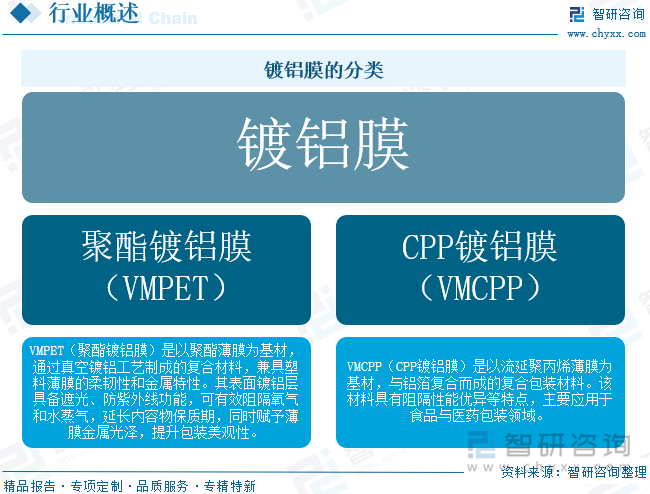
Industry Overview - The aluminum-coated film is a composite material formed by depositing a thin layer of aluminum on the surface of plastic films, enhancing barrier properties, light reflection, and anti-static capabilities [1][3] - The market for aluminum-coated films in China is projected to reach approximately 14.938 billion yuan in 2024, representing a year-on-year growth of 23.29% [1][13] - The demand for high-quality packaging is increasing due to consumer upgrades and government support for green packaging materials, leading to rapid penetration in food, pharmaceutical, and electronic sectors [1][13] Production Process - The production process of aluminum-coated films includes several steps: substrate unwinding, vacuum pumping, heating evaporation boat, aluminum wire feeding, vapor deposition, cooling, thickness measurement, flattening, and rewinding [5][6] - The aluminum is evaporated at high temperatures (1300-1400°C) in a vacuum environment, allowing aluminum molecules to deposit on the plastic film surface [5][6] Industry Chain - The upstream of the aluminum-coated film industry includes raw materials (PET, BOPP, CPP films, aluminum wire) and equipment (vacuum coating machines, substrate treatment systems) [7] - The downstream applications encompass electronics, construction, packaging, and automotive sectors, with significant usage in food, pharmaceutical, and cosmetic packaging [7][10] Market Trends - The aluminum material production in China is expected to grow from 45.546 million tons in 2018 to 67.831 million tons in 2024, with a compound annual growth rate of 6.86% [9] - The packaging industry, a crucial pillar of the national economy, is projected to grow from 970.34 billion yuan in 2018 to 1.195 trillion yuan in 2024, with a compound annual growth rate of 3.53% [10] Key Companies - Major companies in the aluminum-coated film industry include Shanghai Yongchao New Materials Technology Co., Ltd., Qingzhou Jinqingyun New Materials Co., Ltd., and Zhejiang Changyu New Materials Co., Ltd., among others [15][16] - Zhejiang Changyu New Materials Co., Ltd. has an annual production capacity of 100,000 tons of various vacuum aluminum-coated films and is a key player in the market [17] Development Trends - The industry is focusing on high performance, with advancements in materials and processes to enhance barrier properties and meet the demands of food and pharmaceutical sectors [21] - Green and eco-friendly practices are becoming central, with a shift towards biodegradable materials and low-temperature coating processes to reduce environmental impact [22] - The trend towards smart manufacturing is reshaping production and service models, integrating IoT and AI for real-time monitoring and optimization of coating processes [23]
市场洞察:百亿市场崛起,这些企业正在悄悄“攻占工地”
Tou Bao Yan Jiu Yuan· 2025-08-06 11:43
Investment Rating - The report does not explicitly provide an investment rating for the structural adhesive industry Core Insights - The structural adhesive market in China is expected to exceed 50 billion yuan by 2025, driven by urbanization and infrastructure expansion, with a compound annual growth rate (CAGR) of 6.8% from 2015 to 2024 [16] - The export sales of structural adhesives from China are projected to surpass 4.5 billion yuan by 2025, with a CAGR of 3.7% from 2022 to 2024 [17] - The industry is characterized by a diverse competitive landscape, with major players like Huitian New Materials, Hangzhou Zhijiang, and Silica Technology holding significant market shares [22][23] Market Size and Growth - The structural adhesive market in China was approximately 26.9 billion yuan in 2015 and is forecasted to reach around 50 billion yuan by 2025, indicating a strong growth trajectory [16] - The market size is expected to be about 48.5 billion yuan in 2024, reflecting the increasing demand for high-performance adhesive materials [16] Export Performance - In 2022, the export sales of structural adhesives from China reached over 4 billion yuan, with expectations to grow to 4.5 billion yuan by 2025 [17] - Key companies driving exports include Huitian New Materials, Silica Technology, and Kangda New Materials, each achieving over 100 million yuan in overseas sales by 2024 [17][24] Competitive Landscape - The market is fragmented, with a CR10 (concentration ratio of the top 10 companies) of approximately 40% in 2024, indicating a competitive environment [23] - Huitian New Materials, Hangzhou Zhijiang, and Silica Technology are the leading companies, with market shares of 9.5%, 6.2%, and 5.4% respectively in 2024 [23][24] Future Development Trends - The industry is expected to evolve towards high performance, green and environmentally friendly products, and systematized services [29][30] - There is a growing emphasis on customized solutions and comprehensive service offerings, moving from mere product sales to integrated solutions that include design, construction, and maintenance [30] - The trend of globalization is anticipated, with Chinese companies expanding into international markets, particularly along the Belt and Road Initiative [31]


研判2025!中国汽车防冻剂行业产业链、市场规模及重点企业分析:中国汽车防冻剂行业稳步增长,新能源汽车需求推动市场扩容[图]
Chan Ye Xin Xi Wang· 2025-07-31 01:24
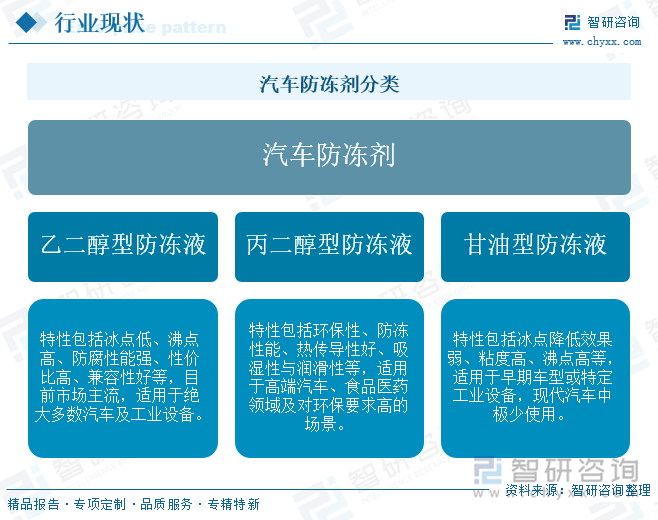
Industry Overview - The automotive antifreeze industry in China is experiencing steady growth, with a market size projected to reach 12.4 billion yuan in 2024, representing a year-on-year increase of 7.54% [1][11] - The rising number of vehicles is driving demand for automotive maintenance products, including antifreeze, which is essential for vehicle upkeep [1][11] - The cooling systems of electric vehicles differ from traditional fuel vehicles, necessitating higher performance and more environmentally friendly antifreeze products, prompting companies to increase R&D investments [1][11] Industry Chain - The upstream of the antifreeze industry includes raw materials and production equipment, with ethylene glycol being the most commonly used antifreeze component, accounting for 30%-60% of antifreeze costs [4][6] - The midstream involves the production and manufacturing of antifreeze, while the downstream application primarily serves the automotive industry [4] Market Dynamics - In the first half of 2025, China's automotive production reached 15.62 million units, a year-on-year increase of 12.45%, and sales reached 15.65 million units, up 11.43%, directly boosting antifreeze demand [7] - The domestic antifreeze industry is gradually achieving import substitution through technological upgrades and capacity expansion, with imports of antifreeze decreasing by 45.58% year-on-year in early 2025 [9] Key Companies - China Petroleum & Chemical Corporation (Sinopec) leads the high-end market with its OAT antifreeze products, which are priced 30%-50% higher than traditional products [13] - China National Petroleum Corporation (CNPC) follows closely, reducing production costs through vertical integration of ethylene glycol [13] - Jiangsu Longpan Technology Co., Ltd. is a leading private company in the antifreeze sector, focusing on high-performance products and expanding its market presence [16] Industry Trends - The industry is moving towards more environmentally friendly antifreeze solutions, with a focus on reducing harmful components and developing biodegradable products [18] - High-performance antifreeze is becoming a priority, especially for electric vehicles, which require specialized cooling solutions [19][20] - The integration of smart monitoring systems for real-time tracking of coolant status is emerging as a significant trend, enhancing maintenance efficiency [21]



2025年中国空调滤纸行业发展历程、市场规模、主要企业经营情况及发展前景展望:空调产业持续发展和消费者环保意识提升,空调滤纸行业规模超百亿元[图]
Chan Ye Xin Xi Wang· 2025-07-15 01:27
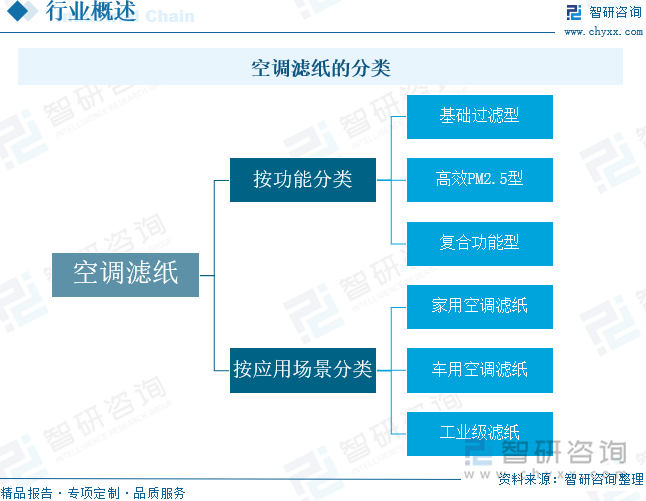
Core Insights - The air conditioning filter paper market in China is experiencing steady growth driven by urbanization and rising living standards, with market size expected to reach 10.355 billion yuan by 2024 [1][13] - The industry faced a decline in 2020 due to the COVID-19 pandemic, but has since rebounded significantly, surpassing 8 billion yuan in 2022 [1][13] - The market is characterized by technological innovation in filter materials and manufacturing processes, enhancing product performance and expanding application areas [1][9] Industry Overview - Air conditioning filter paper is essential for air filtration systems, effectively removing pollutants such as PM2.5 and harmful gases [3][10] - The industry has evolved through three stages: a nascent phase before 2000, rapid growth from 2000 to 2015, and a high-quality development phase from 2016 to present [5] - The current phase is marked by material innovation, functional integration, and smart technology applications [5][21] Market Dynamics - The air conditioning filter paper market is projected to grow from 8 billion yuan in 2022 to 10.355 billion yuan by 2024, driven by increased health awareness and consumption upgrades [1][13] - The production of air conditioning units in China is expected to rise from 178.6153 million units in 2017 to 265.984 million units by 2024, with a compound annual growth rate of 5.85% [10] Industry Structure - The industry features a diverse competitive landscape, with leading companies focusing on high-efficiency filter materials and forming strategic partnerships with major air conditioning manufacturers [15] - Key players include Chongqing Zaiseng Technology Co., Ltd., Hangzhou Special Paper Co., Ltd., and Shenyang Great Wall Filter Paperboard Co., Ltd., among others [15][16] Technological Barriers - The industry faces significant technological barriers in material research and production processes, requiring high levels of investment and expertise [21][24] - Environmental regulations are increasingly stringent, necessitating continuous improvements in production methods to reduce emissions [23][24] Future Trends - The industry is expected to focus on high-performance materials, smart technology integration, and environmentally friendly practices [25][26][27] - Innovations such as nanofiber materials and real-time monitoring capabilities are anticipated to enhance product efficiency and user experience [25][26]





2025年中国高分子防水卷材行业发展历程、产量、市场规模、重点企业及发展趋势研判:高分子防水卷材规模超200亿元,需求推动下市场前景可观[图]
Chan Ye Xin Xi Wang· 2025-07-05 23:44
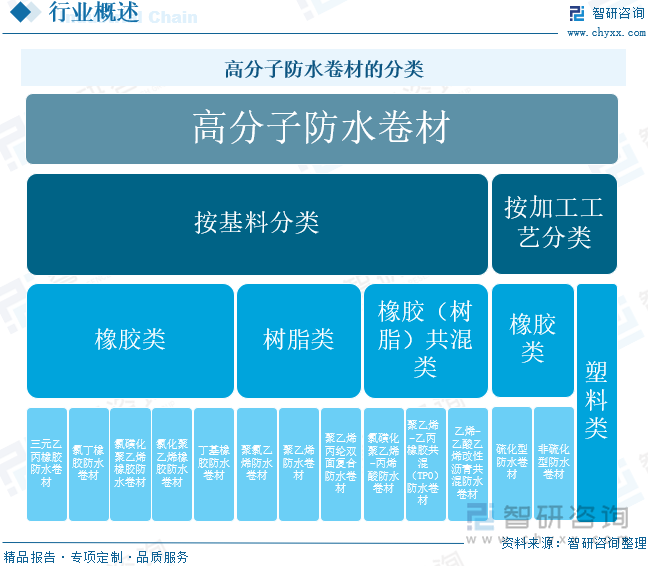
Industry Overview - Waterproof membranes are essential functional materials in the construction industry, comprising a significant part of the building materials industry. They mainly include SBS/APP modified bitumen waterproof membranes, self-adhesive membranes, and polymer waterproof membranes. Among these, polymer waterproof membranes are rapidly increasing their market share due to their durability, corrosion resistance, environmental friendliness, and ease of construction [1][18] - The market demand for polymer waterproof membranes has seen explosive growth due to accelerated urbanization and continuous investment in infrastructure. The market size for polymer waterproof membranes in China is projected to reach approximately 21.808 billion yuan in 2024 [1][18] Market Dynamics - The production of waterproof materials in China has maintained a steady growth rate of around 10% since 2015, with a significant increase in 2020 due to heightened demand. In 2023, the production of waterproof materials reached 5.81 billion square meters, a year-on-year increase of 19.16%. The production is expected to further increase to approximately 6.525 billion square meters in 2024 [14][15] - The polymer waterproof membrane market is expected to continue growing, supported by government policies favoring green building materials and increasing environmental regulations [1][18] Competitive Landscape - The market for polymer waterproof membranes in China is characterized by low concentration and a large number of companies. Major domestic players include Oriental Yuhong, Beixin Waterproof, and Kairun Building Materials, among others. There are also many small and medium-sized enterprises with varying product quality [21][22] - The competitive landscape is evolving, with larger companies expanding and smaller firms facing pressure, potentially leading to increased market concentration in the future [21] Industry Development Trends - The polymer waterproof membrane industry is expected to accelerate its focus on environmental sustainability, emphasizing the development and application of solvent-free and low-VOC materials. Traditional materials will gradually be replaced by recyclable high polymer materials [27] - Future advancements will focus on enhancing performance, including weather resistance, puncture resistance, and lifespan. Innovations such as self-healing materials and specialized membranes for unique applications will drive the industry towards high-end and professional development [28] - The integration of smart technologies in production and application processes is anticipated, with IoT and AI optimizing quality control and enabling real-time monitoring of material performance [29] - The industry will also prioritize ease of construction, developing products that reduce reliance on skilled labor and streamline installation processes [30]

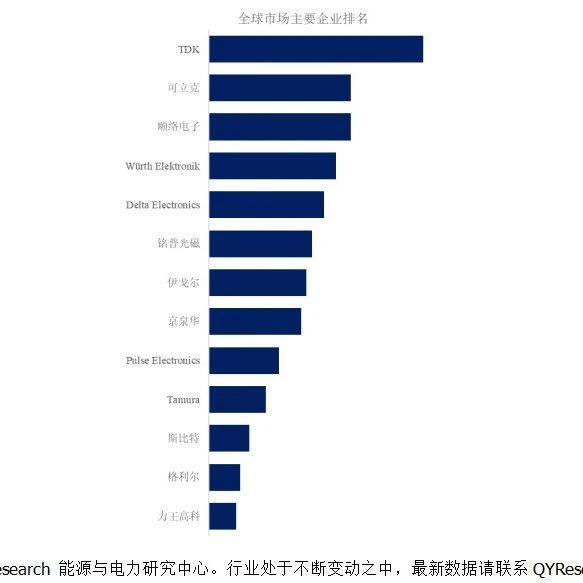
光伏&储能逆变器用磁性元器件,前13大企业占据全球71%的市场份额(2024)
QYResearch· 2025-06-30 09:52
Core Viewpoint - The global market for magnetic components used in photovoltaic (PV) and energy storage (ESS) inverters is projected to reach $3.3 billion by 2031, with a compound annual growth rate (CAGR) of 8.0% in the coming years [1]. Market Overview - The market for magnetic components in PV and ESS inverters is expanding significantly due to the rapid growth of the global photovoltaic and energy storage industries. China, as the largest market for photovoltaic installations, is experiencing a surge in demand for magnetic components [11]. - The top five manufacturers in this market hold approximately 42.0% of the global market share as of 2024 [5]. Technological Requirements - There is an increasing demand for high-performance magnetic components due to the rising efficiency of photovoltaic modules and the growing power requirements of energy storage systems. This necessitates innovations in material selection and manufacturing processes [12][14]. - New magnetic materials, such as nanocrystalline and amorphous alloys, are being adopted to enhance the performance of magnetic components [14]. Development Trends - High performance: Magnetic components are required to have higher precision, stability, and lower losses to meet the operational demands of inverters [14]. - Miniaturization and integration: The trend towards smaller and more integrated magnetic components is driven by space constraints in photovoltaic and energy storage systems, which can improve power density and reduce costs [14]. - Customization: Different applications in photovoltaic and energy storage systems require tailored magnetic components, leading manufacturers to offer customized products and solutions [14].
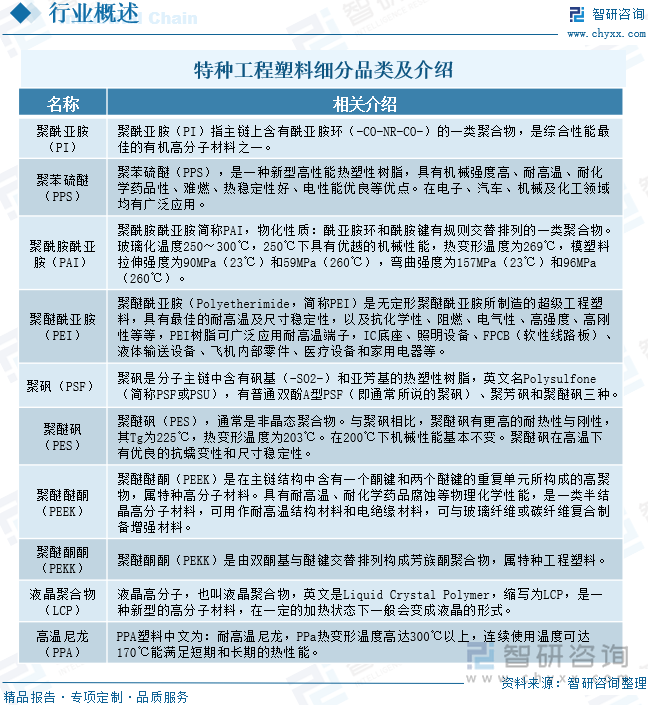
2025年中国特种工程塑料行业发展历程、产业链、市场规模、市场结构及发展趋势研判:本土企业加快产能布局,特种工程塑料规模预计将超200亿元[图]
Chan Ye Xin Xi Wang· 2025-06-27 01:38
Core Viewpoint - The special engineering plastics industry is experiencing significant growth driven by national policies and increasing demand from high-tech sectors such as new energy vehicles, 5G communication, and aerospace. The market size in China is projected to grow from 7.2 billion yuan in 2018 to 16 billion yuan in 2024, and further to 21.2 billion yuan by 2027 [1][19]. Industry Overview - Special engineering plastics are a third generation of plastics, crucial for national economic development and high-end manufacturing upgrades. They include materials like polyimide (PI), polyamide-imide (PAI), and polyether-ether-ketone (PEEK), which exhibit high thermal stability and are used in electronics, automotive, and aerospace applications [4][19]. - The industry has evolved through four stages: the initial phase (1950-1979) focused on imports, the development phase (1980-1999) saw increased domestic production, the rapid growth phase (2000-2010) involved technological advancements, and the current mature phase (2011-present) emphasizes innovation and sustainability [6][7][8]. Market Dynamics - The domestic market for special engineering plastics is expected to grow significantly, with a compound annual growth rate (CAGR) of 14.5% for key raw materials like naphtha, which is projected to increase from 35.8 million tons in 2018 to 80.7 million tons by 2024 [12]. - The global market for special engineering plastics is also expanding, with a forecasted growth from $9.853 billion in 2018 to $15.376 billion in 2024, and expected to reach $16.493 billion by 2025 [16][19]. Key Companies - Notable companies in the industry include Kingfa Technology, Water Holdings, and Prit, which are actively involved in the research, production, and sales of special engineering plastics. These companies are focusing on innovation and expanding their market presence [2][23][24]. - Kingfa Technology reported a revenue of 59.536 billion yuan in 2024, reflecting a year-on-year growth of 26.35% [26]. Water Holdings achieved a revenue of 0.922 billion yuan, with a growth of 10.55% [28]. Development Trends - The industry is moving towards functionalization, high performance, and scalability, with a focus on developing materials that meet specific application needs in sectors like aerospace and electronics [30][31][33]. - There is a growing emphasis on sustainability, with initiatives aimed at developing recyclable materials and optimizing production processes to reduce environmental impact [35]. Application Areas - Special engineering plastics are increasingly used in high-tech applications, including aerospace components, automotive parts, and electronic devices, driven by the demand for materials that can withstand extreme conditions [13][19][30].