价值重估

Search documents
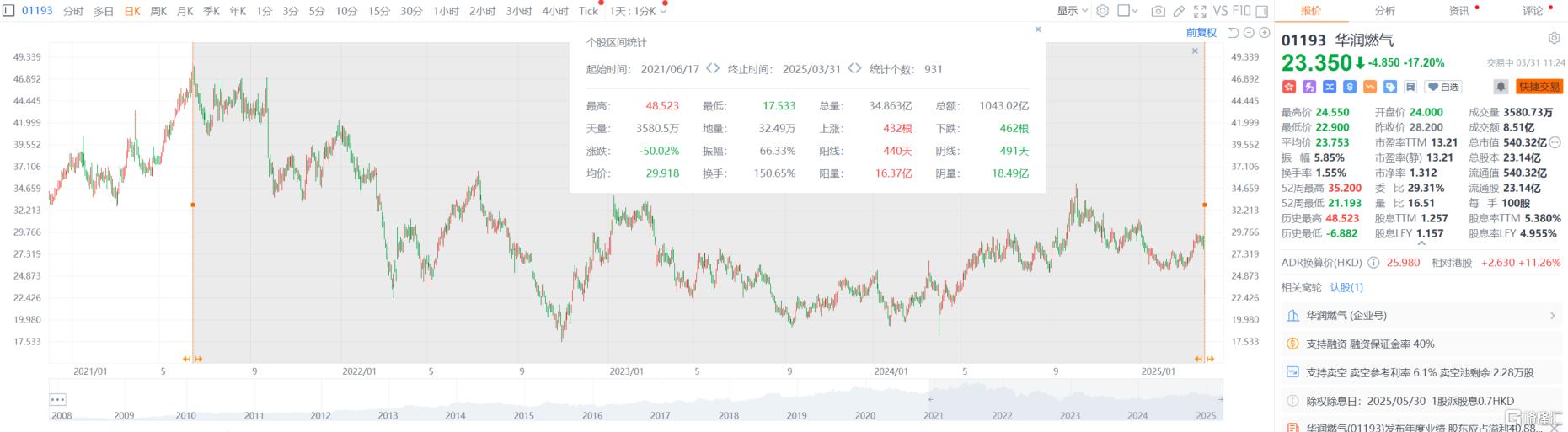
净利暴跌21%,股价已“腰斩”,华润燃气还能迎来价值重估?
Ge Long Hui· 2025-03-31 03:34
Core Viewpoint - China Resources Gas has experienced a significant decline in performance, leading to a sharp drop in its stock price, which fell by 17.55% to HKD 23.25 per share, with a total market capitalization of HKD 53.801 billion [1] Financial Performance - For the fiscal year 2024, China Resources Gas reported revenue of HKD 102.676 billion, a year-on-year increase of 1.4% [4] - Core profit was HKD 4.148 billion, showing a minimal increase of 0.02% [5] - Shareholders' profit attributable to the company was HKD 4.088 billion, a decrease of 21.7% compared to the previous year [4][5] - Basic earnings per share were HKD 1.8 [4] Business Segments - Retail gas sales volume reached 39.907 billion cubic meters, reflecting a year-on-year growth of 2.9%, with residential, industrial, and commercial gas volumes increasing by 6.3%, 1.5%, and 3.8% respectively [5] - The comprehensive service business generated revenue of HKD 4.21 billion, up 4% year-on-year, with profit increasing by 2.1% to HKD 1.4 billion [5] Capital Expenditure and Cash Flow - Capital expenditure for 2024 was HKD 4.42 billion, a significant decrease of 56%, which contributed to a 14.2% increase in free cash flow to HKD 2.58 billion [7] Dividends - The company proposed a final dividend of HKD 0.7 per share, bringing the total annual dividend to HKD 0.95 per share, with a payout ratio of 53%, down from HKD 1.16 per share the previous year [9] Future Outlook - Analysts remain optimistic about China Resources Gas, anticipating a potential revaluation of the company's value due to the stable profit contribution from gas sales and the effective compensation from dual comprehensive services for the decline in connection business profits [10] - Shenwan Hongyuan estimates a reasonable market value of HKD 80.38 billion based on a 16x PE ratio for 2025, indicating a potential upside of 23.2% from the current market capitalization [10] - Huatai Securities set a target price of HKD 28.5, based on a 15x PE ratio for 2025, reflecting an increase in the profit contribution from sustainable business segments [10]


中国科技股史诗级行情启动:这7大龙头将复制美股“七巨头”奇迹?
Sou Hu Cai Jing· 2025-03-31 02:18
Core Viewpoint - Global hedge funds are rapidly increasing their investments in Chinese technology stocks, leading to a market capitalization growth of over $1.3 trillion in both onshore and offshore markets [1] Group 1: Market Trends - Hedge fund giant Appaloosa increased its stake in Alibaba to $1.2 billion in a single quarter, while stocks like Pinduoduo and Bilibili surged over 20% [1] - UBS and Huatai introduced the concept of "China's Seven Tech Giants," which includes Tencent, Alibaba, BYD, SMIC, Xiaomi, CATL, and Huawei, aiming to replicate the $14 trillion valuation of the US tech giants [1] - The introduction of the domestic AI model DeepSeek is seen as a game-changer, potentially increasing China's productivity by 9% over the next decade and pushing the CSI 300 index up by 19% to 4,700 points [1] Group 2: Leading Stocks and Investment Strategies - First-tier stocks like SMIC have seen a 50% increase in Hong Kong over 50 days, with Tencent returning to the HKD 500 mark and Alibaba and Meituan rising over 40% [2] - Second-tier stocks such as Bilibili and Kuaishou experienced a surge of 24%-36% in February, with foreign capital conducting over 80 research visits to companies like Lanke Technology and Huichuan Technology [3] - Key investment lines include hard tech leaders (SMIC, BYD, Huawei), foreign heavyweights (Alibaba, Tencent), and emerging second-tier stocks (Bilibili, Hesai Technology) [7][8][9] Group 3: Challenges and Risks - There are concerns regarding the practical effectiveness of AI in improving productivity, with some concept stocks showing signs of "static overdraft" [4] - Geopolitical tensions are intensifying, particularly in critical areas like semiconductors and algorithms, which remain under pressure [5] - The influx of southbound capital is driven by emotional investment and a "fear of missing out" mentality, potentially leading to increased short-term volatility [6] Group 4: Long-term Outlook - The current situation is likened to the value re-evaluation of US stocks in the 2010s, with predictions of a long bull market for Hong Kong stocks over the next 5-10 years as profits, geopolitics, and capital align [10]
最新公布:资金爆买!
证券时报· 2025-02-28 10:52
Core Viewpoint - The article highlights a significant surge in southbound Hong Kong Stock Connect funds, with a net inflow of 152.8 billion HKD in February, marking a four-year high and the second highest monthly inflow in the history of the program [1][4][6]. Group 1: Southbound Fund Inflows - In February, southbound Hong Kong Stock Connect funds recorded a total net inflow of 152.8 billion HKD, the highest in four years and the second highest monthly inflow ever [1][4][6]. - The last trading day of February saw a notable adjustment in the Hong Kong market, with the Hang Seng Index dropping by 3.28% and the Hang Seng Tech Index falling by 5.32%, yet the southbound funds still recorded a net purchase of 11.9 billion HKD [5]. - Weekly statistics show that the total net inflow for the week reached 75 billion HKD, setting a new four-year weekly record [6]. Group 2: Performance of Technology Stocks - Technology stocks emerged as the biggest winners during this influx, with many experiencing significant gains that outpaced traditional industries [2]. - Despite the overall market adjustment on February 28, major indices in Hong Kong saw substantial increases in February, with the Hang Seng Index rising by 13.43% and the Hang Seng Tech Index by 17.88% [9]. - Several technology stocks, including Huahong Semiconductor, Alibaba-W, and Xiaomi Group-W, recorded cumulative gains exceeding 30% since the beginning of February [9]. Group 3: Divergence Among Technology Stocks - Not all technology stocks benefited equally from the inflow of southbound funds, indicating a significant divergence among different stocks [3][8]. - From early February to February 27, many stocks in the Hang Seng Index saw increased holdings from southbound funds, including major banks and tech companies like Alibaba-W and China National Petroleum [10]. - Conversely, some stocks such as SenseTime-W and Xiaomi Group-W experienced reductions in holdings, despite many of these stocks still showing price increases in February, suggesting a broader confidence in Chinese tech stocks [10].