财务造假

Search documents
刚摘帽,又戴帽:ST百灵 “帽子戏法”背后的11亿造假!
Quan Jing Wang· 2025-12-26 09:37
Core Viewpoint - Guizhou BaiLing has been repeatedly penalized and labeled as ST (special treatment) due to ongoing financial misconduct, leading to significant management and operational instability [2][3][7]. Financial Misconduct - The company has been involved in a cycle of financial manipulation, with a total of 1.114 billion yuan adjusted over four years, showcasing a pattern of inflating and deflating profits [5][6]. - The China Securities Regulatory Commission (CSRC) issued a record fine of 25.6 million yuan, indicating severe regulatory scrutiny and the ineffectiveness of the company's internal control reforms [7]. Management Issues - The company's actual controller, Jiang Wei, has been banned from the market for ten years, which poses a significant threat to the company's strategic stability [2][7]. - Jiang Wei is embroiled in a legal dispute with Huachuang Securities, which is seeking repayment of 1.7 billion yuan, further complicating the company's financial situation [10][11]. Financial Performance - Guizhou BaiLing's revenue for 2024 was 3.825 billion yuan, a decline of 10.26% year-on-year, with a net loss of 82.44 million yuan, primarily relying on government subsidies to mitigate losses [13]. - In the first three quarters of 2025, revenue continued to decline by 24.28%, with a net profit of only 21.21 million yuan, indicating ongoing financial challenges [13]. Research and Development - The company's R&D expenditure has been significantly lower than industry peers, with R&D expenses as a percentage of revenue at 0.82%, 1.95%, and 1.59% from 2022 to 2024, compared to an average of 4.17% to 4.86% among 69 listed traditional Chinese medicine companies [14]. - The core R&D project, "Tang Ning Tong Luo," has not yet completed its Phase III clinical trials, raising concerns about its future revenue potential [14]. Sales and Market Dependency - Guizhou BaiLing's sales expenses are alarmingly high, with a sales expense ratio of 48.46% in 2024, nearly four times that of Yunnan Baiyao [14]. - The company relies heavily on a concentrated customer and supplier base, with the top five customers accounting for nearly 40% of revenue and the top five suppliers for over 45% of purchases, which could jeopardize its operational stability [16].


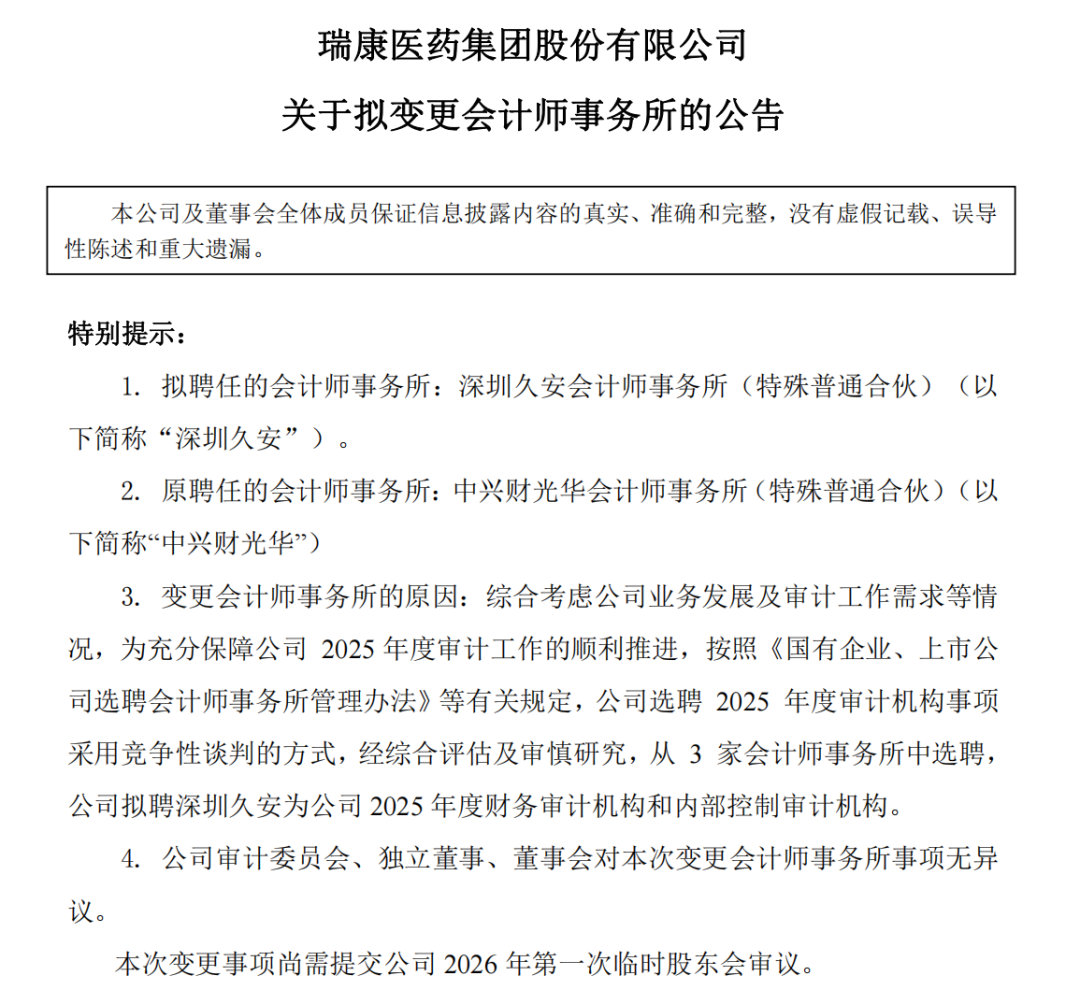
年报审计前夜,瑞康医药临时“开除”中兴财光华会计师事务所
Shen Zhen Shang Bao· 2025-12-25 15:28
Core Viewpoint - Ruikang Pharmaceutical has terminated its cooperation with Zhongxing Caiguanghua Accounting Firm and appointed Shenzhen Jiuan to undertake the 2025 audit, raising concerns about potential audit risks and independence issues [3][4]. Group 1: Company Actions - The company announced the change in auditors on December 24, citing "comprehensive consideration of business development and audit needs" without providing further details [3]. - The decision to change auditors comes just before the annual audit process, which typically starts in January and concludes by the end of April [3]. Group 2: Regulatory Issues - Ruikang Pharmaceutical has faced multiple regulatory warnings over the past five years, including a warning from the Shandong Securities Regulatory Bureau in December 2023 for serious violations [3]. - Specific violations include failing to disclose a 4.6 billion yuan related party transaction and not timely reporting litigation matters totaling 5.84 billion yuan [3]. Group 3: Management Turmoil - In July 2023, the company experienced significant management changes, including the detention of a board member and the resignation of the actual controller's son [4]. - These management upheavals coincide with a decline in the company's operational performance [4]. Group 4: Financial Performance - Revenue for Ruikang Pharmaceutical has seen significant declines from 2020 to 2024, with year-on-year decreases of 22.84%, 22.67%, 41.54%, 34.74%, and a slight drop of 0.85% in 2025 [4]. - The net profit for the company has also deteriorated, with a 63% year-on-year decline in the first three quarters of 2025 [4]. Group 5: Industry Context - Ruikang Pharmaceutical is not alone in terminating its relationship with Zhongxing Caiguanghua; at least 30 other A-share companies have also ended their partnerships with the firm amid concerns over its audit practices [5][6]. - The wave of terminations is linked to Zhongxing Caiguanghua's involvement in a financial fraud case, which has led to regulatory scrutiny and investigations [6].

“水果第一股”洪九果品黯然退市:从670亿市值神话到监管重拳下的崩塌
Huan Qiu Wang· 2025-12-25 08:59
财务疑云尚未消散,管理层的崩塌让危机雪上加霜。2025年4月16日,洪九果品突发公告披露,创始 人、董事长邓洪九,董事彭何、江宗英、杨俊文、谭波及监事会主席余利霞等核心高管,因涉嫌骗取贷 款、虚开增值税专用发票被重庆市两江新区公安分局立案侦查,并被采取不同刑事强制措施。更为严峻 的是,公司总部大楼自2025年1月起已被限制人员出入,IT基础设施使用受限,正常办公陷入停滞,业 务运营被迫由分公司、附属公司及地区人员分散维持。 一个月后,洪九果品披露调查背后的隐情,此次立案源于部分银行债权人提交的报告,直指公司逾期未 偿还的银行贷款问题。彼时部分高管的限制性措施虽逐步解除,董事兼总经理江宗英恢复办公,公司也 试图将分散运营业务重新整合,但创始人邓洪九及彭何等核心成员仍处于被逮捕状态,核心决策层的缺 位让经营复苏举步维艰。资金链的持续断裂成为压垮企业的又一根稻草,2025年5月,洪九果品正式向 法院申请债务重整及预重整,同时考虑引进战略投资者支持其重整计划。 2025年5月30日,洪九果品3名独立非执行董事集体辞职,理由为"专注其他工作",这直接导致公司丧失 全部独立非执行董事,审核委员会彻底瘫痪。作为典型的家族企 ...
监管重拳出击!证监会2025年“手术刀”精准切除上市公司违规病灶
Xin Lang Cai Jing· 2025-12-25 07:42
Core Viewpoint - The regulatory environment for listed companies in China has intensified in 2025, with over 80 companies facing penalties for information disclosure violations, reflecting a shift from lenient to strict enforcement by the China Securities Regulatory Commission (CSRC) [1][6] Group 1: Regulatory Actions - The CSRC has maintained a high-pressure stance on information disclosure violations, with penalties reaching up to 10 million yuan for companies and 500,000 yuan for responsible individuals, a significant increase from previous years [1][6] - Various types of violations have been identified, including failure to disclose periodic reports, financial fraud, and misuse of funds by actual controllers [1][6] Group 2: Financial Fraud Cases - Notable cases of financial fraud include: - Notai Bio, which inflated revenue by 30 million yuan through a closed-loop funding operation and faced a fine of 76.2 million yuan [2][8] - *ST Zitian, which reported inflated revenue of 2.499 billion yuan over two years, with 78.63% of its 2023 revenue being fictitious [2][8] - *ST Suwu, which failed to disclose its actual controller for several years and inflated revenue by 1.771 billion yuan while concealing 4.755 billion yuan in non-operating fund occupation [2][8] Group 3: Consequences of Violations - The implementation of a strict delisting mechanism has led to over 10 companies facing mandatory delisting due to severe violations, with *ST Yuancheng being the 13th company to face such consequences in 2025 [2][8] - The involvement of third-party entities in fraudulent activities has also been addressed, with penalties imposed on accomplices, such as the case of Nanjing Qingya Trading Co., which faced a fine of 7 million yuan and a 10-year market ban [2][8] Group 4: Shareholder Rights and Legal Actions - The regulatory framework now includes comprehensive accountability measures for not only the companies but also responsible individuals and intermediaries involved in fraudulent activities [4][11] - Shareholders affected by violations have successfully pursued legal actions, with several cases resulting in compensation for investors, highlighting the importance of active participation in seeking redress [4][11]


ST长园连发三份公告:董事长被留置 大股东提名新人选
Sou Hu Cai Jing· 2025-12-24 23:32
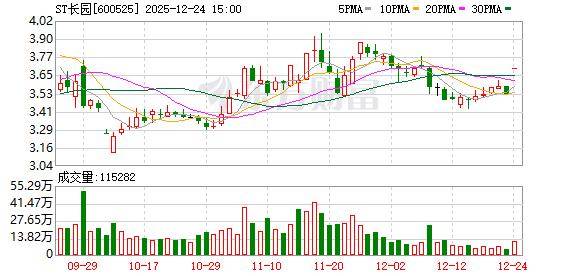
Core Viewpoint - ST Longyuan (600525.SH) is facing a governance crisis as its chairman, Qiao Wenjian, has been detained for suspected job-related violations, leading to a proposal from the major shareholder, Zhuhai Gree Financial Investment Management Co., Ltd. (Gree Jin Investment), to replace him and nominate Yang Tao as a new non-independent director, which could significantly impact the company's future direction [3][6][7]. Governance Issues - Qiao Wenjian has been unable to perform his duties since November 24, 2025, due to his detention, resulting in a governance vacuum as he has missed two consecutive board meetings [6][8]. - The company's articles of association stipulate that a director who fails to attend two consecutive meetings without delegation can be recommended for removal by the shareholders' meeting [6][8]. - Gree Jin Investment holds 14.38% of ST Longyuan's shares, making it the largest shareholder, while the former chairman, Wu Qiquan, holds 8.02% [12]. Financial Performance - ST Longyuan has reported significant financial losses, with a net profit of -3.28 billion yuan for the third quarter of 2025, a 567.01% decrease year-on-year [9]. - The company's revenue has been declining, with a reported revenue of 54.38 billion yuan in Q3 2025, down 1.34% year-on-year, and a net profit of -9.78 billion yuan for the year 2024, a 1243.44% drop [9][10]. - The company has been under scrutiny for financial misconduct, including inflating revenue through various deceptive practices, leading to a significant decline in stock price from a peak of 28.47 yuan per share to around 3.50 yuan [11]. Management Changes - Yang Tao, nominated by Gree Jin Investment, has extensive experience in finance and corporate management, having previously served as a director at ST Longyuan, which may help stabilize the company's governance [7][12]. - Gree Jin Investment has attempted multiple reforms since ST Longyuan was placed under risk warning, but these efforts have not yielded significant results [12][13]. Market Position - ST Longyuan's business is diversified but lacks synergy, with over 97% of its revenue coming from competitive sectors such as smart grid equipment and consumer electronics [10]. - The company is facing increased competition in the energy market and needs to enhance its differentiation strategies to improve its market position [10].

上市公司财务造假,财务总监和实控人都干了什么?
Sou Hu Cai Jing· 2025-12-24 16:08
Core Viewpoint - Financial fraud has severely undermined the principles of fairness and transparency in the A-share market, harming the legitimate rights and interests of investors, with over 10 listed companies facing penalties and forced delisting since 2025, including five companies receiving fines exceeding 100 million RMB [1][3]. Group 1: Financial Fraud Cases - Numerous typical cases of financial fraud in listed companies over the past three to five years have been identified, including companies like Zijing Storage, Kangde Xin, Guizhou Bailing, and Yili Clean Energy, revealing complex relationships between actual controllers and financial directors, as well as chaotic corporate governance [3][4]. - In the case of Kangde Xin, the actual controller and financial director conspired to implement systematic financial fraud for seven years, while Zijing Storage's actual controller organized high-level executives to inflate revenue through fake contracts and falsified documents [4][5]. - The financial fraud methods commonly employed include inflating profits, manipulating costs, and creating fictitious assets, often involving collusion among key personnel [6][8]. Group 2: Penalties and Consequences - The penalties for financial fraud have been severe, with individuals facing both administrative and criminal consequences. For instance, Kangde Xin's actual controller received a 15-year prison sentence and a fine of 202 million RMB, while the financial director received a 13-year sentence and a fine of 10.15 million RMB [5][9]. - Companies involved in financial fraud face significant repercussions, such as ST Gaohong, which reported a cumulative litigation amount of 3.511 billion RMB, representing 427.64% of its latest audited net assets [9][10]. - The ongoing issues of financial fraud and deceptive practices are seen as major threats to the healthy development of China's capital market, undermining investor confidence and market fairness [9][10]. Group 3: Systemic Issues and Recommendations - The prevalence of financial fraud highlights systemic issues within corporate governance, including failures in internal controls and potential negligence by auditing firms, with some cases involving extensive collusion with third parties [10]. - Experts suggest that regulatory oversight of listed companies should be strengthened, with increased penalties for fraudulent activities and accountability for auditing firms and colluding third parties to maintain the integrity of the capital market [10].


ST长园连发三份公告:董事长被留置,大股东提名新人选
2 1 Shi Ji Jing Ji Bao Dao· 2025-12-24 14:08
Core Viewpoint - ST Changyuan is facing a governance crisis due to the suspension of its chairman, Qiao Wenjian, who is under investigation for misconduct, leading to a proposal for his replacement and the nomination of Yang Tao as a new non-independent director by the major shareholder, Zhuhai Gree Financial Investment Management Co., Ltd [1][2][3] Group 1: Governance Issues - Qiao Wenjian has been unable to fulfill his duties since November 24, 2025, due to being placed under detention by the Huizhou Huizhong District Supervisory Committee for suspected misconduct [2] - The company has been in a state of "no actual controller," which has negatively impacted its development [4] - The company’s articles of association allow for the removal of a director who fails to attend board meetings, which applies to Qiao Wenjian's situation [2] Group 2: Financial Performance - ST Changyuan reported a revenue of 54.38 billion yuan for the third quarter of 2025, a year-on-year decrease of 1.34%, and a net profit attributable to shareholders of -3.28 billion yuan, a staggering decline of 567.01% [5] - The company has seen a downward trend in its financial performance, with net profits of 6.74 billion yuan in 2022 and 0.88 billion yuan in 2023, followed by a net loss of 9.78 billion yuan in 2024, a drop of 1243.44% year-on-year [5] - The main business areas include smart grid equipment and energy internet technology services, but the competitive landscape is challenging, necessitating differentiation in the energy market [6] Group 3: Shareholder Actions - Gree Financial Investment, the largest shareholder, holds a 14.38% stake and has attempted to initiate reforms within the company, but with limited success [7] - The company has faced significant stock price declines, from a peak of 28.47 yuan per share to around 3.50 yuan, representing a nearly 90% drop [6] - Gree Financial has initiated legal actions against the company for financial misrepresentation, indicating dissatisfaction with the current management and governance [8][9]
中国四部门提醒企业做好2025年年报 打击财务造假
Xin Lang Cai Jing· 2025-12-24 11:38
Core Viewpoint - The Chinese government, through multiple regulatory bodies, has issued a joint notice emphasizing the importance of adhering to accounting standards and preventing financial fraud in the preparation of the 2025 annual reports [1][2] Group 1: Regulatory Requirements - Companies are required to strictly follow the accounting standards published by the Ministry of Finance, including interpretations and application guidelines, ensuring that all financial information complies with national accounting regulations [1] - Special attention is required in areas such as long-term equity investments, fixed assets, intangible assets, data resources, asset impairment, contingent matters, revenue, government subsidies, business combinations, leases, financial instruments, standard warehouse receipts, insurance contracts, changes in accounting policies and estimates, error corrections, consolidated financial statements, and related party transactions [1] Group 2: Enforcement and Compliance - The regulatory bodies urge companies to ensure that financial data accurately and completely reflects their financial status and operational results, prohibiting any form of financial fraud or performance manipulation [1] - Increased scrutiny will be applied to areas with a history of issues, with a focus on preventing misinterpretation of standards, complex transactions designed to adjust profits, false asset transfers, and evasion of regulatory requirements [1] Group 3: Auditor Responsibilities - Accounting firms are instructed to maintain integrity and adhere to legal regulations during the annual report audit process, focusing on issues such as fictitious revenue, financial "cleaning," fund occupation, performance changes, significant accounting errors, large fund outflows, and delisting risks [2] - Timely identification of corporate fraud, collusion with interested parties, fraudulent issuance, and ongoing post-listing fraud is emphasized [2]
科创信息虚增利润72% 谁是这场“财务魔术”的共谋?
Jing Ji Guan Cha Wang· 2025-12-24 07:50
Core Viewpoint - The company, Kexin Information, has been penalized for financial misconduct, including inflating revenue and profits in its 2023 semi-annual report, highlighting ongoing issues of financial fraud in the A-share market [1][2]. Group 1: Financial Misconduct - Kexin Information inflated its operating revenue by 46.32 million yuan, which accounted for 33.57% of the reported revenue, and inflated profits by 12.79 million yuan, representing 71.94% of the total reported profit [2]. - The fraudulent activities stemmed from a sales business with Dayou Digital Technology, where Kexin Information lacked control over the goods but still recognized revenue using the gross method, violating accounting standards [2]. Group 2: Regulatory Actions - The company and three responsible individuals received an administrative penalty notice from the China Securities Regulatory Commission (CSRC), indicating a serious breach of information disclosure regulations [1][4]. - The three individuals involved, including the chairman and financial director, face fines of 800,000 yuan and 600,000 yuan respectively, while the company itself is fined 1.5 million yuan [4]. Group 3: Company Performance - Despite claims of normal business operations, Kexin Information's financial performance is deteriorating, with a reported revenue of 93.65 million yuan for the first nine months of 2025, a decline of 36.58% year-on-year [5][6]. - The company reported a net loss of 58.84 million yuan, although this was a slight improvement compared to the previous year, indicating ongoing financial distress [6]. Group 4: Industry Context - The issues faced by Kexin Information reflect a broader trend of financial fraud in the A-share market, with other companies also being penalized for similar misconduct [1][7]. - Experts have pointed out that the persistence of financial fraud in the market is often facilitated by intermediaries who fail to uphold their responsibilities, suggesting a need for stricter penalties and regulatory reforms [7].

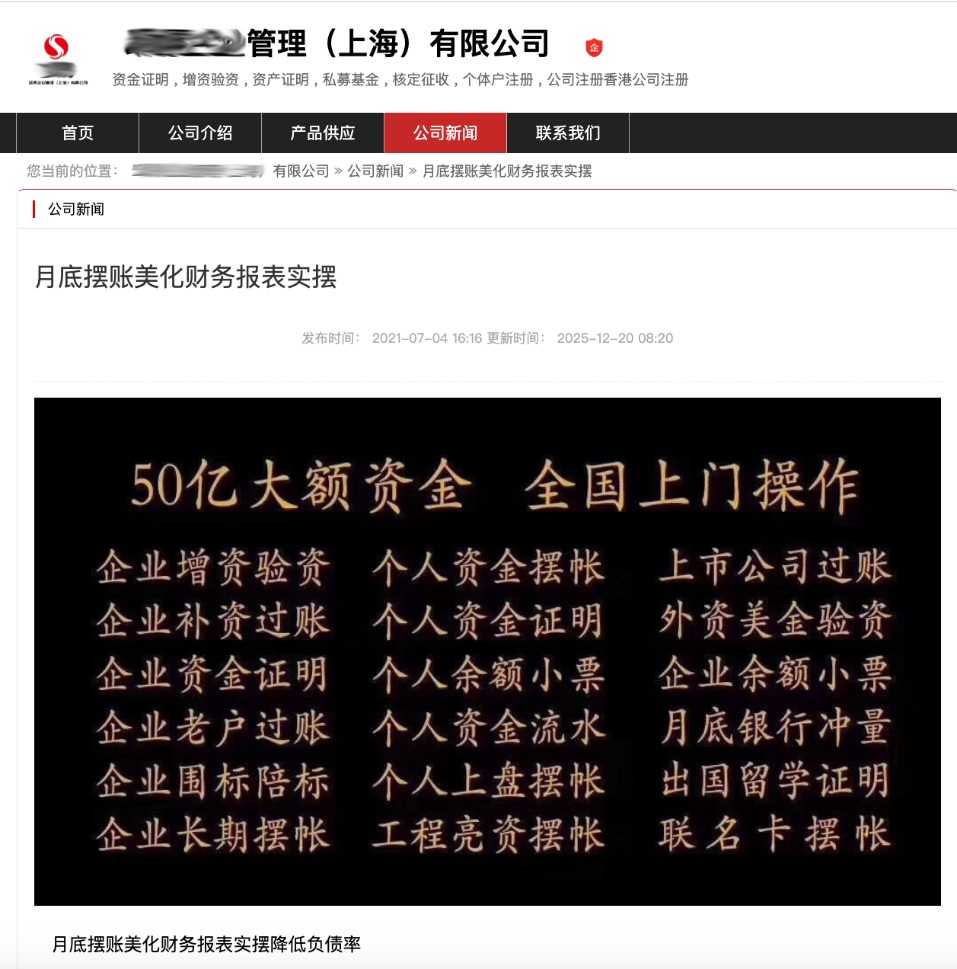
年末业绩压力催生“财报美化”业务 资金中介提供高息资金拆借或成造假“帮凶”
Mei Ri Jing Ji Xin Wen· 2025-12-24 07:45
Core Viewpoint - The article highlights the alarming rise of "financial statement beautification" services among listed and pre-IPO companies, where funds are manipulated to enhance financial metrics without real business backing, raising significant legal and ethical concerns [1][2][18]. Group 1: Nature of the Business - "Financial statement beautification" involves short-term fund borrowing services provided by intermediaries, allowing companies to artificially inflate revenue and cash flow through circular fund transfers without genuine trade [1][12]. - The service is marketed openly in investment groups and online platforms, targeting a wide range of companies, including small-cap and large-cap firms, with claims of significant fund sizes reaching up to ten billion [2][3]. Group 2: Operational Mechanism - The beautification process typically involves a structured operation where companies design a clear fund flow path, and intermediaries facilitate the transfer of funds across multiple accounts [14][15]. - The funding process includes signing dual agreements for confidentiality and operational terms, with companies required to provide various documentation and pay a deposit to secure the funds [14][15]. Group 3: Financial Implications - The cost of these services is exorbitant, with interest rates reaching as high as 73% annually, significantly burdening companies already facing financial difficulties [16][17]. - The high costs and risks associated with these operations can exacerbate the financial strain on companies, particularly those attempting to avoid delisting [16]. Group 4: Legal Risks - The actions of both the companies seeking beautification and the intermediaries providing funds are likely to violate securities laws, with potential legal repercussions for all parties involved [17][18]. - Regulatory bodies maintain a strict stance against financial fraud, indicating that any attempts to manipulate financial statements will be met with severe penalties [18].