资金流向

Search documents
有色金属行业12月16日资金流向日报
Zheng Quan Shi Bao Wang· 2025-12-16 09:17
| 代码 | 简称 | 今日涨跌幅(%) | 今日换手率(%) | 主力资金流量(万元) | | --- | --- | --- | --- | --- | | 600490 鹏欣资源 | | -0.13 | 5.10 | 10587.49 | | 002378 章源钨业 | | 0.81 | 6.26 | 8819.60 | | 002756 永兴材料 | | 3.19 | 4.42 | 3248.60 | | 000657 中钨高新 | | 3.33 | 7.19 | 2802.97 | | 002237 恒邦股份 | | -4.69 | 2.97 | 2626.15 | | 601069 西部黄金 | | -7.61 | 3.12 | 1609.15 | | 002192 融捷股份 | | -0.81 | 4.64 | 551.43 | | 002182 宝武镁业 | | -3.25 | 1.93 | 485.29 | | 600961 株冶集团 | | -5.59 | 2.37 | 468.99 | | 300855 图南股份 | | -2.91 | 3.99 | 343.54 | | 002295 ...





黑色家电板块12月16日跌1.22%,同洲电子领跌,主力资金净流出2.33亿元
Zheng Xing Xing Ye Ri Bao· 2025-12-16 09:09
从资金流向上来看,当日黑色家电板块主力资金净流出2.33亿元,游资资金净流入6803.14万元,散户资 金净流入1.65亿元。黑色家电板块个股资金流向见下表: 证券之星消息,12月16日黑色家电板块较上一交易日下跌1.22%,同洲电子领跌。当日上证指数报收于 3824.81,下跌1.11%。深证成指报收于12914.67,下跌1.51%。黑色家电板块个股涨跌见下表: 以上内容为证券之星据公开信息整理,由AI算法生成(网信算备310104345710301240019号),不构成投资建议。 ...


东百集团换手率27.83%,沪股通龙虎榜上买入1.19亿元,卖出1.81亿元
Zheng Quan Shi Bao Wang· 2025-12-15 09:56
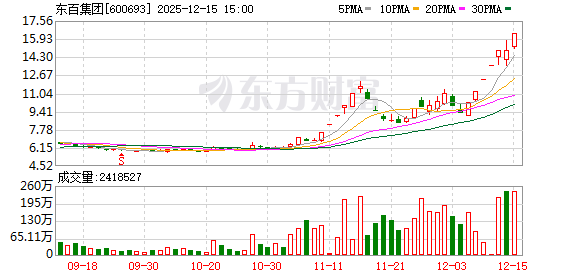
东百集团(600693)今日涨停,全天换手率27.83%,成交额38.47亿元,振幅9.19%。龙虎榜数据显示,沪 股通净卖出6194.25万元,营业部席位合计净卖出1357.27万元。 上交所公开信息显示,当日该股因日换手率达27.83%上榜,沪股通净卖出6194.25万元。 证券时报·数据宝统计显示,上榜的前五大买卖营业部合计成交7.64亿元,其中,买入成交额为3.44亿 元,卖出成交额为4.20亿元,合计净卖出7551.52万元。 资金流向方面,今日该股主力资金净流入1081.04万元,其中,特大单净流入8957.06万元,大单资金净 流出7876.02万元。近5日主力资金净流入2366.43万元。 10月25日公司发布的三季报数据显示,前三季度公司共实现营业收入13.59亿元,同比增长2.34%,实现 净利润8804.79万元,同比增长3.04%。(数据宝) 东百集团12月15日交易公开信息 | 买/ 卖 | 会员营业部名称 | 买入金额(万元) | 卖出金额(万元) | | --- | --- | --- | --- | | 买一 | 沪股通专用 | 11860.77 | | | 买二 | 中国银河 ...

通信行业资金流出榜:中兴通讯等17股净流出资金超亿元
Zheng Quan Shi Bao Wang· 2025-12-15 09:08
沪指12月15日下跌0.55%,申万所属行业中,今日上涨的有13个,涨幅居前的行业为非银金融、商贸零 售,涨幅分别为1.59%、1.49%。跌幅居前的行业为电子、通信,跌幅分别为2.42%、1.89%。通信行业 位居今日跌幅榜第二。 资金面上看,两市主力资金全天净流出471.84亿元,今日有8个行业主力资金净流入,国防军工行业主 力资金净流入规模居首,该行业今日上涨0.83%,全天净流入资金22.87亿元,其次是食品饮料行业,日 涨幅为0.67%,净流入资金为11.24亿元。 主力资金净流出的行业有23个,电子行业主力资金净流出规模居首,全天净流出资金163.31亿元,其次 是电力设备行业,净流出资金为59.19亿元,净流出资金较多的还有有色金属、机械设备、通信等行 业。 通信行业今日下跌1.89%,全天主力资金净流出44.95亿元,该行业所属的个股共124只,今日上涨的有 27只,涨停的有2只;下跌的有95只,跌停的有2只。以资金流向数据进行统计,该行业资金净流入的个 股有31只,其中,净流入资金超亿元的有5只,净流入资金居首的是三维通信,今日净流入资金7.70亿 元,紧随其后的是通宇通讯、联特科技,净流入 ...




X @何币
何币· 2025-12-14 03:46
Industry Knowledge Platform - Crypto space is a knowledge-intensive platform requiring continuous learning and adaptation [1] - Participants need to understand macroeconomics, including interest rate decisions (Federal Reserve rate hikes/cuts), CPI, PPI, non-farm payroll, unemployment rate, USD index, and capital flows [1] - Participants need to understand on-chain data, including on-chain transactions, trading depth, and funding rates [1] Investment and Risk - Knowledge of macroeconomics and on-chain data is crucial for navigating the crypto market [1] - Understanding derivatives such as options and futures contracts is essential [1]
股票行情快报:朗玛信息(300288)12月12日主力资金净买入66.39万元
Sou Hu Cai Jing· 2025-12-12 14:36
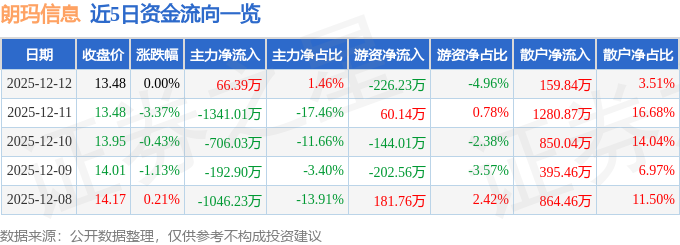
Core Viewpoint - The stock of Langma Information (300288) has shown a stable closing price with minor fluctuations, indicating a mixed sentiment among investors as reflected in the recent capital flow data [1][2]. Group 1: Stock Performance - As of December 12, 2025, Langma Information closed at 13.48 yuan, with no change in price [1]. - The trading volume was 33,700 hands, with a total transaction amount of 45.59 million yuan [1]. - The capital flow data indicates a net inflow of 663,900 yuan from institutional investors, accounting for 1.46% of the total transaction amount [1][2]. Group 2: Recent Capital Flow Trends - Over the past five days, the stock has experienced significant fluctuations in capital flow, with a notable net outflow from retail investors on December 11, amounting to 13.41 million yuan [2]. - The net inflow from retail investors on December 12 was 1.60 million yuan, representing 3.51% of the total transaction amount [1][2]. Group 3: Financial Metrics and Industry Comparison - Langma Information's total market capitalization is 4.555 billion yuan, significantly lower than the industry average of 13.319 billion yuan [3]. - The company reported a net profit of 13.507 million yuan for the first three quarters of 2025, a decline of 67.04% year-on-year [3]. - The company's gross profit margin stands at 29.25%, slightly below the industry average of 31.3% [3].

股票行情快报:今天国际(300532)12月12日主力资金净卖出809.88万元
Sou Hu Cai Jing· 2025-12-12 14:36
Core Viewpoint - The company, Today International (300532), has reported a decline in its financial performance for the first three quarters of 2025, with a significant drop in both revenue and net profit compared to the previous year [2]. Financial Performance Summary - For the first three quarters of 2025, the company's main revenue was 1.71 billion yuan, a year-on-year decrease of 16.17% [2]. - The net profit attributable to shareholders was 220 million yuan, down 18.78% year-on-year [2]. - The net profit after deducting non-recurring items was 189 million yuan, reflecting a decline of 26.68% year-on-year [2]. - In Q3 2025, the company's single-quarter main revenue was 297 million yuan, a decrease of 23.83% year-on-year [2]. - The single-quarter net profit attributable to shareholders was approximately 32.45 million yuan, an increase of 12.81% year-on-year [2]. - The single-quarter net profit after deducting non-recurring items was about 31.07 million yuan, up 10.7% year-on-year [2]. - The company's debt ratio stood at 60.02%, with investment income of 3.25 million yuan and financial expenses of 1.26 million yuan [2]. - The gross profit margin was reported at 25.91% [2]. Market Activity Summary - As of December 12, 2025, the stock closed at 11.57 yuan, with a turnover rate of 0.82% and a trading volume of 35,300 hands, resulting in a transaction amount of approximately 40.93 million yuan [1]. - On December 12, the net outflow of main funds was 8.10 million yuan, accounting for 19.79% of the total transaction amount, while retail investors saw a net inflow of 6.10 million yuan, representing 14.91% of the total [1].

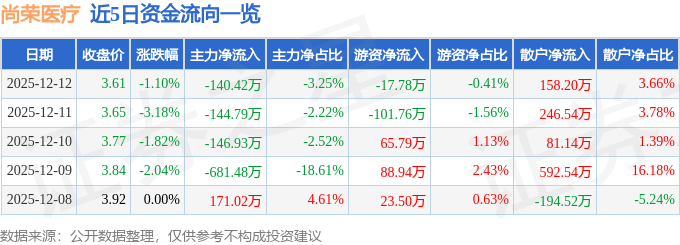
股票行情快报:尚荣医疗(002551)12月12日主力资金净卖出140.42万元
Sou Hu Cai Jing· 2025-12-12 13:15
Core Viewpoint - The stock of Shangrong Medical (002551) has shown a decline in both price and financial performance, indicating potential challenges in the medical device industry [1][3]. Financial Performance - As of December 12, 2025, Shangrong Medical's stock closed at 3.61 yuan, down 1.1% with a trading volume of 118,900 shares and a turnover of 43.236 million yuan [1]. - For the first three quarters of 2025, the company's main revenue was 754 million yuan, a year-on-year decrease of 24.85%, and the net profit attributable to shareholders was -35.1253 million yuan, a decline of 338.5% [3]. - The third quarter alone saw a revenue of 225 million yuan, down 39.25% year-on-year, with a net profit of -27.367 million yuan, a staggering drop of 4004.28% [3]. Market Position and Ratios - Shangrong Medical's total market capitalization is 3.052 billion yuan, significantly lower than the industry average of 10.776 billion yuan, ranking 101 out of 125 in the medical device sector [3]. - The company has a negative price-to-earnings ratio of -65.17, while the industry average is 68.3, indicating poor profitability [3]. - The gross margin stands at 14.35%, compared to the industry average of 51.02%, ranking 120 out of 125 [3]. Capital Flow Analysis - On December 12, 2025, the net outflow of main funds was 1.4042 million yuan, accounting for 3.25% of the total turnover, while retail investors saw a net inflow of 1.582 million yuan, representing 3.66% of the total turnover [1][2]. - Over the past five days, the trend shows consistent net outflows from main and speculative funds, with retail investors being the only group showing net inflows [2].

21.16亿元资金今日流出基础化工股
Zheng Quan Shi Bao Wang· 2025-12-12 09:29
Market Overview - The Shanghai Composite Index rose by 0.41% on December 12, with 21 out of the 28 sectors experiencing gains. The top-performing sectors were non-ferrous metals and electronics, with increases of 1.50% and 1.46% respectively. Conversely, the retail trade and comprehensive sectors saw declines of 1.28% and 1.18% respectively [1] Capital Flow Analysis - The main capital flow showed a net outflow of 4.872 billion yuan across the two markets. However, 14 sectors recorded net inflows, with the power equipment sector leading with a net inflow of 2.805 billion yuan and a daily increase of 1.42%. The machinery equipment sector followed with a net inflow of 1.771 billion yuan and a daily increase of 1.21% [1] Basic Chemical Industry Performance - The basic chemical industry experienced a slight decline of 0.10%, with a total net capital outflow of 2.116 billion yuan. Out of 405 stocks in this sector, 159 stocks rose, including 4 that hit the daily limit, while 230 stocks fell, with 3 hitting the lower limit. Notably, 150 stocks in this sector saw net capital inflows, with ST Jiaao leading at a net inflow of 121 million yuan [2] Top Gainers in Basic Chemical Industry - The following stocks in the basic chemical industry had significant net capital inflows: - ST Jiaao: +4.99%, 120.50 million yuan - Xinjin Road: +10.02%, 116.04 million yuan - Zhenhua Shares: +7.20%, 79.56 million yuan - Other notable gainers included Changjiang Materials and Hangyang Shares with increases of 10.00% and 6.25% respectively [2] Top Losers in Basic Chemical Industry - The following stocks in the basic chemical industry faced substantial net capital outflows: - Duofluor: -8.09%, -581.61 million yuan - Yuntianhua: -3.13%, -316.68 million yuan - Yongtai Technology: -7.21%, -235.59 million yuan - Other significant losers included Salt Lake Shares and Junzheng Group with outflows of -197.29 million yuan and -86.04 million yuan respectively [3]
金风科技12月11日龙虎榜数据
Zheng Quan Shi Bao Wang· 2025-12-11 09:28
Group 1 - Jin Feng Technology's stock reached the daily limit, with a turnover rate of 7.23% and a transaction amount of 4.058 billion yuan, showing a fluctuation of 8.15% [1] - Institutional investors net bought 11.3689 million yuan, while the Shenzhen Stock Connect saw a net purchase of 68.6308 million yuan, with total net buying from brokerage seats amounting to 154 million yuan [1] - The stock was listed on the Shenzhen Stock Exchange due to a daily price deviation of 11.41%, with significant net buying from institutional specialized seats [1] Group 2 - The latest margin trading data shows that the margin balance for Jin Feng Technology is 1.521 billion yuan, with a financing balance of 1.501 billion yuan and a securities lending balance of 2.0304 million yuan [2] - Over the past five days, the financing balance decreased by 72.889 million yuan, a decline of 4.63%, while the securities lending balance dropped by 2.8966 million yuan, a decrease of 12.52% [2] - Detailed trading information on December 11 shows significant buying and selling activities, with the top buying and selling brokerage being the Shenzhen Stock Connect [2]