国产化替代

Search documents
三家子公司斩获高企资质 激智科技高端光学膜创新实力再获权威背书
Quan Jing Wang· 2026-01-06 07:10
Core Viewpoint - The announcement by Jizhi Technology (300566) highlights the successful recognition of three subsidiaries as high-tech enterprises, which will enable them to benefit from tax incentives, thereby enhancing the company's innovation capabilities and long-term profitability in the new materials sector [1] Group 1: Company Achievements - Jizhi Technology's subsidiaries Jiangbei Jizhi, Zhejiang Xinzhi, and Ningbo Tianyuan have all successfully obtained high-tech enterprise certification, with Jiangbei Jizhi undergoing re-certification and the other two achieving this status for the first time [1] - With this recognition, all nine subsidiaries of Jizhi Technology have now been awarded national high-tech enterprise status, reflecting the company's comprehensive R&D system and core technological competitiveness [1] Group 2: Product Development and Market Position - Jiangbei Jizhi focuses on the R&D and production of optical enhancement films, quantum dot films, and composite films, successfully breaking the long-standing monopoly of companies from the US, Japan, and South Korea in the optical film sector [2] - Zhejiang Xinzhi and Ningbo Tianyuan have established robust R&D systems, achieving key breakthroughs in high-performance functional films and optical adhesive films, respectively [2] - The company has positioned itself as a leader in the domestic optical film market, with products meeting international quality standards and a strong capability for mass production [3] Group 3: Industry Trends and Future Prospects - The "14th Five-Year Plan" emphasizes the development of emerging industries, with new materials identified as a strategic sector, suggesting ongoing policy support and market expansion potential [4] - Jizhi Technology is well-positioned to capitalize on the growing demand for high-end products, particularly in the context of the domestic shift towards lightweight display products and the increasing penetration of advanced display technologies [3][4] - The company aims to enhance its market share and profitability through its advanced product matrix and leading production capabilities, benefiting from the ongoing growth in downstream demand [4]
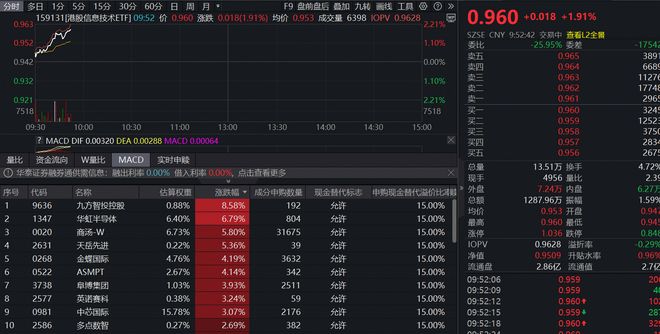
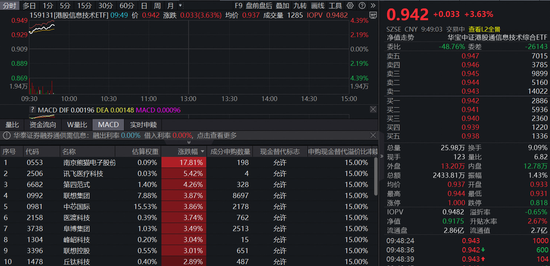
ETF盘中资讯 中芯国际、华虹半导体双双大涨刷新近2月阶段新高!港股信息技术ETF(159131)高开高走涨近2%
Jin Rong Jie· 2026-01-06 02:42
Core Viewpoint - The Hong Kong stock market, particularly the technology sector, is experiencing strong momentum, with significant gains in indices related to technology and the semiconductor industry, indicating a bullish outlook for the sector [1][3]. Group 1: Market Performance - The Hang Seng Technology Index, Hong Kong Stock Connect Information Technology C Index, and Hong Kong Internet Index all rose over 1% [1]. - The first ETF focused on the Hong Kong semiconductor industry, the Hong Kong Information Technology ETF (159131), saw a jump of 3.63% the previous day and continued to rise by 1.91% today, with a trading volume exceeding 12 million [1][3]. - Key stocks in the semiconductor sector, such as Huahong Semiconductor and SMIC, reached new highs, with Huahong Semiconductor increasing nearly 7% and SMIC rising over 3% [1][3]. Group 2: Investment Insights - The National Integrated Circuit Industry Investment Fund, referred to as the "National Big Fund," increased its stake in SMIC from 4.79% to 9.25%, acquiring over 357 million shares at an average price of 74.2 RMB per share, totaling approximately 26.515 billion RMB [3]. - Analysts from Galaxy Securities predict that the Hong Kong stock market's trading activity will remain high, with the technology sector expected to be a long-term investment focus due to factors like price increases in the industry, mergers and acquisitions, and domestic substitution [3]. - The Hong Kong Information Technology ETF is designed to track a composite index composed of 70% hardware and 30% software, focusing on semiconductor, electronics, and computer software sectors, with significant weights assigned to companies like SMIC (20.48%) and Xiaomi Group (9.53%) [3][4].


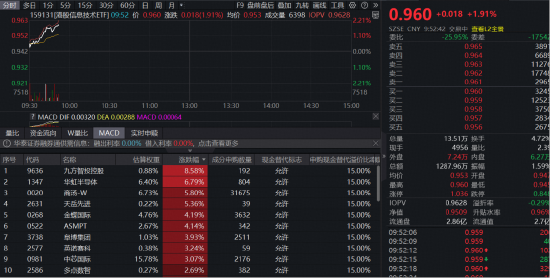
中芯国际、华虹半导体双双大涨刷新近2月阶段新高!港股信息技术ETF(159131)高开高走涨近2%
Xin Lang Cai Jing· 2026-01-06 02:19
Core Viewpoint - The Hong Kong stock market, particularly the technology sector, is experiencing strong momentum, with significant gains in indices and the launch of a new ETF focused on the semiconductor industry [1][3][7]. Group 1: Market Performance - On January 6, the Hong Kong stock market saw the Hang Seng Technology Index, Hong Kong Stock Connect Information C, and the Hong Kong Internet Index all rise by over 1% [1][7]. - The Hong Kong Information Technology ETF (159131), which focuses on the semiconductor industry, opened strongly after a previous jump of 3.63%, increasing by 1.91% with a trading volume exceeding 12 million [1][3][7]. Group 2: ETF Details - The Hong Kong Information Technology ETF (159131) is the first ETF in the market to focus on the "Hong Kong semiconductor" industry chain, with a composition of 70% hardware and 30% software [3][9]. - The ETF includes 42 Hong Kong hard-tech companies, with significant weights assigned to SMIC (20.48%), Xiaomi Group-W (9.53%), and Huahong Semiconductor (5.80%) [3][9]. - The ETF excludes major internet companies like Alibaba, Tencent, and Meituan, allowing for a sharper focus on AI hard-tech trends [3][9]. Group 3: Institutional Investment - SMIC received a substantial investment from the National Integrated Circuit Industry Investment Fund, increasing its stake from 4.79% to 9.25%, with an investment of approximately 26.515 billion RMB [3][9]. - This investment reflects a growing confidence in the semiconductor sector and is expected to contribute to the overall bullish sentiment in the Hong Kong stock market [3][9]. Group 4: Future Outlook - Analysts at Galaxy Securities predict that the trading activity in the Hong Kong stock market will continue to rise, with the technology sector remaining a key focus for medium to long-term investments [3][9]. - Factors such as price increases in the industry chain, mergers and acquisitions, and domestic substitution are expected to drive the market upward [3][9].
中国银河证券:料港股交投活跃度有望续升 关注科技及消费板块
智通财经网· 2026-01-05 06:53
Core Viewpoint - The Hong Kong stock market is expected to remain active and experience an upward trend due to multiple positive factors, with a focus on the technology and consumer sectors for medium to long-term investment opportunities [1] Group 1: Market Performance - The Hong Kong stock market rose by 2.01% last week, with the Hang Seng Technology Index increasing by 4.31% [2] - Among the primary sectors, 7 sectors saw gains while 4 sectors declined, with notable increases in Information Technology (4.54%), Energy (3.97%), and Materials (2.98%) [2] - In the secondary sectors, Semiconductor, Defense, Oil & Petrochemicals, Software Services, and Paper & Packaging led the gains, while Household Products, Durable Goods, Consumer Services, Daily Consumer Retail, and Textiles & Apparel faced declines [2] Group 2: Market Liquidity - The average daily trading volume on the Hong Kong Stock Exchange was HKD 171.19 billion, an increase of HKD 31.26 billion from the previous week [3] - The average daily short-selling amount was HKD 19.93 billion, up by HKD 2.96 billion from the previous week, with short-selling accounting for 11.78% of the trading volume, a decrease of 0.22 percentage points [3] - There was a net outflow of HKD 3.81 billion from southbound funds, a decrease of HKD 6.37 billion compared to the previous week [3] Group 3: Valuation and Risk Appetite - As of January 2, 2026, the Hang Seng Index had a price-to-earnings ratio of 12.09 and a price-to-book ratio of 1.23, both up by 2.36% from the previous week, positioned at the 79% and 56% percentiles since 2010 [4] - The Hang Seng Technology Index had a price-to-earnings ratio of 23.8 and a price-to-book ratio of 3.15, at the 36% and 66% percentiles since 2010 [4] - The risk premium for the Hang Seng Index was 4.08%, which is 1.82 standard deviations below the 3-year rolling mean, placing it at the 4% percentile since 2010 [4]

喜迎开门红,港股科技爆发!首只聚焦“港股芯片”产业链的港股信息技术ETF(159131)跳空高开大涨3.63%
Xin Lang Cai Jing· 2026-01-05 02:01
Core Viewpoint - The A-share and Hong Kong stock markets experienced a strong start to the year on January 5, 2026, with significant gains in technology sectors, particularly in the Hong Kong market, where indices such as the Hang Seng Technology Index rose over 4% [1][3]. Group 1: Market Performance - The first trading day of 2026 saw the Hong Kong stock market's technology sector surge, with the Hang Seng Technology Index and the Hong Kong Internet Index both increasing by over 4% [1][3]. - The first ETF focusing on the "Hong Kong chip" industry chain, the Hong Kong Information Technology ETF (159131), opened with a jump of 3.63%, achieving a real-time transaction volume exceeding 24 million CNY [1][3]. Group 2: Sector Insights - Analysts from Galaxy Securities predict that the Hong Kong stock market will continue to see increased trading activity and an overall upward trend, driven by multiple positive factors [3][9]. - The technology sector remains a key focus for medium to long-term investments, supported by price increases in the supply chain, mergers and acquisitions, and domestic substitution trends [3][9]. Group 3: IPO and Market Trends - The IPO of domestic GPU company Birun Technology on January 2 saw its stock price surge nearly 120% on its first day, marking it as the "first GPU stock" in Hong Kong [3][9]. - Birun Technology aims to capture a market share of 0.2% in the Chinese smart computing chip market by 2025, with the market size projected to reach 50.4 billion USD [3][9]. Group 4: ETF Composition - The Hong Kong Information Technology ETF (159131) is structured with a composition of 70% hardware and 30% software, heavily investing in semiconductor, electronics, and computer software sectors, including major companies like SMIC (20.48% weight) and Xiaomi (9.53% weight) [3][9]. - The ETF excludes large-cap internet companies such as Alibaba, Tencent, and Meituan, allowing for a sharper focus on AI and hard technology trends in the Hong Kong market [3][9].
385只港股去年涨幅超100% “红底股”显著增加
Zheng Quan Ri Bao Zhi Sheng· 2026-01-04 17:13
Group 1 - The Hong Kong stock market experienced a strong start in 2026, with 385 stocks rising over 100% in 2025, including 14 stocks that increased more than 10 times, indicating a bullish trend [1][2] - Notable high-performing stocks include Base Jinbiao Group with a 41.64 times increase, Beihai Kangcheng with over 18 times increase, and Zhu Feng Gold benefiting from rising gold prices with over 12 times increase [1] - The number of "red bottom stocks," which are stocks priced over 100 HKD, increased significantly from 22 at the beginning of 2025 to 45 by the end of the year, reflecting a growing recognition of quality leading enterprises [2] Group 2 - The increase in "red bottom stocks" indicates a shift towards valuing high market capitalization and high liquidity assets, with major companies like Tencent, Ctrip, and NIO leading this trend [2] - The concentration of "red bottom stocks" in sectors such as internet technology, finance, healthcare, and consumer goods suggests a reassessment of long-term value by the market [2] - Analysts from China Galaxy Securities and Huatai Securities express optimism for the Hong Kong stock market in 2026, highlighting technology as a key investment theme driven by multiple favorable factors [3]




中国银河策略:硬科技与消费共振,港股后市可期
Xin Lang Cai Jing· 2026-01-04 07:20
Market Performance - The Hang Seng Index increased by 2.01% to 26,338.47 points, the Hang Seng Tech Index rose by 4.31% to 5,736.44 points, and the Hang Seng China Enterprises Index gained 2.85% to 9,168.99 points during the week from December 29, 2025, to January 2, 2026 [5][32] - Among the primary sectors, 7 sectors rose while 4 sectors declined. The Information Technology, Energy, and Materials sectors saw increases of 4.54%, 3.97%, and 2.98% respectively, while the Consumer Staples, Utilities, and Healthcare sectors experienced declines of 2.25%, 1.60%, and 0.59% respectively [7][34] Liquidity and Trading Volume - The average daily trading volume on the Hong Kong Stock Exchange was HKD 171.19 billion, an increase of HKD 31.26 billion from the previous week. The average daily short-selling amount was HKD 19.93 billion, up by HKD 2.96 billion, with short-selling accounting for 11.78% of the trading volume, a decrease of 0.22 percentage points from the previous week [13][39] - There was a net outflow of HKD 3.81 billion from southbound funds, a decrease of HKD 6.37 billion compared to the previous week's net inflow [14][40] Valuation and Risk Premium - As of January 2, 2026, the PE and PB ratios for the Hang Seng Index were 12.09 times and 1.23 times, respectively, both up by 2.36% from the previous week, placing them at the 79% and 56% percentiles since 2010 [2][16] - The risk premium for the Hang Seng Index was calculated at 4.08% based on the 10-year US Treasury yield of 4.19%, which is at the 4% percentile since 2010 [21][45] - The Hang Seng Tech Index had a PE ratio of 23.8 times and a PB ratio of 3.15 times, positioned at the 36% and 66% percentiles since 2010 [2][16] Investment Outlook - The Federal Reserve's December meeting minutes indicated a consensus on interest rate cuts, although there were significant disagreements among officials. The manufacturing PMI for December in China was reported at 50.1%, indicating expansion, while the non-manufacturing PMI was at 50.2% [29][50] - The technology sector is expected to remain a long-term investment focus due to multiple favorable factors such as price increases in the supply chain, mergers and acquisitions, and domestic substitution [29][50] - The consumer sector is anticipated to benefit from policy support, with current valuations at relatively low levels, suggesting significant medium to long-term upside potential [29][50]
2026年活动日历-半导体行业观察
半导体行业观察· 2026-01-02 03:33
Core Viewpoint - The semiconductor industry is undergoing a deep adjustment period, with accelerated domestic substitution and collaborative innovation in the industry chain being key to development [1]. Group 1: Event Overview - The 2026 events will focus on three core directions: technical collaboration, market connection, and brand enhancement [3]. - A series of events will take place in Shanghai, Beijing, and Shenzhen, covering various themes related to semiconductor innovation and collaboration [2][4][6][9][11]. Group 2: Technical Collaboration - The events will cover critical areas such as compound semiconductors, EDA, automotive chips, and communication AI chips [3]. - The goal is to facilitate direct connections between semiconductor companies and end-user industries like automotive manufacturers and AI technology firms [3]. Group 3: Market Connection - The events aim to link semiconductor companies with automotive manufacturers, communication operators, and AI technology companies, enhancing market access [3]. - Each event is designed to generate significant exposure, with a target of at least 4 million impressions through various promotional channels [2][3]. Group 4: Brand Enhancement - The events will utilize a multi-platform promotional matrix to help companies increase their industry influence [3]. - Activities will include live broadcasts, promotional articles, and interviews to enhance brand visibility and engagement [2][4][10].
科创板第二大,芯片巨头冲IPO
Sou Hu Cai Jing· 2026-01-01 00:00
Core Viewpoint - Changxin Technology, a leading domestic DRAM manufacturer in China, has received approval for its IPO, marking a significant step towards its listing on the STAR Market, and is expected to raise 29.5 billion yuan, making it the second-largest IPO in the market's history [1][4]. Group 1: IPO and Fundraising - The IPO of Changxin Technology is the first "pre-review" project accepted on the STAR Market, with the Shanghai Stock Exchange disclosing two rounds of inquiries on the same day [1]. - The company aims to raise 29.5 billion yuan, with 13 billion yuan allocated for the second phase of wafer manufacturing, 9 billion yuan for next-generation DRAM technology research and development, and 7.5 billion yuan for upgrading production lines [1]. - This IPO could position Changxin Technology as the first storage chip stock in the A-share market [1]. Group 2: Company Structure and Shareholding - Changxin Technology currently has no controlling shareholder, with the largest shareholder holding 21.67% and the second-largest holding 11.71%, indicating a diversified ownership structure [2]. - Significant shareholders include state-owned funds and various investment firms, with no single entity holding more than 50% of the shares [2]. Group 3: Product Development and Market Position - The company has adopted a "jump-generation R&D" strategy, successfully launching four generations of technology platforms since its establishment in 2016 [2]. - Changxin Technology has achieved product coverage from DDR4 to DDR5, with the LPDDR5X product reaching a maximum speed of 10,667 Mbps, a 66% increase over the previous generation [2]. - According to Omdia, Changxin Technology is the largest DRAM manufacturer in China and the fourth globally, with a market share of 3.97% as of Q2 2025 [3]. Group 4: Financial Performance and Future Outlook - Despite significant revenue growth, Changxin Technology has not yet achieved profitability, reporting net losses of 8.33 billion yuan, 16.34 billion yuan, and 7.15 billion yuan from 2022 to 2024 [4]. - The company anticipates a turnaround in 2025, projecting revenues of 55 to 58 billion yuan, a year-on-year increase of 127.48% to 139.89%, and a net profit of 2 to 3.5 billion yuan [4]. - The DRAM industry is currently transitioning from DDR4 to DDR5 and HBM, with Changxin Technology focusing on upgrading its production capabilities to enhance competitiveness [5].
科创板第二大,芯片巨头冲IPO
DT新材料· 2025-12-31 22:06
Core Viewpoint - The article highlights the significant progress of Changxin Technology in the DRAM market, focusing on its upcoming IPO and the company's growth potential amid industry challenges and opportunities [1][5]. Group 1: IPO and Funding - Changxin Technology's IPO has been accepted, aiming to raise 29.5 billion yuan, making it the second-largest IPO on the Sci-Tech Innovation Board since its inception [1][2]. - The funds will be allocated to various projects, including 13 billion yuan for the second phase of wafer manufacturing and 9 billion yuan for next-generation DRAM technology research [1][5]. Group 2: Company Overview - Established in June 2016, Changxin Technology operates under an IDM model, integrating chip design, manufacturing, packaging, testing, and sales [2]. - The company has a diverse shareholder structure, with no single entity holding more than 50% of shares, including significant investments from state-owned funds and tech giants like Alibaba and Tencent [2][5]. Group 3: Product Development and Market Position - Changxin Technology has successfully developed four generations of DRAM technology, with products like LPDDR5X achieving speeds of 10,667 Mbps, a 66% increase from previous generations [3][4]. - As of 2024, the company is projected to be the largest DRAM manufacturer in China and the fourth globally, with a market share of 3.97% [3][4]. Group 4: Financial Performance - The company's revenue has shown explosive growth, with projected revenues of 241.78 billion yuan in 2024, reflecting a compound annual growth rate of 70.81% from 2022 to 2024 [4]. - Despite significant losses in previous years, Changxin Technology anticipates turning a profit in 2025, with expected revenues between 55 billion and 58 billion yuan and a net profit of 2 billion to 3.5 billion yuan [5][6]. Group 5: Industry Context and Future Outlook - The global DRAM market is transitioning from DDR4 to DDR5 and HBM, with Changxin Technology focusing on upgrading its production capabilities to remain competitive [6][7]. - The company is positioned to benefit from the increasing demand for domestic semiconductor production amid geopolitical tensions and supply chain challenges [5][7].