
软件定义汽车

Search documents
2025 Mobility Intelligence Dialogue系列活动启动
Zhong Guo Qi Che Bao Wang· 2025-08-15 01:11
Core Insights - The "2025 Mobility Intelligence Dialogue" series will focus on the theme of "Building the Future of Intelligent Vehicles," gathering industry leaders to discuss the transformation paths, technological breakthroughs, and global opportunities in the automotive sector under the influence of artificial intelligence [2][3] Group 1: Event Overview - The series of events will take place in Shanghai on September 9, Beijing on September 11, and Guangzhou on September 16 [2] - The initiative aims to redefine future mobility, promote new ideas, and facilitate communication among stakeholders in the automotive industry [2][4] Group 2: Key Trends for Discussion - The first core trend is the globalization of new energy vehicles, focusing on China's export landscape and the growth differences in the global battery electric vehicle (BEV) market [3] - The second trend involves the implementation of intelligent technologies, particularly advanced driver assistance systems and software-defined vehicles, exploring opportunities and challenges in a global context [3] - The third trend addresses the construction of supply chain resilience, analyzing battery technology evolution and charging infrastructure development [3] - The fourth trend examines corporate strategic restructuring through financial data, R&D investment, and globalization strategies [3] Group 3: Participation and Contributions - The event will gather authoritative voices from government, industry, academia, and research to interpret industry data and policy trends [4] - Representatives from various sectors of the automotive supply chain will share practical experiences from technology development to market strategies [4] - S&P Global Mobility analysts will release the latest industry reports covering light vehicle sales outlook, powertrain technology forecasts, and competitive financial strategies [4]


小鹏技术首次反哺大众燃油车,德系巨头全面“中化”
Feng Huang Wang· 2025-08-15 01:01
Core Viewpoint - The strategic cooperation between XPeng Motors and Volkswagen Group aims to expand the application of advanced electronic and electrical architecture from electric vehicles to fuel and plug-in hybrid vehicle platforms, enhancing competitiveness in the Chinese automotive market [1][2]. Group 1: Partnership Development - The latest agreement builds on previous collaborations, including a framework agreement signed in April 2024 and a joint development agreement from July 2023, indicating a rapid progression in their partnership [1][2]. - The partnership reflects a long-term strategic relationship based on mutual trust, showcasing both companies' commitment to innovation in core technologies for smart electric vehicles [2][4]. Group 2: Technological Advancements - The new electronic and electrical architecture will be deployed across Volkswagen's CMP and MEB platforms in China, allowing for a platform-based application across different powertrains [1][2]. - This technology adaptation demonstrates that the originally electric vehicle-focused architecture can effectively be integrated into fuel and plug-in hybrid platforms, significantly broadening the market coverage of vehicles equipped with this architecture in China [1][2]. Group 3: Market Implications - For Volkswagen, this collaboration accelerates the implementation of its software-defined vehicle strategy, enabling rapid software iteration and remote upgrades, which shortens the development cycle for new models [2]. - The extension of the architecture to fuel vehicles enhances Volkswagen's technological advantage in traditional powertrain markets while optimizing cost structures, providing more attractive product options for Chinese consumers [2][4].

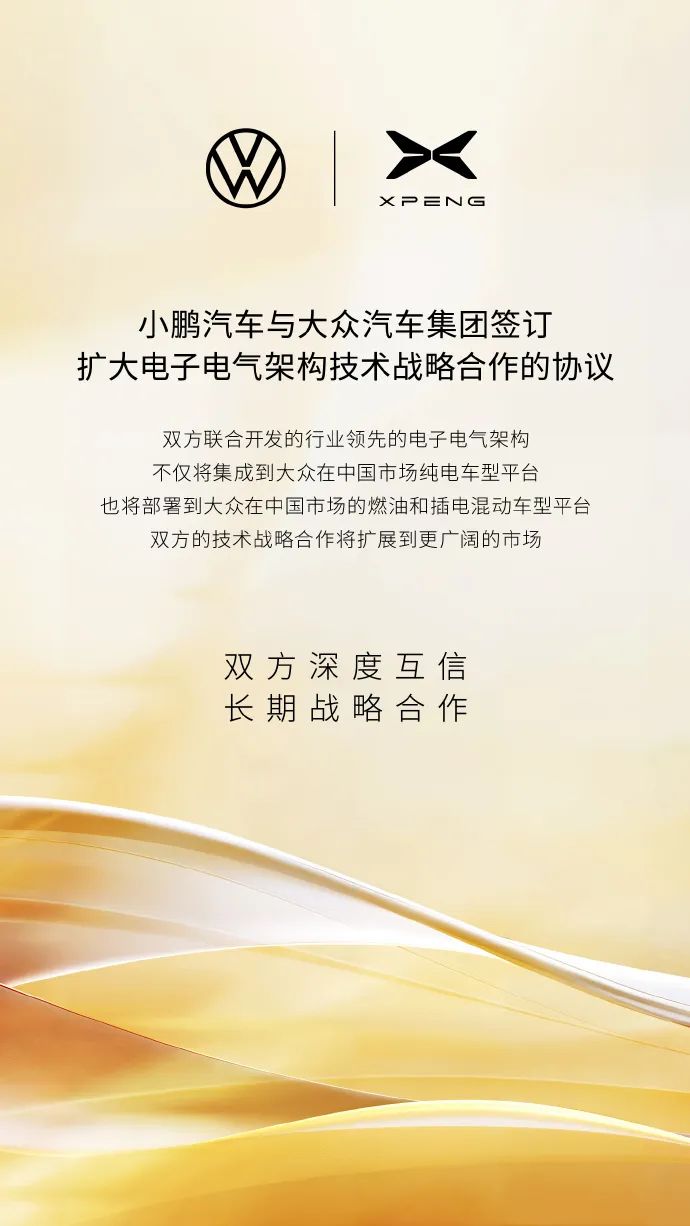
小鹏汽车-W与大众汽车集团签订扩大电子电气架构技术战略合作的协议
Zhi Tong Cai Jing· 2025-08-15 00:48
"本次扩大合作协议是继2024年7月22日签署联合开发协议之后,双方合作历程中的又一重要里程碑。此 举不仅印证了双方长期战略合作伙伴关係的深度互信,更彰显了双方在智能电动汽车核心技术领域持续 技术创新、共同创造价值的坚定决心与前瞻视野",小鹏汽车董事长兼首席执行官何小鹏表示。 大众汽车集团负责中国区业务的管理董事、大众汽车集团(中国)董事长兼首席执行官贝瑞德(Ralf Brandst tter):"先进技术成果的应用不应局限于单一动力形式。大众汽车集团旗下各品牌始终致力于在 各细分市场为客户提供最先进的解决方案。通过将CEA架构延伸至集团强大的燃油车产品矩阵,集团将 进一步巩固在传统动力车型市场的技术领先地位。同时,在竞争激烈的中国汽车市场,我们持续优化成 本结构,确保始终为广大客户提供极具吸引力的车型选择。这将为我们创造更强大的战略纵深,为我们 有针对性的前沿创新投资提供更多空间,助力我们加速驶向全面互联的智能电动未来。" 同时,这也将加速实现大众汽车集团软件定义汽车的战略,加强大众汽车集团车型的全球竞争力。并通 过电子电气架构平台化实现软件的快速迭代和远程升级,大幅度缩短车型的开发周期。 双方研发团队坚持 ...
小鹏汽车-W(09868)与大众汽车集团签订扩大电子电气架构技术战略合作的协议
智通财经网· 2025-08-15 00:31
双方研发团队坚持极致的平台化设计理念,设计并验证了双方为纯电车型平台开发的电子电气架构也能 够部署到燃油和插电混动车型平台的平台化技术方案。这是双方联合研发和技术创新的重要成果,也彰 显了双方长期战略合作的优势和战略价值。这将显著扩大配备该先进电子电气架构车型在中国市场的数 量和规模,为大众汽车集团实现显著的平台化的规模效应和产品竞争力。 "本次扩大合作协议是继2024年7月22日签署联合开发协议之后,双方合作历程中的又一重要里程碑。此 举不仅印证了双方长期战略合作伙伴关係的深度互信,更彰显了双方在智能电动汽车核心技术领域持续 技术创新、共同创造价值的坚定决心与前瞻视野",小鹏汽车董事长兼首席执行官何小鹏表示。 大众汽车集团负责中国区业务的管理董事、大众汽车集团(中国)董事长兼首席执行官贝瑞德(Ralf Brandstätter):"先进技术成果的应用不应局限于单一动力形式。大众汽车集团旗下各品牌始终致力于在 各细分市场为客户提供最先进的解决方案。通过将CEA架构延伸至集团强大的燃油车产品矩阵,集团将 进一步巩固在传统动力车型市场的技术领先地位。同时,在竞争激烈的中国汽车市场,我们持续优化成 本结构,确保始终 ...
小鹏汽车(09868) - 自愿公告 小鹏汽车与大眾汽车集团签订扩大电子电气架构技术战略合作的协议
2025-08-15 00:15
香港交易及結算所有限公司及香港聯合交易所有限公司對本公告之內容概不負責,對其準確性或完整性亦 不發表聲明,並明確表示概不會就本公告全部或任何部分內容而產生或因依賴該等內容而引致之任何損失 承擔任何責任。 自願公告 小鵬汽車與大眾汽車集團簽訂擴大電子電氣架構技術戰略合作的協議 大眾汽車集團負責中國區業務的管理董事、大眾汽車集團(中國)董事長兼首席執行 官貝瑞德(Ralf Brandstätter):"先進技術成果的應用不應局限于單一動力形式。大 眾汽車集團旗下各品牌始終致力於在各細分市場為客戶提供最先進的解決方案。通過 將CEA架構延伸至集團強大的燃油車產品矩陣,集團將進一步鞏固在傳統動力車型市 場的技術領先地位。同時,在競爭激烈的中國汽車市場,我們持續優化成本結構,確 保始終為廣大客戶提供極具吸引力的車型選擇。這將為我們創造更強大的戰略縱深, 為我們有針對性的前沿創新投資提供更多空間,助力我們加速駛向全面互聯的智能電 動未來。" 1 本公司股東及潛在投資者於買賣本公司證券時,務請謹慎行事。 茲提述XPeng Inc. (「本公司」或「小鵬汽車」)日期為2024年7月22日有關電子電氣 架構技術戰略合作聯合開發 ...
“打造智能汽车未来” 标普全球汽车助力探索行业转型新路径
Zhong Guo Jing Ji Wang· 2025-08-14 08:01
Core Insights - The automotive industry is undergoing profound changes driven by artificial intelligence, autonomous driving, software-defined vehicles (SDV), and the transition to new energy sources, while facing challenges such as rising cost pressures, intensified global competition, and supply chain restructuring [1][2] Group 1: Industry Trends - The global connected vehicle market is expected to grow from 56 million units in 2023 to 77 million units by 2030, with penetration rates increasing from 68% to 85% [1] - Over 95% of new connected vehicles are anticipated to have over-the-air (OTA) upgrade capabilities, focusing on cockpit and intelligent driving upgrades [1] Group 2: Event Overview - The "2025 Mobility Intelligence Dialogue" series will take place in Shanghai, Beijing, and Guangzhou, gathering over 400 industry leaders to discuss the transformation paths, technological breakthroughs, and global opportunities in the automotive sector [2][4] - The event will cover four core trends: globalization of new energy vehicles, implementation of intelligent technologies, building supply chain resilience, and corporate strategy restructuring [3] Group 3: Participant Insights - Key players in the automotive industry, including major manufacturers and technology firms, will share practical experiences regarding technology development, product strategy, and market positioning [4] - The dialogue aims to assist Chinese automotive companies in transitioning from "scale expansion" to "high-quality development" by focusing on technological innovation and global strategies [4]
万亿级产业革命来袭,传统车企如何“变身”具身智能体?| 两说
第一财经· 2025-08-14 03:17
Core Viewpoint - The article discusses the transformation of China's manufacturing industry through AI, highlighting the shift from traditional manufacturing to intelligent manufacturing, which is crucial for ascending the global value chain [1][2]. Group 1: AI Integration in Traditional Manufacturing - Traditional car manufacturers are evolving from simple manufacturers to deep integrators of AI technology, with companies like Geely leading the way by deploying advanced computing capabilities [5][6]. - Geely has achieved a computing power level of 23.5 EFlops, positioning itself among the leaders in the automotive industry [5]. Group 2: Breakthroughs in Autonomous Driving - The cost of autonomous driving technology has decreased by at least 70% compared to previous generations, facilitating the transition from technical validation to commercial operation [8]. - The emergence of a new economy based on fully autonomous vehicles is reshaping urban landscapes, moving from a few vehicles under supervision to a truly driverless environment [9]. Group 3: Global Opportunities in Intelligent Manufacturing - China possesses a unique advantage in the current technological revolution, characterized by an "engineer dividend," which is driving the transformation of traditional manufacturing into intelligent manufacturing [11]. - Companies are integrating AI modules and operational control technologies while building talent pipelines and comprehensive supply chains to achieve breakthroughs in key technologies [11]. Group 4: Software-Defined Vehicles - The future of the automotive industry lies in "software-defined vehicles," where advanced electronic architectures and integrated designs provide a solid foundation for software empowerment [13]. - Software is becoming the core driving force behind automotive intelligence, transforming vehicles into mobile intelligent terminals rather than mere mechanical products [13]. Group 5: Leap from Imitation to Leadership - The competitive landscape in the AI era hinges on the ability to integrate talent, technology, and ecosystems across the entire supply chain [14]. - Unlike previous industrial revolutions, China is leveraging its unique advantages, such as the engineer dividend and rapid commercialization, to achieve significant breakthroughs in AI and operational control technologies [14].
港股异动 耐世特(01316)再涨超3% 宣布推出智能运动控制MotionIQ™软件套件
Jin Rong Jie· 2025-08-13 03:57
消息面上,据耐世特官网消息,8月11日,耐世特汽车系统推出了用于智能运动控制的 MotionIQ™软件 套件。MotionIQ基于全球超过1.15亿辆汽车所采用的成熟算法设计而成,将线控底盘控制、开发和车辆 健康监测工作流程整合到一个套件中,有助于整车厂加快产品上市速度,同时提高质量和成本效益。耐 世特全新软件套件包含三个产品系列,分别为 MotionIQ/Control™、MotionIQ/Dev™ 以及 MotionIQ/Health™,它们协同运作,可实现精准运动控制、加速底盘开发以及先进的预测性维护。 据公司方面介绍,随着整车厂采用更集中化的电子电气(E/E)架构来支持其软件定义汽车(SDV)平台,他 们越来越多地进行自研软件开发,其中包括将关乎品牌核心的功能植入车辆子系统。耐世特目前正与多 家全球整车厂合作开展的多个电动助力转向和线控转向量产项目中已提供解耦的转向软件。这种方式使 整车厂能够自主掌控特色的转向功能,加快其软件定义汽车的上市速度。 本文源自:智通财经网 智通财经获悉,耐世特(01316)再涨超3%,截至发稿,涨3.48%,报6.84港元,成交额4607.46万港元。 ...
港股异动 | 耐世特(01316)再涨超3% 宣布推出智能运动控制MotionIQ?软件套件
Zhi Tong Cai Jing· 2025-08-13 03:31
Group 1 - The core point of the article is that Nexperia (01316) has launched the MotionIQ software suite for intelligent motion control, which has led to a stock price increase of over 3% [1] - As of the report, Nexperia's stock price rose by 3.48% to HKD 6.84, with a trading volume of HKD 46.07 million [1] - The MotionIQ software suite integrates chassis control, development, and vehicle health monitoring workflows, helping OEMs accelerate product launch speed while improving quality and cost efficiency [1] Group 2 - The software suite consists of three product series: MotionIQ/Control, MotionIQ/Dev, and MotionIQ/Health, which work together to achieve precise motion control, accelerate chassis development, and enable advanced predictive maintenance [1] - Nexperia is collaborating with several global OEMs on multiple electric power steering and steer-by-wire mass production projects, providing decoupled steering software [2] - This approach allows OEMs to have greater control over unique steering functions, thereby speeding up the launch of their software-defined vehicles [2]
耐世特再涨超3% 宣布推出智能运动控制MotionIQ 软件套件
Zhi Tong Cai Jing· 2025-08-13 03:24
Core Viewpoint - Nextracker (01316) shares increased by 3.48% to HKD 6.84, with a trading volume of HKD 46.07 million, following the launch of its MotionIQ software suite for intelligent motion control [1] Group 1: Product Launch - Nextracker launched the MotionIQ software suite on August 11, designed based on mature algorithms used in over 115 million vehicles globally [1] - The MotionIQ suite integrates steer-by-wire control, development, and vehicle health monitoring workflows into a single package, aiding OEMs in accelerating time-to-market while improving quality and cost efficiency [1] - The suite consists of three product lines: MotionIQ/Control, MotionIQ/Dev, and MotionIQ/Health, which work together to achieve precise motion control, accelerate chassis development, and enable advanced predictive maintenance [1] Group 2: Industry Trends - As OEMs adopt more centralized electronic and electrical (E/E) architectures to support their software-defined vehicle (SDV) platforms, there is an increasing trend towards in-house software development, including embedding core brand functionalities into vehicle subsystems [1] - Nextracker is collaborating with multiple global OEMs on various electric power steering and steer-by-wire mass production projects, providing decoupled steering software that allows OEMs to independently control unique steering features and expedite the launch of their software-defined vehicles [1]