合成生物学

Search documents
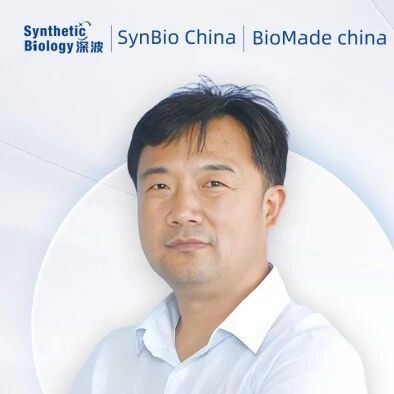
中科康源董事长张东远:《非粮生物质解聚糖化关键技术开发及产业化》
synbio新材料· 2025-11-19 07:03
Core Insights - The article highlights the upcoming "SynBio China Fourth China Synthetic Biology and Biomanufacturing Conference" scheduled for January 8-9, 2026, in Shenzhen, emphasizing the importance of biomanufacturing in future industries [4][8]. Group 1: Conference Details - The conference will feature Dr. Zhang Dongyuan, Chairman of Zhongke Kangyuan (Tangshan) Biotechnology Co., Ltd., who will present a report on the key technologies for the depolymerization of non-grain biomass [2][4]. - The event aims to gather 1,000 participants from various sectors, including academia and industry, to address challenges in industrialization technology [8]. Group 2: Background and Significance - The conference is positioned within the context of China's strategic focus on biomanufacturing as a critical area for future development, alongside quantum technology and 6G [7]. - The article discusses the challenges of crossing the "valley of death" in biomanufacturing, highlighting opportunities for optimization and innovation in various industrialization processes [7]. Group 3: Technological Innovations - Zhongke Kangyuan has developed a comprehensive technology system for biomass depolymerization over seven years, including key technologies such as a continuous oxidation depolymerization system and a high-solid continuous fermentation system [4]. - The company has successfully established China's first production line capable of processing 200,000 tons of straw protein and digestible sugars [4].

2026年中国弹性蛋白行业市场全景评估及投资趋势预测报告
Sou Hu Cai Jing· 2025-11-19 06:19
弹性蛋白(Elastin)是弹性纤维的核心成分,属于结缔组织中的硬蛋白,主要分布于皮肤、血管、肺、韧带、软骨等需要弹性的组织中。其核心功能是赋予 组织可逆的拉伸和回缩能力,如皮肤的紧致、血管的弹性扩张等。中国弹性蛋白行业以技术驱动为核心,2024年,中国弹性蛋白行业市场规模达6.27亿元, 同比增长3.81%。其生产分天然提取(牛颈韧带、猪主动脉等)和重组表达(大肠杆菌、酵母菌生物发酵)两类,重组技术通过合成生物学优化菌株,降低 生产成本并提升纯度。未来,合成生物学、绿色制造及多场景跨界融合将推动行业向低碳、高效、高附加值方向升级,政策规范与标准完善将进一步规范市 场发展。 基于此,依托智研咨询旗下弹性蛋白行业研究团队深厚的市场洞察力,并结合多年调研数据与一线实战需求,智研咨询推出《2026-2032年中国弹性蛋白行 业市场全景调研及发展潜力研判报告》。本报告立足弹性蛋白新视角,聚焦行业核心议题——变化趋势(怎么变)、用户需求(要什么)、投放选择(投向 哪)、运营方法(如何投)及实践案例(看一看),期待携手行业伙伴,共谋行业发展新格局、新机遇,推动弹性蛋白行业发展。 观点抢先知: 行业发展有利因素:合成生物学 ...
“十五五”规划建议发布,生物制造再迎大利好!这家核心龙头,藏不住了!
Jing Ji Guan Cha Wang· 2025-11-19 05:54
Core Insights - The article highlights the significant transformation in the industrial sector driven by biotechnology, emphasizing its role in achieving sustainable growth and meeting carbon neutrality goals [1][2][3] - The Chinese government has officially included biomanufacturing in its national strategy, indicating a strong commitment to advancing this sector through unprecedented measures and a national framework [1][10] - The biomanufacturing industry is projected to capture one-third of the global manufacturing output by the end of the century, creating a market worth approximately $30 trillion [4] Industry Overview - Biomanufacturing is transitioning traditional industries from high-energy, high-emission chemical processes to low-energy, low-pollution biological processes, which is essential for sustainable development [2][12] - The industry is gaining momentum globally due to its economic advantages, mild reaction conditions, and renewable raw materials, leading to a new industrial revolution [3] Government Initiatives - The Ministry of Industry and Information Technology (MIIT) has initiated the selection of "biomanufacturing landmark products" and "biomanufacturing pilot platforms," reflecting the strategic intent to identify and cultivate leading industry examples [5][10] - The MIIT's focus on key areas such as biomanufacturing, integrated circuits, and advanced materials aims to achieve decisive breakthroughs in core technologies [13] Company Spotlight: Jia Bi You - Jia Bi You has emerged as a focal point in the industry, successfully developing 2'-fucosyllactose (2'-FL), a human milk oligosaccharide with significant immune-regulating properties, which has been recognized as a landmark product by the MIIT [7][10] - The company has also been included in the first batch of biomanufacturing pilot capacity construction platforms and high-performance bioreactor innovation tasks, showcasing its advanced technology and market potential [8][9] Technological Advancements - Jia Bi You integrates artificial intelligence with synthetic biology to create an intelligent research and development platform, enhancing its capabilities in enzyme design and microbial strain development [18][37] - The company has developed a comprehensive biomanufacturing platform that includes advanced fermentation systems and real-time monitoring technologies, significantly improving production efficiency and product quality [18][21] Market Position and Growth - Jia Bi You has established itself as a leader in the biomanufacturing sector, with a diverse product portfolio that includes ARA, DHA, and various high-value nutrients, positioning itself to capture significant market opportunities [27][36] - The company has successfully penetrated international markets, collaborating with major global players and obtaining necessary certifications for its products, thereby expanding its global footprint [41][42] Future Prospects - The biomanufacturing sector is expected to experience rapid growth, driven by government support and technological innovation, with Jia Bi You poised to play a pivotal role in this transformation [45][46] - The establishment of innovation centers and collaborative initiatives in regions like Hubei is expected to enhance the overall competitiveness of the biomanufacturing industry in China [29][34]

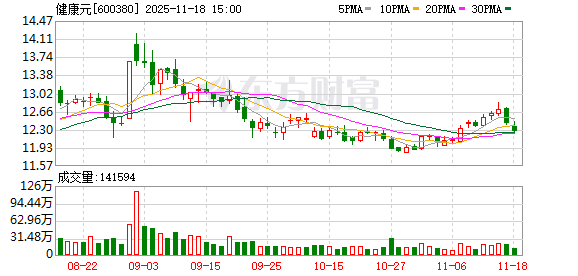
健康元:未来,公司将继续深化合成生物学技术在核心业务中的应用
Zheng Quan Ri Bao· 2025-11-18 13:41
Core Viewpoint - The company, Health元, plans to deepen the application of synthetic biology technology in its core business to strengthen its competitive position in the industry [2] Group 1 - The company will continue to enhance its competitive strength through the application of synthetic biology technology [2]

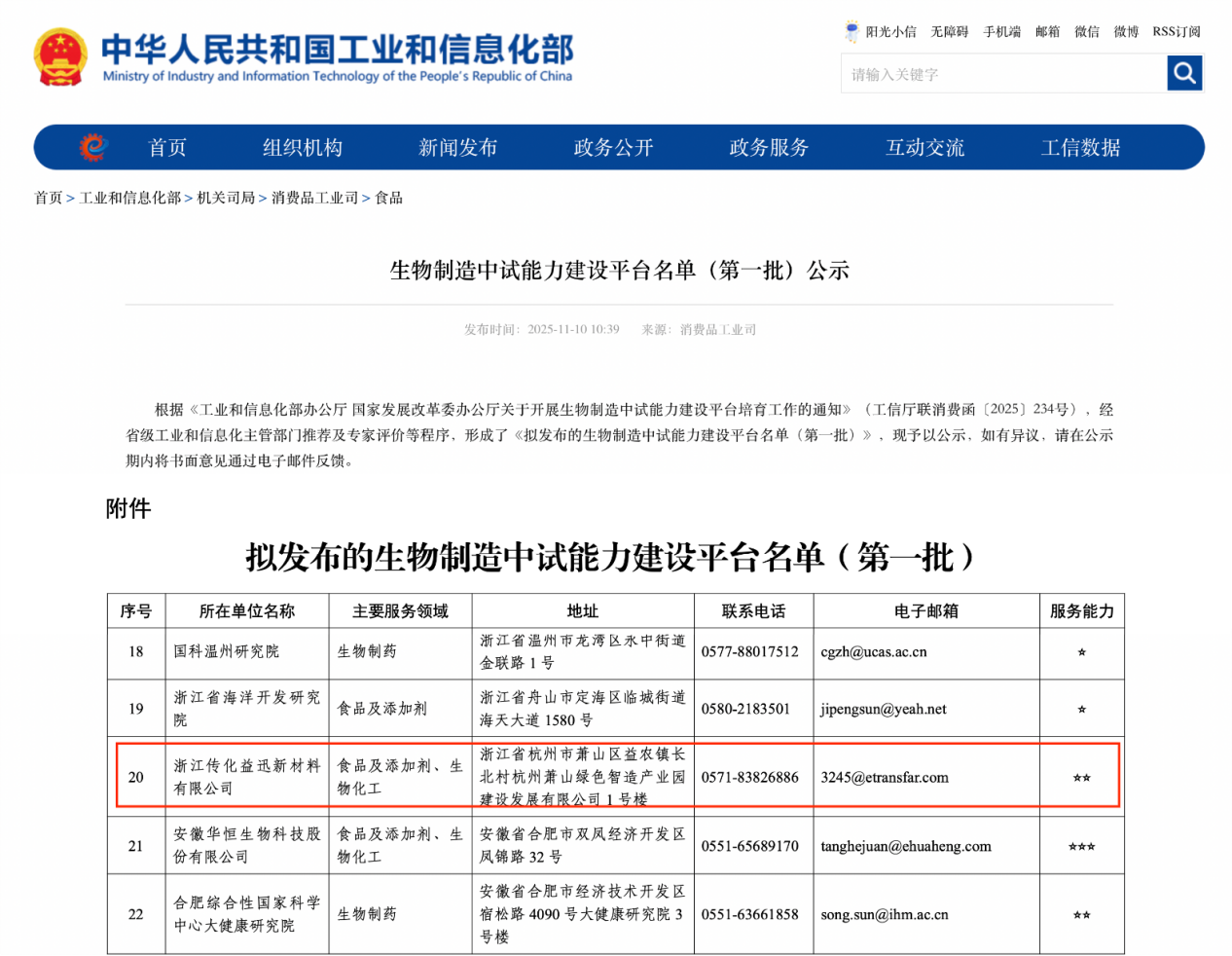
传化集团旗下平台入选全国首批生物制造中试平台名单
Zheng Quan Ri Bao Wang· 2025-11-18 09:48
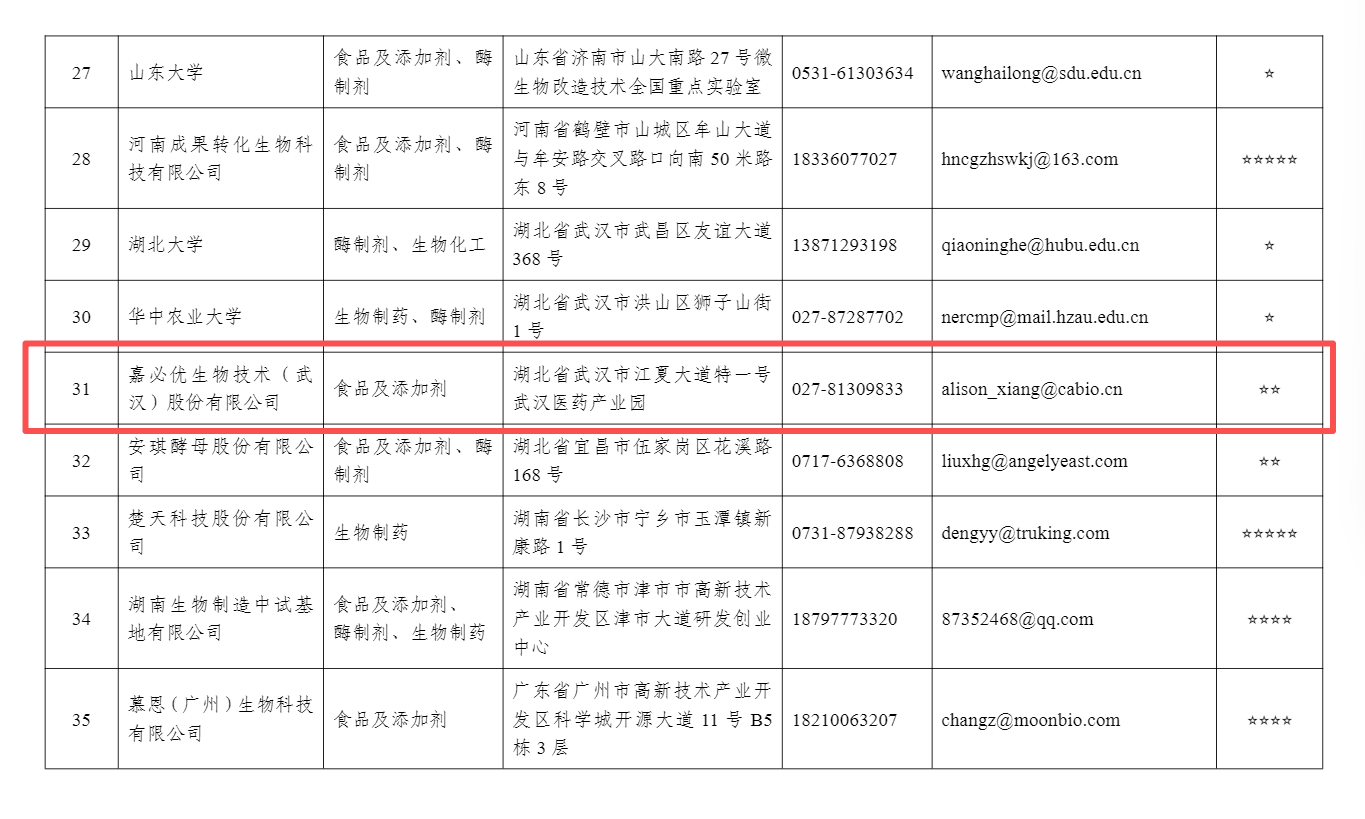
本报讯 (记者冯思婕)近日,工业和信息化部、国家发展改革委联合公示全国首批生物制造中试能力建设平台名单,全国 共有43家单位入选。由传化集团有限公司(以下简称"传化集团")与国有资本合作建设运营的"杭州合成生物产业中试(验 证)中心"成功入选,成为浙江省代表性平台之一。这标志着传化集团在合成生物产业领域的技术实力与产业化能力获得国家 级权威认可。 名单公示/官网截图 | 中华人民共和国工业和信息化部 | ry and Information Technology of the People's Republic of China | | | | ● 阳光小信 无障碍 手机端 邮箱 请输入关键字 | | --- | --- | --- | --- | --- | --- | | (2 | 首页 组织机构 | 新闻发布 | 政务公开 | 政务服务 | 互动交流 T1 | | 首页 > 工业和信息化部 > 机关司局 > 消费品工业司 > 食品 | | | 4-1660 4:1 ) 446 -- 1 | | | | 序号 | 所在单位名称 | 主要服务领域 | 地址 | 联系电话 | 电子邮箱 | 用 | | --- ...

华熙生物中试平台荣膺首批国家级生物制造中试能力建设平台五星评级
2 1 Shi Ji Jing Ji Bao Dao· 2025-11-17 02:04
Core Insights - Huaxi Biological Technology (Tianjin) Co., Ltd. has been recognized as one of the first five "five-star" service capability units in the national list of biomanufacturing pilot platforms, showcasing its leading position in the biomanufacturing sector [1][2] - The pilot platform evaluation is part of the implementation of the "Implementation Opinions on the Innovative Development of Manufacturing Pilot" and focuses on three major tracks and nine key areas, aiming to accelerate the commercialization of scientific research achievements [1][2] - The platform has already served over 20 external companies and completed more than 30 projects transitioning scientific achievements to industrial applications, thus shortening the marketization cycle of innovative products [2] Group 1 - The pilot platform has met stringent standards in technology equipment, public infrastructure, service capability, and intellectual property protection, reflecting the company's technological accumulation and innovation capacity in biomanufacturing [2] - The company has established a complete innovation chain from basic research to industrial application, supported by a "research-development-pilot-industrialization" system that ensures efficient conversion of bioactive substances [2] - The platform is equipped with world-class fermentation systems, purification equipment, and testing instruments, with 64 flexible pilot production lines capable of large-scale conversion of six categories of bioactive substances [2] Group 2 - Looking ahead, the company aims to leverage its national-level platform to collaborate with upstream and downstream partners in the industry, providing comprehensive solutions and fostering a biotechnological innovation ecosystem [3] - The company plans to increase R&D investment, enhance pilot conversion efficiency, and accelerate the industrialization of biotechnological achievements, contributing to high-quality industry development [3] - The establishment of an industrialization ecological alliance is intended to create a cluster effect, promoting collaborative industry cooperation and advancing biomanufacturing into the 5.0 era [3]

聚焦绿色发展,南工大iGEM战队在全球赛事中摘获双金
Yang Zi Wan Bao Wang· 2025-11-16 12:11
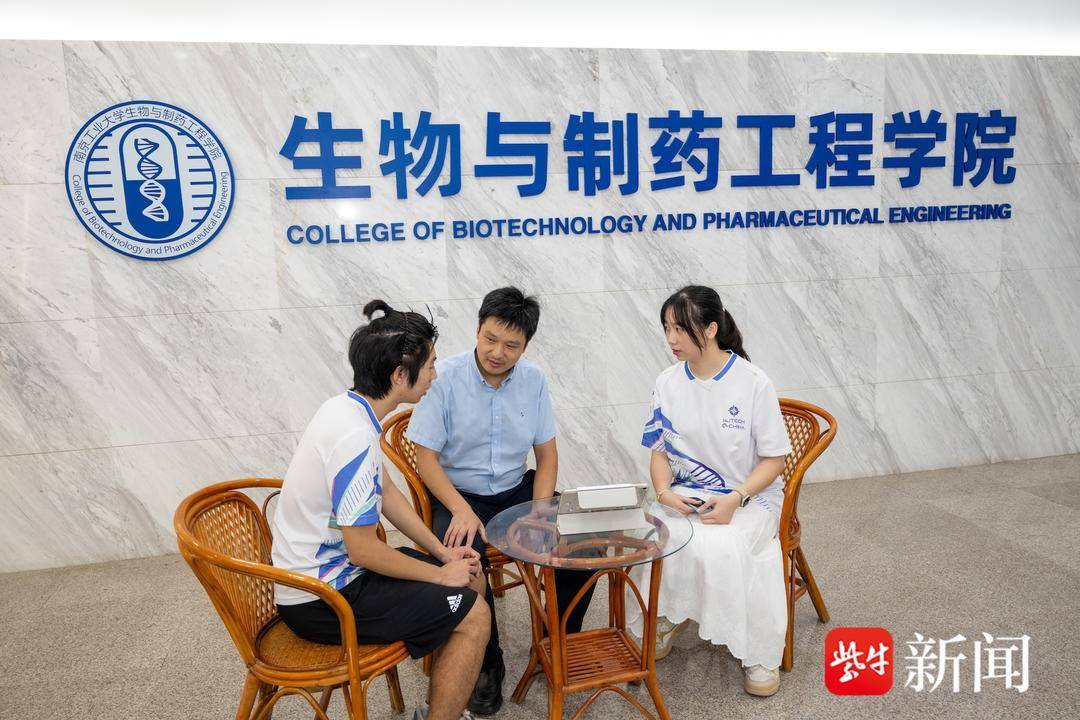
近日,2025年国际基因工程机器大赛(iGEM)在法国巴黎落下帷幕。记者从南京工业大学获悉,该校NJTech-China、NJTECH-CHINA-A两支队伍聚焦友好 环境、绿色发展,在与全球400余支高校代表队的角逐中表现优异,分别斩获全球金奖,在世界竞技舞台彰显了聚力创新的实力和团结协作的风采。 "智能细胞工厂"实现"一菌双产" 聚酰胺54即PA54(俗称"尼龙54")作为聚酰胺家族的新成员,是家族里的"环保优等生",然而其原料须由"生物基尸胺"和"生物基琥珀酸"两种菌种生物合 成,不仅流程复杂,需使用大量酸碱中和剂,还会产生废盐、二氧化碳等废弃物。南京工业大学生物与制药工程学院陈可泉教授团队指导的NJTech-China 团队,通过合成生物学技术,解决了这一问题,在2025年iGEM竞赛中斩获全球金奖、最佳提升元件奖,并获得最佳生物制造项目提名。 指导老师冯娇副教授介绍,以前制造聚酰胺54得请"两个不同的微生物团队"干活,一个团队专门造尸胺,另一个专门造琥珀酸。"就像做饭,得去A厨房 蒸馒头,再去B厨房炖排骨,流程长且复杂,且两者工作时还会浪费资源,产生没用的废弃物。"指导老师许晟副教授形象地补充道:" ...
Twist Bioscience(TWST) - 2025 Q4 - Earnings Call Transcript
2025-11-14 14:02
Financial Data and Key Metrics Changes - The company reported a record revenue of $99 million for Q4, representing a 17% year-over-year increase and marking the 11th consecutive quarter of growth [7] - For the full year, revenue reached $376.6 million, a growth of 20% over fiscal 2024 [7][23] - Gross margin for Q4 was 51.3%, and for the full year, it was 50.7%, an increase from 42.6% in fiscal 2024 [7][23] - Adjusted EBITDA loss improved to approximately $7.8 million for Q4 and $46.9 million for the full year, showing significant improvement compared to fiscal 2024 [27][28] Business Line Data and Key Metrics Changes - SynBio revenue for Q4 was $39.5 million, up 17% year-over-year, and for the full year, it increased to $145 million, also a 17% growth [8][23] - NGS revenue for Q4 grew to approximately $53 million, a 16% increase year-over-year, and for the full year, it reached $208.1 million, a growth of 23% [12][24] - Biopharma revenue was $6.4 million for Q4, a 22% increase year-over-year, with full-year revenue at $23.5 million, a growth of 15% [14][24] Market Data and Key Metrics Changes - Revenue from the Americas increased to approximately $57.3 million in Q4, a 9% year-over-year growth, while EMEA revenue rose to $34.6 million, a 35% increase [25] - APAC revenue increased to $7.2 million in Q4, a 9% year-over-year growth [25] - China accounted for approximately 1% of total revenue for fiscal 2025, indicating a relatively small market share [25] Company Strategy and Development Direction - The company aims to achieve adjusted EBITDA breakeven by the end of fiscal 2026, focusing on setting the stage for future growth acceleration [8] - A new product introduction for NGS aimed at minimal residual disease (MRD) is expected to launch commercially in early 2026, enhancing the company's offerings in cancer diagnostics [18][21] - The company plans to combine SynBio and Biopharma revenue reporting under the term DNA Synthesis and Protein Solutions to better reflect its customer base and operational synergies [16] Management's Comments on Operating Environment and Future Outlook - Management expressed optimism about the growth potential in AI-enabled drug discovery, with significant orders from customers in this area [10][29] - The company anticipates total revenues of $425 million to $435 million for fiscal 2026, reflecting a growth of approximately 13% to 15.5% year-over-year [29] - Management emphasized the importance of staying close to customers to anticipate emerging needs and drive product innovation [32] Other Important Information - The company ended fiscal 2025 with cash, cash equivalents, and short-term investments of approximately $232.4 million [28] - Capital expenditures for fiscal 2025 were $28 million, reflecting investments in growth for the upcoming fiscal year [28] Q&A Session Summary Question: On gross margins and pricing - Management indicated that gross margin expectations are influenced by customer mix and that they expect to maintain a strong margin trajectory moving forward [36][37] Question: NGS growth expectations - Management clarified that NGS growth is expected to rebound to 20% by Q4 2026, with a significant customer ramp anticipated [39][40] Question: Biopharma order sustainability - Management expressed optimism about the sustainability of AI-driven orders and the close ties between Biopharma and SynBio offerings [41][42] Question: Guidance for gross margins - Management expects gross margins to improve throughout fiscal 2026, driven by revenue growth and continuous process improvements [44][45] Question: Market opportunity definition - Management acknowledged the need for clearer market opportunity definitions and metrics to help investors understand growth potential [60][63]

新 和 成(002001) - 2025年11月13日-14日投资者关系活动记录表
2025-11-14 12:29
Group 1: Company Overview - Zhejiang Xinhacheng Co., Ltd. focuses on fine chemicals, driven by innovation and competitive market strategies, forming a development system centered on nutritional products, flavors, high-performance new materials, and APIs [4] - The company has modern production bases in Zhejiang, Shandong, and Heilongjiang, adhering to integrated, systematic, and collaborative development strategies [4] Group 2: Financial Performance - In the first three quarters of 2025, the company achieved a revenue of CNY 16.642 billion, a year-on-year increase of 5.45% [4] - The net profit attributable to shareholders reached CNY 5.321 billion, reflecting a year-on-year growth of 33.37% [4] Group 3: Product Development and Capacity - The main amino acid product is methionine, with a current solid methionine capacity of 300,000 tons and an expansion project of 70,000 tons approved [4] - The company has developed a full-process R&D capability in synthetic biology, covering strain cultivation to industrialization, extending its technology reserves to various applications [4] Group 4: Market Applications - PPS (Polyphenylene Sulfide) is utilized in automotive, electronics, semiconductors, and 5G communications, with both volume and price increasing this year [4] - The new nylon material project in Tianjin focuses on an integrated production chain for "adiponitrile-adipamide-nylon 66," with a planned capacity of 100,000 tons/year for adiponitrile and 140,000 tons for nylon 66 [5] Group 5: Future Plans and Talent Development - The company is expanding its flavor and fragrance segment, with a new industrial park in Shandong and plans to optimize product structure [6] - Talent development is a core strategy, focusing on management, technical skills, and internationalization, with ongoing training programs for future leaders [6] Group 6: Shareholder Returns - The company has implemented three cash dividends in 2025, totaling CNY 2.762 billion, maintaining a cash dividend payout ratio of 30%-50% of net profit [6] - Cumulative cash dividends since listing amount to CNY 16.1 billion, with a commitment to continue sharing operational results with investors [6]

独家|福瑞达在这一领域拿下“全球首创”
FBeauty未来迹· 2025-11-14 09:55
Core Viewpoint - The article highlights the significant achievement of Furuida Biological Co., which has been recognized as the "global pioneer in biosynthetic royal jelly acid" by the China Flavor and Fragrance Cosmetic Industry Association, marking a major milestone in the innovation of cosmetic raw materials [3][4][25]. Group 1: Background and Significance - Royal jelly acid, a key component found in royal jelly, has been studied for its various biological activities, including antibacterial, anti-tumor, and antioxidant properties, earning it titles like "liquid gold" and "longevity factor" [9][10]. - The natural extraction of royal jelly acid is limited, with a yield of only 1.4% to 2.4%, leading to high costs and limited production capacity [10][11]. - Furuida has successfully transitioned from theoretical validation to industrial application in the biosynthesis of royal jelly acid, establishing itself at the forefront of cosmetic ingredient innovation [3][11]. Group 2: Technological Breakthroughs - Furuida has achieved several global firsts in the field of royal jelly acid technology, including the first comprehensive elucidation of its biosynthetic pathway and the first core patent for its biosynthesis method [12][13]. - The company has developed a biosynthetic process that utilizes decanoic acid as a substrate, achieving high yields and environmental friendliness, which has been validated through extensive research and experimentation [20][21]. - The biosynthetic royal jelly acid has been shown to possess the same structural characteristics and biological activity as natural royal jelly acid, demonstrating its efficacy in skincare applications [21][23]. Group 3: Market Impact and Future Directions - Furuida's product line, including the "Jingyan Jinzhi" series, has successfully entered the market, achieving notable sales rankings on platforms like Tmall, indicating strong consumer interest and validation of the product's effectiveness [16][25]. - The recognition of Furuida as a global pioneer signifies a shift in the Chinese cosmetic industry towards innovation in raw materials, moving away from reliance on imported high-end ingredients [25][28]. - The advancements made by Furuida in biosynthetic royal jelly acid not only address supply issues but also provide a sustainable model for the industry, showcasing the potential of synthetic biology in creating high-value cosmetic ingredients [27][28].