
精准医疗

Search documents
联影医疗跌2.01%,成交额5.16亿元,主力资金净流出3747.67万元
Xin Lang Cai Jing· 2025-09-23 03:24
Core Viewpoint - 联影医疗的股价在近期出现波动,尽管今年以来整体上涨,但近几日有所下跌,显示出市场对其表现的关注 [1][2] Company Overview - 联影医疗成立于2011年3月21日,上市于2022年8月22日,主要提供高性能医学影像设备、放射治疗产品及医疗数字化解决方案 [2] - 主营业务收入构成:医学影像诊断设备及放射治疗设备占81.29%,维修收入占13.56%,其他收入占4.68%,软件收入占0.47% [2] Financial Performance - 截至2025年1月-6月,联影医疗实现营业收入60.16亿元,同比增长12.79%;归母净利润为9.98亿元,同比增长5.03% [2] - A股上市后累计派现5.34亿元 [3] Stock Performance - 今年以来股价上涨13.20%,近5个交易日下跌6.52%,近20日上涨4.76%,近60日上涨11.74% [2] - 截至9月23日,股价为143.00元/股,总市值为1178.55亿元 [1] Shareholder Information - 截至6月30日,股东户数为1.65万,较上期减少23.01%;人均流通股为35953股,较上期增加29.89% [2] - 主要流通股东包括华夏上证科创板50成份ETF、香港中央结算有限公司及易方达上证科创板50ETF等,均有增持 [3]

贝达药业跌2.01%,成交额2.62亿元,主力资金净流出1527.74万元
Xin Lang Cai Jing· 2025-09-22 06:05
Company Overview - Beida Pharmaceutical Co., Ltd. is located in Hangzhou, Zhejiang Province, established on January 7, 2003, and listed on November 7, 2016. The company primarily engages in the research, production, and sales of pharmaceuticals, with 99.10% of its revenue coming from drug sales and 0.90% from other sources [1]. Stock Performance - As of September 22, Beida Pharmaceutical's stock price decreased by 2.01%, trading at 65.72 CNY per share, with a total market capitalization of 27.651 billion CNY. The stock has increased by 22.31% year-to-date but has seen a decline of 6.38% over the last five trading days and 9.69% over the last 20 days [1]. - The company experienced a net outflow of 15.2774 million CNY in principal funds, with significant selling pressure observed [1]. Financial Performance - For the first half of 2025, Beida Pharmaceutical reported a revenue of 1.731 billion CNY, representing a year-on-year growth of 15.37%. However, the net profit attributable to shareholders decreased by 37.53% to 140 million CNY [2]. Shareholder Information - As of June 30, 2025, the number of shareholders increased to 32,100, a rise of 9.97%. The average number of circulating shares per person decreased by 9.08% to 13,064 shares [2]. - The company has distributed a total of 669 million CNY in dividends since its A-share listing, with 184 million CNY distributed over the past three years [3]. Institutional Holdings - As of June 30, 2025, notable institutional shareholders include E Fund's ChiNext ETF, which holds 6.3678 million shares (a decrease of 107,600 shares), and China Europe Medical Health Mixed A, which is a new shareholder with 4.3513 million shares [3].

新开源(300109.SZ)及子公司呵尔医疗拟对华道生物合计增资5000万元
Ge Long Hui A P P· 2025-09-19 09:36
Core Viewpoint - The company New Open Source (300109.SZ) aims to enhance its competitive advantage in the precision medicine sector through a strategic investment in Huada Bio and its shareholders [1] Investment Details - New Open Source and its subsidiary Wuhan He'er Medical Technology Development Co., Ltd. plan to sign an investment agreement with Huada Bio and its 28 shareholders [1] - The company will invest a total of RMB 30 million and RMB 20 million in Huada Bio through capital increase, resulting in ownership stakes of 12.2150% and 0.7168% respectively [1]

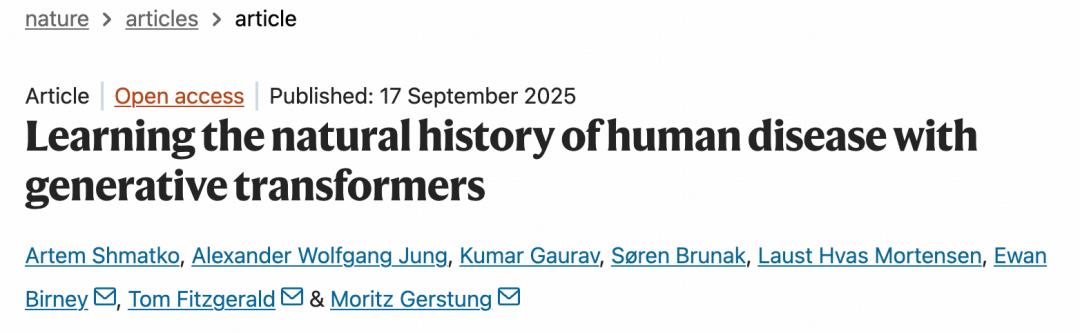
Nature重磅:魔改GPT-2,AI帮你预测未来20年健康风险,涉及1000+疾病
3 6 Ke· 2025-09-19 08:08
Core Insights - The article discusses the breakthrough research of the Delphi-2M model, which utilizes AI to predict individual health trajectories and disease risks over a 20-year period, based on personal medical history and lifestyle data [1][2][9]. Model Overview - Delphi-2M is based on a modified GPT-2 architecture, allowing for the prediction of over 1,256 diseases and mortality risks, achieving high accuracy in its predictions [5][6]. - The model's training relied on high-quality datasets, including 400,000 participants from the UK Biobank, ensuring its generalizability and reliability [4][6]. Validation and Performance - Internal validation showed an average AUC of 0.76 for most diseases, with mortality risk predictions reaching an AUC of 0.97, indicating near-perfect predictive capability [6]. - The model demonstrated strong cross-population applicability, maintaining relevant disease prediction patterns when applied to Danish data without parameter adjustments [6][9]. Long-term Prediction Capability - Unlike traditional models that predict risks for 1-5 years, Delphi-2M can simulate health trajectories for up to 20 years, showing high accuracy in predicting disease incidence rates for older populations [8][10]. - The model effectively distinguishes between high-risk and low-risk individuals based on historical health data, enhancing personalized risk assessment [8][10]. Privacy and Data Generation - Delphi-2M addresses privacy concerns by generating synthetic health data that mimics real population disease incidence patterns without revealing personal information [9][10]. - This capability allows for the training of other medical AI models while protecting individual privacy and optimizing data resource utilization [9][10]. Future Directions - The model's architecture is designed to integrate various data types, including genomic and imaging data, which could enhance its predictive capabilities as data integration progresses [11]. - Delphi-2M is positioned as a supportive tool for medical decision-making, emphasizing the need for integration with clinical expertise and patient preferences [11][12].

药明康德跌2.06%,成交额33.97亿元,主力资金净流出1.84亿元
Xin Lang Cai Jing· 2025-09-19 06:07
Company Overview - WuXi AppTec, established on December 1, 2000, is located in Shanghai and Hong Kong, and was listed on May 8, 2018. The company provides a comprehensive platform for the discovery, development, and manufacturing of small molecule chemical drugs, serving global pharmaceutical companies [1][2]. Financial Performance - For the first half of 2025, WuXi AppTec achieved a revenue of 20.799 billion yuan, representing a year-on-year growth of 20.64%. The net profit attributable to shareholders was 8.561 billion yuan, showing a significant increase of 101.92% year-on-year [2]. - The company has distributed a total of 13.027 billion yuan in dividends since its A-share listing, with 9.373 billion yuan distributed over the past three years [2]. Stock Performance - As of September 19, WuXi AppTec's stock price was 105.22 yuan per share, with a market capitalization of 310.558 billion yuan. The stock has increased by 95.90% year-to-date, with a slight decline of 0.24% over the past five trading days [1]. - The trading volume on September 19 was 3.397 billion yuan, with a turnover rate of 1.28% [1]. Shareholder Structure - As of June 30, 2025, the second-largest shareholder is Hong Kong Central Clearing Limited, holding 302 million shares, an increase of 56.0239 million shares from the previous period. Other notable shareholders include Huaxia SSE 50 ETF and China Europe Medical Health Mixed A [3]. Industry Classification - WuXi AppTec is classified under the pharmaceutical and biotechnology sector, specifically in medical services and contract research organization (CRO) services. The company is associated with concepts such as cell therapy, precision medicine, innovative drugs, and overseas expansion [2].

复星医药跌2.02%,成交额5.80亿元,主力资金净流出8729.33万元
Xin Lang Cai Jing· 2025-09-19 03:11
Group 1 - The core viewpoint of the news highlights the recent stock performance and financial metrics of Fosun Pharma, indicating a decline in stock price and significant net outflow of funds [1][2] - As of September 19, Fosun Pharma's stock price decreased by 2.02% to 30.97 CNY per share, with a total market capitalization of 82.703 billion CNY [1] - The company has seen a year-to-date stock price increase of 26.24%, but a recent decline of 1.74% over the last five trading days [1] Group 2 - Fosun Pharma's main business segments include drug manufacturing and research, with a revenue composition of 45.68% from anti-tumor and immune regulation products, 17.53% from anti-infection products, and 13.83% from metabolic and digestive system products [1] - For the first half of 2025, Fosun Pharma reported a revenue of 19.514 billion CNY, a year-on-year decrease of 4.63%, while the net profit attributable to shareholders increased by 38.96% to 1.702 billion CNY [2] - The company has distributed a total of 12.593 billion CNY in dividends since its A-share listing, with 2.691 billion CNY distributed in the last three years [3]
药明康德涨2.05%,成交额26.41亿元,主力资金净流入8148.11万元
Xin Lang Zheng Quan· 2025-09-17 03:16
Group 1 - The core viewpoint of the news highlights the significant stock performance and financial growth of WuXi AppTec, with a year-to-date stock price increase of 103.39% and a market capitalization of 322.43 billion yuan [1][2] - WuXi AppTec's main business segments include small molecule chemical drug discovery, research and production services, with revenue contributions of 78.37% from chemical services, 12.93% from testing services, and 6.02% from biological services [1][2] - The company reported a revenue of 20.64% year-on-year growth, reaching 20.799 billion yuan for the first half of 2025, and a net profit increase of 101.92%, amounting to 8.561 billion yuan [2] Group 2 - As of June 30, 2025, the second-largest shareholder of WuXi AppTec is Hong Kong Central Clearing Limited, holding 302 million shares, an increase of 5.602 million shares from the previous period [3] - The seventh-largest shareholder is Huaxia SSE 50 ETF, with 48.998 million shares, an increase of 3.2196 million shares [3] - The eighth-largest shareholder is China Europe Medical Health Mixed A, holding 46.0291 million shares, which decreased by 0.0754 million shares [3]
贝达药业跌2.03%,成交额1.65亿元,主力资金净流出596.14万元
Xin Lang Cai Jing· 2025-09-17 02:23
Core Viewpoint - Benda Pharmaceutical's stock has experienced fluctuations, with a year-to-date increase of 26.74% but a recent decline of 5.31% over the past five trading days [1] Financial Performance - As of June 30, Benda Pharmaceutical reported a revenue of 1.731 billion yuan for the first half of 2025, representing a year-on-year growth of 15.37% [2] - The company's net profit attributable to shareholders was 140 million yuan, showing a significant decrease of 37.53% compared to the previous period [2] Stock Market Activity - On September 17, Benda Pharmaceutical's stock price was 68.10 yuan per share, with a trading volume of 165 million yuan and a turnover rate of 0.57% [1] - The total market capitalization of the company stood at 28.652 billion yuan [1] - The net outflow of main funds was 5.9614 million yuan, with large orders showing a buy of 38.5116 million yuan and a sell of 39.5442 million yuan [1] Shareholder Information - As of June 30, the number of shareholders increased to 32,100, a rise of 9.97% from the previous period [2] - The average number of circulating shares per shareholder decreased by 9.08% to 13,064 shares [2] - The top ten circulating shareholders included new entrants such as China Europe Medical Health Mixed A and South China CSI 500 ETF [3]
安图生物(603658):国内发光业务承压,Q2环比改善
Huachuang Securities· 2025-09-15 09:41
Investment Rating - The report maintains a "Recommended" rating for the company with a target price of 51 yuan [2][8]. Core Views - The company's revenue for the first half of 2025 was 2.06 billion yuan, a decrease of 6.65% year-on-year, while the net profit attributable to the parent company was 571 million yuan, down 7.83% [2]. - In Q2 2025, the company achieved revenue of 1.064 billion yuan, a decline of 4.79%, but the net profit attributable to the parent company increased by 1.97% to 301 million yuan, indicating a quarter-on-quarter improvement [2]. - The domestic luminous business is under pressure, but there was a sequential improvement in Q2 [2][8]. - The company continues to focus on R&D, with an investment of 350 million yuan in the first half of 2025, accounting for 16.99% of revenue [8]. Financial Summary - For 2025, the company is projected to achieve total revenue of 4.658 billion yuan, with a year-on-year growth rate of 4.2% [4]. - The net profit attributable to the parent company is expected to be 1.264 billion yuan in 2025, reflecting a growth rate of 5.8% [4]. - The earnings per share (EPS) for 2025 is estimated at 2.21 yuan, with a price-to-earnings (P/E) ratio of 19 times [4]. - The company’s total assets are projected to reach 12.306 billion yuan by 2025, with a debt-to-equity ratio of 9.9% [9]. Business Performance - Domestic revenue in the first half of 2025 was 1.904 billion yuan, down 8.32%, while overseas revenue increased by 19.78% to 157 million yuan [8]. - The company has accelerated its global expansion, entering over 100 countries and regions, and has established subsidiaries in Hong Kong, Hungary, and Indonesia to enhance local operations [8]. - The company has launched several innovative products, including a series of gene sequencers and an AI-assisted clinical decision-making system [8].

复星医药涨2.03%,成交额8.01亿元,主力资金净流入2087.90万元
Xin Lang Cai Jing· 2025-09-15 03:16
Company Overview - Fosun Pharma's stock price increased by 2.03% on September 15, reaching 32.16 CNY per share, with a trading volume of 8.01 billion CNY and a turnover rate of 1.19%, resulting in a total market capitalization of 858.81 billion CNY [1] - The company was established on May 31, 1995, and listed on August 7, 1998, with its main business focusing on drug manufacturing and research, covering medical devices, medical services, and pharmaceutical distribution and retail [1] Financial Performance - For the first half of 2025, Fosun Pharma reported a revenue of 19.514 billion CNY, a year-on-year decrease of 4.63%, while the net profit attributable to shareholders increased by 38.96% to 1.702 billion CNY [2] - The company has distributed a total of 12.593 billion CNY in dividends since its A-share listing, with 2.691 billion CNY distributed over the past three years [2] Stockholder Information - As of June 30, 2025, the number of shareholders decreased by 4.37% to 230,000, with an average of 0 circulating shares per shareholder [2] - The top ten circulating shareholders include Hong Kong Central Clearing Limited, which holds 75.8807 million shares, an increase of 11.1938 million shares from the previous period [3]