
一体化供应链

Search documents
京东物流第三季度一体化供应链收入同比增长45.8% 增速持续领跑行业
Zheng Quan Ri Bao Wang· 2025-11-13 09:49
Core Insights - JD Logistics reported a total revenue of 55.1 billion yuan for Q3 2025, representing a year-on-year growth of 24.1%, with adjusted net profit reaching 2.02 billion yuan, exceeding market expectations [1][1][1] Revenue Breakdown - Integrated supply chain revenue for Q3 reached 30.1 billion yuan, showing a year-on-year increase of 45.8%, continuing to lead the industry in growth rate [1][1][1] - The number of external integrated supply chain customers and average revenue per customer both demonstrated steady growth [1][1][1]
京东物流发布第三季度业绩,收入550.84亿元 同比增长24.1%
Zhi Tong Cai Jing· 2025-11-13 08:54
Core Viewpoint - JD Logistics reported a revenue of RMB 55.084 billion for the third quarter ending September 30, 2025, representing a year-on-year increase of 24.1%, while the pre-tax profit decreased by 20.4% to RMB 2.09 billion, and the profit attributable to shareholders fell by 7.92% to RMB 2.03 billion [1] Group 1: Integrated Supply Chain Solutions - The revenue from integrated supply chain customers reached RMB 30.1 billion, a year-on-year increase of 45.8%, with external integrated supply chain customer revenue at RMB 8.9 billion, up 13.5% [1] - The company is enhancing its end-to-end coverage in the home appliance sector, leveraging digital capabilities to streamline operations and reduce costs for brand clients [1] - The "consolidated distribution" model has effectively reduced the number of transfers in delivery, helping clients lower costs and improve warehouse entry efficiency [1] Group 2: Overseas Business Expansion - The company is actively expanding its overseas business by replicating its warehousing and integrated supply chain capabilities in international markets [2] - A partnership with a well-known electric vehicle brand has extended operations to the Middle East, providing comprehensive logistics services in Dubai [2] - The successful launch of a dedicated air cargo route from Shenzhen to Singapore enhances the logistics network in the Asia-Pacific region, offering efficient solutions for high-end electronic products and cross-border e-commerce packages [2] Group 3: Warehousing Network and Acquisitions - As of September 30, 2025, the company's warehousing network covers nearly all counties in China, with over 1,600 warehouses operated by the company and more than 2,000 cloud warehouses managed by third-party owners [3] - The acquisition of a wholly-owned subsidiary engaged in local instant delivery services for approximately USD 270 million is expected to enhance the company's service offerings and improve last-mile delivery capabilities [3] - Total human resources expenditure reached RMB 103.9 billion over the past twelve months, reflecting the company's commitment to job creation and social contribution [3]
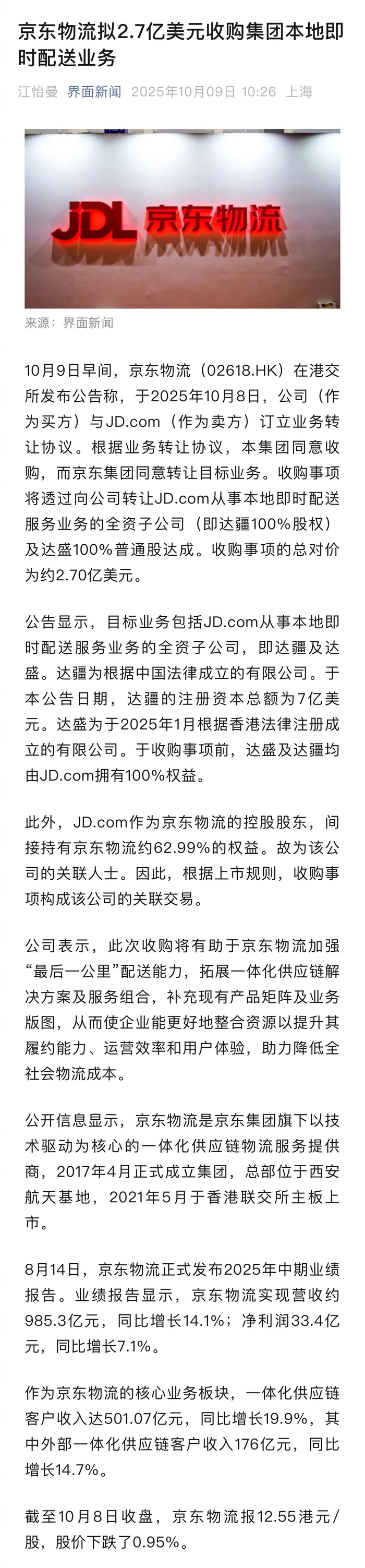
京东物流2.7亿美元收购达疆达盛强化即时配送
Cai Jing Wang· 2025-10-09 04:12
Core Viewpoint - JD Logistics plans to acquire JD.com's local instant delivery business for approximately $270 million, which includes 100% equity of subsidiaries Dajiang and Dasheng, enhancing its last-mile delivery capabilities and integrated supply chain solutions [1][2][4]. Group 1: Acquisition Details - The acquisition agreement was signed on October 8, 2025, with JD.com as the seller and JD Logistics as the buyer [1][4]. - The total consideration for the acquisition is about $270 million [1][4]. - Dajiang, a wholly-owned subsidiary of JD.com, has a registered capital of $700 million, while Dasheng was established under Hong Kong law in January 2025 [1][4]. Group 2: Strategic Implications - The acquisition is expected to strengthen JD Logistics' last-mile delivery capabilities and expand its integrated supply chain solutions and service offerings [2][6]. - This move aims to enhance resource integration, improve fulfillment capabilities, operational efficiency, and user experience, ultimately reducing logistics costs across society [2][6]. Group 3: Company Background - JD Logistics is a technology-driven integrated supply chain logistics service provider under JD Group, officially established in April 2017 and listed on the Hong Kong Stock Exchange in May 2021 [6]. - For the first half of 2025, JD Logistics reported revenue of approximately 98.53 billion yuan, a year-on-year increase of 14.1%, and a net profit of 3.34 billion yuan, up 7.1% [6].

蜜雪集团(02097.HK):一体化供应链优势显著 飞轮效应持续强化
Ge Long Hui· 2025-09-25 20:18
Company Overview - The company is enhancing its integrated supply chain capabilities, consolidating quality-price ratio and scale flywheel effects, and achieving relatively stable growth despite potential disruptions from the decline in delivery subsidies [1] - The company has established deep partnerships with major suppliers for global procurement, reducing costs through scale effects, with specific procurement volumes for lemons, fresh oranges, tea leaves, and coffee beans in 2024 [1] Supply Chain and Operational Efficiency - The company is improving factory automation and optimizing product taste through process upgrades, while also establishing a localized warehousing system in countries like Vietnam, Indonesia, Thailand, and Malaysia [1] - The company has deployed 4,000-5,000 self-developed intelligent dispensing machines, reducing service time from over 20 seconds to 8-10 seconds, enhancing store operational efficiency [1] Market Performance and Growth Potential - The impact of delivery subsidies is gradually weakening, but the company is expected to achieve stable performance growth through product innovation, offline marketing, and mini-program traffic [2] - The company’s "Lucky Coffee" brand is leveraging supply chain advantages to enhance fruit and coffee product innovation, with a projected higher same-store growth rate compared to the overall company [2] International Market Adjustments - The overseas market is still in an adjustment phase, with higher gross margins compared to domestic operations, allowing the company to maintain profitability for franchisees while enhancing quality-price positioning [2] Financial Forecast and Valuation - The company maintains its earnings forecast, with current stock prices corresponding to 24/21x P/E for 2025/2026, and a target price reflecting a potential upside of 35% [2]
中金:维持蜜雪集团“跑赢行业”评级 目标价555港元
Zhi Tong Cai Jing· 2025-09-24 06:18
Core Viewpoint - CICC maintains a "outperform" rating for Mixue Group (02097) with a target price of HKD 555, corresponding to 32x/28x P/E for 2025/2026, indicating a potential upside of 35% [1] Group 1: Integrated Supply Chain Capability - The company is enhancing its integrated supply chain capabilities, solidifying quality-price ratio and scale flywheel effects [2] - On the procurement side, the company collaborates deeply with major suppliers globally, reducing costs through scale effects, with planned purchases of 115,000 tons of lemons, 27,000 tons of fresh oranges, 61,000 tons of tea leaves, and 13,000 tons of coffee beans in 2024 [2] - The company is improving factory automation and optimizing product taste through process upgrades, while establishing 29 domestic warehouses and local storage systems in countries like Vietnam, Indonesia, Thailand, and Malaysia, achieving over 90% coverage of county-level administrative regions in mainland China within 12 hours [2] - The company has developed an intelligent dispensing machine to enhance store operational efficiency, reducing service time from over 20 seconds to 8-10 seconds, with 4,000-5,000 units currently deployed [2] Group 2: Impact of Delivery Subsidies - The impact of delivery subsidies is gradually weakening, but the company is expected to achieve relatively stable performance growth despite potential disruptions [3] - CICC estimates that the company’s same-store sales grew by 13% year-on-year in H1 due to delivery subsidies, with delivery revenue share increasing by approximately 10 percentage points [3] - The company is expected to counter the impact of declining delivery subsidies through product innovation, offline marketing, and mini-program traffic [3] Group 3: Focus on Lucky Coffee and Overseas Adjustments - Lucky Coffee is leveraging Mixue's supply chain advantages to enhance fruit and coffee product innovation, with coffee product revenue accounting for over half of total revenue [4] - The company has signed over 8,000 new stores nationwide as of August 27, with expectations to reach around 8,000 operational stores by year-end [4] - The overseas market is still in an adjustment phase, with higher gross margins compared to domestic operations, allowing the company to maintain profitability for franchisees while enhancing quality-price positioning through product iterations [4]
中金:维持蜜雪集团(02097)“跑赢行业”评级 目标价555港元
智通财经网· 2025-09-24 06:13
Core Viewpoint - The report from CICC maintains a "outperforming the industry" rating for Mixue Group (02097) with a target price of HKD 555, corresponding to a P/E of 32/28x for 25/26, indicating a potential upside of 35% [1] Group 1: Integrated Supply Chain Capability - The company is enhancing its integrated supply chain capabilities, consolidating quality-price ratio and scale flywheel effects [1] - On the procurement side, the company is globally sourcing and collaborating deeply with major suppliers, reducing costs through scale effects, with planned purchases of 11.5k tons of lemons, 2.7k tons of fresh oranges, 6.1k tons of tea leaves, and 1.3k tons of coffee beans in 2024 [1] - The company is improving factory automation to optimize product taste and has established 29 domestic warehouses, along with localized storage systems in Vietnam, Indonesia, Thailand, and Malaysia, achieving over 90% coverage of county-level administrative regions in mainland China within 12 hours [1] - The company has developed an intelligent dispensing machine to enhance store operational efficiency, reducing service time from over 20 seconds to 8-10 seconds, with 4,000-5,000 units currently deployed [1] Group 2: Impact of Delivery Subsidies - The company estimates that delivery subsidies contributed to a 13% year-on-year same-store sales growth in H1, with delivery revenue share increasing by approximately 10 percentage points [2] - Considering the gradual weakening of delivery subsidies since July, the company anticipates a decline in same-store revenue growth in H2 compared to Q2 [2] - The company is expected to counter the impact of declining delivery subsidies through product innovation, offline marketing, and mini-program traffic [2] Group 3: Potential of Lucky Coffee and Overseas Adjustments - Lucky Coffee is leveraging Mixue's supply chain advantages to enhance fruit and coffee product innovation, with coffee product revenue accounting for over half of total revenue, and same-store growth expected to exceed the overall company growth of 13% in H1 [3] - The company has signed over 8,000 new stores nationwide as of August 27, with expectations to reach around 8,000 operational stores by year-end [3] - The overseas market is still in an adjustment phase, with higher gross margins compared to domestic operations, allowing the company to provide discounts while ensuring franchisee profitability remains within a reasonable range [3]
中国巨石20250829
2025-08-31 16:21
Summary of Conference Call Records Industry Overview - The conference call discusses the electronic fabric industry, specifically focusing on companies like China Jushi, Guangyuan New Materials, and Jiantao Group, which are involved in the production of various types of electronic fabrics and materials [1][3][5][6]. Key Points and Arguments China Jushi - China Jushi has rapidly expanded its market share in the electronic fabric sector through a comprehensive technology coverage strategy, including first-generation, second-generation low dielectric fabrics, low expansion fabrics, and Q fabrics [1][3]. - The company possesses over 10,000 weaving machines, significantly surpassing competitors, and is advancing its production capabilities using both pool kiln and crucible methods for second-generation fabric production [3][10]. - The company is focusing on improving its competitiveness in the second-generation fabric market, where supply is currently scarce, and aims to achieve breakthroughs in production technology [4][14]. Guangyuan New Materials - Guangyuan New Materials holds the highest market share in the electronic fabric sector, leveraging mature pool kiln technology and a strong thin fabric business to enter the special electronic fabric market [1][5]. - The company has achieved stable supply and rapid expansion in the first-generation low dielectric fabric market, with an expected sixfold increase in production capacity by the end of 2025 [5]. - Guangyuan's production costs are significantly lower (30% to 40%) compared to traditional methods, which positions it favorably despite challenges in the third-generation Q fabric market [5][10]. Jiantao Group - Jiantao Group is actively developing special electronic yarn production, planning to build ten special AI electronic yarn production lines, with the first low dielectric kiln already operational [6][7]. - The company plans to add six more kilns in 2026, indicating rapid industry growth and a strategic move to enhance competitiveness in the high-speed board market through upstream material supply chain integration [7][9]. - Jiantao's strategy includes reducing reliance on external supply chains, thereby lowering risks associated with supply disruptions [8][9]. Market Dynamics - The first-generation fabric market is experiencing strong supply and demand, with some companies raising prices in August 2025, indicating rapid industry expansion [13]. - The supply-demand balance for second-generation and low expansion fabrics remains tight, with companies striving for stable, high-yield production to gain competitive advantages [14]. - The quartz fabric sector is characterized by a diverse range of participants, with a low entry barrier due to the separation of the drawing and weaving processes, leading to increased specialization [15]. Emerging Risks and Opportunities - There is a potential risk of price competition in the industry, prompting companies to seek cost-optimized technology routes, with pool kiln technology becoming the mainstream choice due to its cost advantages [2][12]. - The industry is expected to face challenges in meeting demand, particularly for second-generation fabrics, with predictions of supply shortages by 2026 [19][22]. - New emerging companies, such as China Yushi and Linzhou Guangyuan, are noted for their unique strengths and are expected to play significant roles in future competition [20]. Conclusion - The electronic fabric industry is poised for rapid growth, driven by technological advancements and strategic expansions by key players. However, companies must navigate potential risks related to supply shortages and price competition while capitalizing on emerging opportunities in the market [21][22].

IPO研究|预计2029年中国一体化供应链物流解决方案市场规模4.67万亿元
Sou Hu Cai Jing· 2025-08-28 08:31
Core Viewpoint - Ande Zhihui Supply Chain Technology Co., Ltd. has submitted a listing application to the Hong Kong Stock Exchange, aiming to leverage its unique "1+3" supply chain logistics model to capture growth in the integrated supply chain logistics market in China [3]. Industry Overview - The integrated supply chain logistics solutions market in China is expected to grow from RMB 3,100.7 billion in 2024 to RMB 4,670.8 billion by 2029, with a compound annual growth rate (CAGR) of 8.5% [4]. - The demand for integrated supply chain logistics solutions is driven by the need for efficiency improvements across production, circulation, and last-mile delivery [4]. Market Segmentation - The fast-moving consumer goods (FMCG) sector is projected to see its integrated supply chain logistics solutions market grow from RMB 520.2 billion in 2024 to approximately RMB 818.6 billion by 2029, with a CAGR of 9.5% [7]. - The home appliance industry remains strong in demand for integrated supply chain logistics solutions, with market size expected to increase from RMB 41.5 billion in 2024 to RMB 57 billion by 2029 [7]. - The automotive and auto parts sector is currently the largest segment for integrated supply chain logistics solutions, with a market size projected to reach approximately RMB 584.7 billion in 2024 and RMB 946.9 billion by 2029, reflecting a CAGR of 10.1% [7].
京东物流涨超7% 将于9月8日起正式染蓝
Zhi Tong Cai Jing· 2025-08-25 03:05
Core Viewpoint - JD Logistics (02618) has seen a significant increase in stock price, rising over 7% following its inclusion in the Hang Seng Index, indicating positive market sentiment and potential growth opportunities for the company [1] Group 1: Stock Performance - JD Logistics shares rose by 7.01%, reaching HKD 13.9, with a trading volume of HKD 304 million [1] Group 2: Index Inclusion - On August 22, the Hang Seng Index Company announced its semi-annual index adjustment, which will include JD Logistics as a constituent stock, increasing the number of constituent stocks from 85 to 88 [1] - The adjustment will take effect after the market closes on September 5 and will be effective from September 8 [1] Group 3: Business Outlook - According to recent research from Zheshang Securities (601878), JD Logistics is a leading company in the integrated supply chain industry, with continuous growth in business volume and increasing scale effects [1] - The integration of JD Logistics with TaoTian and the addition of new food delivery services by JD Group are expected to further enhance the company's revenue [1]
京东物流(02618.HK):供应链业务拓客成效亮眼 即时配送协同可期
Ge Long Hui· 2025-08-16 19:05
Core Viewpoint - The company's Q2 2025 performance met expectations, with significant growth in supply chain business and the launch of full-time delivery rider services, indicating potential for enhanced network collaboration [1][2]. Financial Performance - Q2 2025 revenue reached 51.56 billion yuan, a year-on-year increase of 17% - Non-IFRS net profit was 2.59 billion yuan, up 5% year-on-year, with a non-IFRS net profit margin of 5.0%, down 0.5 percentage points year-on-year [1]. - Integrated supply chain customer revenue grew by 26% year-on-year to 26.9 billion yuan, with external customer revenue increasing by 18% to 9.1 billion yuan [1]. Cost and Expense Analysis - Operating costs rose by 18% year-on-year, with employee benefits and outsourcing costs both increasing by 21% - Gross margin decreased by 1.3 percentage points to 10.6% due to increased costs associated with the expansion of delivery services [2]. - The company employed over 660,000 staff, including full-time delivery riders, an increase of approximately 180,000 from the end of 2024 [2]. Development Trends - The company began recruiting and managing full-time riders in Q2 2025, participating in JD's delivery services and launching instant retail services [2]. - The integration of delivery riders with existing logistics networks is expected to enhance delivery efficiency and capacity flexibility [2]. - Continued investment in internationalization and automation, including the launch of a self-operated express brand in Saudi Arabia and the development of self-researched light trucks [2]. Profit Forecast and Valuation - The company's non-IFRS net profit forecasts for 2025 and 2026 were revised down by 2.7% and 5.8% to 8.307 billion yuan and 8.883 billion yuan, respectively [3]. - The current stock price corresponds to 10.2 times and 9.4 times the non-IFRS P/E ratios for 2025 and 2026, with a target price of 18.50 HKD, indicating a potential upside of 32.5% [3].