
不良贷款率

Search documents
加纳银行业不良贷款率降至19.5%
Shang Wu Bu Wang Zhan· 2025-11-29 15:21
Core Insights - The non-performing loan (NPL) ratio in Ghana's banking sector has decreased from 22.7% in October 2024 to 19.5% in October 2025, a reduction of 3.2 percentage points over twelve months, attributed to a rebound in credit and a contraction in total NPLs [1][1][1] - The Bank of Ghana aims to further reduce the NPL ratio to a maximum of 10% by December 2026, necessitating significant improvements in credit management and loan recovery capabilities among banks [1][1][1] - The central bank has lowered the monetary policy rate from 21.5% to 18%, a decrease of 350 basis points, to stimulate investment and economic activity [1][1][1] - As of October 2025, Ghana's international reserves reached $11.4 billion, equivalent to 4.8 months of import cover, providing a foundation for exchange rate stability and macroeconomic support [1][1][1] - The decline in the NPL ratio indicates enhanced asset quality and risk management capabilities within the banking sector, suggesting a gradual recovery from the impacts of debt restructuring [1][1][1]
中国银行与地产_个人房产抵押贷款风险几何-China Banks and Property_ How risky are individual property-backed loans_
2025-11-25 01:19
Summary of Conference Call on China Banks and Property Industry Overview - The focus is on the Chinese banking sector and the property market, particularly the risks associated with property-backed loans and the implications for banks and borrowers [2][3][4]. Key Points 1. Rising Risks in Property-Backed Loans - Individual property-backed loan risks are increasing due to ongoing declines in property prices, raising concerns about potential defaults on mortgages and business operating loans [2][3]. - Key metrics indicating risk include: - **Foreclosed Properties**: 2.1 million units, or 1.8% of total properties with mortgages or loans [2]. - **Negative Cash Flow**: 1.2% of mortgage holders and 4.8% of all borrowers may have insufficient income to cover their loans [2][3]. - **Negative Equity**: Expected to rise from 0.7 million units in 2025 to 3.3 million units by 2027, with loan losses projected to reach RMB 232 billion [2][9]. 2. Cash Flow as a Key Driver of Defaults - Cash flow issues, rather than property price declines, are seen as the primary driver of potential defaults [3]. - Historical reference from Hong Kong (1997-2003) shows that despite significant property price declines, delinquency rates remained low, indicating that cash flow is a more critical factor [3][16][17]. 3. Regulatory Measures and Their Implications - Anticipated regulatory measures to mitigate risks include: - Personal credit relief policies to remove small defaults from credit reports [4]. - Delivery of over 7.5 million stalled housing units by the end of 2025 [4]. - Potential mortgage rate cuts below 3% [4]. - These measures could lead to increased secondary market listings, putting further pressure on property prices [4]. 4. Implications for Banks - The banking sector is expected to face manageable risks, with a projected NPL ratio of 3% (1.6% for mortgages and 4.8% for MSE/business operating loans) [5]. - Large state-owned banks may need to make additional provisions equivalent to 11-10 basis points of annualized credit cost [5]. - The estimated additional provisioning needed for banks could amount to RMB 0.3 trillion, representing 7.3% of annual PPOP in 2025 [74]. 5. Foreclosure and Refinancing Risks - The number of foreclosed properties is expected to rise significantly, with estimates of 0.64 million units in 2025 and 2.43 million units by 2027 due to refinancing pressures on business operating loans [25][27]. - The outstanding operating loan amount was RMB 29.4 trillion as of the end of 2023, with a significant portion backed by physical property [24]. 6. Market Sentiment and Future Expectations - A significant increase in respondents indicating they will not buy a house in the next two years, rising from 32% in 2024 to 45% in 2025, reflects a pessimistic outlook on the property market [62]. - Property prices are expected to decline by 10% in 2026 and 5% in 2027, following a 12% decline in 2025 [65][68]. 7. Potential Policy Responses - Forbearance measures, such as repayment extensions and penalty waivers, are expected to be implemented to contain defaults [69]. - The PBOC is considering reforms to the personal credit system to alleviate the impact of delinquencies on borrowers [71]. 8. Conclusion - The overall sentiment indicates that while risks in the property market and banking sector are rising, regulatory measures and cash flow management strategies may help mitigate potential defaults and systemic risks [3][4][5][68].

息差企稳、不良双升 三季度银行业盈利与风险博弈继续
Sou Hu Cai Jing· 2025-11-19 16:28
Core Insights - The banking industry is experiencing a phase of stabilization in net interest margins (NIM), with the NIM at 1.42% as of Q3 2025, marking the end of a continuous decline [1][2] - There is a slight increase in non-performing loans (NPLs) and NPL ratios, indicating ongoing risks in certain sectors of the economy [4][5] - The balance between supporting the real economy and maintaining prudent operations is a central concern for the banking sector [1] Group 1: Net Interest Margin Stabilization - As of Q3 2025, the commercial banks' NIM is 1.42%, showing a stabilization compared to previous quarters, despite a year-on-year decline of 11 basis points [2] - Different types of banks show varied trends: joint-stock commercial banks saw a slight increase in NIM to 1.56%, while private banks experienced a decrease to 3.83% [2] - The stabilization is attributed to effective cost control on the liability side and regulatory measures to optimize pricing capabilities [2][3] Group 2: Non-Performing Loans - The NPL balance reached 3.5 trillion yuan, an increase of 883 billion yuan from the previous quarter, with the NPL ratio rising to 1.52% [4][5] - NPL ratios for different bank types are as follows: state-owned banks at 1.22%, city commercial banks at 1.84%, rural commercial banks at 2.82%, and private banks at 1.83% [4] - The increase in NPLs is primarily concentrated in retail loans and the real estate sector, reflecting ongoing economic challenges [5][6] Group 3: Loan Rates and Economic Impact - Loan rates are nearing a "glass bottom," with the average interest rate for new corporate loans at 3.1%, down approximately 40 basis points year-on-year [7][8] - The decline in loan rates is driven by a combination of falling deposit costs and rising credit risks in personal loans [8][9] - Recommendations for policy adjustments include asymmetric reductions in deposit rates and measures to alleviate debt pressures on households [9]
前三季度银行业实现净利润1.9万亿元,不良率微升至1.52%
2 1 Shi Ji Jing Ji Bao Dao· 2025-11-17 13:37
Core Insights - The banking sector in China reported a net profit of 1.9 trillion yuan for the first three quarters of 2025, with stable profitability levels indicated by an average capital return rate of 8.18% and an average asset return rate of 0.63% [1] - There was an increase in non-performing loans (NPLs) in the third quarter, with the NPL balance rising to 3.5 trillion yuan and the NPL ratio increasing to 1.52% [1] - The banking industry's risk compensation capacity has strengthened, with a loan loss provision balance of 7.3 trillion yuan and a provision coverage ratio of 207.15% [2] Banking Sector Performance - As of the end of Q3 2025, the total assets of China's banking sector reached 474.3 trillion yuan, reflecting a year-on-year growth of 7.9% [3] - Large commercial banks accounted for 43.9% of total banking assets, with a total of 208.1 trillion yuan, growing by 10% year-on-year [3] - The asset growth rate for insurance companies accelerated, with total assets reaching 40.4 trillion yuan, a 12.5% increase from the beginning of the year [3] Financial Services and Support - The banking sector has increased its support for inclusive finance, with loans to small and micro enterprises reaching 36.5 trillion yuan, a year-on-year growth of 12.1% [4] - Insurance companies reported a premium income of 5.2 trillion yuan for the first three quarters of 2025, marking an 8.5% increase year-on-year [4] - The number of new insurance policies issued reached 846 billion, reflecting a growth of 7.9% [4]
银行三季度净息差环比持平,股份行回升1BP!三类银行机构利润下滑
Xin Lang Cai Jing· 2025-11-17 12:24
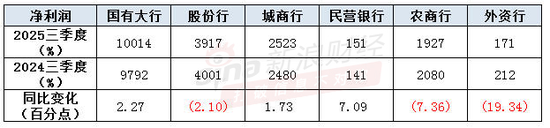
Core Insights - The banking sector in China reported a slight decline in net profit for the first three quarters of 2025, with a total of 1.87 trillion yuan, representing a year-on-year decrease of 0.02%, although the decline has narrowed compared to the first half of the year [1][6] Profitability - State-owned banks, city commercial banks, and private banks saw an increase in net profit, with private banks leading at a growth rate of 7.09% [1][3] - The net profit for state-owned banks was 1.00 trillion yuan, while city commercial banks and private banks reported 252.3 billion yuan and 15.1 billion yuan, respectively [3] - In contrast, joint-stock banks, rural commercial banks, and foreign banks experienced declines in net profit, with decreases of 2.1%, 7.36%, and 19.34%, respectively [1][3] Net Interest Margin - The net interest margin (NIM) for commercial banks remained stable at 1.42% in Q3, with private banks having the highest NIM at 3.83% [1][8] - State-owned banks had the lowest NIM at 1.31%, while joint-stock banks saw a slight increase of 0.01 percentage points to 1.56% [8][9] - Year-on-year, all types of banks experienced a decline in NIM, with state-owned and rural commercial banks both down by 0.14 percentage points [9][10] Asset Quality - As of the end of Q3 2025, the non-performing loan (NPL) balance for commercial banks was 3.5 trillion yuan, with an NPL ratio of 1.52%, reflecting a slight increase of 0.03 percentage points from the previous quarter [13][14] - Foreign banks had the lowest NPL ratio at 1.06%, while rural commercial banks had the highest at 2.82% [14] - Only state-owned banks saw a decrease in NPL ratios compared to the end of the previous year, while other types of banks experienced varying degrees of increase [14] Provision Coverage - The loan loss provision balance for commercial banks was 7.3 trillion yuan, with a provision coverage ratio of 207.15%, both showing a decrease from the previous quarter [16]






三季度末我国银行业金融机构 本外币资产总额474.3万亿元
Jin Rong Shi Bao· 2025-11-17 02:01
Core Insights - The banking and insurance sectors in China have shown growth in total assets, with the banking sector's total assets reaching 474.3 trillion yuan, a year-on-year increase of 7.9% [1] - The insurance sector's total assets reached 40.4 trillion yuan, increasing by 12.5% compared to the beginning of the year [1] Banking Sector Performance - By the end of Q3, the total assets of large commercial banks amounted to 208.1 trillion yuan, growing by 10% year-on-year, accounting for 43.9% of the total banking assets [1] - The non-performing loan balance for commercial banks was 3.5 trillion yuan, with a non-performing loan ratio of 1.52%, reflecting a slight increase of 0.03 percentage points from the previous quarter [2] - Commercial banks achieved a net profit of 1.9 trillion yuan in the first three quarters of 2025, with an average capital return rate of 8.18% [2] Loan and Credit Quality - The balance of inclusive loans for small and micro enterprises reached 36.5 trillion yuan, with a year-on-year growth of 12.1% [1] - The normal loan balance for commercial banks was 228.8 trillion yuan, with 223.7 trillion yuan classified as normal loans and 5.1 trillion yuan as attention loans [2] Liquidity and Capital Adequacy - The liquidity coverage ratio for commercial banks was 149.73%, indicating a stable liquidity position [3] - The capital adequacy ratio for commercial banks stood at 15.36%, with a core tier 1 capital adequacy ratio of 10.87% [2][3] Insurance Sector Performance - The insurance companies' original premium income reached 5.2 trillion yuan, a year-on-year increase of 8.5% [1] - The comprehensive solvency adequacy ratio for the insurance industry was 186.3%, indicating strong solvency [3]
金融监管总局发布最新数据!股份行净息差环比回升1个基点
券商中国· 2025-11-15 23:32
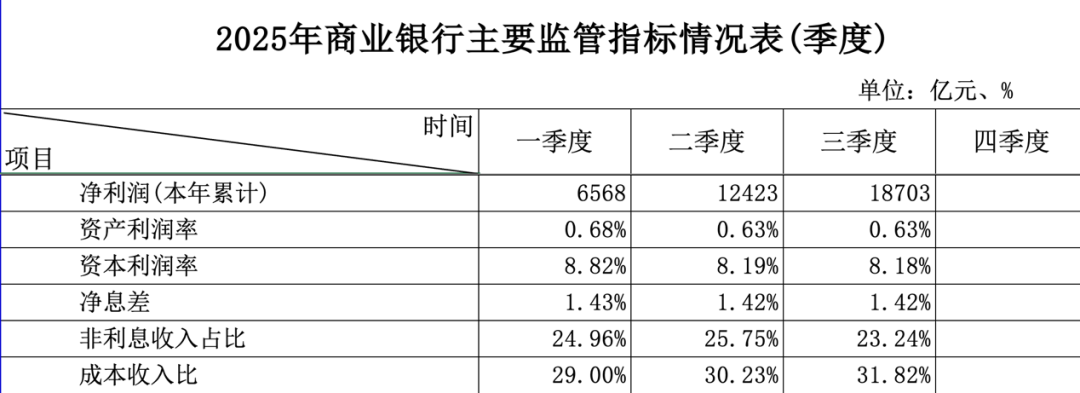
Core Viewpoint - The financial regulatory authority has reported stable growth in the banking and insurance sectors, with significant increases in assets and loans, indicating a robust financial environment in China [1][2][7]. Banking Sector Summary - As of the end of Q3, the total assets of China's banking institutions reached 474.3 trillion yuan, a year-on-year increase of 7.9%, with large commercial banks holding 208.1 trillion yuan, up 10% [1]. - The net profit of commercial banks for the first three quarters was 1.9 trillion yuan, roughly unchanged from the previous year, while the net interest margin stood at 1.42%, stable quarter-on-quarter but down 11 basis points year-on-year [3]. - The non-performing loan balance for commercial banks was 3.5 trillion yuan, with a non-performing loan ratio of 1.52%, reflecting a slight increase from the previous quarter [6]. Insurance Sector Summary - The total assets of insurance companies and insurance asset management companies reached 40.4 trillion yuan, an increase of 4.5 trillion yuan or 12.5% since the beginning of the year [2]. - Life insurance companies accounted for 35.4 trillion yuan, growing 12.3%, while property insurance companies had assets of 3.2 trillion yuan, up 9.9% [2]. Loan Growth and Structure - The balance of inclusive small and micro enterprise loans was 36.5 trillion yuan, with a year-on-year growth of 12.1%, indicating strong support for small businesses [7]. - The proportion of large commercial banks in the total assets of the banking sector reached a new high of 43.88%, up 4.74 percentage points since the end of 2019, highlighting their increasing dominance [7]. Liquidity Indicators - The liquidity coverage ratio for commercial banks was 149.73%, up 0.48 percentage points from the previous quarter, indicating stable liquidity conditions [8]. - Other liquidity metrics, such as the net stable funding ratio and loan-to-deposit ratio, also showed slight improvements, reflecting a solid liquidity position across the banking sector [8].

金融监管总局发布最新数据!股份行净息差环比回升1个基点
Zheng Quan Shi Bao Wang· 2025-11-15 03:07
Core Insights - The banking sector in China has shown signs of stabilization in net interest margins, with a slight recovery observed in the third quarter of this year [2][3] - The total assets of banking institutions reached 474.3 trillion yuan, marking a year-on-year growth of 7.9% [1] - The insurance sector also demonstrated growth, with total assets increasing by 12.5% year-on-year to 40.4 trillion yuan [1] Banking Sector Performance - As of the end of Q3, commercial banks reported a net interest margin of 1.42%, stable compared to Q2 but down 11 basis points year-on-year [2] - The net profit for commercial banks in the first three quarters was 1.9 trillion yuan, roughly unchanged from the previous year [2] - The cost-to-income ratio for commercial banks increased compared to the end of the first half of the year but decreased by 3.74 percentage points compared to the end of last year, indicating improved operational efficiency [4] Asset Quality and Loan Growth - By the end of Q3, the non-performing loan balance for commercial banks was 3.5 trillion yuan, with a non-performing loan ratio of 1.52%, reflecting a slight increase from the previous quarter [7] - The balance of inclusive small and micro enterprise loans reached 36.5 trillion yuan, growing by 12.1% year-on-year, highlighting the sector's commitment to supporting small businesses [7] - Large commercial banks have seen their asset share rise to 43.88% of the total banking sector assets, the highest in recent years [8] Liquidity Indicators - Liquidity indicators for commercial banks remained stable, with the liquidity coverage ratio at 149.73%, up 0.48 percentage points from the previous quarter [10] - The net stable funding ratio was 127.67%, increasing by 0.08 percentage points, while the loan-to-deposit ratio stood at 80.46%, up 0.11 percentage points [10]
金融监管总局发布最新数据!股份行净息差环比回升1个基点
证券时报· 2025-11-15 02:49
Core Viewpoint - The banking and insurance sectors in China have shown signs of stability and growth, with improvements in net interest margins and asset quality, indicating a potential recovery phase for the industry [2][4][5]. Banking Sector Overview - As of the end of Q3 this year, the total assets of China's banking institutions reached 474.3 trillion yuan, a year-on-year increase of 7.9%. Large commercial banks accounted for 208.1 trillion yuan, growing by 10% [2]. - The net profit of commercial banks for the first three quarters was 1.9 trillion yuan, remaining stable compared to the same period last year. The net interest margin stood at 1.42%, stable compared to Q2 but down by 11 basis points year-on-year [4][5]. - The net interest margin for joint-stock commercial banks increased by 1 basis point compared to the end of Q2, indicating a trend towards stabilization [3][5]. Asset Quality and Loan Growth - By the end of Q3, the non-performing loan balance for commercial banks was 3.5 trillion yuan, with a non-performing loan ratio of 1.52%, reflecting a slight increase from the previous quarter [9]. - The balance of inclusive small and micro enterprise loans reached 36.5 trillion yuan, growing by 12.1% year-on-year, while inclusive agricultural loans increased to 14.1 trillion yuan [11]. Liquidity Indicators - The liquidity coverage ratio for commercial banks was 149.73%, up by 0.48 percentage points from the previous quarter, indicating stable liquidity conditions [13]. - Other liquidity metrics, such as the net stable funding ratio and loan-to-deposit ratio, also showed slight improvements, reflecting a healthy liquidity position across the banking sector [13]. Market Position of Large Commercial Banks - The asset share of large commercial banks has risen to 43.88%, marking a new high in recent years, underscoring their dominant role in serving the real economy [10][11].


金融监管总局:三季度末商业银行不良贷款率1.52%
Zheng Quan Shi Bao Wang· 2025-11-14 09:46
人民财讯11月14日电,金融监管总局发布2025年三季度银行业保险业主要监管指标数据情况,2025年三 季度末,商业银行(法人口径,下同)不良贷款余额3.5万亿元,较上季末增加883亿元;商业银行不良贷 款率1.52%,较上季末上升0.03个百分点。2025年三季度末,商业银行正常贷款余额228.8万亿元,其中 正常类贷款余额223.7万亿元,关注类贷款余额5.1万亿元。 ...