主权平等

Search documents
美委关系紧张之际,委内瑞拉议会一读通过与俄罗斯战略伙伴关系草案
Huan Qiu Shi Bao· 2025-09-19 22:41
Core Points - Venezuela's National Assembly has passed the draft of the "Strategic Partnership and Cooperation Treaty between Venezuela and Russia," marking a significant upgrade in bilateral relations [1][2] - The treaty covers multiple areas including politics, economy, energy, defense, and culture, and is based on principles of sovereign equality and non-interference [1] - The agreement is set to last for 10 years with an automatic extension every 5 years, indicating a long-term strategic framework for Venezuela's development [1] - The treaty is expected to undergo a second round of review before becoming law, with a high level of internal consensus observed during discussions [1] - The treaty aims to establish long-term ties beyond traditional energy and military cooperation, including education and technology exchanges [1] - The development is seen as a response to increasing tensions between Venezuela and the United States, with Venezuela seeking to balance its international relations by deepening ties with Russia [2] - The Venezuelan government is looking to enhance its stability through this cooperation amid ongoing economic sanctions and diplomatic pressures from the U.S. [2]
坚持主权平等是首要前提——构建更加公正合理的全球治理体系②
Xin Hua Wang· 2025-09-13 23:22
Core Viewpoint - The global governance initiative proposed by President Xi Jinping emphasizes the principle of sovereign equality as the foremost premise for global governance, addressing key questions about who governs, for whom, and how governance is conducted [1][2]. Group 1: Sovereign Equality - Sovereign equality is identified as the most important criterion for regulating relations between countries, ensuring that all nations, regardless of size or strength, have their sovereignty and dignity respected [1]. - The initiative highlights the current inequalities in the global governance system, which is often dominated by a few powerful nations, and calls for a more equitable representation of emerging markets and developing countries [1][2]. Group 2: International Relations - The principle of sovereign equality is seen as essential for the democratization of international relations, as it allows for the voices and rights of the Global South to be heard and protected [1][2]. - China is portrayed as a leader for the Global South, advocating for equal participation of developing countries in international governance and opposing hegemonic practices [2]. Group 3: Global Governance - The initiative aims to promote fairness and justice in international affairs, emphasizing the need for equal rights, opportunities, and rules among nations to ensure legitimate global governance [2]. - The commitment to multilateralism and the defense of developing countries' interests is highlighted as a key aspect of China's approach to global governance [2].
新华时评丨坚持主权平等是首要前提——构建更加公正合理的全球治理体系②
Xin Hua She· 2025-09-13 15:21
Group 1 - The core idea of the news is the emphasis on "sovereign equality" as a fundamental principle for global governance, proposed by President Xi Jinping during the "Shanghai Cooperation Organization+" meeting [2][3] - The global governance initiative aims to address key questions such as "who governs," "for whom to govern," and "how to govern," highlighting the need for equal respect and participation of all countries regardless of their size or power [2] - The initiative responds to the current inequalities in the global governance system, which is perceived to be dominated by a few powerful nations, and calls for a more inclusive approach that reflects the interests of developing countries [2][3] Group 2 - The initiative advocates for the democratization of international relations, emphasizing the need for greater representation and voice for emerging markets and developing countries in global governance [2][3] - China maintains a principle of mutual respect and equal benefit in its foreign relations, ensuring that all countries are treated equally, as noted by leaders from Malaysia and Grenada [3] - The commitment to uphold sovereign equality is seen as essential for achieving fairness and legitimacy in global governance, fostering cooperation and mutual development among nations [3]
破解治理赤字 彰显大国担当
Ren Min Ri Bao· 2025-09-03 07:19
Core Concepts - The global governance initiative emphasizes five core principles that align with the purposes and principles of the United Nations Charter, aiming to address governance deficits and build a more just and equitable global governance system [1][2] Group 1: Key Principles of Global Governance - Sovereign equality is the primary premise of global governance, advocating that all countries, regardless of size or wealth, have equal rights to participate in decision-making and share governance outcomes [2] - International rule of law is fundamental to global governance, with a call to uphold the principles of the United Nations Charter and ensure equal application of international laws and rules [2] - Multilateralism is the basic path for global governance, with a focus on cooperation and the importance of a multilateral system centered around the United Nations [3] Group 2: Value Orientation and Action - A people-centered approach is the value orientation of global governance, aiming to turn the aspirations of people for a better life into reality and promote common development [3] - Action-oriented principles are crucial for global governance, emphasizing the need for practical cooperation to address urgent issues and long-term challenges, with a focus on tangible outcomes [4] - The global governance initiative is part of a broader set of initiatives, including global development, security, and civilization initiatives, contributing to global stability and certainty [4]
破解治理赤字 彰显大国担当(和音)
Ren Min Ri Bao· 2025-09-02 23:05
Core Ideas - The global governance initiative proposed by President Xi Jinping emphasizes the need for reforming and improving global governance to address governance deficits and build a more just and reasonable global governance system [1][4] Group 1: Principles of Global Governance - Sovereign equality is the primary premise of global governance, advocating that all countries, regardless of size or wealth, have equal rights to participate in decision-making and share governance outcomes [2] - International rule of law is fundamental to global governance, with a call to uphold the principles of the UN Charter and ensure equal application of international laws and rules [2] - Multilateralism is the basic path for global governance, with a focus on cooperation and the importance of a multilateral system centered around the UN [3] Group 2: Value Orientation and Action - People-centered development is the value orientation of global governance, aiming to turn the aspirations of people for a better life into reality and promote common development [3] - Action-oriented principles are crucial for global governance, emphasizing the importance of practical cooperation to address urgent issues and long-term challenges [4] - The global governance initiative is part of a broader set of initiatives, including global development, security, and civilization initiatives, aimed at providing stability and certainty to the world [4]
习主席首次提出“全球治理倡议”,将为世界带来什么?
Yang Shi Xin Wen Ke Hu Duan· 2025-09-02 04:30
Group 1 - The core viewpoint of the news is the proposal of a global governance initiative by President Xi Jinping, emphasizing the need for a more just and equitable global governance system to address global challenges and promote shared development [1][3][10] - The initiative highlights the importance of sovereign equality, where all countries, regardless of size or wealth, participate equally in global governance [4][5] - The call for adherence to international law and the principles of the United Nations Charter is emphasized, advocating for a unified application of international rules without double standards [6][7] Group 2 - The initiative promotes multilateralism as a response to rising unilateralism and protectionism, stressing the need for collective action and cooperation among nations [7][8] - A human-centered approach is advocated, focusing on the well-being of people and ensuring that all nations share in the benefits of global governance [8][9] - The emphasis on action-oriented strategies aims to coordinate global efforts effectively, ensuring tangible outcomes and addressing issues like sustainable development [9][10]

凝聚上合力量 完善全球治理
Xin Hua She· 2025-09-02 00:51
Global Governance Initiative - The initiative emphasizes the importance of sovereign equality, ensuring all countries participate equally in global governance regardless of their size or wealth [1][2] - It advocates for adherence to international law, promoting the equal application of international rules without double standards [2][3] - The initiative calls for the practice of multilateralism, strengthening cooperation and opposing unilateral actions, while maintaining the authority of the United Nations [2][3] Shanghai Cooperation Organization (SCO) Role - The SCO aims to promote a more democratic and just international political and economic order, adhering to the "Shanghai Spirit" of mutual trust and cooperation [3][4] - The organization is positioned to lead in global governance initiatives, contributing to regional stability and security through long-term cooperation agreements among member states [3][4] - The SCO emphasizes the importance of economic collaboration, advocating for open cooperation and the integration of markets to enhance global economic growth [4][5] Economic and Technological Cooperation - China plans to establish cooperation platforms in energy, green industries, and digital economy, along with centers for technology innovation and education within the SCO framework [4][5] - The initiative includes significant projects in renewable energy, such as "10 million kilowatts of photovoltaic" and "10 million kilowatts of wind power" over the next five years [4][5] Cultural and Humanitarian Exchange - The SCO promotes cultural exchanges and mutual understanding among member states, aiming to foster peaceful coexistence and respect for diverse civilizations [5][6] - China will support medical initiatives, including surgeries for congenital heart disease and cataract operations, enhancing healthcare collaboration among member countries [5][6] Commitment to Justice and Fairness - The SCO members are committed to defending international fairness and justice, opposing hegemonism and advocating for true multilateralism [5][6] - The organization seeks to enhance cooperation with other multilateral mechanisms to maintain international economic order and improve global governance [5][6]
为携手迈向人类命运共同体注入澎湃动力
Xin Hua She· 2025-09-01 20:24
Core Points - The global governance initiative proposed by President Xi Jinping aims to create a more just and reasonable global governance system, reflecting China's commitment to building a community with a shared future for mankind [1][2][3] Group 1: International Reactions - Leaders from various countries, including Russia and Belarus, expressed strong support for Xi's global governance initiative, emphasizing its foundation on equality and justice, which are currently lacking in international relations [2][3] - Kazakhstan's President highlighted the importance of the initiative in fostering political interaction and enhancing mutual trust among nations amid geopolitical conflicts [2][3] - Iran's President acknowledged the necessity of reforming global governance, viewing Xi's proposal as a significant step towards a fairer world [2][3] Group 2: Principles of the Initiative - The initiative emphasizes five key principles: sovereignty equality, adherence to international law, multilateralism, a people-centered approach, and action-oriented strategies [3][4] - The call for sovereignty equality resonates particularly with African nations seeking a more equitable role in international affairs [3][4] - The initiative contrasts with the double standards of some countries, advocating for adherence to international law and stability through active participation in multilateral mechanisms [3][4] Group 3: Importance of Multilateralism - The global governance initiative is seen as timely, coinciding with significant anniversaries related to anti-fascism and the establishment of the United Nations, reinforcing the need for coordinated multilateral efforts [3][4] - The initiative aims to address the challenges facing global governance, particularly in light of rising unilateralism and protectionism [3][4] - The emphasis on the United Nations' irreplaceable role in global governance highlights the need for strengthening multilateral institutions [4][5] Group 4: Development and Cooperation - The initiative promotes cooperation and development, particularly for developing countries, aiming to bridge the North-South development gap [5][6] - Xi's proposals are viewed as effective pathways to enhance global governance, emphasizing the need for collaboration and reform to create a balanced international system [5][6] - The initiative aligns with China's broader strategy of continuous reform to improve its governance system while contributing to global governance [6][7]
为携手迈向人类命运共同体注入澎湃动力——习近平主席提出全球治理倡议引发国际社会强烈反响与共鸣
Xin Hua Wang· 2025-09-01 17:50
Core Points - The global governance initiative proposed by President Xi Jinping aims to create a more just and reasonable global governance system, reflecting China's commitment to international cooperation and shared development [1][2][3] Group 1: International Reactions - Leaders from various countries, including Russia, Belarus, Kazakhstan, Iran, and Azerbaijan, expressed strong support for Xi's global governance initiative, emphasizing its foundation on equality and justice [2][3] - The initiative is seen as a timely response to the current geopolitical conflicts and the need for enhanced international cooperation [2][3] Group 2: Principles of the Initiative - The initiative advocates for five key principles: sovereignty equality, adherence to international law, multilateralism, a people-centered approach, and action-oriented strategies [3][4] - The emphasis on sovereignty equality resonates particularly with developing nations seeking a more equitable role in global governance [3][4] Group 3: Importance of Multilateralism - The initiative aligns with the historical context of the 80th anniversaries of the victory in World War II and the establishment of the United Nations, reinforcing the need for a multilateral approach to global challenges [3][4] - The call for strengthening the United Nations' role in global governance highlights the importance of established multilateral institutions in addressing contemporary issues [4][5] Group 4: Development and Cooperation - The initiative aims to bridge the development gap between the Global North and South, with a focus on high-quality cooperation such as the Belt and Road Initiative [5][6] - It emphasizes the need for action-oriented solutions to address discrepancies in development aid and climate financing [5][6] Group 5: Vision for the Future - The global governance initiative is viewed as a pathway to a more balanced and sustainable international system, promoting cooperation over confrontation [6][7] - It seeks to foster a community with a shared future for mankind, advocating for mutual benefits and collaborative efforts among nations [6][7]
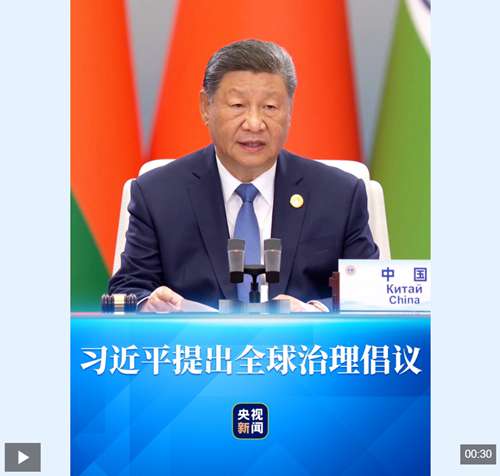
习近平提出全球治理倡议
财联社· 2025-09-01 09:27
Core Viewpoint - The article discusses President Xi Jinping's speech at the "Shanghai Cooperation Organization+" meeting, where he introduced a new global governance initiative emphasizing equality, rule of law, multilateralism, human-centered approaches, and action-oriented strategies [2]. Group 1: Global Governance Initiative - The initiative advocates for sovereign equality, ensuring all countries participate equally in global governance regardless of their size or wealth [2]. - It emphasizes adherence to international law, promoting the equal application of international rules and opposing double standards [2]. - The initiative calls for the practice of multilateralism, strengthening cooperation, and maintaining the authority of the United Nations in global governance [2]. - It promotes a human-centered approach to reforming the global governance system, ensuring that all people can participate and benefit from governance outcomes [2]. - The initiative stresses the importance of action-oriented strategies, coordinating global actions to achieve visible results and avoid fragmentation [2].