二手房市场

Search documents
突然发现!赣州知名江景小区,成交价也刷新!
Sou Hu Cai Jing· 2025-06-13 19:15
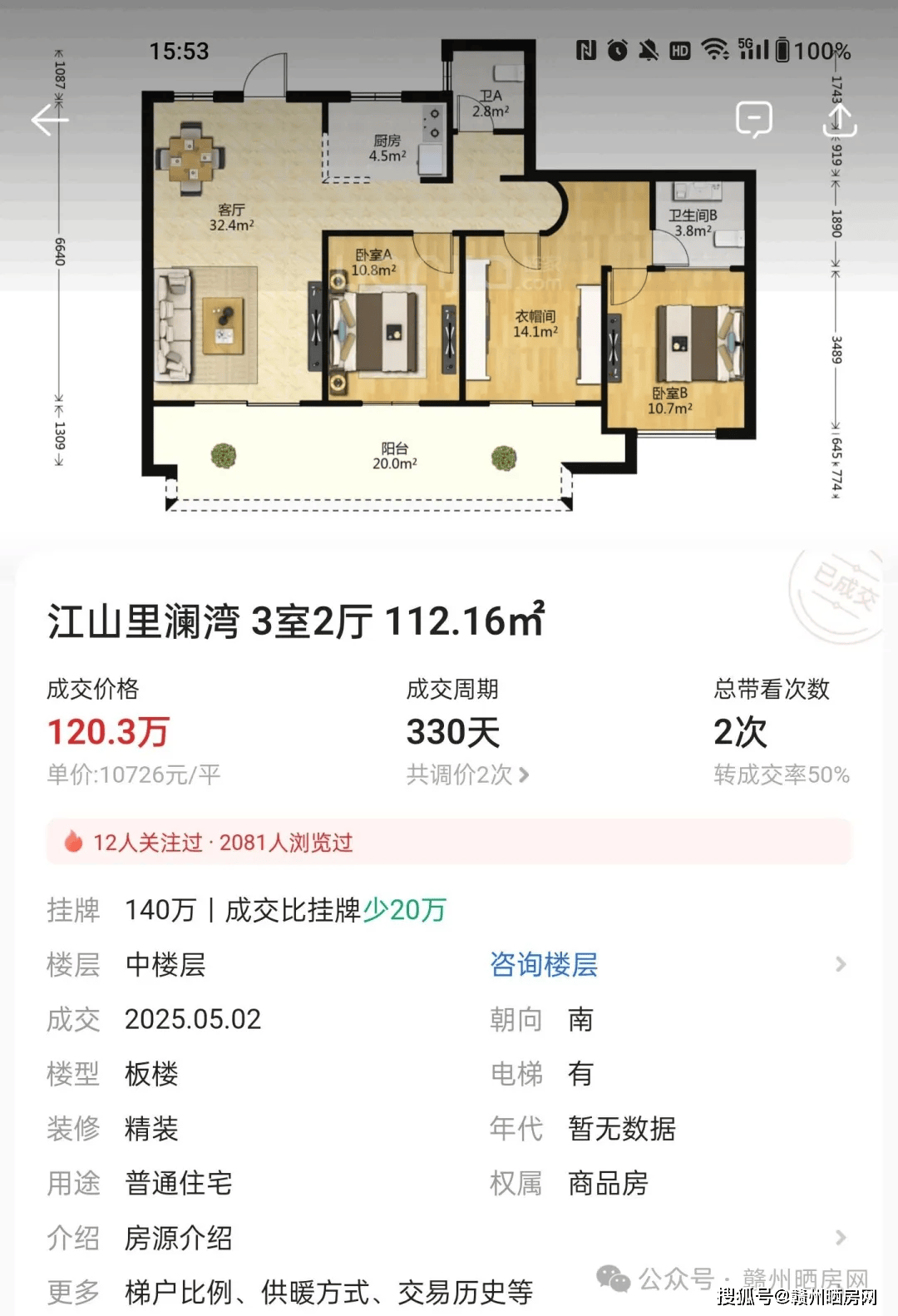
Group 1 - The article highlights the recent sale of a second-hand property in Jiangshanli, a well-known riverside residential community in Ganzhou, which achieved a record low transaction price on the platform [1][33] - The specific property sold was a three-bedroom unit with a built area of approximately 112.16 square meters, which was listed at 1.4 million but sold for 1.203 million, resulting in a unit price of 10,726 yuan per square meter [2][29] - The property had a long transaction cycle of 330 days, with multiple price adjustments from an initial listing price of 1.67 million [9][28] Group 2 - Jiangshanli community consists of three phases, with the first phase, Lanyuan, primarily featuring high-rise buildings, while the second phase focuses on high-end products like large flats and French-style courtyards [10][14] - The community is strategically located near the intersection of Meiguan Avenue and Gankang Road, offering extensive river views and proximity to parks, enhancing its living environment [12][33] - The current average listing price for second-hand properties in Jiangshanli is 16,008 yuan per square meter, ranking 15th among 295 listed communities in the Jiangjiang New District [21][31] Group 3 - The community has a high occupancy rate since its delivery in 2014, with a total of 2,900 units and a green space ratio of 35% [14][10] - The property management was recently changed to China Resources Property, with a management fee of 1.8 yuan per square meter [17] - The market activity for second-hand properties in Jiangshanli is moderate, with only two transactions in the last 90 days and 88 viewings in the last 30 days [22][21]

广州新规下,二手房有救了?!
Sou Hu Cai Jing· 2025-06-10 18:31
Core Viewpoint - The tightening of high usage rates in Guangzhou is expected to impact both new and second-hand housing markets, with mixed implications for developers and homeowners [2][4]. Summary by Sections New Regulations and Developer Impact - New regulations will still allow certain housing types but will eliminate methods that exploit "extra area" such as bay windows and flower beds [2]. - Developers with existing high usage rate inventory may benefit, while those who recently acquired land without exploiting these methods may face challenges [2][4]. Current State of Second-Hand Housing - The current state of second-hand housing in Guangzhou is described as "quite miserable, but not as bad as before," with over 146,000 listings on platforms like Beike, marking a historical peak [2][12]. - Transaction volumes have shown some improvement compared to last year, with April and March seeing over 10,000 transactions, although May saw a decline to 9,228 [2][12]. Impact of High Usage Rate on Second-Hand Housing - The previous high usage rates widened the gap between new and second-hand housing in terms of product quality and price-performance ratio [5][12]. - For example, a new 91㎡ unit can offer superior features compared to a 95㎡ second-hand unit, making it difficult for second-hand homeowners to compete [6][8]. Buyer Preferences and Market Dynamics - Many new home buyers are looking to upgrade from second-hand homes, which complicates the market dynamics as they struggle to sell their existing properties [9][10]. - The current buyer demographic favors smaller units, with 90㎡ and below accounting for half of the second-hand transactions in May [12][14]. Future Outlook for Second-Hand Housing - The tightening of usage rates may stop the widening gap between new and second-hand homes, but it does not eliminate the existing disparity [12][13]. - To revitalize the second-hand market, two strategies are suggested: waiting for new supply to diminish in prime areas to highlight second-hand scarcity, and maintaining competitive pricing against new homes [15][17].

百城二手房市场5月报:各线城市找房热度挂牌均价双双下跌
3 6 Ke· 2025-06-06 02:27
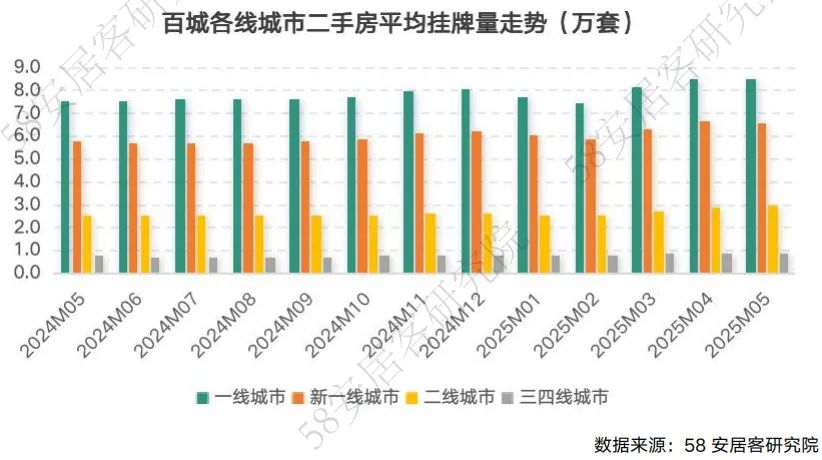
Group 1: Second-hand Housing Listing Volume - In May 2025, the listing volume of second-hand houses in 100 cities reached 2.718 million units, a year-on-year increase of 15.8% [1] - The increase in listing volume by city tier: first-tier cities up by 13.1%, new first-tier cities up by 14.5%, second-tier cities up by 15.4%, and third and fourth-tier cities up by 21.9% [1] - Notable changes in specific cities: Shenzhen had the highest increase among first-tier cities, while Shanghai had the lowest; Chengdu led new first-tier cities, while Suzhou saw a decrease [3][5] Group 2: Second-hand Housing Search Heat Index - The search heat index for second-hand houses in 100 cities was 62.6 in May 2025, down 10.6% year-on-year [7] - The decline in search heat index by city tier: first-tier cities down 11.0%, new first-tier cities down 11.7%, second-tier cities down 11.2%, and third and fourth-tier cities down 9.9% [7] - Specific city changes: Shenzhen experienced the largest decline among first-tier cities, while Beijing had the smallest; in new first-tier cities, Hangzhou saw the largest drop [9][11] Group 3: Second-hand Housing Listing Duration - The average listing duration for second-hand houses in 100 cities was 89.4 days in May 2025, an increase of 7.6% year-on-year [13] - By city tier, first-tier cities had an average duration of 103.0 days (up 9.6%), new first-tier cities 87.1 days (up 9.9%), second-tier cities 83.9 days (up 5.7%), and third and fourth-tier cities 92.3 days (up 7.9%) [13] - Notable changes in specific cities: Shanghai had the largest increase in listing duration among first-tier cities, while Beijing saw a decrease [15][17] Group 4: Second-hand Housing Average Listing Price - The average listing price for second-hand houses in 100 cities was 12,389 yuan per square meter in May 2025, down 9.0% year-on-year [19] - Average prices by city tier: first-tier cities at 48,544 yuan (down 7.8%), new first-tier cities at 16,931 yuan (down 10.2%), second-tier cities at 12,451 yuan (down 10.2%), and third and fourth-tier cities at 8,094 yuan (down 8.6%) [19] - Specific city price changes: Shanghai had the largest price drop among first-tier cities, while Shenzhen had the smallest [21][23]
现在卖房就两个字:降价!
Sou Hu Cai Jing· 2025-06-01 21:19
Core Insights - The real estate market in various cities is experiencing a phenomenon of "increased volume and decreased prices" [1][3] - In Guangzhou, the second-hand housing transaction volume surged by 17.73% year-on-year in May 2025, with a total of 46,722 units sold in the first five months, also reflecting a growth of over 17% [1] - Despite the increase in transaction volume, the average price of second-hand homes in Guangzhou has been declining, with a notable drop in core areas [3] Market Dynamics - The second-hand housing market is no longer a "seller's market," with increased inventory leading to price reductions [3][7] - In cities like Xi'an, the transaction volume reached historical highs, but the listing volume surged to 151,000 units, causing prices to revert to 2019 levels [3] - The inventory turnover period in many cities exceeds 18 months, indicating significant market pressure [8] Regional Variations - In Chengdu, the listing volume exceeds 160,000 units, but core district properties still maintain liquidity, while older properties in suburban areas struggle to attract buyers [4] - In Mianyang, older properties have seen prices drop to 3,066 yuan per square meter, reflecting a significant decline [5] Emerging Trends - The market is shifting towards a "stock housing era," with second-hand transactions in 30 key cities reaching 59% of total sales by 2024 [11] - Price differentiation is intensifying, with new properties in core areas maintaining value while older suburban properties depreciate [13][14] - Policy adjustments, such as potential interest rate cuts and increased public housing supply, may further impact the market dynamics [15] Recommendations for Buyers - Focus on core area new properties, as they demonstrate stronger resilience against price declines [9] - Monitor inventory turnover rates, as a high ratio indicates market stress [8] - Be cautious of high leverage risks, ensuring that mortgage payments do not exceed 40% of household income [10]