
全周期管理

Search documents
业务聚焦 | 做实政治监督 护航高质量发展
Zhong Yang Ji Wei Guo Jia Jian Wei Wang Zhan· 2025-08-20 00:39
Group 1 - Political supervision is essential for implementing the party's political line and ensuring centralized leadership from the Party Central Committee [1] - The Dandong District Commission for Discipline Inspection and Supervision focuses on key political tasks, establishing a clear list of supervision items to enhance political accountability [1][2] - The supervision list includes 47 key areas, such as maintaining the "two safeguards" and enforcing strict party governance [1] Group 2 - The Dandong District Commission emphasizes precision in political supervision, targeting key individuals and critical issues to enhance oversight effectiveness [2] - A comprehensive political portrait of leadership teams is conducted to assess political awareness, accountability, integrity, and public satisfaction [2] - The district has initiated investigations into corruption and misconduct, recovering over 2.8 million yuan through focused supervision efforts [2] Group 3 - The Dandong District Commission is committed to institutionalizing political supervision through the establishment of a "full-cycle management" mechanism [3] - Strengthening on-site supervision and integrating it with daily oversight has led to the identification and rectification of 741 issues [3] - A dynamic analysis and remediation mechanism for political ecology is being developed to ensure continuous improvement and a healthy political environment [3]
深入推进风腐同查同治③筑牢拒腐防变思想防线
Zhong Yang Ji Wei Guo Jia Jian Wei Wang Zhan· 2025-08-17 00:13
Core Viewpoint - The emphasis on integrating the concept of investigating and addressing both corruption and misconduct into various aspects of case handling, rectification, and educational warnings, creating an effective closed loop of case handling, governance, supervision, and education [1] Group 1: Warning Education Initiatives - The establishment of a legal education base in Jinshan District, Shanghai, aims to enhance the impact and deterrence of warning education by organizing court hearings for party members to observe [1] - Suzhou's disciplinary inspection and supervision authorities have created a shared resource library for warning education, utilizing various media to enhance the effectiveness of educational initiatives [2] - The integration of "full-cycle management" into the investigation process ensures that warning education is planned from the outset, focusing on the analysis of misconduct and corruption trends [2] Group 2: Case Studies and Their Impact - The case of a former housing director in Luoyang highlights how minor infractions can escalate into significant corruption, emphasizing the need for vigilance from the outset [3] - The use of personal testimonies and case analyses in warning education has proven effective in conveying the dangers of corruption, as seen in the reactions of participants in educational sessions [3][4] - The case of a former state-owned enterprise leader in Anhui illustrates the importance of addressing early signs of misconduct, with educational materials reflecting the individual's moral decline [5] Group 3: Comprehensive Educational Approaches - The implementation of diverse educational formats, including video productions and public meetings, aims to deepen the understanding of the intertwined nature of misconduct and corruption [4][5] - Continuous collection and analysis of recent cases of misconduct and corruption are essential for developing targeted educational materials for party leaders [4][5] - The focus on specific sectors and the use of case studies to illustrate the consequences of misconduct are critical for reinforcing the message of accountability and ethical behavior [5]
释放风腐同查同治综合效能
Zhong Yang Ji Wei Guo Jia Jian Wei Wang Zhan· 2025-08-07 00:02
Core Viewpoint - The article emphasizes the importance of integrating the investigation and governance of misconduct and corruption to create a clean political environment and promote a healthy development atmosphere for entrepreneurship [1][2][3]. Group 1: Understanding the Nature of Misconduct and Corruption - The concept of "wind and corruption" investigation and governance is a scientific summary of the experiences in strict party governance since the new era, reflecting the deep understanding of the Central Committee regarding the practices of rectifying misconduct and corruption [2]. - Misconduct often serves as a precursor to corruption, with small infractions leading to larger issues, indicating a relationship where misconduct conceals corruption and vice versa [2][3]. - Addressing the intertwined issues of misconduct and corruption requires a comprehensive approach that considers both commonalities and specificities across different regions and sectors [2][3]. Group 2: Strategies for Addressing Misconduct and Corruption - The article suggests maintaining a strategic focus and high-pressure stance to innovate methods for eradicating the conditions that allow misconduct and corruption to thrive [3]. - It advocates for a systematic approach to tackle intertwined issues, emphasizing the need to investigate misconduct while also probing for underlying corruption [3][4]. - The importance of establishing a rapid response mechanism for investigating misconduct and corruption is highlighted, along with the need to utilize data analysis to uncover hidden corruption signs [3][4]. Group 3: Collaborative Efforts in Governance - The integration of various stakeholders is crucial for the effective implementation of the "wind and corruption" investigation and governance strategy, requiring a smooth operational mechanism and close cooperation [4][5]. - Local party committees are urged to take responsibility for advancing the investigation and governance of misconduct and corruption, with a focus on detailed accountability and pressure transmission [5]. - The establishment of a collaborative regulatory mechanism is necessary to address issues related to deteriorating industry ethics and chaotic management environments [5].
深度关注丨破“旋转门” 筑“防火墙”
Zhong Yang Ji Wei Guo Jia Jian Wei Wang Zhan· 2025-07-31 00:29
Core Viewpoint - The article emphasizes the need for strict supervision and regulation of the "revolving door" phenomenon between government officials and businesses, aiming to establish a clean and transparent relationship between politics and commerce to prevent corruption and ensure fair competition in the market [5][10][12]. Group 1: Issues and Cases - The article highlights various cases of corruption related to the "revolving door," where former officials exploit their previous positions for personal gain, such as the case of Zhang, who was found guilty of using his influence for financial benefits after leaving office [6][7]. - It discusses the case of Cao, who engaged in similar misconduct by securing a position in a medical center after retirement, indicating a pattern of delayed corruption where officials plan their post-retirement roles while still in office [7][9]. - The article mentions the case of Feng, who violated regulations by working for a company without proper reporting after retirement, showcasing the ongoing challenges in enforcing compliance among retired officials [9]. Group 2: Regulatory Measures - The article outlines the regulatory framework established by the Chinese Communist Party to restrict former officials from engaging in business activities related to their previous roles, aiming to prevent conflicts of interest and corruption [8][12]. - It emphasizes the importance of enhancing the supervision of retired officials and implementing stricter rules to ensure they do not exploit their former positions for personal gain [12][14]. - The article notes that recent revisions to the regulations have expanded the scope of restrictions to include all party members, not just leaders, thereby tightening the oversight of post-retirement employment [11][12]. Group 3: Impact on Business Environment - The article discusses how the "revolving door" phenomenon undermines fair competition by allowing certain businesses to gain advantages through corrupt practices, which can distort market dynamics and harm other enterprises [10][11]. - It highlights the systemic risks posed by unchecked corruption, which can lead to broader issues within the political and economic landscape, potentially resulting in widespread corruption [11][12]. - The article calls for a comprehensive approach to address these issues, combining regulatory enforcement with cultural changes to promote integrity and transparency in both government and business sectors [14].

北京强降雨造成重大灾害,多家保险公司简化流程启动理赔
Xin Lang Cai Jing· 2025-07-29 09:38
Core Viewpoint - The article highlights the significant impact of extreme rainfall in Beijing, leading to casualties and extensive damage, while emphasizing the proactive measures taken by insurance companies to enhance disaster response and claims processing efficiency [1][2][5]. Group 1: Disaster Impact - As of July 28, Beijing experienced an average rainfall of 165.9 mm, resulting in 30 fatalities and damage to infrastructure, including 31 road sections and 136 villages losing power [1]. - The financial losses from the disaster are estimated at 13.5 million yuan, primarily affecting auto, home, and agricultural insurance [5]. Group 2: Insurance Response - Insurance companies, under the guidance of the Beijing Financial Regulatory Bureau, activated emergency response mechanisms, deploying rescue and investigation vehicles, and preparing emergency supplies [2]. - Multiple insurance firms simplified claims processes, waived certain documentation requirements, and expedited payments, with some claims processed within 40 minutes [4][5]. Group 3: Industry Trends - The insurance industry is shifting from passive claims handling to proactive disaster prevention, focusing on comprehensive risk management [5]. - A new three-tiered insurance system is being piloted in certain districts, integrating public management insurance, agricultural housing insurance, and catastrophe risk reserves [5]. - The industry is exploring innovative insurance products, such as catastrophe bonds and weather-indexed insurance, to enhance coverage and response capabilities [6].



将“全周期管理”理念融入案件查办全过程
Zhong Yang Ji Wei Guo Jia Jian Wei Wang Zhan· 2025-07-23 00:16
Group 1 - The core responsibility of the disciplinary inspection and supervision organs is to perform their duties according to regulations, laws, and party discipline, ensuring that every case withstands scrutiny from practice, the public, and history [1] - The Shandong Province Pingdu City Discipline Inspection Commission and Supervision Commission integrates the "full-cycle management" concept into the entire case handling process, aiming to enhance the quality and efficiency of case handling [1] Group 2 - Establishing a problem clue ledger is essential as it serves as the foundation for the work of disciplinary inspection and supervision organs, requiring thorough efforts in identification, analysis, and management [2] - A "collaborative initial screening" mechanism is established to ensure precise identification of important problem clues through various departments [2] - The city’s disciplinary inspection and supervision organs have handled 639 problem clues this year [2] Group 3 - A coordinated mechanism is being developed to enhance case handling efficiency, focusing on process standardization and information sharing [3] - The leadership of the city’s Discipline Inspection Commission takes the lead in handling complex and significant cases, ensuring focused oversight [3] - This year, the city’s disciplinary inspection and supervision organs have initiated 234 cases, resulting in 195 disciplinary actions and 13 detentions [3] Group 4 - Continuous improvement of case handling outcomes is emphasized through quality evaluations, statistical analysis, and promoting reforms based on cases [4] - A mechanism for case quality evaluation is established to ensure a closed-loop management system for feedback and improvement [4] - This year, 40 disciplinary inspection recommendations have been issued, prompting the establishment of 41 improved systems by relevant departments [5]
研判2025!中国视力矫正行业产业链、发展现状、细分市场、竞争格局及发展趋势分析:技术迭代与国产替代加速,行业迈向千亿智能健康管理新时代[图]
Chan Ye Xin Xi Wang· 2025-07-22 01:14
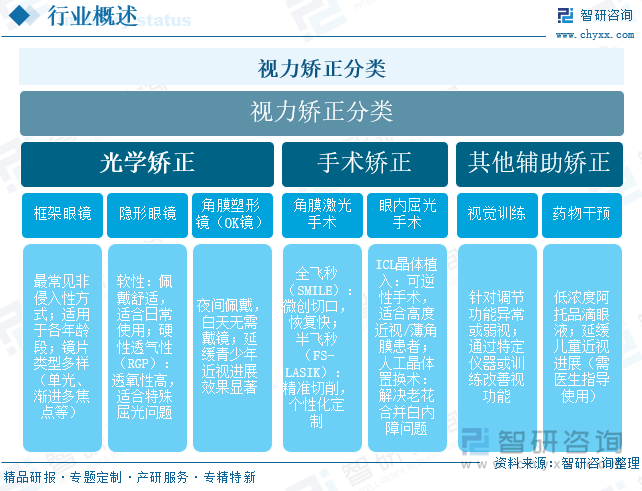
Core Insights - The vision correction industry in China is experiencing rapid growth driven by policy support, market demand, and technological innovation [1][5][22] - The market size is projected to reach 215 billion yuan in 2024, with a year-on-year growth of 11.6% [1][14] - The industry has established a comprehensive treatment system combining surgical and optical correction methods [1][10] Policy Support - The Chinese government has implemented a series of policies to enhance eye health, including the "Comprehensive Prevention and Control of Myopia in Children and Adolescents Implementation Plan" [5][7] - Policies aim to create a management system covering prevention, treatment, and rehabilitation, promoting standardized and high-quality development in the industry [5][22] Market Demand - The number of myopic individuals in China has surpassed 600 million, with a significant increase in myopia rates across all age groups [8][12] - The myopia rate among high school students exceeds 80%, and projections suggest that the rate for the 16-24 age group may reach 94% [8][12] - This growing patient base provides a continuous driving force for the industry's development [1][8] Industry Structure - The vision correction industry has formed a complete industrial chain, with upstream focusing on optical materials and high-end equipment, while midstream includes the production of glasses and surgical devices [10][20] - The downstream market is served by medical institutions, optical centers, and e-commerce platforms, with private eye hospitals contributing over 60% of refractive surgeries [10][12] Competitive Landscape - The industry features a multi-layered competitive structure, with foreign brands dominating high-end markets while domestic brands accelerate their presence [20][21] - Key players include Aier Eye Hospital, Aibo Medical, and Opcon Vision, each with distinct market positions and strategies [21][20] Future Trends - The industry is expected to continue expanding due to policy-driven demand and technological advancements, with a focus on full-cycle management of eye health [22][24] - Innovations such as AI-assisted surgeries and domestic alternatives to imported products are reshaping the competitive landscape [24][25] - The trend towards service accessibility is being driven by private institutions expanding into lower-tier cities and the growth of online sales channels [25][22]



城市发展迈入“存量时代”如何规划、建设、管理好我们赖以生存的城市?
Yang Guang Wang· 2025-07-15 08:31
Core Insights - The Central Urban Work Conference held on July 14-15 marks a significant shift in urban development strategy in China, transitioning from rapid growth to stable development, focusing on quality over quantity [1][9] - The emphasis is on improving urban living conditions, with a focus on integrated planning, construction, and management to enhance the quality of urban life [9][13] Urban Development Strategy - Urbanization in China is moving from extensive expansion to quality enhancement, with a focus on revitalizing existing urban spaces and improving their efficiency [1][8] - The concept of "good" urban living is evolving, with citizens desiring better access to amenities such as supermarkets, schools, and hospitals, as well as improved transportation and livability [1][3] Case Studies - The Shenye Shangcheng project in Shenzhen exemplifies a mixed-use development that integrates commercial, residential, and recreational spaces, achieving an annual sales revenue of 6 billion yuan [1][3] - Qingdao's "Chuang Chuang Yi" Innovation Park has transformed an old industrial area into a hub for leading enterprises, increasing registered companies from under 2,000 to over 4,000 and significantly boosting tax revenue per acre [7][8] Planning and Management - The implementation of a national-level land space planning framework is underway, with a focus on high-quality, green, and efficient urban development [3][9] - The importance of long-term management and maintenance of urban infrastructure is being emphasized, moving away from short-term fixes to sustainable solutions [9][13] Technological Integration - The use of 4D mapping and real-time data collection in cities like Wuhan is enhancing urban management and decision-making processes, supporting the development of smart cities [10][11] - The integration of spatial data and digital tools is crucial for effective urban governance and resource allocation in the context of limited land availability [13]


标本兼治做好“后半篇文章”
Zhong Yang Ji Wei Guo Jia Jian Wei Wang Zhan· 2025-07-10 00:19
Group 1 - The core viewpoint emphasizes the need for a systematic approach to corruption governance, focusing on both case handling and broader systemic reforms to enhance overall effectiveness [1][3][4] - The importance of warning and deterrence through case studies is highlighted, suggesting that disciplinary education should be integrated throughout the entire process of case handling [1][2] - The necessity of deepening systemic treatment by linking case investigations with broader governance strategies is stressed, aiming to prevent minor issues from escalating into major problems [3][4] Group 2 - Strengthening disciplinary education is crucial, with a focus on integrating core regulations into daily practices and enhancing the understanding of compliance among party members [2][3] - Establishing long-term mechanisms for targeted governance is essential, which includes identifying and addressing systemic vulnerabilities within organizations [4] - The need for a robust follow-up and supervision mechanism is emphasized to ensure that corrective actions are effectively implemented and monitored [4]
打好风腐同查同治“组合拳”
Zhong Yang Ji Wei Guo Jia Jian Wei Wang Zhan· 2025-07-03 01:16
Group 1 - The article emphasizes the intertwined nature of misconduct and corruption, highlighting the need for a unified approach to address these issues in party discipline and anti-corruption efforts [1] - The focus is on establishing a rigid responsibility system that links party governance responsibilities, supervisory responsibilities, and regulatory responsibilities, ensuring accountability at all levels [2] - A dual approach to investigation is proposed, where misconduct leads to corruption investigations and vice versa, utilizing various technical methods to uncover hidden corrupt practices [3] Group 2 - The article discusses the importance of collaborative efforts in building a comprehensive supervision network, enhancing coordination among different supervisory bodies to tackle corruption effectively [4] - It stresses the need for systemic solutions to corruption, moving from individual case handling to a broader systemic purification approach, particularly in key sectors like finance, state-owned enterprises, and public resources [5]