
利率正常化

Search documents
欧洲央行管委VILLEROY:利率正常化可能尚未结束
news flash· 2025-05-27 07:13
Core Viewpoint - The European Central Bank (ECB) Governing Council member Villeroy indicated that the normalization of interest rates may not be over yet [1] Group 1 - Villeroy's comments suggest that there may be further adjustments to interest rates in the future [1] - The statement reflects ongoing considerations within the ECB regarding monetary policy and economic conditions [1]
欧洲央行管委兼法国央行行长Villeroy:法国的通胀是一个非常令人鼓舞的迹象。利率正常化可能尚未结束。
news flash· 2025-05-27 07:13
Core Viewpoint - The European Central Bank (ECB) Governing Council member and Bank of France Governor Villeroy indicates that France's inflation is a very encouraging sign, suggesting that the normalization of interest rates may not be over yet [1] Group 1 - Villeroy highlights that the current inflation situation in France is a positive development [1] - The statement implies that the ECB may continue its path towards interest rate normalization in response to inflation trends [1]
关税冲击叠加流动性收紧 日本股市下行风险加大
Qi Huo Ri Bao Wang· 2025-05-22 01:00
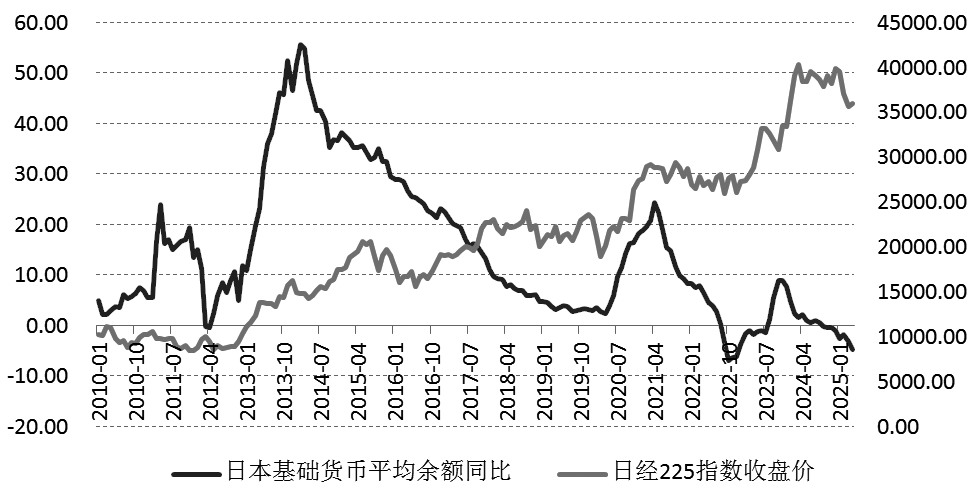
Economic Challenges - Japan's economy faced two major challenges: weak consumer market performance and export impacts due to tariffs [2][8] - In Q1 2025, Japan's GDP contracted by 0.2% quarter-on-quarter, marking the first decline since Q2 2024, with annualized GDP shrinking by 0.7% [2] - Private consumption remained flat in Q1, contributing only 0.1 percentage points to GDP growth, while net exports negatively impacted GDP growth by 3.3 percentage points due to a 0.6% decline in exports [2][3] Inflation and Consumer Spending - High inflation has led to stagnation in consumer spending, with the GDP deflator index rising by 3.3% year-on-year in Q1, surpassing the previous year's 3.1% [2] - Despite a 4.3% increase in employee compensation in Q1, real disposable income for households fell by 2.5% year-on-year, marking the third consecutive month of negative growth [3] Export and Tariff Impacts - The appreciation of the yen and U.S. tariffs have significantly impacted Japan's exports, with a reported 8.2% appreciation against the dollar as of May 20 [3][4] - In March, Japan's export growth slowed to 5.6% year-on-year, down from 9% the previous year, indicating a decline in export performance [3] Automotive Industry and Tariffs - The U.S. imposed a 25% tariff on key automotive parts, which could severely affect Japan's automotive industry, a critical sector contributing 50% of manufacturing output and 30% of total exports [4] - Estimates suggest that U.S. tariffs could reduce Japan's GDP by 0.59% and lead to a potential profit loss of nearly $30 billion in the automotive sector [4] Monetary Policy and Market Conditions - The Bank of Japan is in a difficult position, needing to balance interest rate normalization with the risk of further economic suppression and currency depreciation [5] - As of May 10, the Bank of Japan's total assets decreased by 3.6% year-on-year, indicating tightening liquidity conditions [5][7] Bond Market and Liquidity Issues - Japan's bond market is experiencing significant sell-offs due to tariff impacts and quantitative tightening, leading to liquidity pressures [7] - The auction for 20-year government bonds on May 20 was the worst since 2012, with a bid-to-cover ratio dropping to 2.5 times, reflecting market concerns [7] Overall Market Outlook - Japan's economy is under pressure from weak consumption and tariff impacts, with the potential for significant risks in the stock market [8] - Investors may consider using micro Nikkei 225 index futures to hedge against these risks in the current economic climate [8]

ETO MARKETS:高盛调整美联储降息预期 经济增长稳健降息放缓?
Sou Hu Cai Jing· 2025-05-13 09:14
Core Viewpoint - Goldman Sachs economists have shifted their perspective on the U.S. economic outlook, indicating that the rationale for interest rate cuts has transitioned from "providing insurance" to "normalization" due to relatively robust economic growth and a slight easing in unemployment rate increases [1][5]. Economic Growth and Unemployment Rate - The U.S. economy is showing relatively strong growth, with Goldman Sachs raising its 2025 economic growth forecast by 0.5 percentage points to 1%. Additionally, the likelihood of an economic recession within the next 12 months has been reduced to 35% [3]. Adjustment of Rate Cut Expectations - Based on the latest economic outlook, Goldman Sachs now expects the Federal Reserve to begin cutting rates later than previously anticipated, specifically in December instead of July, and to implement rate cuts at alternating meetings rather than consecutively [4][8]. Shift in Rationale for Rate Cuts - The reasoning behind potential rate cuts has evolved from a focus on providing insurance against economic uncertainty and recession risks to a more measured approach aimed at normalizing interest rates to more typical levels [5][7]. Market Reaction and Future Outlook - The adjustment in Goldman Sachs' perspective has garnered significant attention in the market, with investors likely to be influenced by the revised expectations for the Federal Reserve's rate cut path. Continuous monitoring of the Fed's official statements and economic data will be essential for understanding market trends [6][8].

