
半导体出口管制

Search documents
突发!尹志尧放弃美国籍!
国芯网· 2025-04-21 11:12
国芯网[原:中国半导体论坛] 振兴国产半导体产业! 不拘中国、 放眼世界 ! 关注 世界半导体论坛 ↓ ↓ ↓ 4月21日消息,据外媒报道, 中国半导体设备龙头企业中微半导体创始人尹志尧已放弃美国国籍,恢复中国国籍! 至于尹志尧放弃了美籍、恢复中国国籍的具体原因,中微公司没有在财报中披露更多细节,但业内普遍猜测,可能与此前 美国商务部对华出口管制措施当中的"美国人"条款有关。 从1984年至2004年,尹志尧在多家海外科技企业工作:1984 年至 1986 年,就职于英特尔中心技术开发部,担任工艺工程 师;1986 年至 1991 年,就职于泛林半导体,历任研发部资深工程师、研发部资深经理;1991 年至 2004 年,就职于应用材 料,历任等离子体刻蚀设备产品总部首席技术官、总公司副总裁及等离子体刻蚀事业群总经理、亚洲总部首席技术官。 2004 年至今,尹志尧担任中微公司董事长、总经理、核心技术人员。 尹志尧进行国籍变更的原因,业内普遍猜测与2022年美国商务部发布的对华出口限制措施当中的"美国人"条款有关。 据了解,创办中微公司之时,尹志尧一直都是以美国籍示人。据中微半导体 2022年发布的年报显示,他仍 ...

突发!国产芯片设备巨头中微公司董事长尹志尧放弃美国籍,恢复为中国国籍|硅基世界
Sou Hu Cai Jing· 2025-04-19 06:19
Core Points - The founder and chairman of Zhongwei Semiconductor, Yin Zhiyao, has renounced his U.S. citizenship and restored his Chinese nationality, as reported in the company's annual report [2][4] - The change in nationality is speculated to be related to U.S. export control measures affecting semiconductor manufacturing support for entities in China [4][5] Company Overview - Zhongwei Semiconductor, founded by Yin Zhiyao in 2004, is a leading supplier of etching and deposition tools in China and has been a key player in the semiconductor equipment sector [4] - The company reported a revenue of 9.065 billion yuan in 2024, representing a year-on-year growth of 44.7%, with etching equipment contributing over 7.2 billion yuan, a 54.7% increase [6] - The average annual compound growth rate of Zhongwei's revenue over the past four years has exceeded 40% [6] Financial Performance - In 2024, Zhongwei's net profit was approximately 1.616 billion yuan, a decline of 9.5%, primarily due to a significant increase in R&D expenses, which reached 2.45 billion yuan, up 94.3% [6] - The company's non-GAAP net profit was about 1.388 billion yuan, reflecting a growth of 16.5% [6] R&D and Product Development - Zhongwei has accelerated its new product development process, reducing the typical timeline from three to five years to less than two years for competitive new equipment [6] - The company aims to enhance its electronic beam detection equipment to address industry gaps, with a target of achieving 100% self-sufficiency in domestic key components by the end of Q3 2024 [8] Corporate Actions - On April 18, Zhongwei announced plans to increase capital in its subsidiary, Super Micro Semiconductor Equipment, with a total registered capital of 160 million yuan post-increase [7] - This capital increase involves contributions from various stakeholders, including Yin Zhiyao, who plans to invest an additional 10 million yuan [7]


英伟达领跌,黄仁勋来中国救场
Hu Xiu· 2025-04-17 23:54
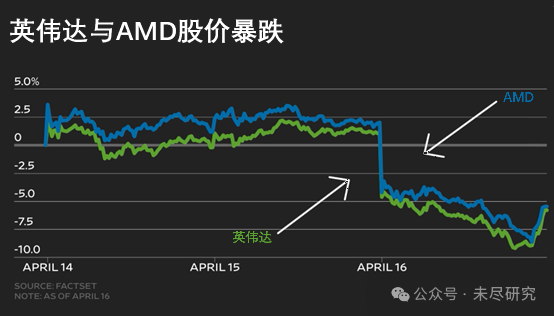
Group 1 - Major semiconductor companies, including Nvidia and AMD, experienced significant stock declines of approximately 7%, while Applied Materials, Lam Research, and KLA fell around 5% [1] - The semiconductor industry is facing numerous challenges, including fluctuating tariff policies, export restrictions on advanced AI chips to China, and a slow recovery in consumer electronics [3] - Nvidia's CEO Jensen Huang recently met with Chinese officials to discuss designing next-generation chips that comply with both customer needs and regulatory requirements [4] Group 2 - Nvidia's warning about the need for U.S. government approval for H20 chip exports to China has raised concerns, leading to a $5.5 billion provision for potential losses [5] - AMD has also indicated uncertainty regarding the licensing of its MI308 series chips for China, leading to an $800 million inventory provision [5] - The Biden administration's legacy includes a framework for AI export controls, which may complicate the future of U.S.-China semiconductor relations [6] Group 3 - The U.S. House of Representatives is investigating how Nvidia sold restricted chips to DeepSeek, citing national security concerns [7] - The ongoing supply chain investigations and potential tariffs on semiconductor components could further increase the U.S. trade deficit with affected economies [8] - Trump's recent directives to investigate the semiconductor supply chain under national security claims could lead to new tariffs, impacting both domestic and international semiconductor production [10] Group 4 - The uncertainty surrounding tariffs is already affecting the semiconductor industry, with companies like TSMC and ASML expressing concerns about the potential impact on their profit margins [13] - The loss of the Chinese market poses a long-term risk for U.S. semiconductor firms, as Chinese companies are increasingly filling market gaps left by U.S. firms [14] - Huawei's advancements in system solutions are positioning it as a significant competitor to Nvidia and AMD, with notable improvements in performance metrics [14][15] Group 5 - The competitive landscape for mature chips is intensifying, with China imposing tariffs on U.S. products, which could disadvantage American manufacturers with local production [15] - The production of mature chips remains critical for the evolution of semiconductor technology and the growth of the domestic supply chain [16] - Jensen Huang's recent visit to China underscores the importance of the Chinese market for Nvidia, highlighting the need for collaboration despite regulatory challenges [17]


芯片巨头警告:美对华出口管制将增加8亿美元额外费用
Guan Cha Zhe Wang· 2025-04-17 04:24
Group 1 - The core point of the article highlights the impact of new U.S. export restrictions on semiconductor companies, particularly AMD and NVIDIA, with AMD estimating up to $800 million in costs due to new licensing requirements for exporting its MI308 chip to China [1] - The U.S. Department of Commerce announced new export licensing requirements on April 15, specifically targeting NVIDIA's H20 chip and AMD's MI308 chip, which will restrict their exports to China [1] - Following the announcement, AMD's stock fell by 8.1% and NVIDIA's stock dropped by up to 7% in the New York market [1] Group 2 - The article notes that the Trump administration is reinforcing regulations to limit China's access to advanced semiconductors, a trend that has been continued by the Biden administration citing national security threats [2] - Prior to the new export controls, AMD held a relatively small market share in the semiconductor sector, while NVIDIA dominated over 90% of the data center GPU market according to IDC [2] - The Chinese government has criticized the U.S. for politicizing economic and technological issues, claiming that the export controls hinder global semiconductor industry development and ultimately harm the U.S. itself [2]
