国际化转型

Search documents
恒瑞医药20250708
2025-07-09 02:40
Summary of the Conference Call for 恒瑞医药 Company Overview - **Company**: 恒瑞医药 (Hengrui Medicine) - **Industry**: Pharmaceutical Key Points and Arguments Internationalization and Business Development - 恒瑞医药 is accelerating its internationalization through diversified cooperation models, entering the business development (BD) realization phase, with significant growth in innovative drug licensing revenue expected to reach 3.1 billion RMB by 2025, driving overall revenue and profit growth [2][27] - The company has strengthened its BD capabilities since 2023, achieving rapid development in external licensing agreements, including a deal with Merck for small molecule licensing with upfront payments close to 700 to 800 million RMB and milestone payments nearing 12.4 billion RMB [2][6][7] Generic and Innovative Drug Business - In the generic drug market, 恒瑞医药 has steadily expanded overseas, with overseas revenue projected to reach 720 million RMB in 2024, while domestic generic drug business is expected to maintain around 12 billion RMB [2][4] - The company plans to launch three first-generic drugs overseas in 2024, which have significant global sales potential, contributing to growth in 2025-2026 [4] - In the innovative drug sector, 恒瑞医药 is expected to launch 25 innovative drugs from 2025 to 2027, entering a peak period for innovative drug launches, with products like JAK1 inhibitors and PD-1/TGFβ showing great potential [4][22] Product Development and Clinical Trials - The small molecule oral GLP-1 product shows excellent safety, with a discontinuation rate below 5%, significantly lower than competitors, and the dual-target injection product has shown promising efficacy data [10] - In the ADC (Antibody-Drug Conjugate) field, products like CMET ADC and nectin-4 ADC exhibit strong BD potential, with the latter showing over 55% objective response rate (ORR) in clinical trials for resistant urothelial carcinoma [15][18] Strategic Partnerships and Collaborations - 恒瑞医药 has shifted its collaboration model from primarily licensing in technology to actively engaging in licensing out, partnering with both small biotech firms and multinational corporations [6][9] - The company has made significant progress in collaborations with small biotech and new code companies, with promising developments in ADC and small molecule GLP-1 products [9] Market Position and Competitive Landscape - 恒瑞医药 is recognized as one of the most competitive companies in the breast cancer field, with a comprehensive layout including next-generation HER2 ADC and HER2 TKI targeting unmet clinical needs [20] - The company is also making strides in autoimmune and metabolic diseases, with several first-in-class targets showing excellent efficacy [21] Sales and Revenue Forecast - The sales team reform initiated in 2020 has been completed, with a new innovative sales model expected to drive faster growth [25] - For 2025, the company anticipates achieving around 3.1 billion RMB in innovative drug licensing revenue, contributing to overall revenue and net profit growth [27] Research and Development Pipeline - As of now, 恒瑞医药 has 133 pipelines in development, with 31 nearing market launch and the rest in various stages of clinical trials [13][14] - The company has categorized its pipelines based on global competitive landscape and potential for licensing out, indicating a strategic approach to maximize asset value [14] Additional Important Insights - The company has faced geopolitical risks and strategic adjustments in its innovative drug development approach, focusing on fewer but more novel clinical developments since 2022 [5] - The ADC field remains a key focus, with the company actively pursuing BD opportunities despite missing earlier windows [15][16] This summary encapsulates the critical insights from the conference call, highlighting 恒瑞医药's strategic direction, product development, market positioning, and future growth potential.

加大“内卷式”竞争整治力度 推动产业结构优化调整——促进汽车行业健康发展
Jing Ji Ri Bao· 2025-06-08 22:05
Core Viewpoint - The Chinese automotive industry has seen a significant increase in production and sales, surpassing 10 million units in the first four months of the year, but overall profitability has declined, with profit margins dropping to 4.1%, below the average of 5.6% for downstream industrial enterprises. The industry is facing challenges due to chaotic price wars, prompting calls for fair competition and sustainable development [1][2]. Group 1: Industry Challenges - The chaotic price wars are impacting the entire automotive supply chain, leading to quality issues and operational difficulties for downstream dealers, which in turn affects after-sales service [2]. - Excessive price competition distorts market signals, resulting in reduced profits for many companies, weakening their innovation capabilities, and potentially lowering product quality [2][3]. - The automotive industry is undergoing a critical transformation towards electrification, intelligence, low carbon, and internationalization, requiring collaborative efforts to build a robust industrial ecosystem [2][4]. Group 2: Innovation and Quality - Technological innovation is essential for fostering industry advantages, with a focus on next-generation battery technology, smart chassis, and automotive chips [4][5]. - Quality management across all stages of production is crucial for building consumer trust, particularly in core areas like battery consistency and software stability [5]. - The industry must prioritize long-term strategies that consider overall benefits, as disorganized price wars could undermine the global brand influence of Chinese electric vehicles [6][7]. Group 3: Policy and Market Dynamics - The government is encouraging companies to innovate and manage costs effectively, while also increasing regulatory efforts to maintain a fair market environment [3][6]. - Policies such as trade-in programs are aimed at boosting domestic automotive consumption and achieving multiple goals of consumption and industrial upgrades [7]. - The automotive sector is recognized as a strategic and pillar industry for the national economy, with ongoing efforts to enhance consumer demand and address market constraints [7][8].
华新水泥积极分红累派现136亿 推新一轮员工持股计划激励业绩
Chang Jiang Shang Bao· 2025-05-28 23:40
Core Viewpoint - Huanxin Cement continues to implement employee stock ownership plans to attract and retain talent while achieving positive business performance despite industry challenges [1][5] Group 1: Employee Stock Ownership Plans - The third phase of Huanxin Cement's employee stock ownership plan for 2023-2025 was announced, with a total of 750 core employees participating [3] - The first two phases of the plan involved the purchase of 620.78 million shares, with a total transaction amount of approximately 58.17 million yuan [2][3] - The current plan aims to deepen the long-term incentive mechanism for core employees, enhancing the company's core competitiveness and ensuring the achievement of strategic goals [3] Group 2: Financial Performance and Dividends - Huanxin Cement announced a cash dividend of 9.56 billion yuan for the 2024 fiscal year, marking the 28th dividend distribution since its listing in 1994 [1][6] - The company reported a revenue of 342.17 billion yuan for 2024, a year-on-year increase of 1.36%, while net profit decreased by 12.52% to 24.16 billion yuan [5][6] - The dividend payout ratio is 40% of the net profit attributable to shareholders, placing Huanxin Cement among the top 4% of listed companies in terms of dividend distribution [6] Group 3: Industry Position and Growth Strategy - Despite overall pressure in the cement industry, Huanxin Cement has achieved growth through a strategy focused on overseas expansion, integrated operations, and innovation [1][5] - The company has diversified its operations beyond cement, with significant contributions from aggregate and concrete sales, as well as environmental services [5] - Huanxin Cement's overseas revenue reached 79.84 billion yuan in 2024, a 47% increase year-on-year, with overseas cement sales growing by 37% [5]

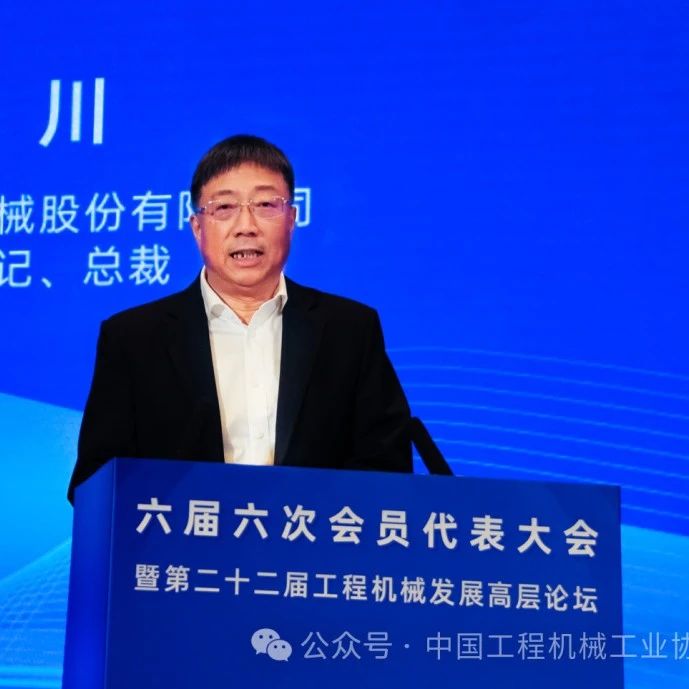
陆川:聚势开新篇 转型拓新局 实干创新绩——为中国式现代化建设贡献工程机械产业新力量
工程机械杂志· 2025-05-16 03:01
Core Viewpoint - The engineering machinery industry is at a critical juncture, facing both unprecedented opportunities and challenges due to changes in the internal and external environment. The industry must respond to national strategies and promote sustainable development while transitioning from scale growth to high-quality development [2][4]. Group 1: Three Driving Forces for New Development - The domestic market is stabilizing, indicating the potential for an upward cycle in the engineering machinery industry, which typically experiences a complete cycle every 8-10 years. The industry entered a downward cycle in the second half of 2021, and a new upward cycle is anticipated in 2025 due to replacement demand for aging equipment [4][8]. - The export market has shown continuous high growth, with Chinese engineering machinery companies successfully transitioning from trade exports to a comprehensive international development model, which includes product exports, overseas factories, cross-border mergers, and global collaborative research and development [4][5]. - Recent government policies aimed at stabilizing the economy and promoting infrastructure projects are expected to release more funding for construction projects, positively impacting the engineering machinery industry [5][6]. Group 2: Five Transformations for Upgrading - The industry is accelerating its transformation towards high-end, intelligent, green, service-oriented, and international development. This shift is essential for optimizing the industrial structure and achieving high-quality growth [9][10]. - High-end development is crucial as the demand for large-scale and high-end machinery increases globally, marking a transition from quantity accumulation to quality improvement [9]. - Intelligent transformation is driven by advancements in artificial intelligence and industrial internet technologies, leading to the development of interconnected, unmanned, and smart manufacturing products [9]. - Green transformation is being propelled by national carbon neutrality goals, with companies focusing on phasing out high-energy-consuming equipment and promoting electric and hybrid machinery [9][10]. - The service-oriented approach is gaining traction as competition shifts from traditional sales to full lifecycle and value chain competition, increasing demand for service solutions [10]. Group 3: Globalization of Chinese Brands - Chinese engineering machinery manufacturers have become globally competitive, marking a significant shift in the industry from Western dominance to Chinese scale and capability [11]. - The industry must build a high-quality development ecosystem and enhance supply chain resilience to address challenges such as trade barriers and technological gaps [13][14]. - The Belt and Road Initiative presents opportunities for expanding into overseas markets, reinforcing the global presence of Chinese engineering machinery brands [14].