
增值税政策调整

Search documents
瑞达期货多晶硅产业日报-20251020
Rui Da Qi Huo· 2025-10-20 09:39
Report Industry Investment Rating - Not provided Core Viewpoints - The overall supply scale of the polysilicon industry remains large, with partial corporate production cuts falling short of expectations, leading to continued accumulation of social inventory and increasing supply - side pressure [2]. - The demand side is relatively weak, with sluggish demand in the downstream photovoltaic industry chain, reduced demand for polysilicon from silicon wafers, and narrowing industry gross margins [2]. - The European market has high inventory, suppressing import demand, while the US tariff policy's loosening only drives the growth of energy - storage system exports, which cannot fully offset the negative impact of the European market. However, emerging markets show a surge in demand, buffering the decline in the demand side [2]. - If supply pressure continues to increase, high inventory will exert significant downward pressure on prices. Polysilicon prices have started to decline, mainly affected by market sentiment. With some factories planning to stop production in the dry season, the market sentiment's feedback needs to be observed. It is recommended to buy on dips [2] Summary by Related Catalogs Futures Market - The closing price of the main polysilicon contract is 50,340 yuan/ton, down 2,000 yuan; the main position volume is 56,806 lots, down 11,421 lots. The 11 - 12 spread of polysilicon is - 2,490 yuan, up 35 yuan; the spread between polysilicon and industrial silicon is 41,775 yuan/ton, down 2,135 yuan [2]. Spot Market - The spot price of polysilicon is 52,750 yuan/ton, unchanged; the basis is 175 yuan/ton, down 1,710 yuan. The weekly average price of photovoltaic - grade polysilicon is 6.53 US dollars/kg, down 0.01 US dollars. The average prices of cauliflower - type, dense, and re - feed polysilicon are 30 yuan/kg, 36 yuan/kg, and 34.8 yuan/kg respectively, all unchanged [2]. Upstream Situation - The closing price of the main industrial silicon contract is 8,565 yuan/ton, up 135 yuan; the spot price is 9,350 yuan/ton, down 50 yuan. The monthly export volume of industrial silicon is 76,642.01 tons, up 2,635.83 tons; the monthly import volume is 1,337.59 tons, up 1,220.14 tons. The monthly output of industrial silicon is 366,800 tons, up 33,600 tons, and the total social inventory is 552,000 tons, up 10,000 tons [2]. Industry Situation - The monthly output of polysilicon is 125,000 tons, up 20,000 tons; the monthly import volume is 1,006 tons, down 164 tons. The weekly spot price of imported polysilicon in China is 6.9 US dollars/kg, up 0.01 US dollars; the monthly average import price is 2.62 US dollars/ton, down 0.25 US dollars [2]. Downstream Situation - The monthly output of solar cells is 69.857 million kilowatts, up 3.475 million kilowatts. The average price of solar cells is 0.82 RMB/W, up 0.01 RMB/W. The monthly export volume of photovoltaic modules is 149,022,600 units, up 38,589,900 units; the monthly import volume is 21,440,200 units, up 6,914,600 units, and the monthly average import price is 0.25 US dollars/unit, down 0.05 US dollars. The weekly comprehensive price index of the photovoltaic industry for polysilicon is 32.82, unchanged [2]. Industry News - Affected by recent meetings and the electricity price during the wet/dry season, some polysilicon bases in Southwest China have gradually reduced raw - material input and are expected to completely stop production from late October to early November, with the involved production capacity being about 320,000 tons/year [2]. - The Ministry of Finance and other three departments have adjusted the value - added tax policy for wind power generation and other industries [2].

风电核电增值税返还政策调整进口LNG综合价格创四年新低:申万公用环保周报(25/10/13~25/10/17)-20251020
Shenwan Hongyuan Securities· 2025-10-20 07:55
Investment Rating - The report provides a "Buy" rating for several companies in the power and gas sectors, indicating a positive outlook for their performance [41]. Core Insights - The report highlights the recent adjustments in the value-added tax (VAT) policies for wind and nuclear power, which may impact profitability for operators in these sectors [9][10]. - It notes the competitive pricing results for electricity in Xinjiang and Gansu, with Xinjiang's prices nearing the upper limit of the bidding range, suggesting a favorable environment for renewable energy operators [8]. - The report discusses the decline in global LNG prices, with China's comprehensive LNG import price reaching a four-year low, which could benefit domestic gas companies [12][27]. Summary by Sections 1. Power Sector - Xinjiang's mechanism electricity bidding results show a scale of 36 billion kWh for solar and 185 billion kWh for wind, with prices at 0.235 CNY/kWh and 0.252 CNY/kWh respectively, indicating a competitive market [5][8]. - The VAT policy changes will eliminate the 50% VAT refund for onshore wind from November 1, 2025, while maintaining it for offshore wind until the end of 2027 [9][10]. - Recommendations include focusing on companies like Guodian Power, China Nuclear Power, and Longyuan Power due to their stable growth prospects [11]. 2. Gas Sector - Global gas prices have shown slight declines, with the US Henry Hub price at $2.82/mmBtu, reflecting a 2.90% weekly drop [12][15]. - China's LNG import price has dropped to 2852 CNY/ton, the lowest since mid-2021, driven by lower oil prices affecting long-term contracts [27][29]. - The report suggests a positive outlook for gas companies like Kunlun Energy and New Hope Energy, as cost reductions and economic recovery may enhance profitability [29]. 3. Environmental Sector - The report emphasizes the benefits of debt-for-equity swaps and the increasing stability of returns for green energy operators, recommending companies like China Everbright Environment and Hongcheng Environment [11]. - It highlights the ongoing rise in SAF (Sustainable Aviation Fuel) prices, suggesting investment opportunities in related companies [11]. 4. Key Company Valuations - The report includes a valuation table for key companies, with several rated as "Buy," indicating strong expected performance in the coming years [41].




大唐新能源跌超3% 前九月发电量增超一成 三部门调整风力发电等增值税政策
Zhi Tong Cai Jing· 2025-10-20 02:44
Core Points - Datang New Energy's stock dropped over 3%, currently at HKD 2.52 with a trading volume of HKD 64.6341 million [1] - The company reported a cumulative power generation of 25,890,603 MWh by September 30, 2025, an increase of 11.68% compared to 2024 [1] - Wind power generation reached 21,840,558 MWh, up 7.40% year-on-year, while solar power generation increased by 42.22% to 4,050,045 MWh [1] Policy Changes - The Ministry of Finance, General Administration of Customs, and State Taxation Administration announced the cancellation of the 50% VAT refund policy for onshore wind power effective November 1, 2023 [2] - From November 1, 2025, to December 31, 2027, a 50% VAT refund policy will be applied to offshore wind power products [2] - Analysts suggest that the removal of the VAT refund for onshore wind indicates its technological maturity and competitive cost, eliminating the need for special tax support [2]
港股异动 | 大唐新能源(01798)跌超3% 前九月发电量增超一成 三部门调整风力发电等增值税政策
智通财经网· 2025-10-20 02:43
Group 1 - The core viewpoint of the news is that Datang New Energy's stock has declined over 3% following the announcement of its power generation results and changes in tax policies affecting wind power [1] - As of September 30, 2025, Datang New Energy reported a cumulative power generation of 25,890,603 MWh, an increase of 11.68% compared to 2024 [1] - The wind power generation reached 21,840,558 MWh, reflecting a year-on-year increase of 7.40%, while solar power generation was 4,050,045 MWh, showing a significant increase of 42.22% compared to 2024 [1] Group 2 - The Ministry of Finance, General Administration of Customs, and State Taxation Administration announced the cancellation of the 50% VAT refund policy for onshore wind power starting November 1, 2023 [2] - From November 1, 2025, to December 31, 2027, a 50% VAT refund policy will be implemented for offshore wind power products, indicating a shift in tax incentives from onshore to offshore wind energy [2] - Analysts suggest that the removal of the tax incentive for onshore wind power indicates its technological maturity and competitive cost, reducing the need for special tax support [2]
财政部等三部门:关于调整风力发电等增值税政策
Sou Hu Cai Jing· 2025-10-20 01:16
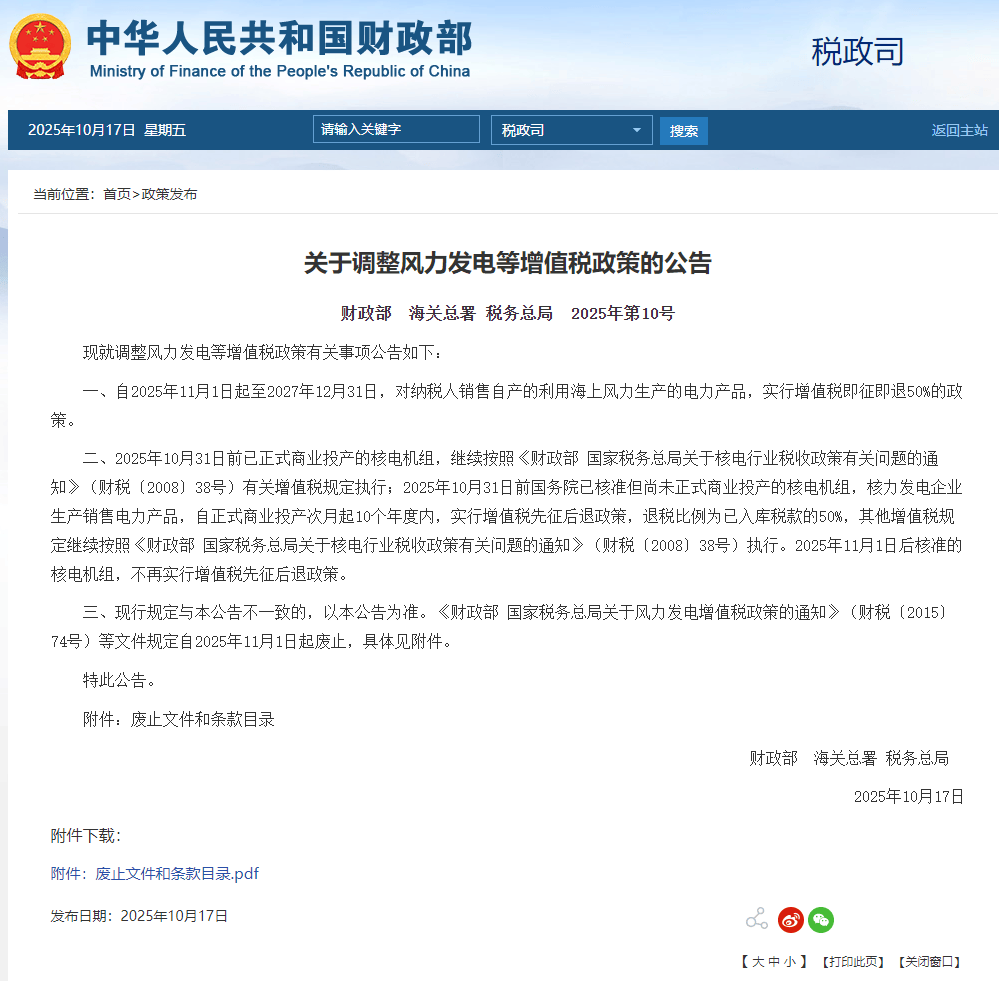
Core Points - The announcement outlines adjustments to the value-added tax (VAT) policy for wind power generation and nuclear power plants in China, effective from November 1, 2025, to December 31, 2027 [1][6] - A 50% VAT immediate refund policy will be implemented for taxpayers selling electricity generated from offshore wind power [1][6] - Existing nuclear power plants that commenced commercial operations before October 31, 2025, will continue to follow previous VAT regulations, while newly approved nuclear plants after this date will not benefit from the VAT refund policy [1][6] Summary by Sections Wind Power - From November 1, 2025, to December 31, 2027, a 50% VAT immediate refund policy will apply to electricity products generated from offshore wind power [1][6] Nuclear Power - Nuclear power plants that are officially operational before October 31, 2025, will adhere to existing VAT regulations as per the 2008 notice [1][6] - For nuclear power plants approved before October 31, 2025, but not yet operational, a VAT refund policy will apply for 10 years post-commercial operation, with a 50% refund on paid VAT [1][6] - Nuclear power plants approved after November 1, 2025, will not be eligible for the VAT refund policy [1][6] Regulatory Changes - The announcement supersedes previous regulations that are inconsistent with it, specifically the 2015 notice on wind power VAT policy, which will be abolished starting November 1, 2025 [1][6]

三部门发布重要公告
中国能源报· 2025-10-19 04:44
Core Viewpoint - The announcement from the Ministry of Finance, General Administration of Customs, and State Taxation Administration introduces a new VAT policy for offshore wind power products, effective from November 1, 2025, to December 31, 2027, allowing a 50% VAT refund for taxpayers selling self-produced electricity from offshore wind power [1][2]. Summary by Sections VAT Policy for Offshore Wind Power - From November 1, 2025, to December 31, 2027, a 50% VAT refund policy will be implemented for taxpayers selling self-produced electricity generated from offshore wind power [1]. Nuclear Power Tax Policy - Nuclear power units that officially commence commercial operation before October 31, 2025, will continue to follow existing VAT regulations as per previous notifications. For nuclear power units approved before this date but not yet operational, a VAT refund policy will apply for 10 years post-commercial operation, with a 50% refund on paid VAT [1]. - Nuclear power units approved after November 1, 2025, will not be eligible for the VAT refund policy [1]. Repeal of Previous Regulations - The announcement states that existing regulations inconsistent with this new policy will be superseded, and previous notifications regarding wind power VAT policies will be abolished starting November 1, 2025 [2].

三部门调整风力发电等增值税政策
Sou Hu Cai Jing· 2025-10-18 15:49
Core Points - The Ministry of Finance, General Administration of Customs, and State Taxation Administration have jointly announced adjustments to the value-added tax (VAT) policy for wind power generation [1] - From November 1, 2025, to December 31, 2027, a 50% VAT immediate refund policy will be implemented for taxpayers selling electricity products generated from offshore wind power [1] - For nuclear power units that have officially commenced commercial operation before October 31, 2025, existing VAT regulations will continue to apply [1] - Nuclear power units approved by the State Council but not yet in commercial operation before October 31, 2025, will benefit from a VAT first-levy-then-refund policy for ten years starting from the month after they commence commercial operation, with a refund rate of 50% of the tax paid [1] - Nuclear power units approved after November 1, 2025, will no longer be eligible for the first-levy-then-refund VAT policy [1]
财政部等三部门公告!
Sou Hu Cai Jing· 2025-10-17 13:55
Core Points - The Ministry of Finance and two other departments announced a new VAT policy for offshore wind power and nuclear power generation, effective from November 1, 2025, to December 31, 2027 [1] Group 1: Offshore Wind Power - From November 1, 2025, to December 31, 2027, a 50% VAT refund policy will be implemented for taxpayers selling electricity products generated from offshore wind power [1] Group 2: Nuclear Power - Nuclear power plants that officially commence commercial operations before October 31, 2025, will continue to follow existing VAT regulations as per the 2008 notice [1] - For nuclear power plants approved before October 31, 2025, but not yet operational, a VAT refund policy will apply for 10 years post-commercial operation, with a 50% refund on paid VAT [1] - Nuclear power plants approved after November 1, 2025, will not be eligible for the VAT refund policy [1]
财政部等三部门公告!
证券时报· 2025-10-17 13:38
Core Points - The Ministry of Finance and two other departments announced a new VAT policy for offshore wind power and nuclear power generation, effective from November 1, 2025, to December 31, 2027, which includes a 50% VAT refund for offshore wind power sales [1] - Existing nuclear power plants that commenced commercial operation before October 31, 2025, will continue to follow previous VAT regulations, while newly approved nuclear plants after this date will not benefit from the VAT refund policy [1] Group 1 - From November 1, 2025, to December 31, 2027, a 50% VAT refund policy will be implemented for taxpayers selling electricity generated from offshore wind power [1] - Nuclear power plants that are commercially operational before October 31, 2025, will adhere to the existing VAT regulations, while those approved but not yet operational will have a VAT refund policy for the first ten years post-commissioning [1] - The announcement supersedes previous regulations regarding VAT for wind power and nuclear power, specifically nullifying the 2015 VAT policy for wind power [1]

财政部等三部门:自2025年11月1日起至2027年12月31日,对纳税人销售自产的利用海上风力生产的电力产品,实行增值税即征即退50%的政策
Sou Hu Cai Jing· 2025-10-17 13:03
Core Points - The Ministry of Finance and two other departments announced a new VAT policy for offshore wind power generation, effective from November 1, 2025, to December 31, 2027, allowing a 50% immediate VAT refund for taxpayers selling self-produced electricity from offshore wind [1] - Nuclear power plants that officially commence commercial operations before October 31, 2025, will continue to follow existing VAT regulations as per the 2008 notice [1] - For nuclear power plants approved before October 31, 2025, but not yet in commercial operation, a VAT refund policy will apply, allowing a 50% refund of the tax paid for the first ten years after commercial operation begins [1] - Nuclear power plants approved after November 1, 2025, will not be eligible for the VAT refund policy [1]