外汇储备结构调整

Search documents
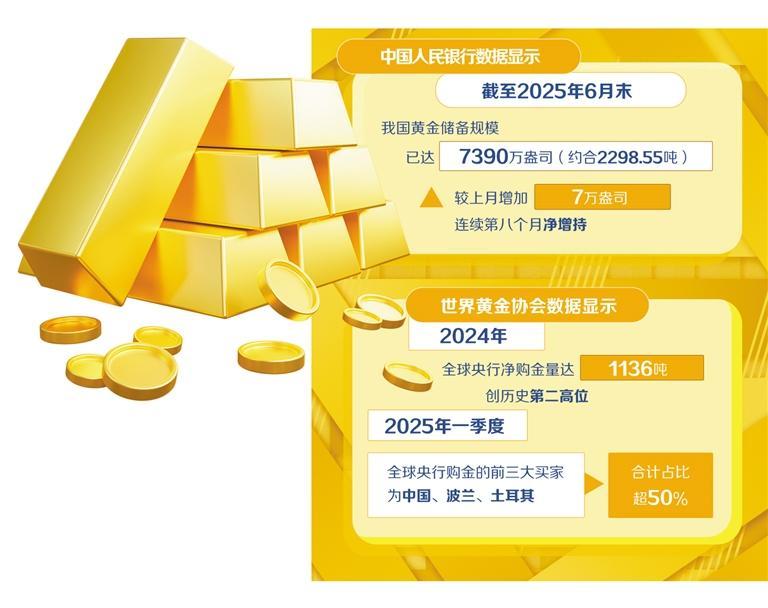
经济日报:全球央行“购金热”持续
Jing Ji Ri Bao· 2025-07-28 23:36
Core Insights - The People's Bank of China reported that as of June 2025, China's gold reserves reached 73.9 million ounces (approximately 2,298.55 tons), marking a net increase of 70,000 ounces for the eighth consecutive month [2] - The ongoing enthusiasm for gold purchases by central banks globally reflects concerns over economic uncertainty, weakening dollar credibility, and geopolitical risks, which will have lasting impacts on foreign exchange reserve structures, gold price trends, and investor decisions [2] Summary by Sections Gold Reserve Increase - Since resuming gold purchases in November last year, China's central bank has shown a "high then stable" monthly gold buying pattern, with an average monthly increase of 60,000 to 160,000 ounces from January to June 2025 [3] - In 2024, global central banks' net gold purchases reached 1,136 tons, the second-highest on record, with China, Poland, and Turkey accounting for over 50% of the total in Q1 2025 [3] Strategic Implications - The central bank's gold purchases align with the internationalization of the renminbi, as it has become the second-largest trade financing currency and the third-largest payment currency globally [4] - The trend of increasing gold reserves is expected to continue, as China's gold reserves still lag behind those of developed economies, indicating a strategic need for asset allocation and security [4][5] Market Dynamics - While the central bank's gold purchases may support gold prices, it does not guarantee price increases, as historical instances show that increased central bank purchases can coincide with declining gold prices [6] - The pace and intensity of gold purchases by central banks vary, leading to different short-term impacts on domestic and international gold prices [6] Investment Considerations - The central bank's actions signal the enduring safe-haven appeal of gold, prompting investors to consider various investment vehicles such as gold-themed financial products, physical gold, and gold ETFs [8] - Investors are advised to avoid blindly chasing high prices, as the current high levels of gold prices may already reflect existing uncertainties, and new investors should prioritize long-term value preservation over short-term gains [9]

美联储要投降?中国减持美债,陆续运回黄金,李显龙一语激起千层浪
Sou Hu Cai Jing· 2025-07-20 00:45
Group 1 - The Federal Reserve is facing increasing internal calls for interest rate cuts, with San Francisco Fed President Mary Daly predicting two rate cuts by the end of the year, warning that waiting for inflation to drop to 2% could lead to missed opportunities that harm the economy and labor market [1] - Fed Governor Waller echoed similar sentiments, suggesting an immediate reduction of rates from the current 4.25%-4.5% to around 3% to alleviate economic pressure, indicating a response to prevailing economic conditions [1][3] Group 2 - The Fed's shift is not only a reaction to economic data but also a response to external political pressures, particularly from former President Trump, who argues that a 1% rate cut could save the U.S. $360 billion in interest payments, highlighting the increasing pressure on the Fed [3] - Concurrently, China has been reducing its holdings of U.S. Treasury bonds for three consecutive months, bringing its holdings down to $756.3 billion, while simultaneously increasing its gold reserves, which are expected to reach 73.9 million ounces by June 2025, indicating a strategic shift in its foreign exchange reserve structure [3][5] Group 3 - The preference for gold over U.S. Treasuries is driven by the low yields of the latter in the face of inflation and dollar depreciation, with global central banks also increasing gold purchases, reaching the second-highest level in 2024, as a response to the dominance of the dollar [5] - Countries are adapting to a new economic landscape, seeking balance with the U.S. as unilateralism increases its isolation, evidenced by ASEAN countries using local currencies for transactions and Saudi Arabia doubling its oil trade with China in yuan [6]
央行增持黄金,普通投资者跟不跟
经济观察报· 2025-07-10 09:48
Core Viewpoint - The article emphasizes the need for cautious consideration of asset allocation for ordinary investors entering the gold investment field, especially given the recent rapid rise in gold prices to historical highs, which may increase financial risks contrary to the hedging logic of gold investment [1]. Group 1: Gold Investment Trends - As of July 7, 2025, China's foreign exchange reserves exceeded $3.3 trillion, with pure gold holdings rising for eight consecutive months to 73.9 million ounces [2]. - There have been instances where central banks increased gold holdings, yet gold prices declined, such as during the period from 2012 to 2016 when central banks bought significantly more gold than they sold, while international gold prices continued to fall [3][4]. - The domestic gold price increased from a low of 368 yuan per gram in January 2022 to a high of 825 yuan per gram in April 2025, marking a 124% increase, while international gold prices also saw over a 110% rise during the same period [4]. Group 2: Market Dynamics and Investor Behavior - The increase in gold prices is influenced by geopolitical tensions, the deepening of U.S.-China relations, and a weakening U.S. dollar, which are seen as significant factors affecting the political and economic landscape for decades to come [4]. - In the second quarter of 2025, global gold ETFs experienced a net outflow of 123 tons, the largest quarterly outflow in three years, indicating that some investors are choosing to take profits and exit the gold market [5]. - Domestic retail sales of gold and silver jewelry grew by 12.3% year-on-year from January to May 2025, with a peak in trading volume in April, suggesting a surge in investor interest [6]. Group 3: Investment Strategy and Considerations - The article suggests that the key to achieving substantial returns from gold lies in long-term holding, as short-term investments may yield lower returns due to the lack of interest income compared to other investment vehicles [7]. - Investors should be aware of the high repurchase price spread when selling physical gold, which can be over 10% lower than the purchase price, and consider transaction costs when making investment decisions [7]. - The article warns that as more ordinary investors flock to the gold market, it may indicate that gold prices have already factored in current uncertainties, potentially reaching a peak in demand [6][7].
为什么中国越抛售剩下的越多?年初说中国还有美国国债7064亿元
Sou Hu Cai Jing· 2025-05-27 02:09
Core Viewpoint - China sold $18.9 billion of U.S. Treasury bonds in March, yet the total amount of U.S. debt held by China increased from $706.4 billion at the beginning of the year to $765.4 billion, raising questions about the apparent contradiction in these figures [1][3]. Group 1: Statistical Discrepancies - The U.S. Treasury's data reflects the balance of U.S. debt held in foreign institutional accounts, not real-time buy/sell transactions, leading to potential misinterpretations of China's actions [3][7]. - China's transactions may involve intermediaries in countries like Belgium, Switzerland, and Singapore, causing the appearance of increased holdings despite sales [3][7]. Group 2: Strategic Adjustments - China is not simply liquidating its U.S. debt but is strategically reallocating its assets to more flexible and stable investments, or converting them into cash reserves [5][9]. - The ongoing U.S. fiscal deficit and declining confidence in the Federal Reserve's monetary policy are prompting China to adjust its foreign reserve strategy [5][9]. Group 3: Long-term Strategy - The management of U.S. debt holdings is part of China's broader national strategy, influenced by global market dynamics and geopolitical considerations [9][10]. - The adjustments in holdings are not random but are calculated moves in response to the evolving international financial landscape [9][10].