
数字化供应链

Search documents
中物联何辉:2025年全社会物流总额预计达380万亿元 亟待加快可信贸易规则建设
Xin Hua Cai Jing· 2025-12-19 05:49
Core Insights - The total logistics volume in China is expected to reach approximately 380 trillion yuan by 2025, with the sales of bulk commodity production materials projected to exceed 1 trillion yuan for the first time, highlighting the resilience and potential of China's economy amidst global uncertainties [1][2] - From January to October this year, China's total social logistics volume reached 293.7 trillion yuan, a year-on-year increase of 5.1%, indicating steady expansion in logistics demand and continuous optimization of structure [1] - The China Bulk Commodity Price Index (CBPI) stood at 114.1 points in November 2025, reflecting a month-on-month increase of 0.8% and a year-on-year increase of 1.6%, demonstrating improved supply-demand relationships in the domestic industry [1] Industry Development Strategies - Accelerate the cultivation of new productive forces in bulk commodities, integrating trustworthy trade concepts throughout the global resource allocation process, and fostering high-quality development through the use of digital technologies [3] - Enhance global resource allocation capabilities in bulk commodities by leveraging China's large market advantages and promoting international capacity cooperation, aiming to strengthen the competitiveness of bulk commodity circulation enterprises [3][4] - Create a fair, stable, and sustainable global supply chain by utilizing digital technologies to establish new mechanisms for shared interests and risk-sharing, while promoting green and low-carbon development in various sectors [4]
从“烟火气”到“算法力”:数智创新驱动农批行业发展
Nan Fang Nong Cun Bao· 2025-12-15 02:36
Core Insights - The article emphasizes that AI is not just a tool for solving problems in the agricultural wholesale market but a transformative force that can reshape the entire industry's value [2][31]. Digitalization and Standardization - Digitalization is identified as a crucial pathway for the development of the agricultural wholesale industry, with a plan to cultivate around 100 leading digital supply chain enterprises by 2030 [16][18]. - Currently, approximately 16% of medium and large wholesale markets have adopted unified electronic settlement systems, marking initial steps towards digitalization [20]. - Standardization is highlighted as essential for the high-quality development of agricultural products, facilitating quality assurance, packaging standardization, and traceability systems [23][24][25]. AI's Role in Restructuring the Market - AI is described as the cornerstone for reconstructing the agricultural wholesale market, serving as a "compressor of uncertainty," a "simulator of complex systems," and a "decoder and amplifier of implicit knowledge" [32][33]. - The integration of AI allows for the transformation of uncontrollable factors in agricultural circulation into calculable decision-making probabilities, enhancing operational efficiency and restructuring the market's value network [34][38][41]. Market Upgrades and Innovations - The agricultural wholesale market has evolved to a fully digitalized 4.0 version since its inception in 1985, with various markets exploring localized models [48]. - Significant investments, such as the 1.2 billion yuan project to upgrade the Lingjiatang market, aim to modernize facilities and enhance logistics capabilities [50][51]. - Companies like Anyuan Agricultural Technology are developing third-generation vegetable supply chain ecosystems, focusing on data-driven production planning and online procurement platforms [58]. Consensus on Digital Transformation - A consensus emerged that successful digital transformation must align with the actual needs, resource endowments, and developmental stages of enterprises, combining traditional market vitality with data-driven efficiency [67][69]. - The agricultural wholesale market is positioned at a new starting point, leveraging digital innovation to pursue greater efficiency, intelligence, and sustainability [71].


2025年第49周:服装行业周度市场观察
艾瑞咨询· 2025-12-15 00:06
Group 1: Luxury Goods Market - The Italian luxury goods association reports that the "crisis peak" in the Chinese market has passed, with a projected global luxury market growth of 5% by 2026, driven by recovering consumer confidence in China [3][4] - The report highlights significant market differentiation, with China expected to grow by 4%, while North America and the Middle East are projected to grow by 4.5% and 6%, respectively [3][4] - Key challenges for the industry include price dynamics, geopolitical factors, and sustainability [4] Group 2: Children's Clothing Market - The children's clothing market is experiencing accelerated concentration, with the top 10 brands expected to reach a CR10 of 31% by 2025, driven by leading brands like Balabala and Jinfa Labi [6][8] - Despite declining birth rates, the market is shifting towards a "consumption dividend," with Gen Z parents prioritizing brand, technology, and sustainability [5][8] - The market is projected to reach 473.8 billion yuan by 2025, attracting various players due to high profit margins [5] Group 3: Underwear Industry - The domestic underwear industry is showing signs of "weak recovery and strong differentiation," with major brands reporting varied revenue performance in Q3 2025 [7] - Aimer's revenue increased slightly by 0.16%, but it faced net losses due to weak mid-to-high-end demand [7] - Brands like Langsha and Huijie are experiencing growth through differentiated strategies, while others like Yimin Group's Gujin brand are struggling with revenue declines [7] Group 4: Eyewear Industry - The global eyewear market is expected to exceed $330 billion by 2030, with a CAGR of 8.6%, driven by increased screen time and aging populations [6] - The Asia-Pacific region is projected to become the fastest-growing market due to population growth and urbanization [6] Group 5: Fashion and Apparel Trends - Decathlon is attempting to reshape its brand image by collaborating with the French space agency to launch a space suit, aiming to shift consumer perception from "affordable" to "high-end" [9][10] - The rise of self-media IPs has enabled brands like Yingshijifeng to achieve significant sales in the apparel e-commerce sector, although reliance on IP poses risks [11] - ANTA's recent financial performance indicates a strong focus on high-end sports apparel, with a notable increase in revenue and profit margins [12][20] Group 6: Market Dynamics and Challenges - The luxury goods market in China is expected to contract by 3%-5% this year, with a shift towards experiential consumption and a focus on health and interpersonal connections [6] - Traditional brands like Diana have struggled to adapt to changing consumer preferences, leading to their exit from the Chinese market [17] - The competitive landscape is intensifying, with brands needing to innovate and enhance operational efficiency to thrive [19][20]



京东工业登陆港股 “京东系”上市公司增至5家
Zheng Quan Shi Bao· 2025-12-11 18:27
Core Viewpoint - JD Industrial officially listed on the Hong Kong Stock Exchange on December 11, becoming the fifth publicly traded company under Liu Qiangdong's umbrella, expanding the "JD system" of listed companies [1] Group 1: Company Overview - JD Industrial focuses on providing digital and intelligent supply chain technology and service solutions for industrial enterprises since its establishment in 2017 [2] - The company has experienced several rounds of financing prior to its IPO, with notable investors including GGV Capital and Sequoia China [2] Group 2: Financial Performance - Projected total revenue for JD Industrial from 2022 to 2024 is 14.1 billion, 17.3 billion, and 20.4 billion yuan, with a compound annual growth rate (CAGR) of 20.1% [2] - Adjusted net profit for the same period is expected to be 710 million, 820 million, and 910 million yuan, with a CAGR of 12.8% [2] - In the first half of 2025, the company achieved total revenue of 14.1 billion yuan, representing a year-on-year growth of 18.9% [2] Group 3: IPO Details - The IPO was priced at HKD 14.1 per share, raising approximately HKD 2.827 billion in net funds, excluding the over-allotment option [1] - The public offering was oversubscribed by 60.52 times, while the international offering was oversubscribed by 7.88 times [1] - Major cornerstone investors included M&G, CPE Investment, and others, collectively accounting for approximately 44.45% of the global offering [2] Group 4: Ownership Structure - Post-IPO, Liu Qiangdong controls approximately 75.71% of the voting rights through JD Group and other entities [2]

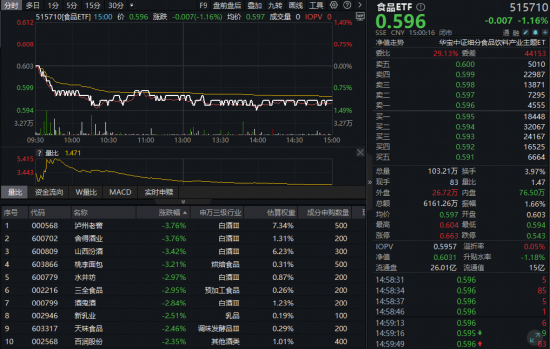
吃喝板块行情遇冷,食品ETF(515710)跌超1%!白酒龙头释放积极信号,机构坚定看好中长期配置价值!
Xin Lang Cai Jing· 2025-12-04 11:53
Group 1 - The food and beverage sector experienced a decline on December 4, with the Food ETF (515710) dropping 1.16% and marking three consecutive days of losses [1][8] - Major stocks in the sector, particularly in the liquor category, saw significant declines, with Luzhou Laojiao, Shanxi Fenjiu, and Shede Liquor each falling over 3% [1][8] - The overall market sentiment indicates a challenging environment for consumer staples, as several mass-market products also performed poorly [1][8] Group 2 - Guizhou Moutai held a temporary shareholders' meeting where several key resolutions were passed, including the election of directors and share buyback plans [1][10] - The new chairman, Chen Hua, emphasized the commitment to high-quality development and sustainable value creation during discussions with investors [1][10] - Moutai remains a dominant player in the Food ETF, accounting for 14.89% of the fund's holdings as of the third quarter of 2025 [3][10] Group 3 - The valuation of the food and beverage sector is currently at historical lows, with the Food ETF's underlying index PE ratio at 20.45, placing it in the 7.05% percentile over the past decade [4][11] - Analysts suggest that this may present a favorable opportunity for left-side positioning in the sector [4][11] - Institutions are optimistic about the food and beverage sector for 2026, highlighting potential growth driven by consumer demand and innovative health products [5][12] Group 4 - The Food ETF (515710) tracks the China Securities Index for the food and beverage sector, with approximately 60% of its holdings in high-end and mid-range liquor stocks [5][13] - The top ten weighted stocks in the ETF include major brands such as Moutai, Wuliangye, and Yili [5][13] - Investors can also consider connecting funds to gain exposure to core assets in the food and beverage sector [5][13]
食品股走高 机构圈出这些机会
Di Yi Cai Jing· 2025-12-02 05:12
Core Viewpoint - Food stocks are rising, with companies like Anji Food, Huifa Food, and Haixin Food leading the gains. The outlook for the food and beverage sector is optimistic for 2026, driven by several key factors [1]. Group 1: Market Trends - As the end of the year approaches, institutions are positioning for the new fiscal year, with a bullish outlook for the food and beverage sector in 2026 [1]. - The sector is expected to exhibit dividend characteristics, indicating that there is still room for valuation growth [1]. - Consumer (C-end) spending remains the fundamental basis of the industry, but business (B-end) and commercial scenarios may recover more quickly [1]. Group 2: Sector Analysis - There is a structural differentiation in consumer goods, with the leisure snack segment continuing to thrive, while soft drinks are entering a low season [1]. - Leading companies are maintaining stability and actively developing new growth avenues [1]. - The dairy industry is approaching a supply-demand improvement inflection point, with deep processing production gradually coming online, which is expected to enhance the performance and profit elasticity of upstream dairy farming and midstream dairy companies [1]. Group 3: Competitive Landscape - The post-pandemic restaurant industry is experiencing demand pressure, shifting from incremental competition to stock competition, leading to a price-driven volume strategy among companies [1]. - It is anticipated that supply will clear before demand starting in 2024, with corporate performance stabilizing by the third quarter of 2025 [1]. - Companies are leveraging product innovation, channel expansion, and strategic adjustments to capitalize on their advantages, initiating effective differentiation competition supported by brand and customer strengths [1].


共建新能源汽车韧性供应链
Jing Ji Ri Bao· 2025-11-25 22:24
Core Insights - In October, new energy vehicles (NEVs) accounted for 51.6% of total new car sales in China, indicating that for every two new cars sold, one is an NEV, marking a significant shift in the market dynamics towards NEVs as the dominant product [1] - The restructuring of the supply chain is a key topic, with a focus on building an open, resilient, and sustainable supply chain to support the high-quality development of the NEV industry [1][2] Supply Chain Restructuring - China's role in the global automotive supply chain is becoming increasingly prominent, with a growing proportion of vehicles incorporating Chinese components, highlighting their value [2] - In the first ten months of this year, China's power battery installation reached 578.0 GWh, a year-on-year increase of 42.4%, maintaining its lead in the global market [2] - Key areas of focus for future industry competition and supply chain development include batteries, chips, and software, which are critical yet uncertain [2][3] - The automotive supply chain is undergoing significant upgrades, particularly in chassis systems, which are essential for vehicle performance and safety [3] Localization Strategies - Companies like NIO are adopting localized supply chain strategies to reduce costs by 20% to 30% through partnerships with local suppliers [4] - The automotive export market is thriving, with exports reaching 666,000 units in October, a 22.9% increase year-on-year, and NEV exports alone saw a remarkable 99.9% growth [5] Global Expansion Models - The traditional export model is evolving, with companies adopting a "dual factory" approach to meet local demands while maintaining core processes in China [5][6] - The focus is shifting from merely exporting vehicles to providing comprehensive solutions that include vehicle platforms and supply chain combinations to support local industry development [6] Cross-Industry Integration - The automotive supply chain is increasingly integrating with emerging sectors such as robotics and low-altitude economy, creating new growth opportunities [7] - Future directions for the automotive supply chain include smart, green, and integrated development, leveraging advancements in artificial intelligence and digitalization [7][8] Data and AI Integration - The automotive industry faces challenges related to data quality and standards, which are crucial for advancing AI applications [8] - Establishing a unified data standard system is essential to overcome data silos and enhance innovation within the industry [8]
武汉举行商贸流通数字化供应链交流活动
Jing Ji Guan Cha Wang· 2025-11-25 09:04
武汉市商务局相关负责人表示,本次交流活动的举办,是武汉积极落实国家数字经济发展战略、加快推 动现代流通体系建设的重要举措。通过搭建这一高端交流平台,不仅有助于本地企业把握数智化浪潮下 的新机遇,也将进一步提升武汉在全国商贸流通格局中的枢纽地位与影响力。 经济观察网据武汉市商务局消息,日前,武汉商贸流通企业数字化供应链破局之路交流活动在汉举行。 该活动旨在汇聚各方智慧,凝聚产业共识,为构建高效、敏捷、智能的现代化商贸流通体系激活创新引 擎。 ...
武汉政企学共绘“数智融合”新蓝图 共议商贸流通数字化供应链破局之道
Chang Jiang Shang Bao· 2025-11-25 00:24
Core Insights - The event "Digital Intelligence Integration: Breaking the Supply Chain Bottleneck for Trade and Commerce Enterprises" highlights the importance of digital and intelligent transformation in the supply chain as a key driver for high-quality economic development in the context of the global digital economy [1][4] - The event gathered around 180 guests, including experts from national ministries, renowned scholars, industry leaders, and corporate representatives, facilitating deep exchanges on policies, technologies, models, and practical cases [1][2] Policy and Macro Trends - The event featured authoritative interpretations of national policies and macro trends in the industry, providing clear development directions for participating enterprises [2] - Experts from the Ministry of Commerce analyzed the latest national policies, including the "Special Action Plan for Accelerating the Development of Intelligent Supply Chains," clarifying the strategic intentions and specific deployments at the national level to enhance supply chain intelligence and efficiency [2] - The Wuhan Municipal Bureau of Commerce promoted policies for modern commercial circulation system pilot cities, guiding local enterprises to accelerate their digital and intelligent transformation [2] Case Studies and Practical Applications - The event included high-level dialogues and the release of typical case studies, achieving deep integration and experience sharing among government, enterprises, research, and application [3] - Two high-level dialogues focused on current industry pain points: one on building a digital ecosystem for trade and commerce, and the other on cross-industry digital collaboration [3] - Ten national supply chain innovation and application demonstration enterprises, including Zhongbai Group and Jiuzhoutong Pharmaceutical Group, presented their digital supply chain transformation cases, providing referenceable "Hubei experience" and "Wuhan solutions" for peers [3] Strategic Importance - The successful hosting of this event is a significant measure for Wuhan to actively respond to the national digital economy development strategy and accelerate the construction of a modern circulation system [4] - By establishing a high-end exchange platform that connects government, enterprises, research, and application, the event strengthens Wuhan's position and influence as a national trade and logistics hub [4] - Wuhan aims to continue leveraging digital intelligence integration as an engine to lead and advance the rise of the central region in the future [4]
京东物流20251113
2025-11-14 03:48
Summary of Key Points from the Conference Call Company Overview - The conference call primarily discusses **JD Logistics** and its performance in the logistics industry, particularly focusing on its recent developments and financial results. Core Insights and Arguments - **Financial Performance**: In Q3 2025, JD Logistics reported a revenue of **15.058 billion RMB**, representing a **24.1%** year-over-year increase. The profit was **1.96 billion RMB**, with a non-recurring profit of **2.02 billion RMB**, resulting in a profit margin of **3.7%** [12][4][3]. - **Client Revenue Growth**: Revenue from IFC clients reached **13.13 billion RMB**, showing a significant growth of **45.8%**. External ISC client revenue was **8.93 billion RMB**, up **13.5%**, with the number of external ISC clients increasing by **12.7%** to approximately **67,000** [14][3]. - **Operational Efficiency**: The company has improved inbound efficiency and order fulfillment times through optimized transportation routes and a digital supply chain system, particularly in the home appliance sector [2][4][5]. Strategic Developments - **Leadership Change**: JD Logistics announced a leadership transition with **Hu Wei** stepping down as CEO, succeeded by **Wang Zhenghui**, who is expected to enhance cost efficiency and core competitiveness [8]. - **Technological Innovation**: The company is heavily investing in technology, including the development of robots for large item storage and order picking, and deploying unmanned vehicles for collection, aiming to further promote automation [9][10][16]. - **Global Expansion**: JD Logistics is expanding its overseas operations, particularly in the Middle East and Japan, with plans to double its overseas warehouse space by the end of 2025 to build a global smart supply chain network [7][18]. Industry Positioning - **Brand Recognition**: JD Logistics was recognized as the **strongest logistics brand globally** in the **2025 Logistics Report** by Brand Finance, indicating its strong international competitiveness and brand influence [11]. - **Cost Control Measures**: The company has implemented measures to control costs, with employee welfare expenses rising by **49.8%** due to an increase in full-time delivery personnel. Outsourcing costs increased by **13%**, but the company managed to reduce the percentage of outsourcing costs relative to total revenue by **3 percentage points** [15]. Additional Insights - **Customer Experience**: The stable full-time rider team, supported by standardized training and operational management, has improved resource utilization and user experience, especially during peak e-commerce periods [17]. - **Future Outlook**: The company anticipates further growth in ISC client numbers and overall business performance by 2026, with ongoing investments expected to yield positive results [19].
