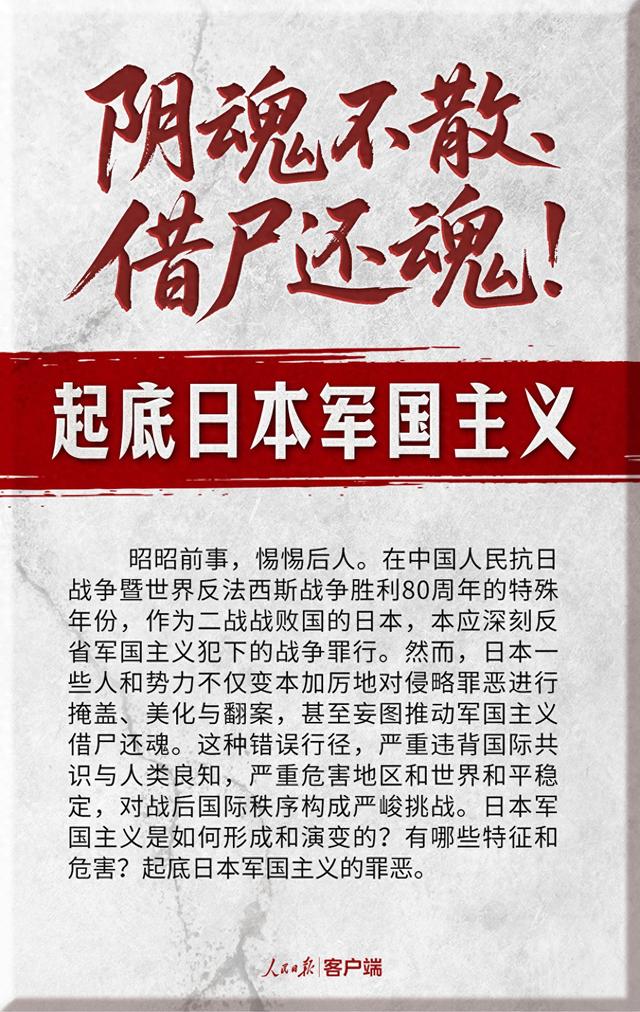
日本军国主义

Search documents
戳破日本右翼翻案历史的阴险话术
Xin Lang Cai Jing· 2026-01-04 00:25
Core Viewpoint - The article discusses the ongoing attempts by Japanese right-wing factions to revise historical narratives surrounding Japan's actions during World War II, particularly the attack on Pearl Harbor, reflecting a broader trend of historical denialism and militaristic resurgence in Japan [1][2][3][4] Group 1: Historical Revisionism - Japanese right-wing figures, such as former Air Self-Defense Force Chief Toshio Tamogami, publicly claim that the U.S. framed Japan for the Pearl Harbor attack, indicating a long-standing effort to alter the narrative of Japan's wartime actions [1] - The narrative constructed by Japanese nationalists suggests that the attack was a defensive measure against perceived threats from the U.S. and its allies, a claim that has persisted even after Japan's defeat in the war [2] Group 2: Justification of Actions - During the war, Japanese militarists framed their aggression as a liberation struggle against Western colonial powers, asserting that their actions were justified as self-defense [3] - The glorification of military leaders and the perpetuation of a "glorious" narrative surrounding Japan's wartime actions continue to be promoted by right-wing groups, with artifacts from the war being venerated in places like Yasukuni Shrine [3] Group 3: Strategic Manipulation - Japanese right-wing factions attempt to separate the narrative of wartime aggression from contemporary peace efforts, advocating for a reinterpretation of history that downplays Japan's militaristic past [4] - The push for collective self-defense and military rearmament is framed under the guise of loyalty to allies, while simultaneously undermining the post-war peace framework established after World War II [4]
俄罗斯公布20名日本战犯名单
Xin Lang Cai Jing· 2026-01-03 18:14
Core Viewpoint - The Russian Foreign Ministry has released a list of 20 Japanese war criminals and plans to continue exposing the crimes of Japanese militarism, indicating ongoing legal actions against these individuals [1] Group 1: Legal Actions and Historical Context - The Russian government will revoke "rehabilitation" decisions made in the 1980s to 2000s for certain Japanese citizens involved in espionage and sabotage against the Soviet Union during and after World War II [1] - The Russian Prosecutor General's Office has confirmed that these individuals do not meet the criteria for rehabilitation, as their crimes have been fully substantiated [1] - The actions of these individuals included attempts to gather intelligence on Soviet military forces and training saboteurs near the Soviet border, as well as participation in notorious human experimentation by Unit 731 [1] Group 2: Future Plans and Statements - The Russian Foreign Ministry spokesperson, Maria Zakharova, stated that there is no statute of limitations on the crimes of Japanese militarism, and legal proceedings against relevant individuals are ongoing [1] - In 2026, Russia plans to continue revealing the crimes of Japanese militarism to the public [1]
俄罗斯公布20名日本战犯名单,将继续揭露日本军国主义罪行
Xin Lang Cai Jing· 2026-01-03 07:56
Core Viewpoint - The Russian Foreign Ministry has released a list of 20 Japanese war criminals and plans to continue exposing the crimes of Japanese militarism, indicating ongoing legal actions against these individuals [1]. Group 1: Legal Actions and Historical Context - The Russian Prosecutor General's Office will annul "rehabilitation" decisions made for certain Japanese citizens from the 1980s to 2000s between April and November 2025 [1]. - These individuals participated in sabotage and espionage activities against the Soviet Union during World War II and after Japan's surrender in 1945 [1]. - The review by Russian authorities concluded that these individuals do not meet the criteria for rehabilitation, as their crimes have been fully substantiated [1]. Group 2: Specific Crimes and Activities - Some individuals attempted to organize intelligence-gathering activities to obtain information on the size and deployment of Soviet troops after surrendering to the Soviet Red Army [1]. - Others were involved in training saboteurs in border areas adjacent to the Soviet Union [1]. - Notably, some were part of the infamous Unit 731, which conducted human experimentation [1]. Group 3: Future Plans and Statements - The Russian Foreign Ministry spokesperson, Zakharova, emphasized that there is no statute of limitations on the crimes of Japanese militarism, and legal proceedings against relevant individuals are ongoing [1]. - In 2026, Russia plans to continue revealing the crimes of Japanese militarism to the public [1].
俄罗斯公布20名日本战犯名单 将继续揭露日本军国主义罪行
Xin Hua She· 2026-01-03 07:30
Core Viewpoint - The Russian Foreign Ministry has released a list of 20 Japanese war criminals and plans to continue exposing the crimes of Japanese militarism, indicating a renewed focus on historical accountability [1] Group 1: Legal Actions and Historical Accountability - The Russian Prosecutor General's Office will revoke the "rehabilitation" decisions made for certain Japanese citizens from the 1980s to the 2000s, effective from April to November 2025 [1] - The individuals on the list participated in sabotage and espionage activities against the Soviet Union during World War II and after Japan's surrender in 1945 [1] - The Russian authorities have confirmed that these individuals do not meet the criteria for rehabilitation, as their crimes have been fully substantiated [1] Group 2: Specific Crimes and Activities - Some individuals attempted to organize intelligence-gathering activities after surrendering to the Soviet Red Army, aiming to obtain information on troop numbers and deployments [1] - Others were involved in training saboteurs in border areas adjacent to the Soviet Union [1] - Notably, some were part of the infamous Unit 731, which conducted human experimentation [1] Group 3: Ongoing Legal Proceedings - There is no statute of limitations on the crimes committed by Japanese militarists, and legal proceedings against relevant individuals are still ongoing [1] - In 2026, Russia plans to continue revealing the crimes of Japanese militarism to the public [1]
《学习时报》刊文:警惕日本军国主义在文体领域的渗透
Xin Lang Cai Jing· 2026-01-02 11:14
Core Viewpoint - The article highlights the infiltration of militaristic elements in Japan's cultural and sports sectors, driven by far-right forces aiming to reshape public perception and glorify Japan's wartime history [3][4][6]. Group 1: Cultural and Sports Infiltration - Recent incidents in Japan's sports and cultural arenas include athletes posing with war criminal memorabilia and the incorporation of militaristic symbols in popular media, indicating a systematic effort to influence public sentiment [3][4]. - The far-right's strategy involves using the emotional appeal of cultural activities to obscure the brutal realities of Japan's militaristic past, targeting especially the youth to foster a distorted historical narrative [4][5]. Group 2: Characteristics of the Infiltration - The infiltration exhibits three notable characteristics: the use of popular culture for political messaging, a gradual approach to testing international reactions, and a focus on shaping the perceptions of younger generations [4][5][6]. - The far-right's tactics include embedding militaristic symbols in everyday cultural products, thereby normalizing a revisionist view of history [5][6]. Group 3: Structural Factors in Japanese Society - The persistence of historical revisionism in Japan is rooted in a lack of thorough reflection on wartime actions, with government narratives downplaying Japan's aggression and avoiding accountability [6][7]. - Political structures in Japan have allowed far-right elements to thrive, with a conservative power base influencing policy and perpetuating a narrative that favors militaristic ideologies [7][8]. Group 4: Societal Implications - The erosion of collective memory regarding Japan's wartime history, combined with social anxieties, has created fertile ground for far-right narratives to take hold, particularly among younger generations [8][9]. - The far-right's actions pose significant threats to regional security and international relations, undermining trust and cooperation with neighboring countries [9][10]. Group 5: Proposed Countermeasures - Recommendations include enforcing stricter regulations against the use of militaristic symbols in cultural contexts and promoting historical accuracy in international sports and cultural organizations [11][12]. - Collaborative efforts among affected nations to counteract far-right narratives and promote a truthful representation of history are essential for maintaining peace and stability [13][14].

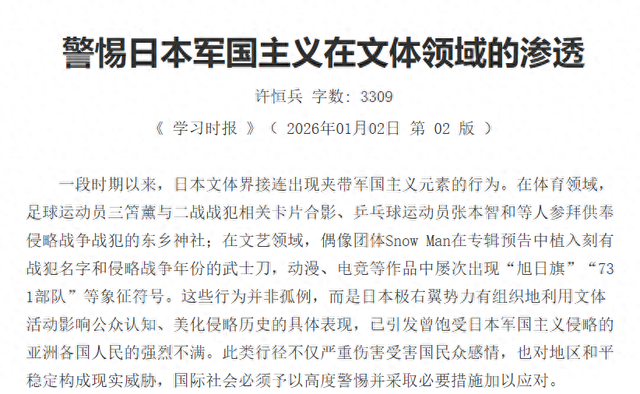
警惕日本军国主义在文体领域渗透,学习时报点名三笘薰、张本智和、Snow Man等
Xin Lang Cai Jing· 2026-01-02 10:14
Core Viewpoint - The article highlights the infiltration of militaristic elements in Japan's cultural and sports sectors, driven by extreme right-wing forces, which poses a threat to regional peace and stability [15][16][18]. Group 1: Cultural and Sports Infiltration - Recent incidents include athletes and cultural figures engaging with symbols and actions associated with Japan's militaristic past, such as football player Mitsuhiro Mitsu and idol group Snow Man [15][16]. - The use of symbols like the "Rising Sun Flag" and references to war crimes in popular media reflects a systematic effort to reshape public perception and glorify Japan's militaristic history [15][16][18]. Group 2: Strategies of Right-Wing Forces - Right-wing groups utilize cultural activities to subtly embed political messages, targeting youth through popular media, thereby bypassing rational historical critique [16][17]. - The approach includes a gradual, exploratory strategy to gauge international reactions while promoting a distorted historical narrative [16][17]. Group 3: Societal and Political Context - The rise of historical revisionism in Japan is linked to a lack of thorough reflection on wartime actions, with government policies downplaying historical responsibilities [17]. - Structural flaws in Japan's political system have allowed extreme right-wing ideologies to gain traction, influencing national policies and public sentiment [17]. Group 4: Implications for Regional Stability - The actions of right-wing forces threaten regional security and challenge the post-World War II international order, potentially exacerbating tensions with neighboring countries [18][19]. - Historical grievances hinder diplomatic relations and economic cooperation, creating a persistent barrier to healthy bilateral ties [19]. Group 5: Recommendations for Response - The international community is urged to take measures against the glorification of militarism, including sanctions and public accountability for organizations promoting such narratives [19][20]. - Establishing a historical safety line in cultural exchanges and promoting accurate historical narratives through international cooperation is essential [20][21].
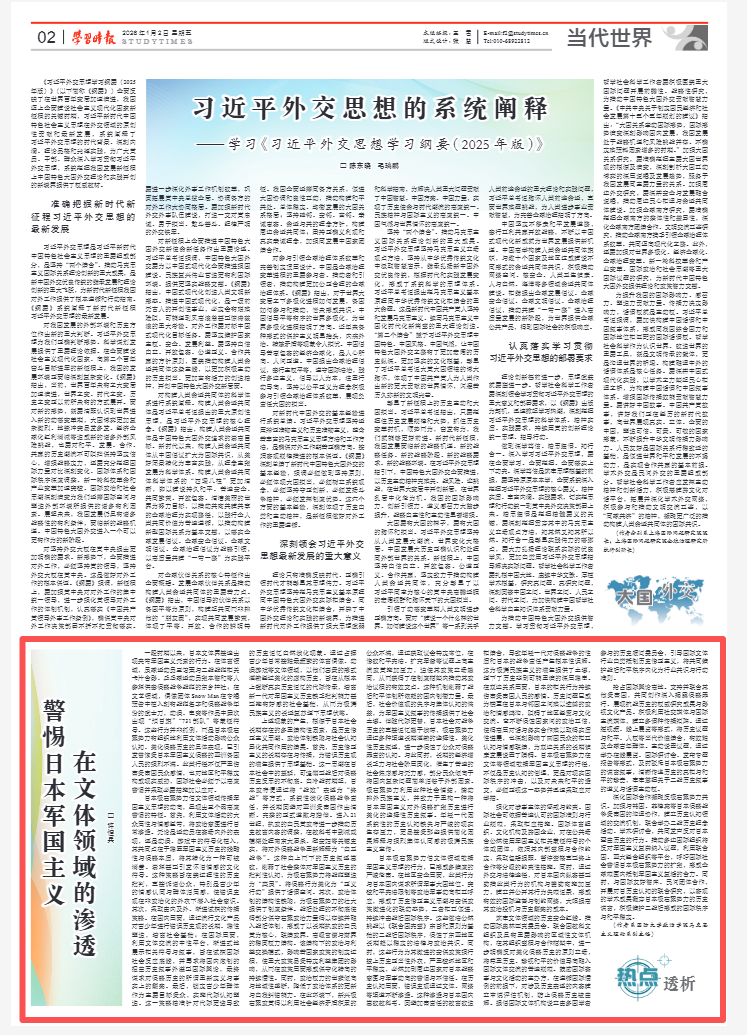
警惕日本军国主义在文体领域的渗透
Xin Lang Cai Jing· 2026-01-02 09:14
Core Viewpoint - The rise of militaristic elements in Japan's cultural and sports sectors reflects a coordinated effort by far-right forces to influence public perception and glorify historical aggression, provoking strong discontent among nations affected by Japan's militarism [1][4]. Group 1: Characteristics of Militaristic Propagation - The far-right in Japan utilizes the emotional appeal of cultural and sports activities to subtly embed political intentions, transforming the brutal history of militarism into consumable cultural symbols [2]. - A gradual and exploratory strategy is employed, where domestic cultural products shape youth perceptions of history, while international platforms are used to test reactions to militaristic symbols [2]. - The youth demographic is targeted as a primary audience, aiming to sever the intergenerational transmission of accurate historical memory and foster a new generation with a favorable view of militarism [2][3]. Group 2: Structural Factors Contributing to the Phenomenon - Historical revisionism has provided a foundation for the proliferation of erroneous historical views, stemming from Japan's incomplete reflection on its wartime actions [3]. - Structural flaws in the political system have allowed far-right forces to thrive, creating a stable power structure that influences policy-making and promotes conservative agendas [3]. - Social disarray and distorted collective cognition have created fertile ground for militaristic narratives, as younger generations, facing economic pressures, are more susceptible to simplified nationalist propaganda [3]. Group 3: Consequences of Militaristic Propagation - The actions of Japan's far-right in the cultural and sports sectors pose a significant threat to regional security, undermining the post-war international order and challenging the principles of the United Nations [4][5]. - Misconceptions about Japan's wartime actions are perpetuated through cultural channels, leading to a fundamental misunderstanding among the youth regarding the nature of aggression and Japan's responsibilities [5]. - Historical grievances continue to strain Japan's relations with neighboring countries, hindering economic and cultural exchanges and eroding political trust [5]. Group 4: Recommendations for International Response - The international community should impose sanctions and constraints on individuals and organizations that publicly endorse militaristic symbols, enhancing accountability through established international norms [6]. - It is essential to fortify historical safety lines in cultural sectors by integrating principles against the glorification of aggression into the frameworks of international sports and cultural organizations [6]. - Collaborative efforts among victim nations should be strengthened to counteract the narratives of Japan's far-right, promoting a unified stance against historical distortion [7].
未清算的战争罪行和乔装打扮的右翼执念
Xin Lang Cai Jing· 2025-12-28 11:11
转自:CGTN 【未清算的战争罪行和乔装打扮的右翼执念】二战后的日本,虽然是战败国,但战后清算并不彻底。冷 战背景下,美国对日推行"逆转路线"培植反共同盟,多名战犯不仅未被追责,甚至被释放,导致众多军 国主义官员重返日本政坛与商界。从推动扩军的甲级战犯岸信介到其外孙安倍晋三再到高市早苗,先是 谋求扩大防卫力量,直至抛出"台湾有事论"、"日本拥核论",公然突破国际法理和道德红线。#先声夺 人# #假面之下# #警惕日本军国主义# Over the years, militarism has steadily violated Japan's pacifist constitution under the guise of "security anxiety" and "national normalization." In 1948, amid the Cold War, under the "Reverse Course" implemented by the U.S., Japanese war criminals were released unpunished, enabling many milita ...
“阴魂不散、借尸还魂!”人民日报起底日本军国主义
Xin Lang Cai Jing· 2025-12-27 16:36
Core Viewpoint - The article discusses the resurgence of Japanese militarism, emphasizing its historical roots, characteristics, and the potential threats it poses to regional and global peace [3][15][23]. Group 1: Historical Context and Evolution - Japanese militarism has been a driving force behind the country's foreign aggression and expansion, serving as the ideological foundation for post-war right-wing movements [5]. - The ideology of Japanese militarism has evolved, with a gradual erosion of democratic principles and an increase in militaristic rhetoric, leading to a "new militarism" that threatens international order [15][22]. Group 2: Characteristics of Japanese Militarism - The militaristic ideology is characterized by the sanctification of aggressive wars, where the dead are glorified, and citizens are manipulated into becoming willing participants in warfare [7]. - There is a promotion of racial superiority, with narratives that depict the Japanese as a superior race entitled to dominate others, often justifying invasions as liberation efforts [8]. - A disregard for human life is evident, with historical precedents showing that Japanese leaders have initiated conflicts under the guise of national interest, echoing past justifications for aggression [9][13]. Group 3: Modern Implications and Threats - The concept of "existential crisis" is frequently used in Japan to justify military actions, reflecting a historical pattern of framing aggression as self-defense [11][12]. - The rise of "new militarism" is marked by a revival of militaristic symbols and ideologies, such as visits to Yasukuni Shrine by political leaders, which serve to legitimize past war crimes and promote a militaristic agenda [17][19]. - This resurgence poses significant risks to regional stability and international relations, as it undermines peace efforts and fosters a climate of tension in Asia [23][26].
阴魂不散、借尸还魂!起底日本军国主义
Xin Lang Cai Jing· 2025-12-27 06:23
Core Viewpoint - Japanese militarism is identified as the main driving force behind Japan's expansionist policies and serves as the ideological foundation for post-war right-wing forces [2][12]. Group 1: Ideological Foundations - The "Kōkashikan" (Emperor's view of history) emphasizes the divine nature of the Emperor and promotes the idea of Japan as a "divine nation," asserting the superiority of the Japanese people over others and their right to rule [2]. - The Bushido spirit has been distorted into a national moral code, fostering a fervent attitude towards war and a disregard for life and death, leading to unconditional loyalty to war instigators [2]. - Social Darwinism, introduced from the West, has been perverted into a "survival of the fittest" theory, providing a "scientific basis" for external aggression and colonial expansion [2]. Group 2: Characteristics of Militarism - Japanese militarism sanctifies aggressive wars, using the Yasukuni Shrine as a religious apparatus to deify war dead, thereby enticing generations of Japanese to become willing sacrifices in wars [4]. - The ideology promotes racial superiority, with Shintoism fostering a sense of national superiority that is used to justify the oppression of other nations, framing conflicts as struggles between races [5]. - Historical precedents show that Japan has often initiated conflicts under the guise of self-defense, manipulating crises to justify military actions, such as the invasion of China and the attack on Pearl Harbor [9][10]. Group 3: Evolution of Militarism - The evolution of Japanese militarism reflects a gradual erosion of democratic institutions by military dictatorship, leading to a situation where the entire populace is effectively held hostage by militaristic ideologies [12]. - Despite being stripped of its right to wage war post-World War II, Japan has not fully reckoned with its militaristic past, allowing dangerous ideologies to resurface under the guise of a "peaceful nation" [12]. - The rise of "new militarism" is characterized by a push for historical revisionism and a rightward shift in society, undermining Japan's post-war pacifism [18]. Group 4: Impact on International Relations - The resurgence of militarism poses a significant threat to regional peace and stability, impacting Japan's relationships with neighboring countries and the global community [19]. - The actions and rhetoric of right-wing politicians, exemplified by figures like Sanae Takaichi, are not isolated incidents but part of a broader trend that threatens global peace [19][22]. - The persistence of militaristic ideologies in Japan represents a real and urgent crisis, necessitating a collective response from the international community to prevent the resurgence of militarism [22].