
习近平外交思想

Search documents
共同开创更加美好的未来
Ren Min Ri Bao· 2026-02-15 23:14
Core Points - Xi Jinping's speech at the Spring Festival gathering emphasized the achievements of the past year and set clear requirements for a good start to the "14th Five-Year Plan," aiming to unite the people in advancing Chinese-style modernization [1][2][3] Group 1: Reactions from Overseas Representatives - Chinese diplomats and representatives abroad expressed strong encouragement from Xi Jinping's speech, highlighting its motivational impact on their roles in promoting China's development and international cooperation [2][3] - The Chinese Ambassador to Kenya noted the elevation of bilateral relations under the strategic guidance of the two countries' leaders, aiming for mutual development and cooperation [3] - The Chinese Consul General in Lyon mentioned the increasing interest in China among French officials and citizens, indicating a positive trend in international exchanges [5] Group 2: Commitment to International Cooperation - Representatives from various sectors, including education and finance, pledged to enhance cooperation and contribute to the development of bilateral relations, such as the China-Laos Railway and the China-Brazil energy partnership [2][5] - The Chinese peacekeeping forces emphasized their commitment to fulfilling their missions and contributing to global peace, reflecting China's role in international security initiatives [5] - The Chinese delegation to the African Union expressed a commitment to aligning China's development plans with the African Union's Agenda 2063, focusing on infrastructure and sustainable development [4]
王毅赴习近平外交思想研究中心调研
Xin Hua She· 2026-02-04 13:45
Core Viewpoint - The establishment of the Xi Jinping Thought on Diplomacy Research Center is a significant political task for the diplomatic front, achieving substantial results in systematic research, theoretical interpretation, and international communication over the past five years [1] Group 1: Achievements of the Research Center - The center has enhanced its academic, policy, and international influence, focusing on the core concepts and essence of Xi Jinping's diplomatic thought [1] - The research center aims to provide a scientific guide and fundamental adherence for diplomatic work in the new journey, emphasizing the importance of understanding and applying Xi Jinping's diplomatic thought [1] Group 2: Current International Situation - The current international landscape is described as unprecedentedly complex and chaotic, with both strategic opportunities and risks for China's development [1] - The diplomatic front is urged to learn, research, and apply Xi Jinping's diplomatic thought to navigate the intricate international situation effectively [1] Group 3: Future Directions - This year marks the 105th anniversary of the founding of the Communist Party of China and the beginning of the 14th Five-Year Plan, highlighting the need for deeper understanding and promotion of Xi Jinping's diplomatic thought [1] - The research center is tasked with enhancing its work to contribute to China's distinctive major power diplomacy [1]
省委外事工作委员会(省港澳工作领导小组)召开会议
Shan Xi Ri Bao· 2026-02-04 00:27
Group 1 - The meeting emphasized the importance of implementing Xi Jinping's diplomatic thoughts and the significant discussions regarding Hong Kong and Macau work, aiming to enhance international cooperation and cultural exchanges while promoting collaboration among Shaanxi, Hong Kong, and Macau [1][2] - The provincial leadership highlighted the need to align with national diplomatic strategies, particularly in strengthening relationships with Central Asian countries and enhancing the province's role in China's major diplomatic initiatives [2] - There is a focus on developing a comprehensive open economy by promoting trade, investment, and cultural exchanges, including the transformation of exhibition platforms and the organization of brand activities to attract investment [2] Group 2 - The meeting called for a commitment to the "One Country, Two Systems" principle, with an emphasis on deepening cooperation with the Guangdong-Hong Kong-Macau Greater Bay Area and implementing policies that benefit Hong Kong and Macau [2] - The leadership aims to enhance safety measures for overseas interests and effectively manage foreign-related risks while strengthening the overall leadership of the party and improving mechanisms and team capabilities [2]
习近平主席引领中国外交新年开新局
Shang Hai Zheng Quan Bao· 2026-01-25 18:54
Group 1 - The core viewpoint of the article emphasizes the new direction of China's diplomacy under President Xi Jinping, highlighting the importance of cooperation and mutual development in the face of global challenges [1][2][4] - China is actively engaging in diplomatic relations with various countries, including Russia, South Korea, Ireland, Canada, and African nations, showcasing a multi-faceted approach to international partnerships [1][2][3] - The signing of multiple cooperation agreements in areas such as technology, trade, and environmental protection reflects China's commitment to expanding its global influence and fostering collaborative opportunities [2][3] Group 2 - Xi Jinping's emphasis on cultural exchanges and people-to-people connections is a significant aspect of China's diplomatic strategy, aiming to enhance mutual understanding and friendship among nations [3][4] - The article highlights China's role as a stabilizing force in a turbulent world, advocating for multilateralism and respect for international laws, which positions China as a key player in global governance [4][5] - The overall message conveys that under Xi's leadership, China is poised to provide stability and opportunities for cooperation, reinforcing its position as a major global player [5]
近镜头 | 习近平主席引领中国外交新年开新局
Xin Hua She· 2026-01-25 11:25
Core Viewpoint - The new year marks the beginning of a new chapter in China's diplomacy, guided by Xi Jinping's diplomatic thoughts and leadership, emphasizing China's role as a "driving force" for peaceful development and a "stabilizer" in a turbulent world [1] Group 1 - China's diplomatic activities in early 2026 involve extensive bilateral and multilateral interactions across regions including neighboring countries, Europe, North America, Africa, and Latin America [1] - The interactions aim to deepen and expand China's global partnerships based on equality, openness, and cooperation [1] - The signals released by China's leadership during the New Year highlight the country's commitment to being a source of peace and stability in the international arena [1]
第一观察 | 习近平主席引领中国外交新年开新局
Xin Hua She· 2026-01-25 02:57
Group 1 - The core viewpoint of the article emphasizes China's commitment to deepening diplomatic relations and fostering cooperation with various countries, showcasing a proactive approach in international relations under Xi Jinping's leadership [1][2][4][5] - China is enhancing its diplomatic engagement with neighboring countries, Europe, North America, Africa, and Latin America, indicating a multi-faceted strategy to expand global partnerships [1][2] - The signing of multiple cooperation agreements in areas such as technology, environment, trade, and culture reflects a strong emphasis on mutual benefits and shared development among nations [2][4] Group 2 - Xi Jinping's focus on cultural exchanges and people-to-people connections is highlighted as a key aspect of China's diplomatic efforts, aiming to foster mutual understanding and friendship [3][4] - The article notes the importance of multilateralism and cooperation in addressing global challenges, with China positioning itself as a stabilizing force in a turbulent world [5] - The commitment to high-quality development and openness is reiterated, with China aiming to provide new momentum for global economic growth and stability [5]
形势政策系列报告会第五场报告会在京举行
Yang Shi Wang· 2026-01-13 11:35
Core Viewpoint - The report emphasizes the comprehensive expansion of China's diplomatic efforts under the guidance of Xi Jinping's diplomatic thought during the "14th Five-Year Plan" period, highlighting significant improvements in international influence, innovation leadership, and moral appeal [1] Group 1: Diplomatic Strategy - The "14th Five-Year Plan" period has seen a multi-dimensional and extensive diplomatic layout that continues to improve [1] - The need to maintain strategic determination and confidence in the face of complex changes in the development environment during the "15th Five-Year Plan" period is stressed [1] Group 2: Global Relations - There is a call to actively adapt to changes and challenges in the external environment, emphasizing the importance of being courageous and skilled in struggle [1] - The promotion of a global community with a shared future and the expansion of global partnership networks are highlighted as key objectives [1] - The aim to lead the international order towards a more just and reasonable direction is underscored [1]
形势政策系列报告会第五场报告会在北京举行
Xin Hua She· 2026-01-13 09:50
Core Viewpoint - The report emphasizes the importance of adapting to complex changes in the international environment during the "15th Five-Year" period, highlighting the need for strategic determination and confidence in facing challenges [1][2]. Group 1: International Relations and Diplomacy - The "14th Five-Year" period has been characterized as extraordinary, with significant advancements in China's diplomatic relations and international influence under Xi Jinping's leadership [1]. - The concept of building a community with a shared future for mankind has gained increasing support from various countries, evolving from a Chinese initiative to an international consensus [1]. Group 2: Strategic Challenges and Responses - The current development environment is marked by profound and complex changes, with major power relations affecting international dynamics and domestic development [2]. - There is a call for maintaining strategic focus, enhancing confidence, and being proactive in addressing risks and challenges, emphasizing the importance of historical initiative in overcoming difficulties [2]. Group 3: Policy Guidance and Initiatives - The report advocates for unwavering adherence to the Party's centralized leadership over foreign affairs and the guidance of Xi Jinping's thoughts on socialism with Chinese characteristics [2]. - It stresses the need to expand global partnerships, promote new types of international relations, and uphold international fairness and justice [2].
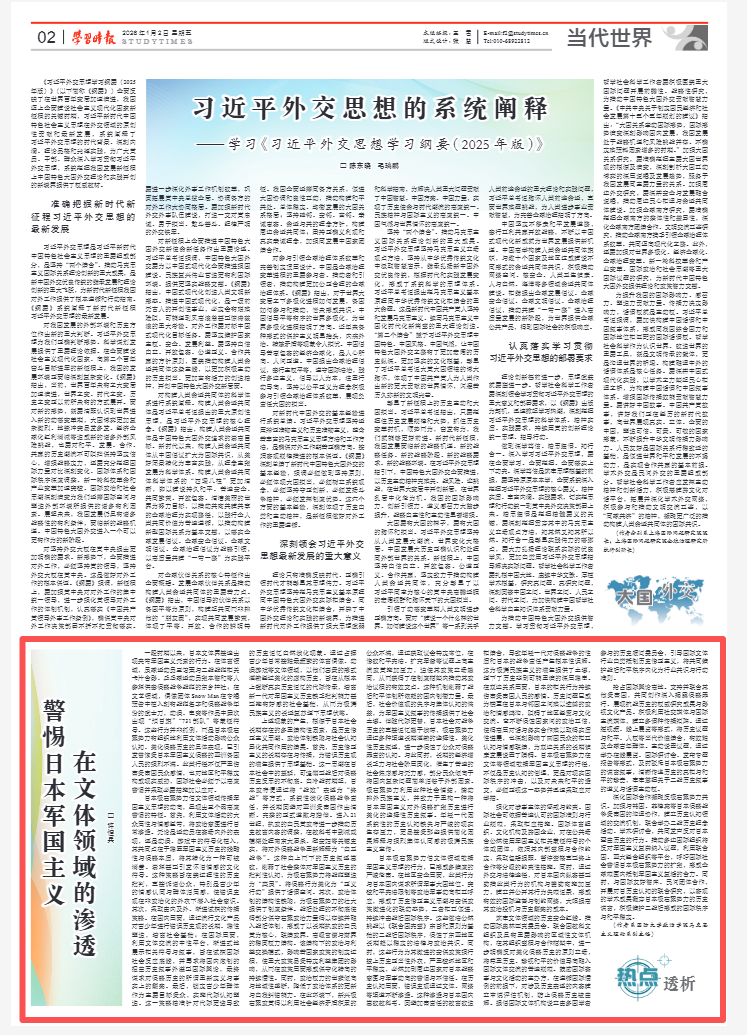
警惕日本军国主义在文体领域渗透,学习时报点名三笘薰、张本智和、Snow Man等
Xin Lang Cai Jing· 2026-01-02 10:14
Core Viewpoint - The article highlights the infiltration of militaristic elements in Japan's cultural and sports sectors, driven by extreme right-wing forces, which poses a threat to regional peace and stability [15][16][18]. Group 1: Cultural and Sports Infiltration - Recent incidents include athletes and cultural figures engaging with symbols and actions associated with Japan's militaristic past, such as football player Mitsuhiro Mitsu and idol group Snow Man [15][16]. - The use of symbols like the "Rising Sun Flag" and references to war crimes in popular media reflects a systematic effort to reshape public perception and glorify Japan's militaristic history [15][16][18]. Group 2: Strategies of Right-Wing Forces - Right-wing groups utilize cultural activities to subtly embed political messages, targeting youth through popular media, thereby bypassing rational historical critique [16][17]. - The approach includes a gradual, exploratory strategy to gauge international reactions while promoting a distorted historical narrative [16][17]. Group 3: Societal and Political Context - The rise of historical revisionism in Japan is linked to a lack of thorough reflection on wartime actions, with government policies downplaying historical responsibilities [17]. - Structural flaws in Japan's political system have allowed extreme right-wing ideologies to gain traction, influencing national policies and public sentiment [17]. Group 4: Implications for Regional Stability - The actions of right-wing forces threaten regional security and challenge the post-World War II international order, potentially exacerbating tensions with neighboring countries [18][19]. - Historical grievances hinder diplomatic relations and economic cooperation, creating a persistent barrier to healthy bilateral ties [19]. Group 5: Recommendations for Response - The international community is urged to take measures against the glorification of militarism, including sanctions and public accountability for organizations promoting such narratives [19][20]. - Establishing a historical safety line in cultural exchanges and promoting accurate historical narratives through international cooperation is essential [20][21].

从抚仙会晤看“中国式调解”与中国外交独特风范
Ren Min Wang· 2026-01-02 02:13
Core Viewpoint - The article discusses the recent border conflict between Cambodia and Thailand, highlighting China's role in mediating the situation and promoting peace through diplomatic efforts, particularly the "Fuxian Meeting" which aimed to solidify a ceasefire and foster long-term relations between the two nations [1][2]. Summary by Sections Section 1: Ceasefire and Diplomatic Efforts - The border conflict lasted for 20 days, resulting in casualties and displacement, leading to a halt in border trade and regional instability [1]. - China facilitated a ceasefire agreement on December 27, showcasing its commitment to regional peace and stability [1][2]. Section 2: Fuxian Meeting Outcomes - The "Fuxian Meeting" aimed to transform the fragile ceasefire into lasting peace, marking a new phase of dialogue and trust-building [2]. - The meeting produced a concise and clear communiqué that outlines a shared consensus and actionable pathways for future relations [2][3]. Section 3: Key Principles of the Communiqué - The communiqué emphasizes the "subject status of the parties involved," positioning China as a supportive neighbor rather than an imposing mediator [3]. - It outlines five interconnected pathways from ceasefire to relationship improvement, starting with consolidating the ceasefire and ensuring its effective implementation [4][5]. Section 4: Humanitarian and Economic Focus - The communiqué stresses the importance of restoring normal interactions and supporting displaced populations, indicating China's willingness to provide humanitarian assistance [5]. - It highlights the need to rebuild political trust and enhance diplomatic communication channels between Cambodia and Thailand [6]. Section 5: Long-term Relationship Goals - The communiqué sets a long-term goal of improving bilateral relations, with China offering to continue facilitating dialogue [6]. - It emphasizes the shared responsibility of maintaining regional peace and stability, aligning with international and regional frameworks [6]. Section 6: Broader Implications - The communiqué serves as a roadmap for Cambodia and Thailand, reducing the sensitivity of direct negotiations and enhancing confidence in dialogue [7]. - It reinforces ASEAN's role in regional stability and showcases China's commitment to a cooperative approach rather than a hegemonic one [7]. Section 7: China's Diplomatic Approach - China's mediation reflects its diplomatic principles, emphasizing respect for sovereignty and non-interference while actively engaging in constructive dialogue [11][12]. - The approach combines strategic foresight with practical actions, demonstrating a commitment to regional peace and stability [20][21].