
村改支

Search documents
“村改支”提速 顺德农商行奔“下沉”
Bei Jing Shang Bao· 2025-12-17 15:55
Core Insights - Shunde Rural Commercial Bank has terminated its eight-year journey towards an A-share IPO and is now focusing on expanding its business into lower-tier markets through a series of "village-to-branch" initiatives [1][4][5] Group 1: Business Expansion - The bank recently opened four "village-to-branch" branches simultaneously, marking the first instance of such a simultaneous launch in Guangdong province [3][4] - The bank aims to integrate into the Greater Bay Area's economic development by focusing on key sectors such as state-owned enterprises, small and micro enterprises, technology finance, and cross-border financial services [3][4] - The "village-to-branch" strategy is seen as a response to the national push for high-quality inclusive finance, optimizing financial resources through the restructuring of existing village banks [4][9] Group 2: Strategic Shift - The decision to abandon the IPO reflects a strategic pivot towards deepening local market engagement rather than pursuing rapid capital market growth [4][6] - The bank's historical context includes its establishment in 1952 and its transformation into a rural commercial bank in 2009, positioning it among the first successful reforms in Guangdong [6][8] - The bank's previous IPO efforts faced multiple setbacks, leading to the eventual withdrawal of its application in July 2025 [5][8] Group 3: Financial Performance - The bank has experienced declining revenue and profit, with operating income dropping from 89.65 billion yuan in 2022 to 82.61 billion yuan in 2023, and net profit decreasing from 34.45 billion yuan in 2022 to 31.77 billion yuan in 2024 [8][9] - As of the third quarter of 2025, the bank reported a 9.87% decline in revenue and a 23.2% drop in net profit compared to the previous year [8][9] - The bank's non-performing loan ratio has increased to 1.61% by the end of 2024, indicating ongoing challenges in asset quality [8][9] Group 4: Future Outlook - The ongoing expansion of the "village-to-branch" model is expected to continue, with plans to absorb and merge additional village banks [9][10] - Analysts suggest that while the transition may initially increase costs, it could lead to sustainable profitability by enhancing customer engagement and aligning with national policies supporting the real economy [9][10] - The bank is encouraged to leverage its advantageous position in the Greater Bay Area to improve its financial services and operational efficiency, aiming for both strategic stability and short-term profit enhancement [10]


四家“村改支”支行同步开业!顺德农商行不拼上市拼下沉
Bei Jing Shang Bao· 2025-12-17 13:04
终止八年"奔A"征程后,顺德农商行通过一系列"村改支"举动实现业务半径向下沉市场的扩张。12月17 日,北京商报记者获悉,近期该行4家"村改支"支行同步揭牌开业,创下广东省内4家"村改支"金融机构同 期开业的先例。2025年,这家老牌农商银行挥别了筹谋八年的A股上市路,面对营收与净利润的负增长态 势,通过下沉市场打开业务新空间或成为发力的新方向。 6家"村改支"完成揭牌开业 年内正式宣告终止IPO征途的顺德农商行正在打开另一条业务赛道。12月17日,北京商报记者获悉,近 期,顺德农商行番禺支行、东莞常平支行、南海高新支行、新会支行4家"村改支"支行同步揭牌开业。据 悉,这是广东省内首次出现4家"村改支"金融机构同时开业。 在开业仪式上,顺德农商行党委书记、董事长李宜心表示,此次吸收合并大湾区村镇银行并改建为分支机 构,是该行积极融入大湾区发展的具体实践。未来该行将聚焦区镇国资与重点项目建设、小微企业与民营 经济、科技金融与产业创新、跨境金融与便利化服务等重点领域,以最优的服务、最实的作风,成为服务 当地经济、造福社会民生的金融生力军。 事实上,此次4家支行开业并非顺德农商行"村改支"的首次探索。早在今年3月, ...

中小银行整合加速推进
Jing Ji Ri Bao· 2025-12-11 21:34
Consolidation and Restructuring of Small and Medium Banks - The pace of mergers and restructuring among small and medium banks has accelerated, with over 300 banks completing mergers or dissolutions by December 8, 2025, including more than 100 village banks in the first three quarters [1] - Large commercial banks are increasingly involved in the "village-to-branch" transformation, with notable examples including the Industrial and Commercial Bank of China and Agricultural Bank of China acquiring village banks and converting them into branches [1][2] - The number of village banks is projected to decrease significantly, with 99 banks expected to close in 2024, accounting for nearly 50% of the total reduction in banking institutions [1] Rural Financial Institutions and Reforms - As of June 2025, the number of rural commercial banks in China was 1,505, a decrease of 58 from the previous year, while village banks saw a reduction of 98, indicating a trend towards consolidation [3] - The reform of rural financial institutions is gaining momentum, with several provinces establishing provincial-level rural commercial banks or cooperative banks, enhancing the integration of small banks into larger entities [2][3] Support for Agricultural Financing - The primary responsibility of rural small and medium banks is to support agriculture and small enterprises, with recent regulatory measures aimed at enhancing their role in rural financial services [4] - By the end of 2024, rural cooperative financial institutions are expected to have a total agricultural loan balance of 13.11 trillion yuan, serving nearly 44.94 million households [4] Risk Management and Governance - The Chinese government emphasizes the importance of risk management in the financial sector, particularly for small and medium banks, to prevent systemic risks [7][8] - Regulatory bodies are focusing on improving corporate governance within small banks, which is seen as crucial for achieving high-quality development and sustainability [8]



“村改支”浪潮来袭!村镇银行加速“离场”,银行业开启减量提质新阶段
Jin Rong Shi Bao· 2025-11-20 13:07
Core Viewpoint - The recent approvals by the National Financial Supervision Administration for several banks to acquire their affiliated rural banks and convert them into direct branches signify a shift from quantity expansion to quality enhancement in the rural banking sector [1][2]. Group 1: Recent Developments - Multiple cases of "village to branch" transformations have been approved, indicating a significant acceleration in the reform and restructuring of small and medium-sized banks [2]. - In November, Shanghai Pudong Development Bank successfully acquired two rural banks, converting them into branches, showcasing a trend among various banking institutions to engage in mergers and acquisitions of rural banks [2]. - The restructuring methods "village to branch" and "village to division" are becoming mainstream, allowing banks to absorb rural banks and enhance their operational capabilities [2][3]. Group 2: Strategic Implications - The absorption of rural banks into larger banking institutions enhances service capabilities and risk resilience for rural banking services [3]. - For the parent banks, the restructuring expands their business scope and allows for the potential establishment of new branches in areas where they previously had no presence [3]. Group 3: Policy and Market Dynamics - The acceleration of rural bank integration aligns with regulatory directives aimed at reducing the number of financial institutions while improving service quality [4]. - As of mid-2025, the number of rural banks is projected to decrease to 1,440, reflecting a significant reduction in the sector, which is part of a broader strategy to enhance service quality through consolidation [4]. - The integration of rural banks is not merely about reducing the number of branches but represents a strategic shift towards more focused and quality-driven financial services [4].

金融监管总局批复,同意收购!
Jin Rong Shi Bao· 2025-11-20 12:48
Core Viewpoint - The recent approvals by the National Financial Supervision Administration for several banks, including SPDB and Zhengzhou Bank, to acquire their affiliated rural banks and convert them into direct branches indicate a shift from quantity expansion to quality improvement in rural banking services [1][2]. Group 1: Recent Developments - Multiple cases of "village to branch" transformations have been approved in various regions, including Zhejiang and Inner Mongolia, reflecting a significant acceleration in the reform and restructuring of small and medium-sized banks [2]. - SPDB successfully acquired Zezhou Rural Bank and established it as a branch, marking its second acquisition of a rural bank in November [2]. - Zhengzhou Bank announced plans to acquire shares from other shareholders of Xun County Rural Bank and convert it into a branch, showcasing the trend of "village to branch" and "village to division" as mainstream methods of restructuring [2]. Group 2: Strategic Implications - The absorption and conversion of rural banks into branches enhance service capabilities and risk resilience for the main banks, while also broadening their operational scope [3]. - The restructuring aligns with regulatory goals to reduce the number of financial institutions while improving service quality, as evidenced by a reduction in the number of rural banks from 1,440 by mid-2025, down from 1,538 at the end of 2024 [4]. - The integration of rural banks is not merely about reducing the number of branches but represents a strategic shift towards more refined financial services and diversified product offerings to meet varied customer needs [4].
最新进展!农行100%控股5家村镇银行,仅1家暂未收购
Xin Lang Cai Jing· 2025-11-18 10:43
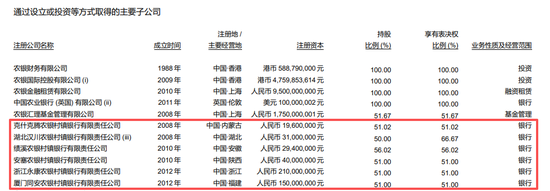
Core Viewpoint - Agricultural Bank of China (ABC) is nearing the completion of its integration of village and town banks, with five out of six banks fully acquired, while one remains pending [1][4][6]. Group 1: Acquisition Details - ABC has become the sole shareholder of Keshiketeng Nongyin Village Bank, with other shareholders exiting [1][4]. - The bank has fully acquired Hubei Hanchuan Nongyin Village Bank, Anxi Nongyin Village Bank, Zhejiang Yongkang Nongyin Village Bank, and Xiamen Tong'an Nongyin Village Bank, all now 100% controlled by ABC [1][4][6]. - The only remaining bank, Pizhi Nongyin Village Bank, has not yet been fully acquired, and ABC's investor hotline indicated that updates will be provided through official announcements [1][6]. Group 2: Regulatory Approvals - The China Banking and Insurance Regulatory Commission (CBIRC) has issued multiple approvals for ABC's acquisitions, allowing the establishment of branches for the acquired banks [4][6]. - Specific approvals include the establishment of branches such as the Agricultural Bank of Keshiketengqi Yingchang Branch and others for the fully acquired banks [4]. Group 3: Industry Context - The strategy of "village to branch" is part of a broader initiative to consolidate rural financial resources and improve operational efficiency, as outlined in the central government's policy documents [6][10]. - Other major banks, including ICBC and Bank of Communications, have also engaged in similar acquisitions of village banks, indicating a trend among large banks to strengthen their presence in rural markets [7][8][9].
“村改支”,又有新动作
Zhong Guo Ji Jin Bao· 2025-11-05 15:04
Core Viewpoint - Hengfeng Bank has officially acquired Guang'an Hengfeng Rural Bank, taking over all its assets, liabilities, and operations following the approval from the Sichuan Regulatory Bureau of the National Financial Supervision Administration [1][3]. Group 1: Acquisition Details - The Sichuan Regulatory Bureau approved the dissolution of Guang'an Hengfeng Rural Bank, with Hengfeng Bank assuming its assets, liabilities, business, and employees [3]. - Guang'an Hengfeng Rural Bank was established on December 15, 2010, with a registered capital of 200 million yuan [3]. - Hengfeng Bank's stake in Guang'an Hengfeng Rural Bank increased to 66% after acquiring an additional 52 million shares earlier this year [4]. Group 2: Strategic Moves - Hengfeng Bank has been actively acquiring stakes in multiple rural banks, including the acquisition of Chongqing Jiangbei Hengfeng Rural Bank and plans to merge with Yangzhong Hengfeng Rural Bank [6]. - The bank has initiated preparations for an initial public offering (IPO) in 2023, with a focus on meeting overall listing conditions as a core strategic goal [6]. Group 3: Financial Performance - As of the end of 2024, Hengfeng Bank reported total assets of 1.54 trillion yuan, with operating income of 25.775 billion yuan, reflecting a year-on-year growth of 1.98% [6]. - The net profit for the same period was 5.357 billion yuan, showing a year-on-year increase of 4.30% [6]. - The bank's non-performing loan balance was 12.873 billion yuan, a decrease of 1.060 billion yuan from the previous year, with a non-performing loan ratio of 1.49% [7].
“村改支”,又有新动作
中国基金报· 2025-11-05 14:11
Core Viewpoint - Hengfeng Bank has officially acquired Guang'an Hengfeng Rural Bank, taking over all its assets, liabilities, and operations, marking another instance of the "village-to-branch" transformation in China [2][6]. Summary by Sections Acquisition Details - On November 4, the Sichuan Regulatory Bureau of the National Financial Supervision Administration approved the dissolution of Guang'an Hengfeng Rural Bank, with Hengfeng Bank assuming all its assets, liabilities, and business operations [4]. - Following the approval, Guang'an Hengfeng Rural Bank ceased all operations immediately and is required to return its license within 15 working days [4]. Ownership Changes - Guang'an Hengfeng Rural Bank was established on December 15, 2010, with a registered capital of 200 million yuan. Hengfeng Bank held a 40% stake in the bank prior to the acquisition [4]. - In January 2023, Hengfeng Bank increased its stake in Guang'an Hengfeng Rural Bank to 66% by acquiring 52 million shares from other shareholders [5]. Broader Context - This acquisition is part of Hengfeng Bank's broader strategy to absorb multiple rural banks. Earlier in 2023, it acquired Chongqing Jiangbei Hengfeng Rural Bank and announced plans to merge with Yangzhong Hengfeng Rural Bank [8]. - Hengfeng Bank is preparing for an initial public offering (IPO) and aims to meet overall listing conditions as a core strategic goal [8]. Financial Performance - As of the end of 2024, Hengfeng Bank reported total assets of 1.54 trillion yuan, with operating income of 25.775 billion yuan, reflecting a year-on-year growth of 1.98%. Net profit reached 5.357 billion yuan, up 4.30% [8]. - The bank's asset quality improved, with non-performing loans totaling 12.873 billion yuan, a decrease of 1.060 billion yuan from the previous year, and a non-performing loan ratio of 1.49%, down 0.23 percentage points [9].

“村改支”再落一子:这一村镇银行解散,被恒丰银行收编
Nan Fang Du Shi Bao· 2025-11-05 07:53
Core Viewpoint - The recent approval by the Sichuan Financial Regulatory Bureau to dissolve Guang'an Hengfeng Village Bank and transfer its assets and liabilities to Hengfeng Bank reflects the ongoing reform and consolidation of small financial institutions in China, with a notable acceleration in the reduction of village banks this year [2][5]. Group 1: Mergers and Acquisitions - Hengfeng Bank has been actively acquiring village banks, including Guang'an Hengfeng Village Bank, which was established in December 2010 with a registered capital of 200 million yuan. After the acquisition, Hengfeng Bank will hold a 40% stake in the new branches [3][4]. - In addition to Guang'an, Hengfeng Bank is also in the process of merging with Yangzhong Hengfeng Village Bank, which will see the latter dissolved and its assets and liabilities transferred to Hengfeng Bank [4]. Group 2: Industry Trends - The number of village banks in China has decreased by 98 in the first half of this year, indicating a significant acceleration in the pace of consolidation compared to previous years. This trend is part of a broader effort to enhance the quality and efficiency of the banking sector [5][6]. - The ongoing reforms in the banking sector are driven by the need to address the challenges of low growth, low demand, low interest margins, and high risks, particularly affecting rural and small banks [6][7].

村镇银行“归巢”
Bei Jing Shang Bao· 2025-10-29 16:40
Core Viewpoint - The ongoing "village-to-branch" reform led by main initiating banks aims to optimize the rural financial landscape by absorbing and merging village banks, addressing issues such as weak capital, governance, and risk management [1][7][12]. Group 1: Recent Developments - On October 29, three village banks in Shandong (Jining Blue Ocean, Rizhao Blue Ocean, and Yinan Blue Ocean) were approved for dissolution, with all assets and operations transferred to Qingdao Rural Commercial Bank [1][3]. - The day before, six village banks in Sichuan were also absorbed by Chengdu Rural Commercial Bank, marking a significant step in the reform process [3][4]. - The "village-to-branch" initiative is part of a broader trend where both state-owned and regional banks are consolidating village banks into their operations [5][9]. Group 2: Strategic Implications - The absorption of village banks allows main initiating banks to leverage unified risk management frameworks and capital allocation mechanisms, effectively reducing potential risks [5][10]. - This consolidation enhances the main banks' county-level network coverage, utilizing existing village bank customer bases to deepen financial services in rural areas [5][12]. - The reform is seen as a long-term strategy to improve the quality of financial services while addressing risks, with a focus on balancing efficiency and service quality [12][13]. Group 3: Regulatory Context - The 2025 Central Document emphasizes the importance of maintaining the agricultural support role of rural banks and encourages a tailored approach to reform [12][13]. - Regulatory bodies are pushing for main initiating banks to increase capital in viable village banks while encouraging full acquisitions of those lacking potential [13][14].
