
渔光互补

Search documents
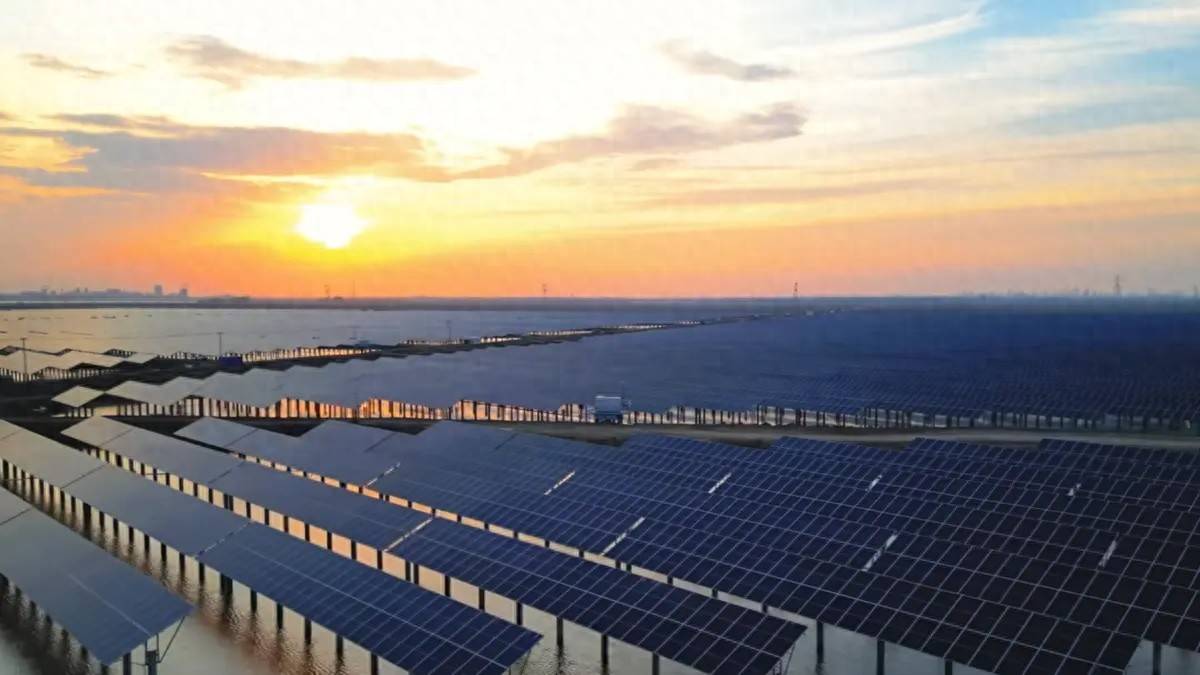
中国全球最大渔光互补基地之一,37万片太阳能板熠熠生辉
Sou Hu Cai Jing· 2025-07-09 09:20
Core Insights - The article discusses a significant solar energy project in China that combines photovoltaic power generation with aquaculture, achieving full-capacity grid connection [1][3]. Group 1: Project Overview - The project features a 250 megawatt solar power station integrated with fish farming, located in Tangshan, Hebei Province, and represents a high level of land utilization [3]. - The project occupies approximately 353 hectares, utilizing floating solar panels above fish ponds, which allows for dual use of land resources [4]. Group 2: Environmental Impact - The project is expected to generate around 400 million kilowatt-hours of clean electricity annually, equivalent to saving 120,000 tons of standard coal and reducing carbon dioxide emissions by 320,000 tons [4]. - The floating solar panels provide shade, which helps lower water temperatures, promoting aquatic life and reducing disease in fish farming [4]. Group 3: Efficiency and Innovation - Floating solar power stations can achieve 15% higher efficiency compared to land-based solar stations due to the cooling effect of water [4]. - The company emphasizes its role in global energy transition and commitment to innovation for a net-zero future [4]. Group 4: Industry Context - The company is not the first to implement such a project; in 2022, another company announced a 70 megawatt floating solar power station in Cangzhou, Hebei [5]. - A Norwegian salmon and trout producer reported a 90% reduction in diesel usage due to a floating solar power station above its fish farm [6].


国家电投滨州沾化B12-1(一期)200兆瓦渔光互补项目并网
Zhong Guo Fa Zhan Wang· 2025-06-04 14:07
Core Viewpoint - The successful grid connection of the 200 MW fish-solar complementary photovoltaic project by State Power Investment Corporation (SPIC) marks a significant advancement in the development of the renewable energy base in Shandong's saline-alkali land [1][3]. Group 1: Project Overview - The project has a total investment of 820 million yuan and an installed capacity of 200 MW, covering an area of approximately 6,000 acres, with the construction of a 220 kV booster station [1]. - The project utilizes a single-axis tracking system, which is expected to increase electricity generation by approximately 6% compared to fixed supports, and includes the installation of 340,000 photovoltaic modules [1]. - It is projected to provide 338 million kWh of clean electricity annually, saving 110,000 tons of standard coal and reducing carbon dioxide emissions by 280,000 tons, sufficient to meet the annual electricity needs of 330,000 households [1]. Group 2: Technological Innovations - The project employs innovative technologies such as N-type TOPCon photovoltaic modules, single-axis intelligent tracking supports, and an intelligent operation and maintenance platform to effectively convert saline-alkali wasteland into an ecological economic zone [2]. - The integration of photovoltaic power generation with aquaculture creates a multi-dimensional development model, reducing land leasing and infrastructure costs while forming a diversified profit system through power generation, fishery value addition, and job creation [2]. Group 3: Future Development - The successful implementation of the project signifies a leap in SPIC's comprehensive development capabilities in saline-alkali land, with plans to accelerate the construction of additional projects in the Shandong region [3].

2025年中国渔光互补光伏电站行业类型、发展环境、项目建设情况及行业趋势研判:渔光互补光伏电站发展优势明显,项目接连落地[图]
Chan Ye Xin Xi Wang· 2025-05-20 01:20
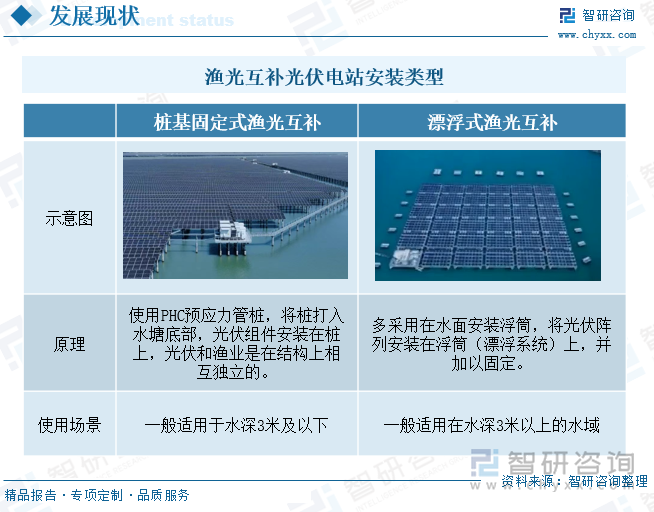
Core Viewpoint - The "fish-solar complementary" model combines aquaculture and photovoltaic power generation, allowing for dual use of water surfaces for energy production and fish farming, addressing land scarcity for solar projects and providing new solutions for the aquaculture industry [1][11][5]. Industry Overview - The "fish-solar complementary" model is characterized by the installation of solar panels above fish ponds, enabling fish and shrimp farming below, thus creating a dual benefit of energy generation and aquaculture [2][5]. - Common installation methods include pile foundation and floating systems, with the former suitable for water depths of 3 meters or less, and the latter for deeper waters [2][5]. Market Background - The global push for clean energy and the reduction of fossil fuel dependency has led to the rapid growth of the photovoltaic industry in China, which has become the second-largest power source after coal [7][9]. - In 2024, China's solar photovoltaic capacity is expected to reach 885.68 GW, with a new installed capacity of 277.57 GW, leading the world in both new and cumulative installations [7][9]. Current Market Status - Various policies have been introduced to encourage the development of "fish-solar complementary" photovoltaic stations, promoting the integration of aquaculture and green energy [13][15]. - Significant projects include the 378 MW project by Yueda Huafeng and the 1.09 million kW project by Guohua Investment, showcasing the growing interest and investment in this sector [16][17]. Industry Chain - The industry chain for "fish-solar complementary" includes upstream components like solar panels and aquaculture supplies, midstream project design and construction, and downstream markets for electricity and aquatic products [19][21]. Development Trends - The trend towards "fish-solar complementary" is expected to accelerate, driven by technological innovations and decreasing investment costs, making it a mainstream model for solar power station construction [25][27].
萧山益农“渔光互补”点亮绿色经济
Hang Zhou Ri Bao· 2025-05-13 02:50
Core Insights - The "fishing and solar power complementarity" project in Yinan Town, Xiaoshan District, integrates solar power generation with aquaculture, utilizing the space above water for solar panels while developing aquaculture below [5][6] Group 1: Project Overview - The project spans 700 acres of water surface with thousands of solar panels arranged in a chessboard pattern, allowing for efficient use of space [5] - The water temperature under the solar panels is 2°C to 3°C lower than in regular water bodies, which benefits the survival rate and quality of shrimp [5] - The project has entered an ecological cycle mode of "power generation above, aquaculture below" [5] Group 2: Aquaculture Details - The shrimp species being cultivated are characterized by fast growth, strong resistance, large size, and high survival rates [6] - The typical cultivation cycle for South American white shrimp is from May to October, with an expected average yield of 300 kilograms per acre [6] Group 3: Technological and Research Collaboration - The Zhejiang Academy of Agricultural Sciences is collaborating with Yinan Town to enhance the project through innovations in shading, temperature control, and smart aquaculture [6] - The project aims to ensure stable production, health safety, and ecological protection of aquatic products while exploring new development paths for the "fishing and solar power complementarity" model [6] Group 4: Economic Impact - The project is expected to generate an average annual electricity output of approximately 117 million kilowatt-hours, saving 33,000 tons of standard coal and reducing carbon dioxide emissions by 102,000 tons annually [6] - The unified operation of the fish ponds has increased annual income for the village collective by over 1.2 million yuan, addressing low aquaculture efficiency and providing multiple job opportunities [7]
渤海湾畔崛起“蓝色地标”
Ke Ji Ri Bao· 2025-04-29 01:10
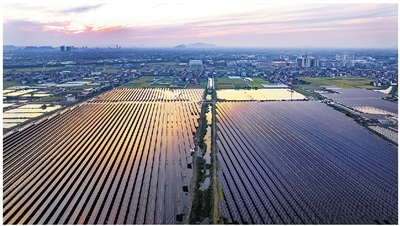
Group 1 - The Huaneng Binzhou Photovoltaic Project is the first approved marine photovoltaic project following the national marine three-dimensional confirmation policy, marking a shift from flat management to three-dimensional development and utilization of marine resources [2] - The project covers an area of 15,800 acres and is expected to generate 1.286 billion kilowatt-hours of electricity annually, saving 385,800 tons of standard coal and reducing carbon dioxide emissions by 917,700 tons [2][3] - The project employs innovative methods such as "fishing-light complementarity" and "salt-light complementarity," allowing for the simultaneous generation of electricity, salt production, and aquaculture [3] Group 2 - The project is one of the largest single renewable energy projects in Shandong, with a total construction area of over 5,000 acres and a planned capacity of 300 megawatts for one of its segments [3] - The project has spurred the development of related industries such as high-end equipment manufacturing and smart fisheries, providing a replicable model for coastal regions in China [3]
青达环保:一季度净利润同比增长990%
news flash· 2025-04-27 07:37
Group 1 - The core viewpoint of the article highlights that Qingda Environmental (688501.SH) reported significant financial growth in the first quarter of 2025, with a net profit increase of 990% year-on-year [1] - The company achieved an operating revenue of 619 million yuan, representing a year-on-year growth of 317.43% [1] - The net profit attributable to shareholders reached 68.71 million yuan, with a substantial increase of 990.26% compared to the previous year [1] Group 2 - The non-recurring net profit was reported at 67.92 million yuan, showing a remarkable year-on-year growth of 1067.48% [1] - The significant performance improvement is primarily attributed to the substantial increase in operating revenue, driven by the completion of the "fishing-solar complementary" project [1]
