
科创次新股

Search documents
8月15日沪深两市强势个股与概念板块
2 1 Shi Ji Jing Ji Bao Dao· 2025-08-15 10:25
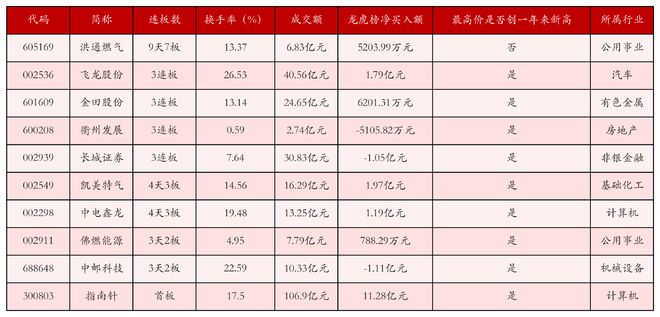
Strong Stocks - As of August 15, the Shanghai Composite Index rose by 0.83% to 3696.77 points, the Shenzhen Component Index increased by 1.6% to 11634.67 points, and the ChiNext Index climbed by 2.61% to 2534.22 points [1] - A total of 104 stocks in the A-share market hit the daily limit up, with the top three strong stocks being Hongtong Gas (605169), Feilong Co., Ltd. (002536), and Jintian Co., Ltd. (601609) [1] - Detailed data for the top 10 strong stocks includes metrics such as the number of limit-up days, turnover rate, trading volume, and net buying amount from the top trading accounts [1] Strong Concept Sectors - The top three concept sectors by increase are PEEK materials, Sci-tech new shares, and liquid cooling servers, with PEEK materials showing a rise of 5.31% [2] - The top 10 concept sectors are listed with their respective increase percentages, limit-up stock ratios, and the proportions of rising and falling stocks [2] - Notably, PEEK materials and Sci-tech new shares had a 100% increase in their rising component stocks, indicating strong market performance [2]


A股市场大势研判:三大指数小幅收涨
Dongguan Securities· 2025-06-19 02:38
Market Overview - The three major indices experienced slight gains, with the Shanghai Composite Index closing at 3388.81, up by 0.04% [2] - The Shenzhen Component Index closed at 10175.59, up by 0.24%, while the CSI 300 Index rose by 0.12% to 3874.97 [2] Sector Performance - The top-performing sectors included Electronics (1.50%), Communication (1.39%), and National Defense & Military Industry (0.95%) [3] - Conversely, the worst-performing sectors were Beauty Care (-1.73%), Real Estate (-1.35%), and Building Materials (-1.22%) [3] Concept Index Performance - The PCB concept led the concept sectors with a gain of 3.29%, followed by the Sci-Tech New Shares at 2.80% [3] - The weakest concept sectors included Glyphosate (-2.82%) and Rare Earth Permanent Magnet (-2.57%) [3] Market Outlook - The market showed mixed performance with many stocks declining despite the slight rise in indices, indicating a lack of significant profit-making opportunities [4] - The market is expected to remain in a range-bound state due to ongoing divergence between bulls and bears, with potential for a rebound supported by economic resilience and policy backing [6] Policy Developments - The 2025 Lujiazui Forum introduced significant financial opening measures, including the establishment of a trading report library and a digital RMB international operation center [5] - The government plans to support consumer goods replacement policies with a budget of 300 billion yuan, of which 162 billion yuan has already been allocated [5]
市场情绪监控周报(20250609-20250613):本周热度变化最大行业为石油石化、有色金属-20250615
Huachuang Securities· 2025-06-15 11:45
Quantitative Models and Construction Methods - **Model Name**: Broad-based Index Heat Rotation Strategy - **Model Construction Idea**: The model uses the weekly heat change rate (MA2) of broad-based indices to construct a rotation strategy. The idea is to buy the index with the highest heat change rate at the end of each week, or stay in cash if the "Others" group has the highest rate[7][13]. - **Model Construction Process**: 1. Calculate the total heat of constituent stocks for each broad-based index (CSI 300, CSI 500, CSI 1000, CSI 2000, and "Others") by summing up their individual heat indicators[8][11]. 2. Compute the weekly heat change rate for each group and smooth it using a 2-week moving average (MA2)[11][13]. 3. At the end of each week, invest in the index with the highest heat change rate (MA2). If the "Others" group has the highest rate, remain in cash[13]. - **Model Evaluation**: The strategy demonstrates a reasonable annualized return and manageable drawdown, indicating its potential effectiveness in capturing short-term market sentiment[16]. Model Backtesting Results - **Broad-based Index Heat Rotation Strategy**: - Annualized Return: 8.74% (since 2017)[16] - Maximum Drawdown: 23.5%[16] - 2025 YTD Return: 10.1%[16] Quantitative Factors and Construction Methods - **Factor Name**: Total Heat Indicator - **Factor Construction Idea**: The total heat indicator aggregates the attention metrics (e.g., browsing, watchlist additions, and clicks) of individual stocks, normalized as a percentage of the market total, to serve as a proxy for market sentiment[7]. - **Factor Construction Process**: 1. For each stock, calculate the sum of browsing, watchlist additions, and clicks[7]. 2. Normalize the value as a percentage of the total market activity for the same day[7]. 3. Multiply the normalized value by 10,000 to scale the indicator within the range [0, 10,000][7]. - **Factor Evaluation**: The factor effectively captures market sentiment and is used as a proxy for emotional intensity in broader market or sector-level analysis[7]. - **Factor Name**: Weekly Heat Change Rate (MA2) - **Factor Construction Idea**: This factor measures the weekly change in the total heat indicator, smoothed using a 2-week moving average, to identify trends in market sentiment[11][13]. - **Factor Construction Process**: 1. Compute the weekly change rate of the total heat indicator for each stock or group[11]. 2. Apply a 2-week moving average (MA2) to smooth the weekly change rate[11][13]. - **Factor Evaluation**: The smoothed heat change rate provides a stable and actionable signal for rotation strategies and sentiment analysis[13]. Factor Backtesting Results - **Total Heat Indicator**: - Range: [0, 10,000][7] - **Weekly Heat Change Rate (MA2)**: - CSI 300: +7.76% (highest among broad-based indices for the week)[16] - "Others" Group: -3% (lowest among broad-based indices for the week)[16] - **Concept Heat TOP/BOTTOM Portfolios**: - BOTTOM Portfolio Annualized Return: 15.71%[33] - BOTTOM Portfolio Maximum Drawdown: 28.89%[33] - 2025 YTD Return for BOTTOM Portfolio: 21.1%[33]
市场全天震荡调整,创业板指领跌
Dongguan Securities· 2025-05-11 23:39
Market Overview - The A-share market experienced a day of volatility with the ChiNext index leading the decline, closing at 2011.77, down 0.87% [2][3] - The Shanghai Composite Index closed at 3342.00, down 0.30%, while the Shenzhen Component Index closed at 10126.83, down 0.69% [2][3] Sector Performance - The top-performing sectors included Beauty Care (up 1.41%), Banking (up 1.36%), and Textile & Apparel (up 0.72%) [2] - Conversely, sectors such as Electronics (down 2.07%), Computers (down 1.96%), and Defense & Military (down 1.87%) faced significant declines [2] Trade Data Insights - In the first four months of the year, China's total goods trade reached 14.14 trillion yuan, a year-on-year increase of 2.4%, with exports amounting to 8.39 trillion yuan, up 7.5% [4] - Notably, exports of mechanical and electrical products reached 5.04 trillion yuan, growing by 9.5% and accounting for 60.1% of total exports [4] Market Sentiment and Technical Analysis - The total trading volume in the Shanghai and Shenzhen markets was 1.19 trillion yuan, a decrease of 101.4 billion yuan from the previous trading day [5] - The Shanghai Composite Index remains above the 5-day moving average, indicating strong support around the 3335-3340 point range, suggesting a stabilizing market trend [5] Future Outlook - The market is expected to continue its oscillating recovery pattern, supported by policy easing and economic recovery [5] - Key sectors to focus on include Financials, Public Utilities, and TMT (Technology, Media, and Telecommunications) as they are likely to benefit from ongoing policy support and economic improvements [5]