算力互联互通

Search documents
国家算力互联互通节点建设将加快推进
Zhong Guo Zheng Quan Bao· 2026-02-06 20:24
Core Insights - The Ministry of Industry and Information Technology (MIIT) has issued a notice to promote the construction of national computing power interconnection nodes, aiming for high-quality development in the computing power industry [1][2] - The proposed "1+M+N" national computing power interconnection node system includes one national node, multiple regional nodes, and industry-specific nodes, all operating under unified standards and rules [1][2] Group 1: National Strategy - The notice aligns with the central government's directives and the "Computing Power Interconnection Action Plan" to enhance the efficiency and service level of public computing resources [1] - The initiative supports the construction of a strong manufacturing nation, a strong network nation, and a digital China [1] Group 2: Node Structure - The "1+M+N" architecture consists of one established national computing internet service node, M regional nodes, and N industry nodes, facilitating comprehensive support services and market-oriented services [2] - Regional nodes will provide services such as identification registration and resource aggregation in areas with high demand for computing power [2] Group 3: Implementation and Requirements - The MIIT will accelerate the construction of these nodes, with specific conditions for regional and industry node applications, including a minimum registered capital of 50 million yuan for construction entities [1] - Major telecommunications companies like China Telecom and China Mobile are actively engaged in industry trial construction work [2]
利好来了!刚刚,工信部重磅发布!
券商中国· 2026-02-06 11:49
Core Viewpoint - The Ministry of Industry and Information Technology (MIIT) has announced the construction of a national computing power interconnection node system, which is expected to enhance the efficiency and service level of public computing resources and promote high-quality development in the computing power industry [2][3]. Group 1: National Computing Power Interconnection Node System - The MIIT's notification outlines a "1+M+N" system for national computing power interconnection nodes, aiming to standardize and facilitate the efficient flow of computing resources across different regions and sectors [2][3]. - The construction goals include establishing a supply-demand matching system for computing power in regions and key industries, enhancing overall computing power levels [2][3]. - Regional nodes will provide a unified service platform for interconnection, including services such as resource aggregation, selection, and monitoring [2][3]. Group 2: Industry Trends and Demand - The domestic computing power demand is expected to accelerate, driven by rapid iterations of domestic AI models and the evolving interaction methods that are shaping the demand for inference-side computing power [4][5]. - Major AI models from companies like Alibaba and Baidu are being released, which will further drive the commercialization of these models and increase the demand for computing power [5][6]. - The infrastructure for AI computing power is undergoing systematic upgrades to support the explosive demand for training and inference, transitioning from vertical scaling to distributed cluster expansion and cross-domain collaboration [6][7]. Group 3: Hardware Innovations - Key hardware components such as optical modules and switches are innovating around high speed, low power consumption, and low cost, with a focus on co-packaged optics (CPO) and linear drive pluggable optics (LPO) [7]. - Domestic optical module manufacturers are gaining a leading position in the global market, which positions them to benefit significantly from the expansion of AI computing infrastructure [7].






工业和信息化部:推进“1+M+N”国家算力互联互通节点体系建设
Shang Hai Zheng Quan Bao· 2026-02-06 10:22
下一步,工业和信息化部将加快推进国家算力互联互通节点建设,促进算力产业高质量发展,助力制造 强国、网络强国和数字中国建设。 (责任编辑:谭梦桐) 《通知》提出建立"1+M+N"国家算力互联互通节点体系,通过构建"统一标识、统一标准、统一规 则"运行机制,实现不同区域、主体、架构的算力资源标准化互联和高效流动应用,有效提高公共算力 资源使用效率和服务水平。 据工信微报2月6日消息,为深入贯彻党中央、国务院决策部署,落实《算力互联互通行动计划》任务要 求,推动算力产业高质量发展,工业和信息化部近日印发《关于开展国家算力互联互通节点建设工作的 通知》(以下简称《通知》)。 ...
工信部:组织开展国家算力互联互通节点建设工作 提升整体算力水平
智通财经网· 2026-02-06 07:32
Core Viewpoint - The Ministry of Industry and Information Technology (MIIT) of China has announced the establishment of a national computing power interconnection node system to enhance the efficiency and service level of public computing resources, promoting high-quality development in computing power [2][4]. Group 1: Overall Requirements - The initiative is guided by Xi Jinping's thoughts and aims to implement the new development concept, focusing on building computing power interconnection nodes in key strategic areas and industries [2]. Group 2: Work Content - The national computing power interconnection node system consists of one national computing internet service node and multiple regional and industry nodes [3]. Group 3: Construction Goals - Regional and industry nodes will be established to meet the high demand for computing power, creating a mechanism for supply and demand matching, and facilitating standardized interconnection and efficient application of computing resources [4]. Group 4: Construction Content - Regional nodes will have a unified service platform providing comprehensive support services such as identification registration, interconnection scheduling, and data monitoring. Key components include computing internet service centers, resource aggregation, selection, identification management, operation monitoring, and security management systems [5]. - Industry nodes will have their own service platforms to provide market-oriented services for resource aggregation, identification, and selection, connecting to regional nodes [5]. Group 5: Operating Mechanism - The nodes will operate under a mechanism of "unified identification, unified standards, and unified rules," ensuring that all nodes obtain a unique identification code through the national node and adhere to standardized construction and interface connections [6]. Group 6: Node Application - Regional nodes are to be jointly applied for by local communication management bureaus and industrial and information departments, while industry nodes are recommended by local departments in collaboration with communication management bureaus [7]. - Each provincial administrative region can apply for one regional node, and each industry can generally apply for one industry node [7]. Group 7: Application Conditions - Applicants must specify the construction and operation entities, with the construction entity having a registered capital of no less than 50 million yuan and the operational entity holding relevant telecommunications business licenses [7]. Group 8: Material Requirements - Applicants must fill out the application form according to the national computing power interconnection node construction plan and submit it to the MIIT by April 1, 2026 [8]. Group 9: Review Method - The review of regional nodes will be organized by the MIIT, while industry nodes will undergo initial review by local communication management bureaus or industrial departments before being submitted for final review [9].
工信部:组织开展国家算力互联互通节点建设工作
Hua Er Jie Jian Wen· 2026-02-06 07:13
工信部发布关于组织开展国家算力互联互通节点建设工作的通知,通知提出,区域、行业节点分别面向 算力需求旺盛的地区、重点行业,建设算力供需对接体系机制,实现不同区域、主体、架构的算力资源 标准化互联和高效流动应用,提升整体算力水平。区域节点建设统一服务平台,为区域内算力互联互通 提供标识注册、互联调度和数据监测等综合性支撑服务。主要包括算力互联网服务中心、算力资源汇 聚、算力选择、算力标识管理、算力运行监测、安全保障等业务和安全管理系统。行业节点建设各自服 务平台,为行业内算力互联互通提供算力资源汇聚、算力标识、算力选择等市场化服务,并接入区域节 点。主要包括算力互联网服务中心、算力资源汇聚、算力选择、安全保障等业务和安全管理系统。 市场有风险,投资需谨慎。本文不构成个人投资建议,也未考虑到个别用户特殊的投资目标、财务状况或需要。用户应考虑本文中的任何 意见、观点或结论是否符合其特定状况。据此投资,责任自负。 风险提示及免责条款 ...
智算服务市场规模突破1300亿元
Jing Ji Ri Bao· 2026-01-14 22:10
Core Insights - The recent 2025 Computing Power Internet Conference marked a significant advancement in China's computing power development, entering a new phase of collaborative interconnectivity [1] - By December 2025, the scale of consumer-level users in China's computing power internet is expected to approach 10 million, with public intelligent computing service usage reaching 1.407 billion card hours and the market size for intelligent computing services exceeding 130 billion yuan [1] Group 1: Development and Infrastructure - The Ministry of Industry and Information Technology emphasizes the importance of accelerating the construction of computing power infrastructure as a crucial support for AI development [1][2] - Current challenges include a fragmented service landscape, uneven facility distribution, and significant differences in cluster architecture, necessitating a national-level push for coordinated computing power interconnectivity [2] - The establishment of a national computing power internet service platform, supported by key regions and telecom operators, aims to provide diverse public services and facilitate unified access to computing resources [3] Group 2: Technological Advancements - The computing power industry is undergoing rapid technological iteration, with standardization being essential for high-quality development and innovation [5][6] - There is a pressing need to enhance the efficiency of computing resource scheduling and address barriers in cross-domain data flow, which currently hinder the industry's growth [6] - Accelerating core technology breakthroughs and fostering collaborative innovation among academia, industry, and users is vital for building a secure and advanced computing power system [7] Group 3: Application and Integration - Significant breakthroughs have been achieved in computing power facility interconnectivity, with ongoing efforts to promote large-scale applications in enterprise-level scenarios such as scientific computing and industrial simulation [8] - Companies are leveraging deep digitalization of complex scenarios to enhance the infrastructure and application ecosystem for computing power [8] - The integration of computing power resources is being exemplified by companies like Dassault Systèmes, which is building a global cloud-based R&D platform to support high-intensity tasks [9] Group 4: Future Directions - The focus for 2023 is to transition from pilot breakthroughs to deeper application phases in computing power internet construction, emphasizing coordination, rule standardization, technological advancement, and scenario empowerment [9]
广东算网协同服务平台正式上线
Zheng Quan Shi Bao Wang· 2025-12-22 02:01
Core Viewpoint - The Guangdong Computing Network Collaborative Service Platform has officially launched, marking a significant step in implementing the "Computing Power Interconnection Action Plan" at the provincial level [1] Group 1: Platform Overview - The platform is developed by the China Academy of Information and Communications Technology (CAICT) in collaboration with the Guangzhou Internet Exchange Center and Guangdong Unicom [1] - It focuses on four core functions: publishing computing power support policies, integrating with the national unified computing power identification system for standardized resource management, creating a bridge for supply-demand matching to reduce computing costs for government and enterprises, and offering customized computing power services for various industry scenarios [1] Group 2: Strategic Importance - The launch of the platform signifies a transition in the Greater Bay Area's computing power strategy from "single-point layout" to "collaborative interconnection" [1]
工信部:2028年基本实现公共算力资源标准化互联
Sou Hu Cai Jing· 2025-12-15 09:41
Group 1 - The core viewpoint is that China is systematically advancing the construction and layout of computing power centers to enhance the supply capacity and efficiency of intelligent computing resources, aiming to accelerate the establishment of a collaborative and efficient national integrated computing power network [1][5]. Group 2 - Data shows that the scale and level of China's computing power infrastructure are continuously improving, with the current number of operational computing power centers reaching 12.5 million standard racks [3]. - Challenges in the development of computing power in China include low efficiency in computing power monitoring, incomplete supply-demand information, and a lack of overall planning in computing power distribution [3]. Group 3 - Zhang Yunming, Vice Minister of the Ministry of Industry and Information Technology, emphasized the need to collaboratively layout intelligent computing facilities and accelerate the construction of a national integrated computing power network, enhancing the capabilities of the information and communication industry to support and integrate AI applications [5]. Group 4 - The "Computing Power Interconnection Action Plan" released by the Ministry of Industry and Information Technology proposes the establishment of a computing power interconnection platform system to achieve standardized interconnection of public computing resources across different entities and architectures [5]. Group 5 - According to Li Wei, Deputy Director of the Cloud Computing and Big Data Research Institute of the China Academy of Information and Communications Technology, the overall system is expected to complete the experimental verification phase by 2025, with standardized interfaces and protocols for computing power interconnection becoming feasible [7]. - The International Data Corporation predicts that China's intelligent computing power scale will continue to grow rapidly, with a projected increase of 43% in 2025 compared to 2024, and by 2026, the scale will reach double that of 2024 [7].
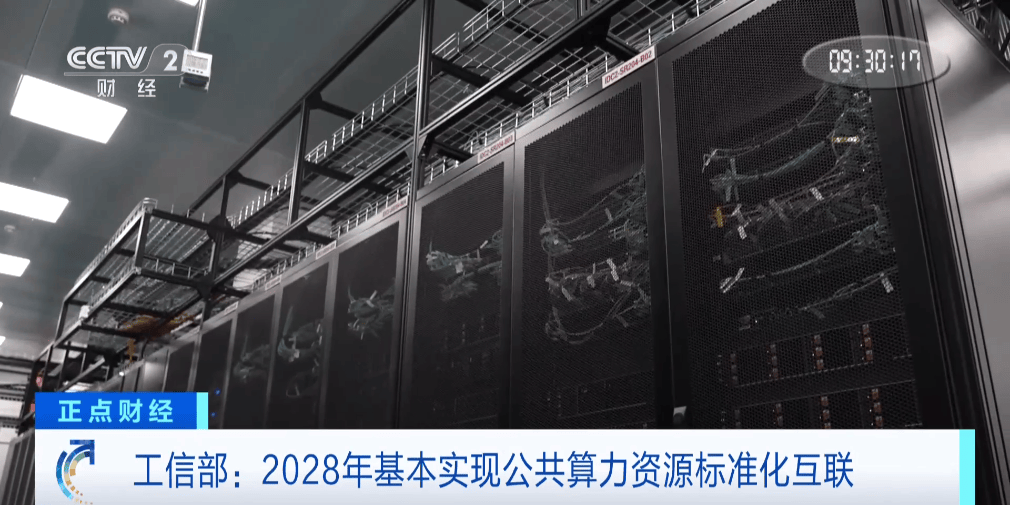
建设全国一体化算力网络按下“加速键” 向“智”向“绿”转型发展
Yang Shi Wang· 2025-12-15 02:08
Group 1 - The core viewpoint is that China is actively advancing the construction and layout of computing power centers to enhance the supply capacity and efficiency of intelligent computing resources, aiming to build a collaborative and efficient national integrated computing power network [1][3]. - As of now, China's computing power infrastructure has reached a scale of 12.5 million standard racks, but faces challenges such as low monitoring efficiency, incomplete supply-demand information, and lack of overall planning in resource allocation [1][5]. - The Ministry of Industry and Information Technology has released the "Computing Power Interconnection Action Plan," which aims to establish a standardized interconnection platform for public computing resources by 2025, with a goal of achieving a computing power internet by 2028 [5][6]. Group 2 - The intelligent computing centers are being rapidly deployed, with a focus on reducing operational energy consumption. AI chips used for model training are more powerful but also consume more energy, prompting a shift towards greener data centers [6][12]. - In Langfang, Hebei, six of the top ten computing power service providers in China are establishing large-scale intelligent computing clusters, with the largest single data center in the country located there [6][10]. - The energy utilization efficiency (PUE) target for projects has been set below 1.39, with some achieving below 1.25, indicating significant progress in energy efficiency [8].
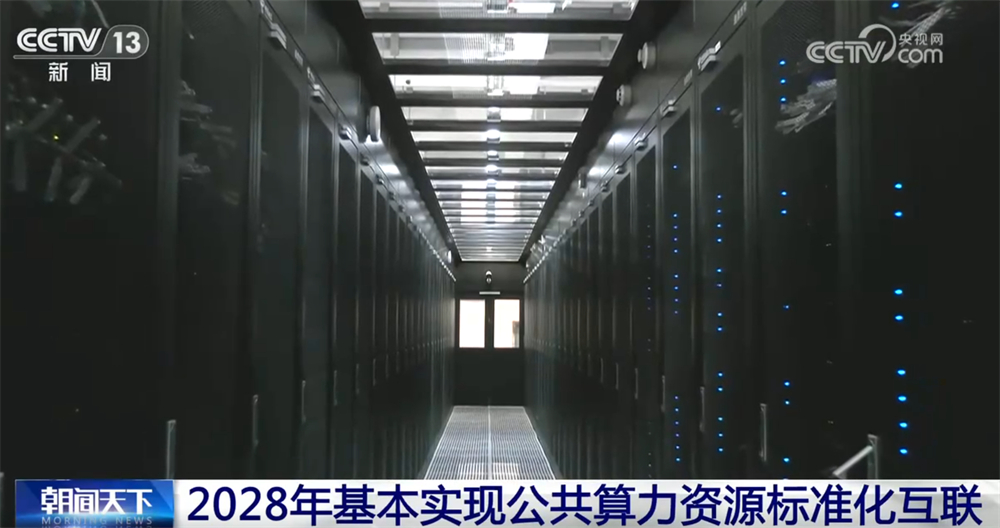
2028年基本实现公共算力资源标准化互联
Yang Shi Xin Wen· 2025-12-15 00:55
Core Insights - China is systematically advancing the construction and layout of computing power centers to enhance the supply capacity and efficiency of intelligent computing resources, aiming to build a collaborative and efficient national integrated computing power network [1] Group 1: Development of Computing Power Infrastructure - The scale and level of computing power infrastructure in China are continuously improving, with the current number of operational computing power centers reaching 12.5 million standard racks [1] - The Ministry of Industry and Information Technology (MIIT) emphasizes the need for a collaborative layout of intelligent computing facilities and the acceleration of AI deployment in information and communication networks [1] Group 2: Future Projections and Standards - By 2025, the overall system is expected to complete the experimental verification phase, with standardized interfaces and protocols for public computing resources achieving feasibility during this phase [3] - The International Data Corporation forecasts that China's intelligent computing power scale will maintain rapid growth, with a projected 43% increase in 2025 compared to 2024, and it is expected to double by 2026 compared to 2024 [3] Group 3: Green Transformation of Data Centers - The shift towards intelligent computing centers is accompanied by efforts to reduce operational energy consumption, with AI chips used for model training being more powerful but also consuming more energy [4] - In Langfang, a significant number of data centers are transitioning to intelligent computing centers, with over 20 centers currently undergoing this transformation [4] - The energy utilization efficiency (PUE) target for projects has been set below 1.39, with actual operations achieving a PUE below 1.25 [4] Group 4: Regional Development Initiatives - The Langfang Development and Reform Commission plans to accelerate the implementation of computing power foundational actions and promote the coordinated development of intelligent power grids [5] - The International Energy Agency predicts that by 2030, the electricity consumption of AI facilities will increase fivefold, raising higher demands for the green transformation and comprehensive energy utilization in the computing power industry [5]