
费率改革

Search documents
降费这一年,65家基金公司业绩哪家强?全排名出炉
Xin Lang Cai Jing· 2025-05-05 10:34
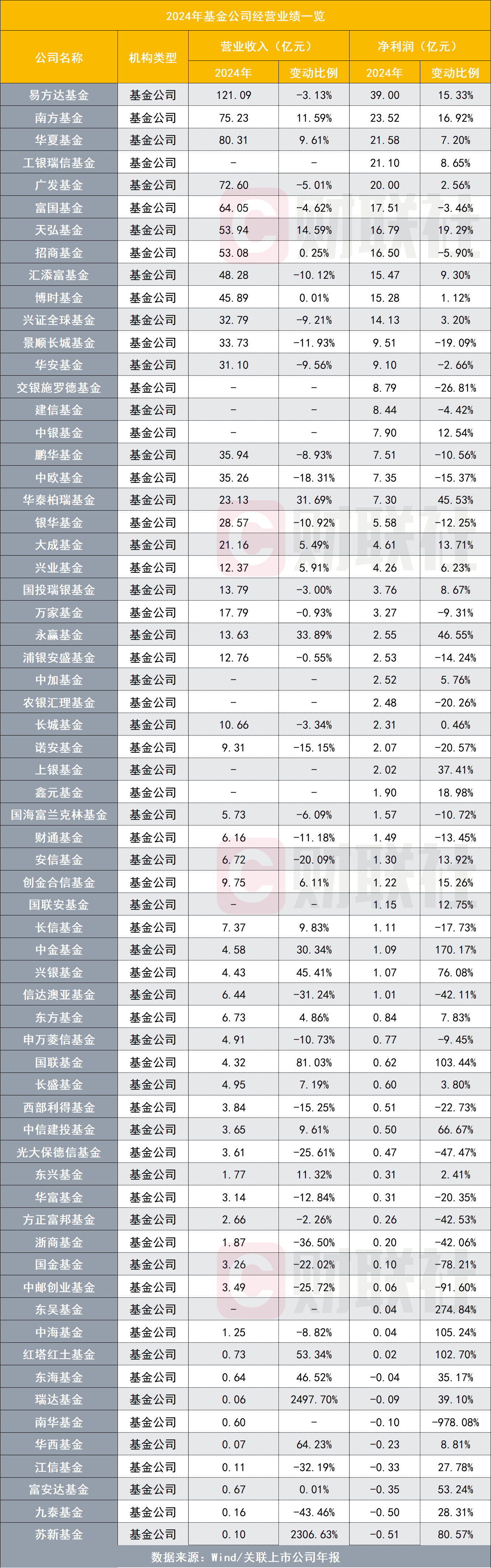
Core Insights - The overall net profit of 65 fund companies reached 34.115 billion yuan in 2024, an increase of 1.323 billion yuan compared to 2023 [1] - Only 39 out of the 65 fund companies reported a year-on-year increase in net profit, indicating that the majority of companies faced challenges [1] - Less than half of the companies reported a year-on-year increase in revenue, highlighting the impact of fee rate adjustments on the industry [1] Financial Performance Overview - The top 11 fund companies with net profits exceeding 1 billion yuan saw changes in their rankings, with more than half experiencing shifts [5][6] - Two companies, namely Invesco Great Wall Fund and Jiao Yin Schroder Fund, dropped out of the 1 billion yuan net profit tier compared to 2023 [13] - The net profit of Tianhong Fund increased by 19.29% to 1.679 billion yuan, marking the most significant rise among the top companies [8][11] Revenue and Profit Changes - The total management fee income for over half of the fund managers declined, with a total drop exceeding 10 billion yuan [5][14] - The fee rate reform has led to significant revenue impacts, with many companies seeking to enhance their competitive edge [5][19] - Companies like Dongwu Fund reported a remarkable net profit increase of 274.84%, while others like Nanhua Fund faced a staggering loss of 978.08% [15][18] Strategic Responses - Fund companies are focusing on refining their core competencies to adapt to the ongoing fee rate reforms and market changes [19][20] - Companies such as Huaxia Fund and Guotou Ruijin Fund are enhancing their product offerings and digital integration to maintain competitiveness [20][21] - The industry is witnessing a trend where smaller firms are showing significant profit growth, while larger firms are experiencing more pronounced absolute profit changes [18]

2024年公募基金年报大数据分析:宁德时代持股总市值位列第一 港股依旧是重要配置方向
Zhi Tong Cai Jing· 2025-04-01 23:34
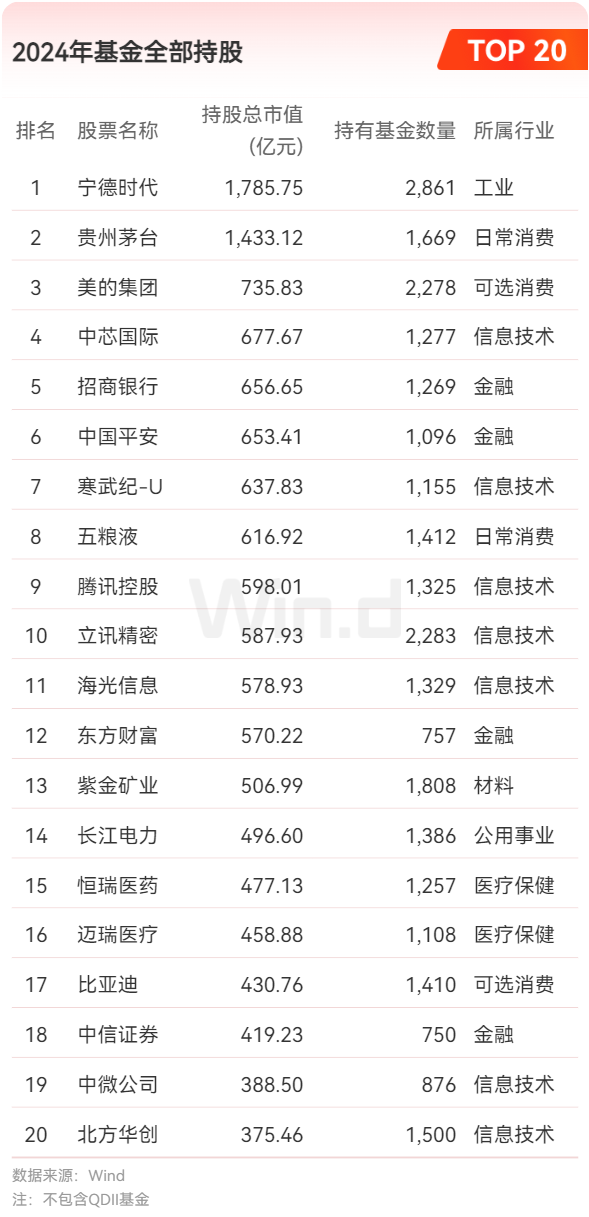
Group 1 - The overall structure of public fund holders has stabilized over the past year, with institutional investors favoring large-cap style funds, and the holdings in the CSI 300 ETF have exceeded 800 billion yuan [1][25]. - The pure bond funds are actively seizing the bond bull market, with the median duration increasing to 2.47 years, up by 0.26 years from the mid-2024 report [19]. - The fee reform has shown initial results, with total expenses for public funds in 2024 amounting to 236.036 billion yuan, resulting in a total fee rate of 0.73%, significantly lower than the same period last year [1][35]. Group 2 - In the 2024 report, the top three sectors for public fund holdings are industrial, consumer staples, and consumer discretionary, with CATL (宁德时代) having the highest total market value of 178.575 billion yuan, held by 2,861 funds [2][3]. - The top 20 stocks held by public funds include major companies such as Kweichow Moutai and Midea Group, with significant holdings across various sectors [3][4]. Group 3 - Hong Kong stocks remain an important allocation direction for public funds, with the top four heavy stocks each exceeding 20 billion yuan in market value [5][6]. - The highest proportion of public fund holdings relative to circulating market value is for Zhixiang Jintai-U, at 54.35% [8]. Group 4 - Public funds have significantly increased their holdings in stocks that have generally risen in value, with the top stock, Dekeli, seeing a 123.73% increase in its holding proportion [10]. - Conversely, stocks that public funds have significantly reduced their holdings in have generally declined in value, with the top stock, Shennong Group, experiencing a -9.86% drop [13]. Group 5 - The top FOF funds are primarily tool-oriented, with the highest holding value in the Huaxia Hang Seng ETF at 777 million yuan [16]. - The top three fund companies receiving FOF inflows are E Fund, Fortune, and GF Fund, with held values of 5.3 billion yuan, 4.818 billion yuan, and 3.617 billion yuan, respectively [20]. Group 6 - Institutional investors are the main holders of bond funds, with an 84.32% share, while individual investors dominate FOF, mixed, and money market funds with shares of 90.61%, 80.73%, and 72.54%, respectively [24]. - The proportion of institutional holdings in public funds has increased to 48.49%, up by 2.09 percentage points from the previous year [23]. Group 7 - The management fee income for most public fund companies has decreased year-on-year, with E Fund leading at 8.21 billion yuan, down 11.47% [37]. - The total transaction commission paid by public funds to brokers in 2024 was 10.986 billion yuan, a decrease of 5.849 billion yuan compared to the previous year [50].





信达澳亚基金公募管理规模持续增高 优化业务结构推动高质量发展
Cai Fu Zai Xian· 2025-03-31 02:38
Core Viewpoint - The report highlights the strong performance and growth potential of Xinda Australia Fund, with record public management scale and impressive returns on equity products, positioning the company favorably in the market [1][2]. Group 1: Financial Performance - As of December 31, 2024, Xinda Australia Fund achieved a total asset of 830.75 million, marking a historical high in public management scale [1]. - The fund reported an operating income of 644.09 million and a net profit of 100.67 million for the year 2024 [2]. - The fund's equity products have shown a remarkable return of 119.76% over the past seven years, ranking first among public institutions [1]. Group 2: Product Performance - Notable products such as Xinda Performance Driven A, Xinda Advantage Industry A, and Xinda Prosperity Preferred A achieved net value growth rates of 28.34%, 26.30%, and 24.33% respectively in 2024, significantly outperforming their benchmarks [1]. - The company is focusing on expanding its "fixed income" and "fixed income plus" product lines to create a new growth pillar alongside its equity business [2]. Group 3: Strategic Initiatives - Xinda Australia Fund is actively responding to regulatory calls to benefit investors by reducing management and custody fees, enhancing the investment experience despite short-term profit pressures [1]. - The company is investing in research and development capabilities, product innovation, and system upgrades to optimize its business structure for future growth [2].