集团化办学

Search documents
人工智能时代,科学教育这样开展
Ke Ji Ri Bao· 2025-07-29 23:19
Group 1 - The core viewpoint emphasizes the importance of science education in enhancing youth scientific literacy and fostering technological innovation talent, as highlighted by the director of the Beijing Haidian District Education Science Research Institute [1] - In 2023, the Ministry of Education and 18 other departments issued guidelines to strengthen science education in primary and secondary schools, focusing on integrating education, technology, and talent development [1] - The conference showcased various innovative practices in science education, with school principals sharing their experiences on how to create a "new engine" for the development of science education [1] Group 2 - The integration of artificial intelligence (AI) into education is reshaping teaching methods and educational ecosystems, prompting educators to rethink how to conduct science education in the AI era [2] - The principal of Renmin University Affiliated High School proposed two approaches to leverage AI in science education: incorporating AI into the curriculum and using AI as a tool to enhance students' AI literacy [2] - The school has developed a comprehensive AI curriculum system with over 30 courses and has created more than 100 teaching cases for interdisciplinary AI education [2] Group 3 - The importance of cultivating humanistic literacy alongside AI in science education was emphasized, with a focus on integrating AI into various educational contexts, including arts education [3] - A notable course combining information technology and history allowed students to engage with cultural heritage, enhancing their cultural confidence [4] Group 4 - The scarcity of quality educational resources in science education necessitates the sharing of resources among schools, particularly in underprivileged areas [5] - Group-based education is identified as a key method to promote equitable access to quality educational resources, as outlined in the 2023 action plan by the Ministry of Education [5] - Experts at the conference stressed the need for unified educational philosophies and mechanisms across different schools within educational groups to avoid fragmentation [5][6] Group 5 - The principal of Beijing No. 80 Middle School shared experiences from their educational group, which includes ten schools and provides support to schools in less developed regions [6] - The group focuses on creating a cohesive scientific education system through cultural, institutional, and digital collaboration, while also ensuring smooth transitions between educational stages [6] Group 6 - The "Home-School-Society Collaborative Education" model aims to mobilize community resources to enhance science education, with examples of partnerships between schools and technology companies [7] - Various initiatives, such as building observatories and weather stations, have been implemented to enrich the educational experience for students [7] Group 7 - Huangpu District has developed a collaborative model for science education across different educational stages, integrating family, community, and institutional resources [8][9] - The district's approach includes creating specialized science courses that leverage local scientific resources and partnerships with higher education institutions to foster innovation and research skills among students [9]

阳光照彻文明路——记“全国文明校园”杭州市长寿桥小学
Hang Zhou Ri Bao· 2025-07-25 03:35
Core Viewpoint - Hangzhou Changshouqiao Education Group emphasizes the importance of nurturing every child with a sunny disposition, focusing on a collaborative educational approach that integrates family, school, and community [1][2]. Group 1: Historical Background and Development - Established in 1962, Changshouqiao Primary School has evolved into a prominent educational institution in Hangzhou, recognized for its commitment to quality education and cultural heritage [1]. - The school has received over 160 honors, including the recent designation as a "National Civilized Campus," reflecting its long-standing dedication to educational excellence [1]. Group 2: Educational Philosophy and Curriculum - The core educational philosophy revolves around the concept of "sunshine," which is manifested through a robust teacher training system and a collaborative educational framework [2]. - The "Sunshine Gold Curriculum" integrates national, local, and school-based courses, supported by a "Three Nourishment" ideological framework that promotes moral education and community service [2]. Group 3: Extracurricular Activities and Community Engagement - The school hosts various events, such as art exhibitions and science festivals, to foster creativity and responsibility among students, encouraging them to engage with their community [3]. - The "1+6" moral education initiative has been expanded to include interdisciplinary projects that promote ecological awareness and cultural heritage, linking school activities with family and community values [3]. Group 4: Future Directions and Goals - The school aims to enhance its educational practices by integrating social responsibility into daily activities, ensuring that every child has a role within the school community [4]. - Future plans include strengthening infrastructure, transforming the teaching workforce, and exploring diverse educational pathways to further enrich the learning environment for students [4].
海南印发中小学薄弱学校提升行动方案
Hai Nan Ri Bao· 2025-05-14 02:14
Core Viewpoint - The Hainan Provincial Education Department has issued the "Hainan Province Primary and Secondary School Weak School Improvement Action Plan (2025-2027)" aiming to enhance the educational quality of weak schools and reduce disparities across urban and rural areas, ultimately achieving 100% inclusion of weak schools in group-based management [2][3] Group 1: Key Tasks - The plan outlines 10 key tasks including strengthening party leadership, enhancing teacher quality, standardizing school management, integrating diverse educational reforms, supporting research to improve quality, expanding group-based schooling, meeting school condition standards, advancing digital education, monitoring quality, and facilitating experience exchange [2][3] - A significant focus is on promoting group management between quality schools and weak schools, with a target of 100% inclusion of weak schools in this model [2] Group 2: Funding and Resource Allocation - Approximately 370 million yuan is planned for investment in smart education infrastructure for primary and secondary schools, with at least 75% of the funds directed towards rural areas, aiming to improve the digital education environment of 707 township schools [2] Group 3: Teacher Development - The plan emphasizes the construction of a strong teaching staff for weak schools, ensuring that the proportion of full-time ideological and political education teachers in primary schools reaches over 70%, and that all junior and senior high schools are equipped with dedicated teachers [3] - There will be preferential arrangements for excellent teachers and graduates from teacher training programs to teach in weak schools, particularly in the early grades of primary and junior high schools [3] Group 4: Curriculum Development - The initiative aims to develop regionally distinctive school-based curricula that integrate national and local educational content, leveraging Hainan's unique ecological, historical, and cultural attributes [3] Group 5: Implementation and Oversight - To ensure effective implementation of the plan, the provincial education department will enhance coordination, provide professional guidance, and promote best practices through various forms of publicity to raise awareness among the community and parents about quality schools [3]
从“单打独斗”到“抱团取暖”——西宁教育改革促均衡发展
Xin Hua She· 2025-05-05 07:55
Core Viewpoint - The article highlights the transformation of Chihan School in Qinghai Province, which has improved its educational quality and facilities, addressing previous challenges of low enrollment and poor performance [1][4]. Group 1: Educational Reform Initiatives - In 2023, Xining City initiated a pilot program for group-based schooling reform to enhance educational quality and accessibility in rural areas [1][2]. - The county has established two major educational groups, encompassing 21 primary and secondary schools, to promote collaborative development and resource sharing [2][5]. - A core team of excellent principals and teachers has been assigned to lead Chihan School, significantly improving its management and teaching quality [2][4]. Group 2: Improvement in School Performance - Chihan School's student enrollment has nearly doubled from under 150 to around 300, alleviating pressure on local primary schools and achieving top academic results in the county [4][5]. - The school has received continuous support from Nanjing City, Jiangsu Province, which has provided funding to enhance its facilities [2][4]. Group 3: Broader Educational Goals - Xining City aims to build a high-quality and equitable public education service system as a strategic task and major livelihood project [4][5]. - The city has formed seven preschool education alliances covering 80 kindergartens, promoting resource sharing and collaborative development [5].
北京一零一中教育集团迎来新成员,三所民办校正式加入
Xin Jing Bao· 2025-04-30 04:41
Core Viewpoint - Three private schools in Haidian District, Beijing, have officially joined the Beijing 101 Middle School Education Group, maintaining their operational nature and management mechanisms, which is a significant step in promoting the integration of private schools into public education systems [1][2][3] Group 1: Integration of Private Schools - The three private schools are Qihui Future School, Zhongguancun Foreign Language School, and Daoxianghu School, which will enhance the coverage of quality educational resources and promote collaborative innovation in education [1][2] - Qihui Future School has a strong affiliation with Beijing 101 Middle School and was previously known as the experimental school before its renaming [1] - Zhongguancun Foreign Language School is a comprehensive private school established in 2004, offering a 12-year education system and managing over 2,400 students across two campuses [1][2] Group 2: Educational Group Development - The addition of these private schools presents new opportunities and challenges for the Beijing 101 Middle School Education Group, aiming to create a vibrant and efficient new organization that leverages the strengths of diverse member schools [3] - The education group plans to promote resource sharing, enhance educational productivity, and ensure the orderly flow of educational resources and faculty among member schools [3] - There is an emphasis on standardizing the management of private schools within the group, strengthening risk prevention, and fostering a collective awareness to address demographic changes in school-age populations [3]
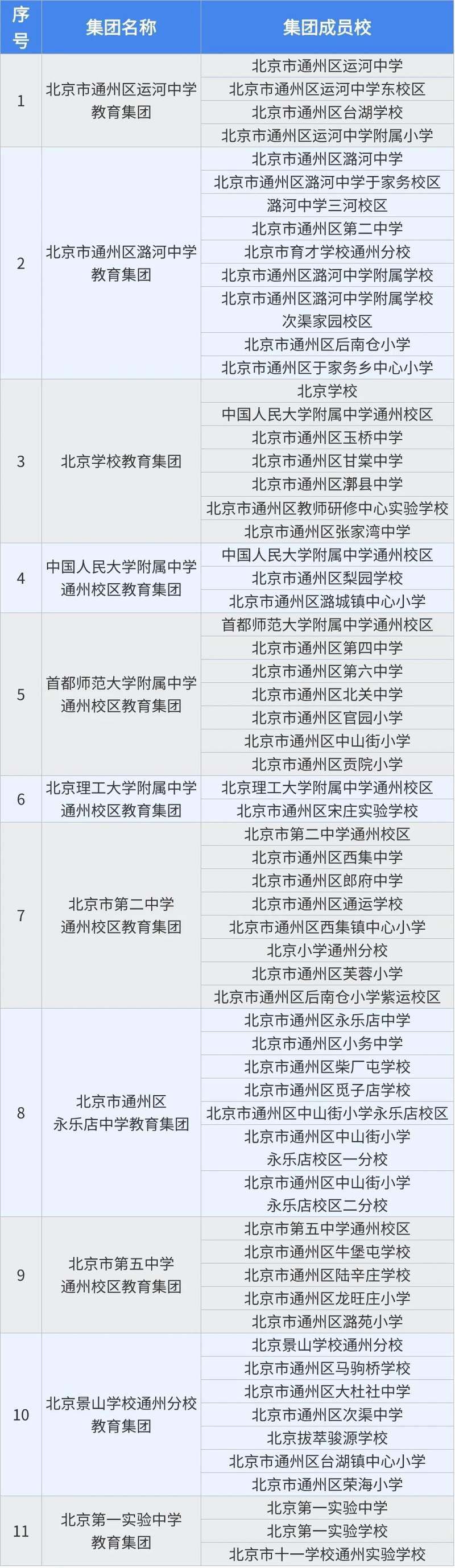
北京市通州区成立第六批教育集团,所有中学实现集团化办学全覆盖
Xin Jing Bao· 2025-04-25 09:22
截至目前,通州区的高中教育集团达到11个,本次新成立的北京理工大学附属中学通州校区教育集团,支持宋庄 地区办学,原宋庄镇中心小学更名为宋庄实验学校,纳入该集团;北京市第二中学通州校区教育集团支持西集、 郎府地区办学,原通运小学更名为通运学校,纳入该集团;北京市第五中学通州校区教育集团支持张家湾南部地 区办学;北京景山学校通州分校教育集团支持台湖、马驹桥地区办学;原北苑小学更名为后南仓小学北苑校区, 纳入后南仓小学教育集团。 | 臣 | 集团名称 | 集团成员校 | | --- | --- | --- | | 를 | | | | 1 | 北京市通州区运河中学 | 北京市通州区运河中学 | | | | 北京市通州区运河中学东校区 | | | 教育集团 | 北京市通州区台湖学校 | | | | 北京市通州区运河中学附属小学 | | 2 | 北京市通州区潞河中学 教育集团 | 北京市通州区潞河中学 北京市育才学校通州分校 | | | | 北京市通州区潞河中学于家务校区 | | | | 潞河中学三河校区 | | | | 北京市通州区第二中学 | | | | 北京市通州区潞河中学附属学校 | | | | 北京市通州区潞河 ...