AI健康管理

Search documents
赋能医药产业创新完善生育保险制度
Zhong Guo Zheng Quan Bao· 2025-08-18 20:14
Group 1: Medical Insurance Development - The National Medical Insurance Administration emphasizes empowering the pharmaceutical industry and implementing measures to support high-quality development of innovative drugs [1][2] - By mid-2025, significant progress is expected in medical insurance, including an increase in the number of insured individuals under maternity insurance to 253 million and total maternity insurance benefits expenditure reaching 67.832 billion [1] - The meeting highlights the need for a comprehensive adjustment of the national medical insurance drug catalog and the establishment of a commercial health insurance innovative drug catalog [2] Group 2: Maternity Insurance and Long-term Care - The meeting encourages regions to include flexible employment workers, migrant workers, and new employment forms in maternity insurance coverage, while also exploring basic service packages for prenatal check-ups [3] - There is a push for the implementation of long-term care insurance, with a focus on planning and supporting long-term care services at the community level [3] - The meeting calls for the integration of long-term care services with commercial insurance products to enhance accessibility and suitability of care [3] Group 3: Digital Transformation in Medical Insurance - The meeting aims to transition the medical insurance system from passive payment to proactive empowerment, focusing on health investment rather than just disease compensation [3] - There is an emphasis on promoting research in disease prediction modeling, pharmacoeconomics, and disease attribution analysis in collaboration with medical institutions and research organizations [3] - The integration of technology in medical insurance is encouraged to foster new medical services, AI health management, and smart elderly care [3]
大厂为何扎堆卷赛博“大白”
虎嗅APP· 2025-07-19 13:48
Core Viewpoint - The article discusses the rapid growth and potential of AI in healthcare, highlighting its transformative impact on patient management and the healthcare system in China, while also addressing the challenges and limitations faced by AI technologies in this sector [2][4][10]. Group 1: AI in Healthcare Services - AI services are increasingly being adopted by patients for health management, with applications such as report interpretation and intelligent triage leading the trend [2][3]. - Major internet companies like JD Health, Alibaba Health, and Baidu Health are actively developing independent AI health management applications, indicating a competitive landscape [3][4]. - The AI health management market in China is projected to reach 25.9 trillion yuan by 2027, with a compound annual growth rate exceeding 20% [4]. Group 2: Impact on Traditional Healthcare - AI technologies are significantly changing the traditional healthcare system, allowing hospitals to serve a larger number of patients efficiently [5][10]. - AI can alleviate the burden on healthcare professionals by handling repetitive tasks, thus improving overall service efficiency [7][10]. - The integration of AI into healthcare aims to create a closed-loop system that connects various healthcare services, enhancing data collection and patient management [7][10]. Group 3: Challenges and Limitations - Despite the potential benefits, there are significant challenges in gaining public trust in AI healthcare solutions, with only 3.59% of people believing AI can fully replace doctors [13][14]. - The complexity of integrating AI into healthcare requires deep collaboration with medical professionals to ensure the accuracy and reliability of AI systems [14][15]. - Legal and regulatory challenges, particularly concerning data privacy and the definition of responsibility in AI applications, pose significant hurdles for the industry [15][16].




大厂为何正扎堆卷赛博“大白”
Hu Xiu· 2025-07-19 13:12
Core Viewpoint - The article discusses the rapid growth and adoption of AI-driven health management services in China, highlighting the competitive landscape among major internet companies and the potential impact on the healthcare system [5][14][16]. Group 1: Market Trends and Growth Potential - The AI health management market in China is projected to reach 2.59 trillion yuan by 2027, with a compound annual growth rate exceeding 20% [4]. - Over 90% of working individuals are affected by sub-health conditions, creating a significant demand for AI health management solutions [3][4]. - Major internet companies like JD Health, Alibaba Health, and Baidu Health are actively developing independent AI health management applications, indicating a fierce competition in the sector [3][4][10]. Group 2: AI Integration in Healthcare - AI technologies are being utilized to enhance patient care, with hospitals reporting significant increases in patient consultations through AI systems [6][7]. - AI health management products are emerging to cover pre-consultation and post-discharge follow-ups, addressing gaps in traditional healthcare services [8][9]. - The integration of AI with offline healthcare services aims to create a seamless healthcare experience for users, improving data collection and service efficiency [10][11]. Group 3: Challenges and Considerations - Despite the promising market, there are challenges in gaining trust from the public, as only 3.59% of people believe AI can fully replace doctors [18][19]. - The complexity of healthcare services requires AI systems to connect with a wide range of medical resources, which is crucial for effective health management [16][23]. - Legal and regulatory issues surrounding data privacy and AI accountability remain significant hurdles for the industry [28][29][30].
瑞尔特百万AI健康马桶大抽奖揭幕AI健康时代
Zhong Guo Chan Ye Jing Ji Xin Xi Wang· 2025-07-18 09:08
Core Insights - The event "With Love, Together: Million Lottery" hosted by Rietter on July 1, 2025, showcased the company's commitment to user engagement and innovation in health management through the launch of the AI Health Toilet IX9 [1][2] - Rietter's "Lifetime Rights Plan" was initiated in April 2025, aiming to enhance customer loyalty and brand interaction by offering significant rewards to users of their smart toilets [2][4] - The AI Health Toilet IX9 represents a significant advancement in home health management, featuring an AI system for seamless health monitoring and various patented technologies ensuring high sanitation standards [3][5] User Engagement and Brand Strategy - The lottery event was supervised by the Xiamen Public Notary Office to ensure fairness, and it involved 101 winners receiving the AI Health Toilet IX9, emphasizing transparency in the brand's promotional activities [2][4] - The event also leveraged social media platforms to enhance user interaction, encouraging participants to share their experiences and thereby strengthening brand advocacy [4][6] - Rietter's strategy integrates technology, health, and emotional connection, aiming to create a sustainable and socially responsible brand image through initiatives like the Lifetime Rights Plan and educational donations [4][6] Product Features and Innovations - The AI Health Toilet IX9 includes advanced features such as real-time monitoring of 14 physiological indicators and the ability to generate visual health reports, enhancing its role as a personal health management center [5][6] - The product employs innovative sanitation technologies, achieving a 99.9% sterilization rate and receiving multiple certifications, which positions it as a leader in the smart bathroom segment [3][5] - User testimonials during the event highlighted the practical benefits of the product, reinforcing the brand's commitment to improving family health and well-being through technology [3][4]

【私募调研记录】久阳润泉资本调研南威软件
Zheng Quan Zhi Xing· 2025-07-03 00:15
Group 1 - The core focus of Nanjing Software is on the health management sector, specifically through its initiative "Chashou Health," which aims to leverage institutional innovation and core capabilities in government information technology to gain a competitive edge in the health industry [1] - Chashou Health is positioned as a closed-loop health management service, offering free AI platform health knowledge services and aiming to build an industrial ecosystem with future revenue from personalized value-added services [1] - The company plans to collaborate closely with regional health commissions and local government systems to integrate health management services, targeting a high-quality startup phase [1] Group 2 - The three-year goal for Chashou Health is to validate the effectiveness of AI in health management and to establish itself as the first choice for users in health management services [1] - The health model integrates knowledge from experts at Peking University Medical School and top-tier hospitals, with plans to expand collaborations with experts across various fields [1] - Currently, the service is not subject to medical device regulations, but the company intends to keep pace with policy changes and actively apply for Class III certifications in the future [1] Group 3 - Nanjing Software has a strong partnership with Huawei, which will continue to develop in the health sector [1] - Chashou Health operates as an independent entity, receiving resource support while using AI to restructure traditional business models [1]

【私募调研记录】追云资产调研南威软件
Zheng Quan Zhi Xing· 2025-07-03 00:15
Group 1 - The core focus of Nanwei Software is on the health management sector, specifically through its initiative "Chashou Health," which aims to leverage institutional innovation and integrate core capabilities from government information technology into the health industry [1] - Chashou Health is designed as a closed-loop health management system that offers free health knowledge services via an AI platform, aiming to build an industrial ecosystem and generate revenue through personalized value-added services [1] - The company plans to collaborate closely with regional health commissions and local government systems to implement health management services, targeting a high-quality launch over the next three years [1] Group 2 - The goal for the next three years is to validate the effectiveness of AI in health management and establish a health service ecosystem, positioning itself as the top choice for user health management [1] - Chashou Health's model integrates knowledge from Peking University Medical School and top-tier hospitals, with a commitment to expanding collaborations with experts across various fields [1] - Currently, the service is not regulated under medical device laws, but the company intends to stay aligned with policy changes and actively apply for Class III certifications in the future [1] Group 3 - The company has a strong collaborative foundation with Huawei and plans to continue partnerships in the health sector [1] - Chashou Health operates as an independent entity, receiving resource support while utilizing AI to restructure traditional business models [1]
传统互联网医疗模式难改民众“看病难” 蚂蚁集团携AQ如何破局
Jing Ji Guan Cha Bao· 2025-06-30 10:43
Core Insights - The article discusses the increasing demand for health management and medical services due to an aging society and the diverse needs of the public [2] - Ant Group has launched the AI health management app "AQ" to address these needs, providing over a hundred AI functions and connecting users to a vast network of healthcare resources [3][4] - The competitive landscape of AI health management is intensifying, with AQ aiming to differentiate itself by offering integrated online and offline medical services [3][5] Group 1: AI Health Management Market - The AI health management market is rapidly evolving, with major internet platforms leveraging AI to capture a share of this trillion-dollar market [3] - AQ connects over 5,000 hospitals and nearly one million doctors, aiming to provide a comprehensive health management service [3][6] - The app addresses key pain points in traditional internet health management, such as difficulty in accessing quality medical services and the challenge of accurately conveying symptoms [5][6] Group 2: Technology and Functionality - AQ utilizes a medical model that analyzes vast amounts of healthcare data to guide users in expressing their symptoms accurately, thereby improving the matching process with healthcare professionals [7] - The app supports advanced features like visual recognition for skin diseases, allowing users to take photos for diagnosis [7][9] - AQ's development involves collaboration with medical professionals and extensive training to ensure high-quality service delivery [7][9] Group 3: Addressing Resource Shortages - The app aims to alleviate the shortage of quality medical resources, as evidenced by the fact that only 7.8% of hospitals are tertiary hospitals yet they handle over 50% of outpatient visits [8][9] - The introduction of "digital twins" of renowned doctors is a key strategy for AQ to enhance access to specialized medical advice [9][10] - The digital twin initiative allows doctors to serve a significantly larger patient base, improving healthcare accessibility [9][10] Group 4: Family Doctor Ecosystem - The emergence of AI health applications like AQ is seen as a potential solution to the challenges faced by the family doctor service model in China [11][12] - Current statistics indicate a shortfall in the number of family doctors, with only 3.28 per 10,000 people, compared to a target of 5 [12] - Local governments are exploring the use of AI digital family doctors to provide 24/7 online services, aiming to enhance the efficiency and reach of family healthcare [13][14]

爱康集团发布《2025版北京市体检人群抽样健康报告》
Zheng Quan Ri Bao Wang· 2025-06-28 02:44
Core Viewpoint - The report aims to decode health issues for Beijing residents through in-depth analysis of health checkup big data, emphasizing the importance of health awareness and disease prevention [1] Group 1: Health Report Overview - The "2025 Beijing Health Report" was released by iKang Health Technology Group in collaboration with the Beijing News, with academic support from Peking University [1] - This is the fourth health report targeting the health of Beijing's checkup population, focusing on nearly 1.5 million individuals who underwent health checks from April 1, 2024, to March 31, 2025 [1] Group 2: Health Challenges and Recommendations - The report highlights the impact of local diseases influenced by dietary structure, environment, and lifestyle, aiming to raise public health awareness and reveal disease risks [2] - Experts emphasize the importance of exercise in changing health trajectories and reducing risks of various diseases, advocating for proactive health management among residents [2] Group 3: Health Management Solutions - iKang provides integrated and personalized health management solutions, encouraging residents to take responsibility for their health and prioritize annual health checkups [3] - The report includes comprehensive statistical analyses of health conditions among the checkup population, covering demographics, cancer follow-up statistics, and abnormal results across 22 health metrics [3] Group 4: AI Integration in Health Management - iKang has launched the "iKangAI+" initiative, introducing over ten AI products for specialized screenings over the past seven years, creating a robust "iKang AI Matrix" [3] - The company upgraded its AI health assistant, iKKie, by integrating medical expertise with AI algorithms to enhance user experience and service delivery [3][4] - The "iKKie Health Manager" WeChat mini-program automates the health management process, providing a comprehensive service from report upload to professional verification [4]
医疗与消费周报:药物警戒行业:AI“东风”正盛,国内工作水平稳健提升-20250604
Huafu Securities· 2025-06-04 11:37
Group 1 - The report highlights that the pharmaceutical index has shown positive returns across most of the six sub-industries, indicating a strong performance in the sector [1][9]. - The draft of the "Best Practice Framework for AI in Pharmacovigilance" was released on May 1, aiming to guide the development and application of AI in monitoring adverse drug reactions. This technology is expected to bring revolutionary improvements to drug safety monitoring, although a risk-oriented regulatory and governance system is necessary [2][7]. - According to the "China Pharmacovigilance Industry Research Report," the Chinese pharmacovigilance market is experiencing significant growth, with 2.419 million adverse drug reaction reports filed in 2023, reflecting an improvement in monitoring capabilities [2][8]. Group 2 - The report notes that the global pharmacovigilance market was valued at 58.568 billion in 2022 and is projected to grow at a CAGR of 10.02%, reaching approximately 103.894 billion by 2028 [8]. - The report emphasizes that the domestic AI healthcare models are rapidly developing, and the pharmacovigilance industry is expected to continue its strong growth trajectory, necessitating the establishment of a comprehensive regulatory framework [8]. - The report indicates that the innovation drug sector is entering a harvest period, supported by strong policy backing and innovation-driven growth, which is expected to enhance the overall performance of the pharmaceutical sector [16][20].
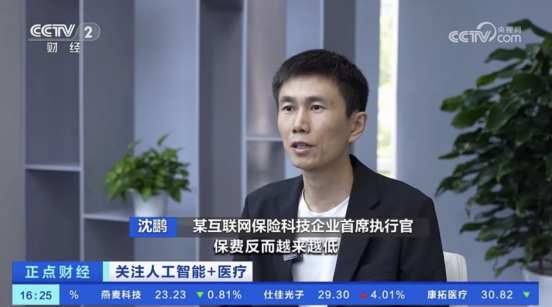
水滴公司CEO沈鹏接受央视采访:AI驱动保险创新 为带病人群提供动态保障
智通财经网· 2025-06-03 09:25
Group 1 - The core viewpoint of the articles highlights the rapid growth and potential of the AI health management market in China, which is expected to exceed 1 trillion yuan and reach 2.59 trillion yuan by 2027, with a compound annual growth rate of over 20% [1] - The company Waterdrop is leveraging AI technology to create a comprehensive health management ecosystem that links user health data with insurance premiums, allowing for dynamic adjustments based on health improvements [1][4] - Waterdrop has developed innovative insurance products tailored for high-risk groups, including those with chronic diseases, by lowering underwriting thresholds and introducing health management mechanisms that can reduce premiums based on health improvements [2][6] Group 2 - There is a significant gap in the insurance market for the 400 million individuals with pre-existing conditions in China, who have historically faced challenges in obtaining insurance coverage due to data limitations and complex underwriting processes [4] - Waterdrop has launched over 1,000 innovative insurance products, including the first medical insurance without health declarations and a long-term critical illness insurance that incorporates dynamic health incentives, aimed at traditionally underserved populations [6]