AI电力

Search documents
西部证券晨会纪要-20251118
Western Securities· 2025-11-18 01:55
Group 1: Dollar Performance and Economic Outlook - The short-term performance of the dollar is influenced by multiple factors, including weak macro data, fluctuating monetary policy expectations, sensitive capital flows, and geopolitical sentiments [1][7] - The dollar index has faced significant declines, with an approximate 11% drop from January to June 2025, marking the largest mid-year decline since 1973 [6][7] - Long-term issues such as the worsening U.S. fiscal deficit and debt problems, along with geopolitical conflicts, are eroding the credibility of the dollar [1][8] Group 2: Index Component Adjustments - The report predicts that nine stocks may be added to the CSI 300 index, including Huadian New Energy and Shenghong Technology, while others like TCL Zhonghuan may be removed [11][12] - The adjustments in major indices are expected to create significant liquidity and price impacts for the stocks involved due to the influence of passive investment strategies [11][12] Group 3: AI and Power Supply Challenges - The power supply gap is identified as a critical issue for the AI competition in the U.S., presenting significant opportunities for the renewable energy industry [3][17] - The report emphasizes the need for technological giants to address power supply issues to meet their 2026 commitments, as insufficient power can lead to underutilization of purchased chips [13][14] - China's advantages in the power sector, including a leading position in renewable energy and smart grid technology, are highlighted as key factors in the global energy landscape [16][17] Group 4: Company-Specific Insights - Tianyoude Wine is projected to achieve revenues of 1.143 billion, 1.160 billion, and 1.189 billion yuan from 2025 to 2027, with a slight decline in 2025 followed by modest growth [4][21] - The company has faced significant sales pressure, with a 10.79% year-on-year revenue decline in the first three quarters of 2025, but has maintained positive operating cash flow [19][20] - The introduction of flavored liquor products targeting younger consumers is part of the company's strategy to enhance market presence [20][21]

擎画“完美故事”系列报告(四):AI电力的“攻守易形”
Western Securities· 2025-11-17 12:24
Core Conclusions - AI has entered phase two: shifting focus from "hard investment" to "soft efficiency" as the demand for computing power surges while power supply bottlenecks become prominent [1][2] - Addressing power supply issues is essential for tech giants to meet their 2026 commitments, as the marginal benefits of merely acquiring computing power are diminishing [2] - The shift from "computing power support" to "power core" reflects China's advantages in the AI supply chain, particularly in power grid equipment and renewable energy technologies [3][4] Industry Insights - China's power system is not just a temporary advantage but a systemic lead, with one-third of global power generation capacity and significant green energy contributions [4] - The comprehensive technology leadership across the entire power industry chain, including self-developed ultra-high voltage equipment and smart grid operations, positions China favorably [4] - The synergy of national strategy and market mechanisms ensures a stable and reliable power system with relatively low electricity prices [4] Investment Opportunities - The power gap in the U.S. AI race presents significant opportunities for the renewable energy sector, with a critical turning point expected by 2026 [5] - Recommended areas for investment include upstream raw materials (key metals, cooling liquids, special steel, lithium battery materials), power generation manufacturing (gas turbine, solar, wind, storage, nuclear), and transmission and distribution companies [5][6]
【市场探“涨”】金属铬 两周涨价近三成
Shang Hai Zheng Quan Bao· 2025-11-06 05:11
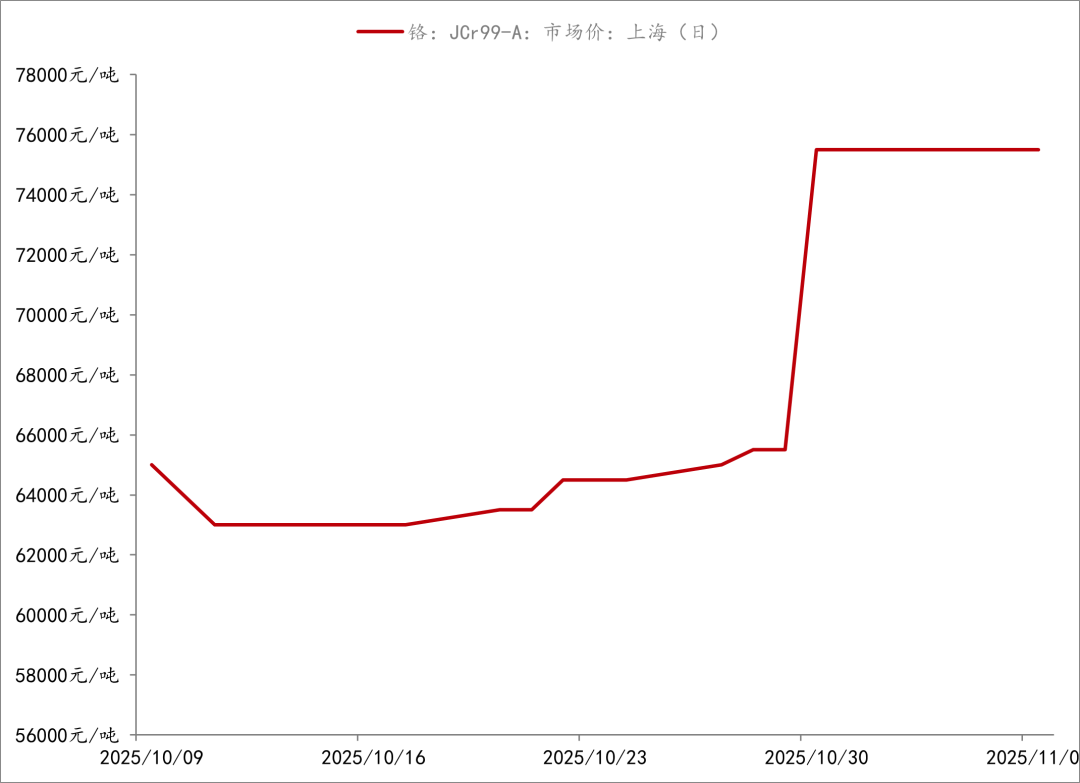
Core Viewpoint - Recent price increases in various chemical and industrial products have sparked widespread market attention, raising questions about the drivers of this price surge, its sustainability, and the potential for performance recovery among upstream and downstream companies in the industry [1] Group 1: Price Trends and Market Dynamics - Chromium prices have surged rapidly, with a notable increase of 18.9% from October 21 to November 6, reaching 75,500 yuan per ton [2] - The price of Chinese metal chromium rose by 28% compared to October 21, with a daily increase of 7,000 yuan per ton noted on November 5 [2][5] - The supply-demand dynamics are tightening, indicating a potential revaluation of the chromium industry [2] Group 2: Company Performance - Zhenhua Co., a leading chromium salt producer, saw its stock price increase by over 80% in a short period, with a reported price of 33.10 yuan per share on November 6 [4] - The company is projected to become one of the top five global chromium producers by the end of 2024 [4] - Zhenhua Co. is focusing on expanding the downstream applications of chromium, particularly in new materials for power equipment [4] Group 3: Supply Chain and Regulatory Factors - The South African government plans to impose export controls on chromium ore, requiring permits and introducing a 25% export tax, which could significantly impact global supply [5] - South Africa accounts for nearly half of the world's chromium production, with China heavily reliant on imports due to limited domestic resources [5][6] Group 4: Future Demand and Industry Outlook - The demand for chromium is expected to rise due to the expansion of solid oxide fuel cells (SOFC) and other applications, with projected demand increases of 0.38 million tons to 2.62 million tons from 2025 to 2027 [7] - The chromium and chromium salt supply-demand gap is anticipated to exceed 70,000 tons and 300,000 tons by 2028, respectively, indicating a supply shortage [7] - The chromium salt industry is poised for a value reassessment, driven by increased demand from AI data centers and gas turbine applications [7]

【研选行业】AI电力稀缺资源,2025年已涨价两波,这些公司卡位核心环节
第一财经· 2025-11-05 12:20
Group 1 - The core viewpoint of the article emphasizes the importance of understanding and utilizing research reports to identify investment opportunities and avoid missing out on market trends [1] - The article highlights the ongoing "material war" in humanoid robots, focusing on lightweight materials such as aluminum alloys, magnesium alloys, and engineering plastics (PEEK/PPS), with four companies identified as key players in this sector [1] - It discusses the critical role of chromium salts as a scarce resource for AI power, predicting a supply-demand gap of 32% by 2028, and notes that the price of metallic chromium has already increased twice by 2025, indicating that certain companies are strategically positioned in this market [1]

国海证券:SOFC新蓝海 铬盐价值再次迎来重估
智通财经网· 2025-11-05 07:20
Core Viewpoint - The chromium salt industry is undergoing a value reassessment driven by significant growth in gas turbine demand due to AI data centers and a substantial increase in demand for commercial aircraft engines [1][2]. Group 1: Chromium Salt Demand and Supply - The price of metallic chromium is expected to rise in two waves by 2025, influenced by the overseas "two-machine" industrial chain driving high growth in chromium salt demand [1]. - The demand for chromium salt is projected to have a supply gap of 340,900 tons by 2028, with a gap ratio of 32% [2]. Group 2: SOFC Technology and Market Potential - SOFC (Solid Oxide Fuel Cell) technology is expected to significantly drive the demand for chromium salt, with 1GW of SOFC demand potentially requiring 8,200 tons of metallic chromium and 29,550 tons of sodium dichromate [1]. - The energy demand from data centers is projected to exceed supply, with an announcement of 35GW of data center capacity in the next five years, which is more than six times the average energy capacity of New York City [3]. - SOFCs are anticipated to have a broader market space due to their higher energy conversion efficiency compared to gas turbines and existing steam turbines, leading to a significant reduction in cost per kilowatt hour as capacity is released [3]. Group 3: Investment Recommendations - The industry is recommended for investment, particularly in companies such as Zhihua Co., Ltd. (603067.SH), Sanhuan Group, Yishitong (688733.SH), and Weichai Power (000338.SZ), which are key players in the SOFC and chromium salt markets [4].


产业链精炼:AI电力投资的核心机会与布局逻辑
Ge Long Hui· 2025-11-04 09:45
Core Insights - The critical bottleneck for AI development is electricity supply, as highlighted by Microsoft CEO Satya Nadella, emphasizing that without power, high-performance GPUs remain idle [1][3] - The total capital expenditure for AI in China is projected to reach 2-2.5 trillion yuan by 2030, with 800 billion yuan allocated for non-IT infrastructure like power and cooling [1][3] Short-term Opportunities (1-3 years) - The demand for AI Data Center (AIDC) power and electrical equipment is expected to surge, as these are essential for AI operations [4] - AI servers now require significantly more power, with configurations moving from two 800W power supplies to four 1800W supplies, indicating a doubling of power needs [7] - High-efficiency power supplies are becoming a necessity, with companies like 欧陆通 and 麦格米特 leading the market with high-capacity offerings [8][9] Mid-term Opportunities (3-5 years) - Solid State Transformers (SST) are anticipated to become a key component in AIDC power supply, with a projected market size reaching hundreds of billions by 2030 [11][14] - The efficiency of SSTs is significantly higher than traditional transformers, making them ideal for high-power data centers [13] - Major companies are already investing in SST technology, indicating strong future demand [19] Long-term Opportunities (5-10 years) - Thorium molten salt reactors and nuclear fusion are seen as revolutionary solutions for stable and clean energy, crucial for supporting the growing power demands of AI [23][26] - Thorium reactors are expected to be commercially deployed by 2030, with a total market size projected to reach trillions [23] - The rapid advancements in nuclear fusion technology could potentially eliminate power constraints for AI, with commercial viability expected post-2040 [26]




产业链精炼:AI电力投资的核心机会与布局逻辑
格隆汇APP· 2025-11-04 09:11
Core Viewpoint - The article emphasizes that electricity has become a critical bottleneck for AI development, highlighting that without sufficient power, even the most advanced AI systems cannot function effectively [2][4]. Group 1: AI Data Center (AIDC) and Power Supply - AIDC is likened to a "super luxury house" for AI, where power and electrical equipment are essential for operation [6]. - The demand for power supply in AI servers has doubled, with traditional servers requiring two 800W power supplies now upgraded to four 1800W high-power supplies [8]. - The efficiency of power conversion is crucial; a 1% drop in efficiency can lead to additional costs of several million yuan annually for a gigawatt-level data center [9]. Group 2: Electrical Equipment - Upgrading electrical equipment is necessary to support AI data centers, focusing on three categories: transformers, cooling equipment, and backup power systems [10]. - Transformers now need to upgrade from 10kV to 110kV, with dry-type transformers gaining market traction due to their higher efficiency [11]. - AI servers generate 6-8 times more heat than traditional models, necessitating the adoption of immersion cooling systems, which are significantly more efficient [11]. Group 3: Medium-Term Opportunities - Solid-state transformers (SST) are identified as a key medium-term opportunity, with a projected market size reaching hundreds of billions by 2030 [12][15]. - SSTs offer superior efficiency and adaptability for high-power data centers, making them a tailored solution for AI needs [14]. Group 4: Long-Term Opportunities - The article discusses long-term opportunities in thorium molten salt reactors and nuclear fusion as revolutionary energy solutions for AI's power demands [20][21]. - Thorium reactors are highlighted for their safety, sustainability, and alignment with carbon neutrality goals, with significant market potential projected [22]. - Nuclear fusion is still in early stages but shows promise for future energy solutions, with potential commercialization predicted for 2040 [24][25]. Group 5: Investment Strategy - The article suggests a phased investment approach: short-term focus on AIDC power supplies and electrical equipment, medium-term on materials like SST, and long-term on energy revolution technologies [26].

这家没赚钱的AI电力公司,市值竟高达160亿美元
财富FORTUNE· 2025-10-15 13:06
Core Insights - Fermi Company, an AI power startup, achieved a market valuation of $16 billion shortly after its IPO, despite having no customers or revenue to date [2][3] - The company aims to create a "super grid" integrating nuclear, solar, and gas power to supply large data centers in Texas, with a projected capacity to meet the electricity needs of 8 million households [2][3] Company Background - Fermi's success is attributed to the policies of the Trump administration and its connections within the political landscape, including support from former Texas Governor Rick Perry [3][4] - The company has ambitious plans to develop a gas-fired AI power facility, leveraging its location near significant energy resources and infrastructure [7][8] Project Details - Fermi plans to achieve gas power generation by spring next year, utilizing refurbished second-hand equipment and acquiring unused gas generators from failed projects [4][9] - The project aims for a total capacity of 11 gigawatts, which is double the average electricity demand of New York City, with annual increases of 1 gigawatt thereafter [4][9] Market Reaction - The IPO was priced at $21 per share, with 32.5 million shares sold, indicating strong market interest despite the company's early-stage status and lack of revenue [4][5] - Analysts note that while the market remains optimistic about data center growth, investing in a company with limited assets and no revenue carries significant risks [5] Strategic Partnerships - Fermi has partnered with Westinghouse Electric to introduce four advanced AP1000 modular nuclear reactors, although these will take years to implement [9][10] - The company is also refurbishing a 200-megawatt gas generator and acquiring a 400-megawatt Siemens gas generator to meet its initial power generation goals [9][10]