AI Capex

Search documents
Misra: If data worsens, the Fed can cut faster
Youtube· 2025-10-01 12:11
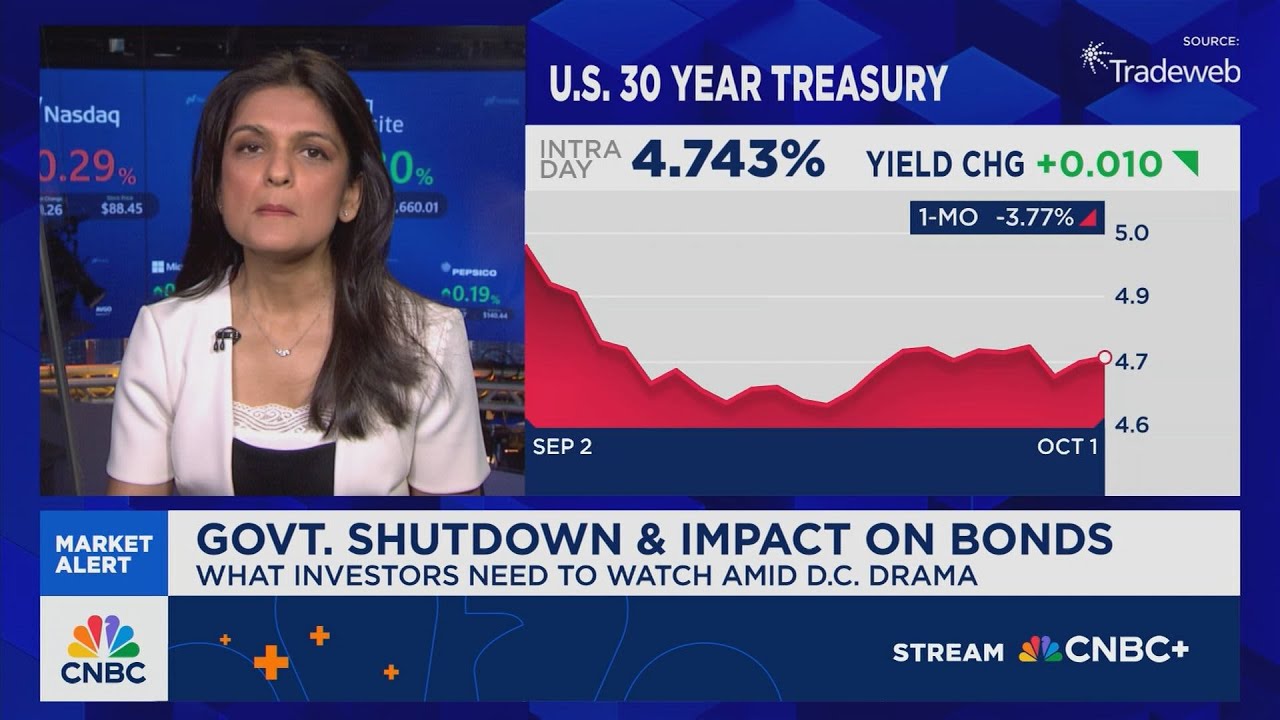
Core Viewpoint - The bond market is expected to react to economic conditions, particularly if a prolonged government shutdown occurs, with a focus on the long end of the yield curve [1][2]. Economic Conditions - Concerns about the deficit and the "sell America" trade have made the long end of the curve appear cheap, but a prolonged shutdown could weaken economic data, potentially leading to a more aggressive Fed response [2][6]. - If economic data worsens, particularly if unemployment rises above 4.5%, the Fed may cut rates more rapidly, impacting both the front and long ends of the yield curve [2][3]. Bond Market Dynamics - Demand for Treasury auctions remains strong despite political volatility, with primary dealer participation and end-user demand being closely monitored [4][5]. - Structural positives in the U.S. economy, such as strong corporate fundamentals and careful refinancing, support bond demand, even amid cyclical slowdowns [6][13]. Investment Strategy - The 5 to 10 year part of the yield curve is identified as the "sweet spot" for bond investors, offering attractive yields of 5-6% without excessive duration risk [14][15]. - Investors are encouraged to consider high-quality bonds as a hedge against risk assets, despite some diversifying into gold and cryptocurrencies [11][12]. Market Sentiment - There has been significant inflow into bonds, although the attractiveness of money market funds yielding around 4% may temper urgency for further investment [8][9]. - The absence of debt ceiling concerns is viewed positively, allowing for a focus on potential economic impacts from a government shutdown [13].

Misra: If data worsens, the Fed can cut faster
CNBC Television· 2025-10-01 12:11
Bond Market Reaction & Fed Policy - The long end of the curve is considered cheap based on valuation metrics, but the front end could also move if economic data weakens due to a prolonged shutdown [2] - The market is pricing in gradual Fed cuts to neutral, but a worsening economy (unemployment rate above 45%) could lead to more aggressive Fed action [2] - An independent Fed is responding to data and aiming to reduce the level of restrictiveness, making bonds attractive [6] - The Fed is expected to cut rates to 3%, which is close to neutral, even without a significant slowdown [8] Auction & Demand - End-user demand for Treasury auctions remains strong, indicating structural positives in the US economy [5] - Structural positives in the US economy, such as AI capex and strong corporate fundamentals, are driving demand for US bonds [6] - People look at 55%-6% in high-quality bonds and they like it [6] Investment Strategy & Risk Hedge - The 5 to 10-year part of the curve is considered a sweet spot, offering a balance between yield and duration risk [3][14][15] - Bonds are still considered a hedge, especially with the Fed likely to cut rates more aggressively [12][13] - Investors may diversify into other assets like gold and cryptocurrency, but US Treasuries remain a safe haven [9][10][11][12] - High-yield market can offer yields higher than 5%-6% without taking on that much duration risk [15]
为什么投资人不担心阿里云有泡沫?
3 6 Ke· 2025-09-25 00:54
Core Viewpoint - Alibaba has committed to investing at least 380 billion yuan in AI infrastructure over the next three years, which has significantly boosted its market value and stock price [1][2][11]. Investment and Market Response - Alibaba's market capitalization doubled from approximately 1.5 trillion HKD at the beginning of the year to 3.32 trillion HKD, driven by strategic announcements related to AI investments [2][11]. - The announcement of the 380 billion yuan investment led to a 35% increase in Alibaba's stock price within ten trading days [2]. - Following the Q2 earnings call, where Alibaba's cloud performance exceeded expectations, the stock surged by 13.5% overnight [2]. - The recent Cloud Summit saw Alibaba's stock rise by 9.16%, adding nearly 300 billion HKD to its market value in a single trading day [11]. AI Investment Logic - The current investment logic in the capital market favors companies making substantial AI capital expenditures, as investors prefer to invest in AI rather than miss out on potential gains [4][7]. - Despite concerns about AI investment returns, the enthusiasm for AI Capex continues to drive Alibaba's market value [5][9]. AI Infrastructure and Future Goals - Alibaba's CEO, Wu Yongming, outlined a three-phase path towards achieving Artificial Superintelligence (ASI), emphasizing the need for significant infrastructure investment [10][11]. - The company plans to enhance its global data center energy consumption by tenfold by 2032 compared to 2022 levels, indicating a long-term commitment to AI infrastructure [11]. - Alibaba aims to position itself as a full-stack AI service provider, with a focus on open-source models and a robust AI cloud computing platform [10][11]. Industry Context and Competition - The AI industry is experiencing a surge in capital investment, with projections of 2.9 trillion USD in infrastructure spending from 2023 to 2028 [12]. - The Cloud Summit showcased a shift towards Alibaba's own products and models, moving away from previous focuses on external AI models like ChatGPT [14]. - The competitive landscape emphasizes the importance of unique core competencies beyond just capital expenditure, as companies seek to attract smart money [12][19].

Goldman Sachs' Meena Flynn: We're encouraging our clients to continue to stay invested
CNBC Television· 2025-09-18 20:09
Market Outlook & Investment Strategy - Goldman Sachs encourages clients to stay invested and deploy incremental capital over 6-18 months, anticipating potential drawdowns [2] - The market has an 80% probability of experiencing a 10% drawdown, but valuations are not always reliable predictors of market performance [3] - Family offices are looking to decrease cash holdings by 30% over the next 12 months, shifting towards public and private equities [5] - There is significant "right tail risk" in the market, suggesting potential for further upside [7] Economic Factors & Fed Policy - $73 trillion is sitting in money market funds, which could move into risk assets as rates decline [8] - The Fed anticipates a slowdown followed by reacceleration, driven by fiscal and monetary stimulus, and a weaker dollar [9] - Fiscal stimulus is expected to increase cash flow for consumers and corporations [10] AI & Earnings - AI capex has doubled in the last two years, from $150 billion to $300 billion, but remains at 50% of cash flows, unlike the tech bubble [12][13] - The top five stocks have a return on equity (ROE) of 65% and grew over 20% in the first half of the year [14] - The market is more driven by earnings than the overall economy [16] Market Positioning & Sentiment - Client sentiment is mixed, with wealth management clients being neutral to risk-on [4] - Hedge funds are at the 40th percentile of net long positioning, and mutual funds are holding $170 billion in cash, indicating relatively light positioning [6] - The market is expected to hover around current levels until the end of the year, with a moderate upward trend in 2026 [17] Small Caps vs Large/Mid Caps - Small caps have been performing well, but last year the S&P outperformed small caps despite rate cuts and GDP growth [18][19] - Goldman Sachs prefers large and mid-cap stocks [19]
从这个季度开始,市场不再质疑AI Capex了
3 6 Ke· 2025-08-19 02:44
Core Insights - The focus on AI has intensified as major tech companies released their Q2 earnings, shifting market sentiment from skepticism about AI investments to a belief that more investment is needed [1] - Analysts are increasingly questioning the monetization and capital return of AI, indicating a growing confidence in AI's revenue-driving capabilities [1][2] Group 1: AI's Impact on Major Companies - Google's Q2 performance serves as a strong indicator for the industry, showcasing significant growth driven by AI in cloud services and advertising [3][5] - Google reported Q2 revenue of $96.4 billion, a 14% increase, with cloud services revenue reaching $13.6 billion, up 32% [5][7] - Meta's Q2 revenue was $47.52 billion, a 22% increase, with advertising revenue also growing by 22% due to AI efficiencies [11][12] Group 2: AI in Advertising - AI has been instrumental in enhancing advertising efficiency across platforms, with Google's AI Max improving conversion rates by 14% for advertisers [9][10] - Meta's new AI advertising model increased Instagram's ad conversion rates by approximately 5% and Facebook's by 3% [13][14] - Tencent's advertising business grew by 20% year-on-year, reaching 36 billion yuan, driven by AI applications in ad creation and performance analysis [16] Group 3: Capital Expenditure Trends - Google plans to increase its capital expenditure from $75 billion to $85 billion, primarily for server and data center investments to support cloud service demand [25][27] - Meta's capital expenditure for Q2 was $17 billion, representing 35.8% of its revenue, indicating aggressive investment in infrastructure [26] - Both companies are establishing a competitive edge through substantial AI-related capital investments, which may raise barriers for smaller players in the industry [27] Group 4: Future Outlook and Market Dynamics - The integration of AI into online marketing is expected to yield significant benefits for companies like Google and Meta, as improved ad performance leads to increased budgets from advertisers [26][19] - The AI landscape is evolving, with startups in the AI space, such as OpenAI and Anthropic, gaining substantial attention and revenue [23][24] - The focus on maximizing returns from previous capital investments is anticipated to shift the competitive landscape as companies navigate the cost implications of their AI investments [28]


美国2025年二季度GDP数据点评:由负转正,但外强中干
Soochow Securities· 2025-07-31 01:50
Economic Growth - The US GDP for Q2 2025 showed a seasonally adjusted annual growth rate of +3.0%, reversing from a previous decline of -0.5% and exceeding Bloomberg analysts' consensus expectation of +2.6% and the Atlanta Fed's GDPNow forecast of +2.9%[1] - The core PCE for the same period increased by +2.5%, surpassing the expected +2.3% and down from +3.5% in the previous quarter[1] Structural Analysis - The significant GDP growth was driven by a reversal of the "import surge & inventory accumulation" seen in Q1, with the contribution from goods imports rebounding from -4.84% to +5.02% and inventory changes dropping from +2.59% to -3.17%[1] - The Private Domestic Final Purchases (PDFP), a core GDP indicator, grew by only +1.2%, marking the fourth consecutive quarter of decline and indicating weak internal economic growth[1] Inventory Dynamics - Inventory changes shifted from $160.5 billion to -$26 billion, reflecting a transition from active inventory accumulation by producers and wholesalers to inventory reduction, while retail inventories continued to grow albeit at a slower pace[1] - If demand does not absorb retail inventories, the likelihood of businesses actively restocking in Q3 may be limited[1] Future Outlook - Attention should be paid to the risk of the Federal Reserve not lowering interest rates in September, which could lead to an increase in US Treasury yields and the US dollar index rising back to the 100-105 range[1] - The current market is trading under the assumption of "strengthening growth leading to delayed rate cuts," and if upcoming employment data reflects similar trends, the probability of a rate cut in September may decrease, tightening financial conditions and increasing downward pressure on the economy[1] Risks - Potential risks include unexpected policy actions from Trump, excessive rate cuts by the Federal Reserve leading to inflation rebound, and prolonged high interest rates causing liquidity crises in the financial system[1]
How the Mag 7 Are Driving the Future of AI Capex
Bloomberg Television· 2025-07-25 18:39
AI 投资与支出 - 四家公司计划今年支出超过 3000 亿美元,约六家公司支出超过 4000 亿美元,已从对股市有重要影响转变为对 GDP 有重要影响 [3] - 大型科技公司资本支出增加,固定资产占账面价值的比例从 20% 增加到 70% 以上 [4] - 企业将原本用于股票回购或特别股息的自由现金流转移到资本支出 [6][7] 债券市场影响 - 科技公司资本支出增加,导致资金从金融市场(尤其是债券市场)流出,可能导致更高的收益率 [5] - 本周期企业部门的累计现金流盈余比十年前下降了 75% [8] 集中风险 - 少数几家超大规模企业正在引领这一趋势,存在集中风险 [10] - 这些公司都在追求相同的目标,对同一未来进行集中押注,如果投资回报不佳,可能对经济产生重大影响 [12][13] 未来挑战 - 企业资本支出激增引发了产能利用率以及新资本折旧经济率的问题 [7] - 投资于新技术前沿的功能性淘汰风险以及技术更新换代的速度 [8]